Leadership Interview Questions and 12 Full Sample Answers
By Mustafa Tarabya, founder of CVBooster · Published · Updated
10 min read
Leadership interview questions ask you to prove, with a real story, that you can set direction, develop people, handle conflict, make decisions and own the results when things go wrong. The constraint is that every answer needs a specific situation; "I am a people person" scores nothing. The U.S. Office of Personnel Management defines the competency as "the demonstrated ability to lead and inspire a group toward meeting the organization’s vision, mission, and goals". Below are the 12 questions panels ask most, each with a full answer for first-time leads, managers or senior leaders. Written by Mustafa Tarabya, who hired for his own company, read every application himself and now writes CVBooster's guides.
You have led people for years and you are about to be asked to describe your leadership style in thirty seconds, by someone who will write down one adjective.
Leadership style and approach
What is your leadership style?
This tests whether you know how you actually lead, and whether it fits their team. Name the style in plain words, then prove it with one situation. Level: first-time lead.
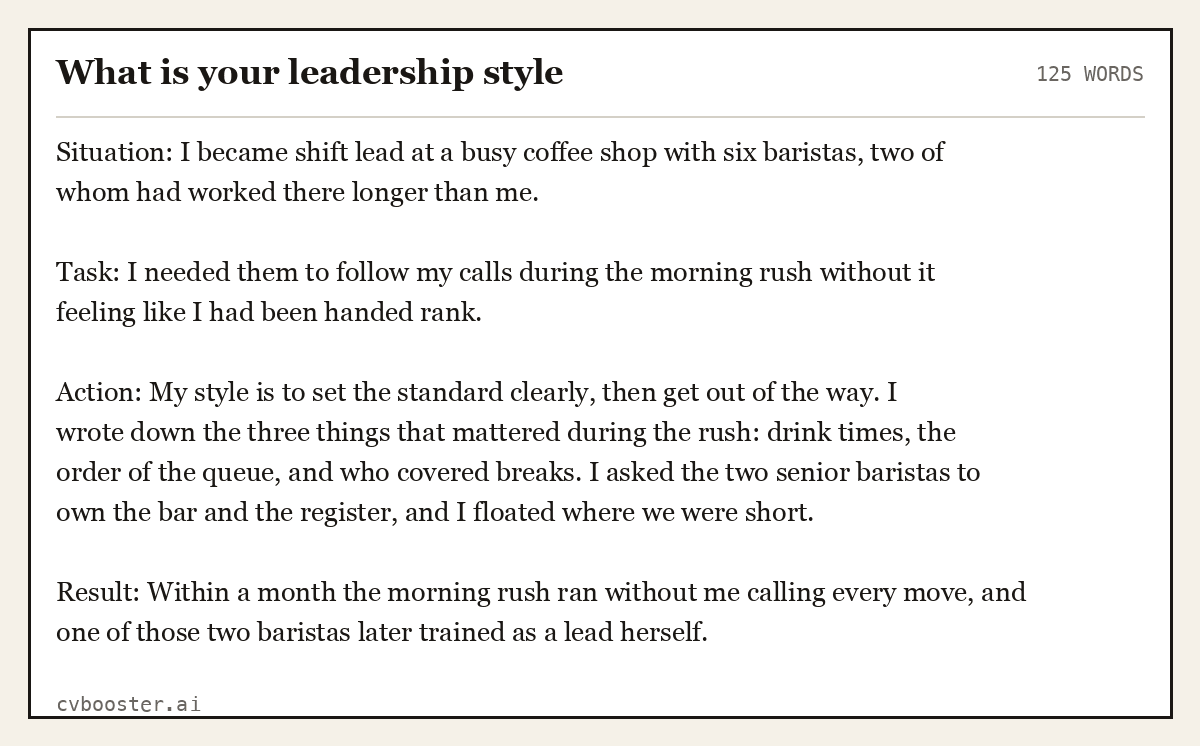
Situation: I became shift lead at a busy coffee shop with six baristas, two of whom had worked there longer than me.
Task: I needed them to follow my calls during the morning rush without it feeling like I had been handed rank.
Action: My style is to set the standard clearly, then get out of the way. I wrote down the three things that mattered during the rush: drink times, the order of the queue, and who covered breaks. I asked the two senior baristas to own the bar and the register, and I floated where we were short.
Result: Within a month the morning rush ran without me calling every move, and one of those two baristas later trained as a lead herself.
Wrong answer: a list of adjectives with no situation, such as "collaborative, transparent and empowering".
How would your team describe you as a leader?
This tests self-awareness. Use words your team actually used, in feedback or a review, and own one honest edge. Level: manager.
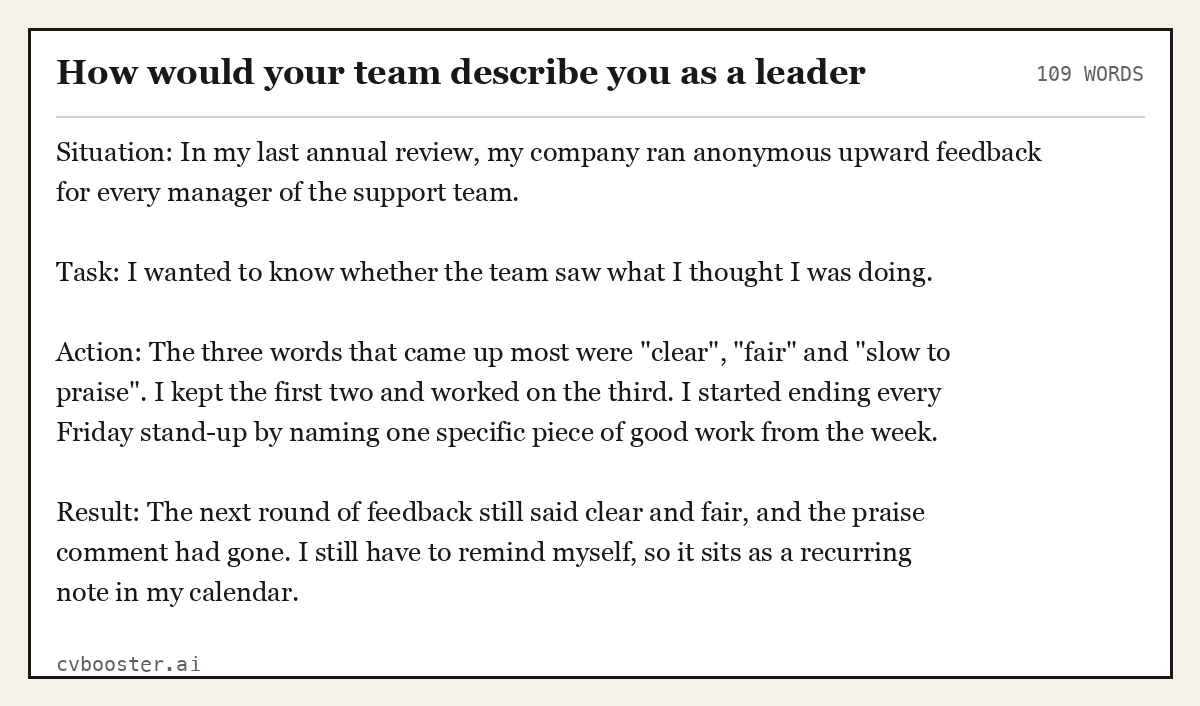
Situation: In my last annual review, my company ran anonymous upward feedback for every manager of the support team.
Task: I wanted to know whether the team saw what I thought I was doing.
Action: The three words that came up most were "clear", "fair" and "slow to praise". I kept the first two and worked on the third. I started ending every Friday stand-up by naming one specific piece of good work from the week.
Result: The next round of feedback still said clear and fair, and the praise comment had gone. I still have to remind myself, so it sits as a recurring note in my calendar.
Wrong answer: only flattering words, which nobody believes.
Developing and motivating people
Tell me about a time you developed someone on your team.
This tests whether you grow people or just use them. OPM's description of developing others includes "providing opportunities to learn through formal and informal methods." Level: manager.
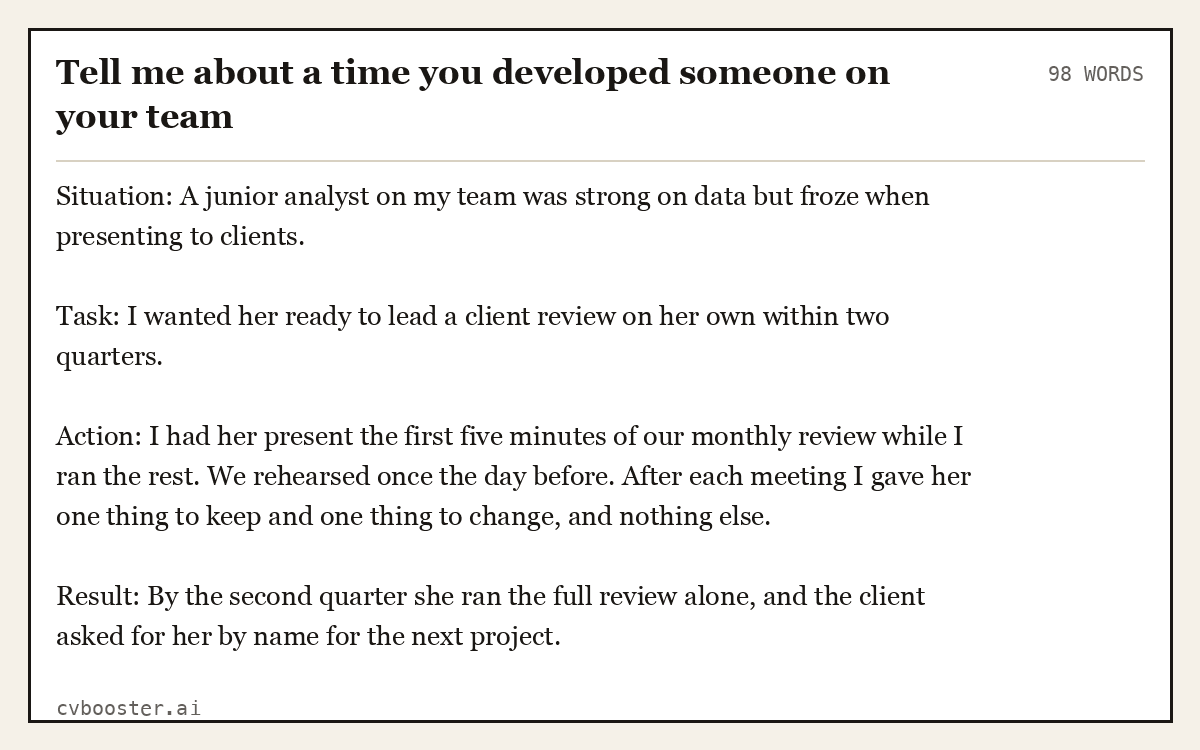
Situation: A junior analyst on my team was strong on data but froze when presenting to clients.
Task: I wanted her ready to lead a client review on her own within two quarters.
Action: I had her present the first five minutes of our monthly review while I ran the rest. We rehearsed once the day before. After each meeting I gave her one thing to keep and one thing to change, and nothing else.
Result: By the second quarter she ran the full review alone, and the client asked for her by name for the next project.
Wrong answer: "I mentor everyone", without one person in it.
How do you motivate a team that is losing energy?
This tests whether you look for the cause before you try to fix the mood. Level: first-time lead.
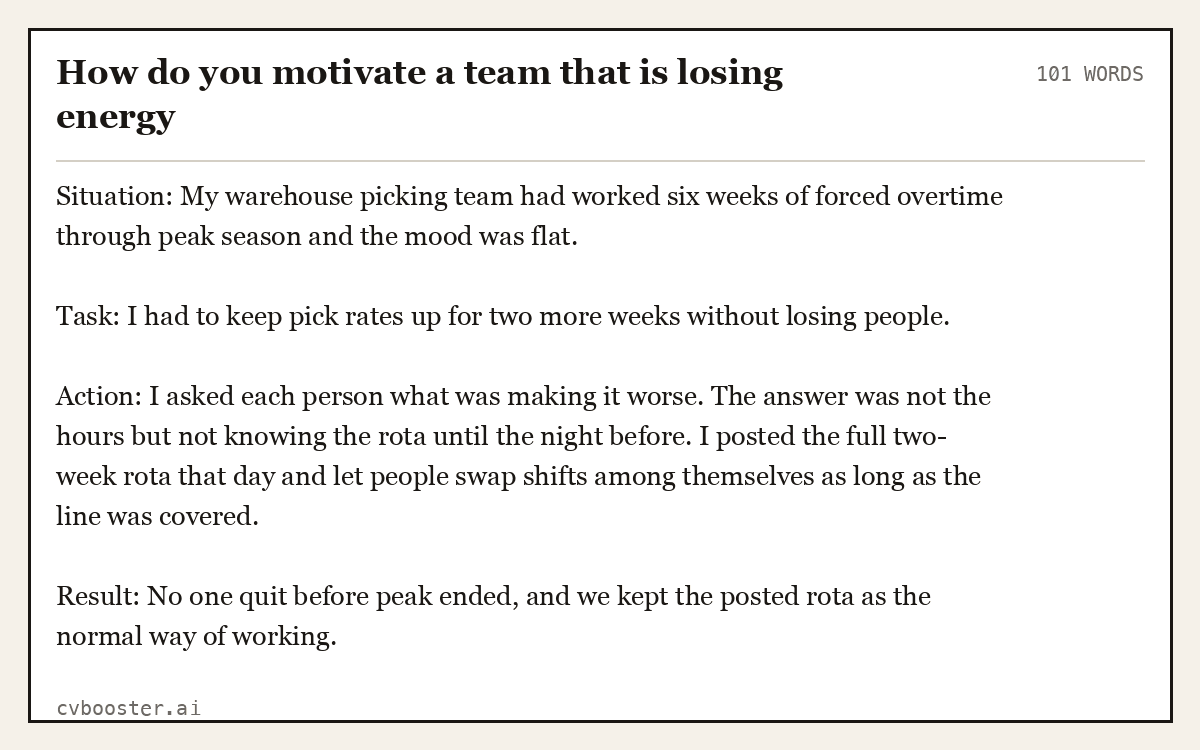
Situation: My warehouse picking team had worked six weeks of forced overtime through peak season and the mood was flat.
Task: I had to keep pick rates up for two more weeks without losing people.
Action: I asked each person what was making it worse. The answer was not the hours but not knowing the rota until the night before. I posted the full two-week rota that day and let people swap shifts among themselves as long as the line was covered.
Result: No one quit before peak ended, and we kept the posted rota as the normal way of working.
Wrong answer: pizza and a pep talk.
Conflict and difficult conversations
Tell me about a time you handled conflict between team members.
This tests whether you deal with conflict early and fairly, rather than hoping it passes. Level: manager.
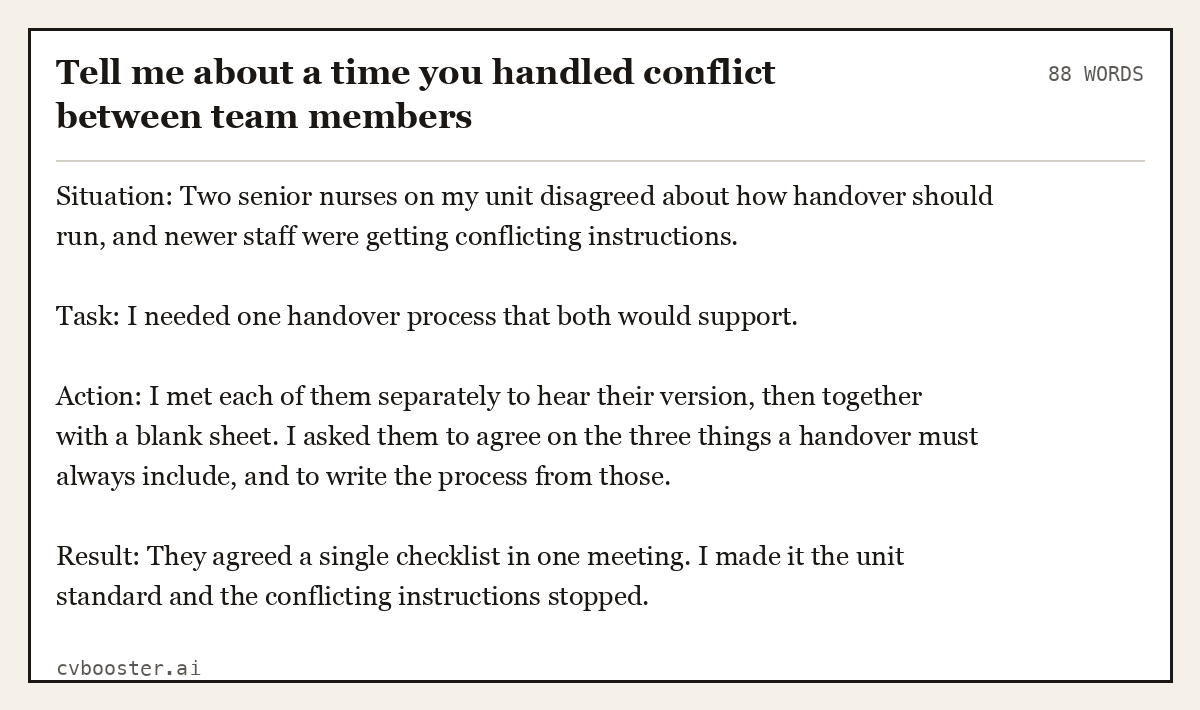
Situation: Two senior nurses on my unit disagreed about how handover should run, and newer staff were getting conflicting instructions.
Task: I needed one handover process that both would support.
Action: I met each of them separately to hear their version, then together with a blank sheet. I asked them to agree on the three things a handover must always include, and to write the process from those.
Result: They agreed a single checklist in one meeting. I made it the unit standard and the conflicting instructions stopped.
Wrong answer: "I escalated it to HR", as a first step.
Tell me about a time you had to address poor performance.
This tests whether you act. OPM lists the expectation to take "swift action to address performance- or conduct-based deficiencies in employees supervised." Level: manager.
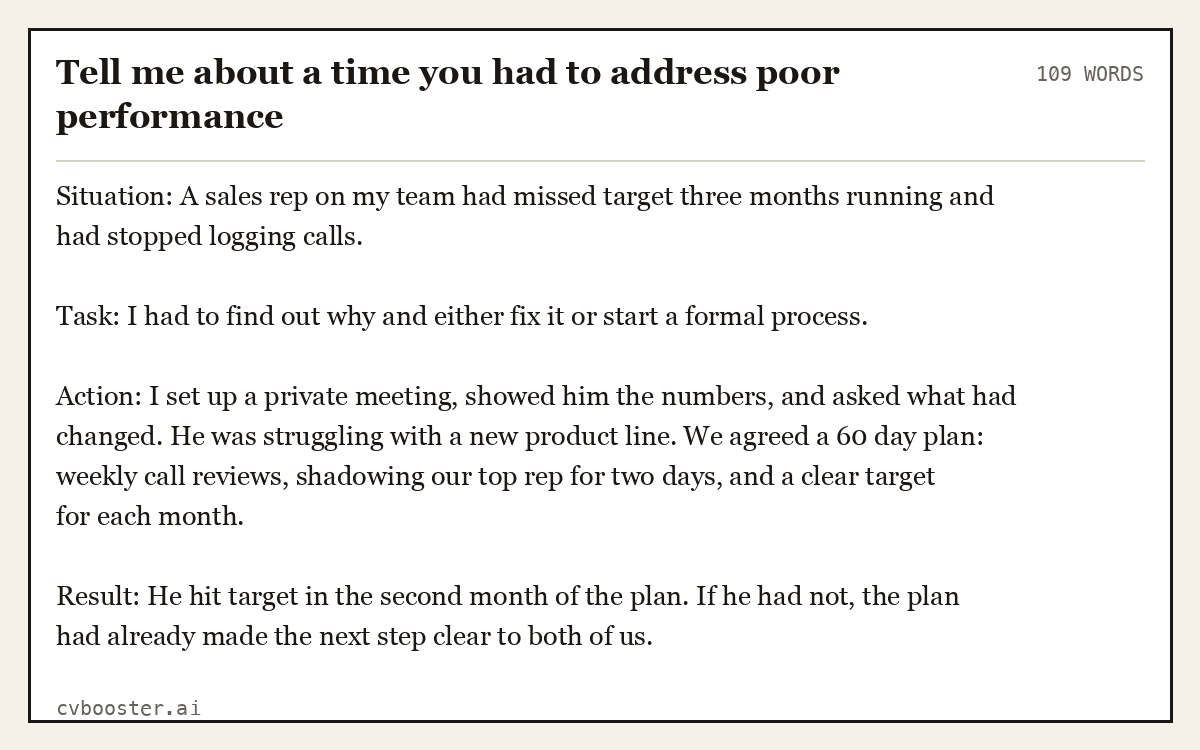
Situation: A sales rep on my team had missed target three months running and had stopped logging calls.
Task: I had to find out why and either fix it or start a formal process.
Action: I set up a private meeting, showed him the numbers, and asked what had changed. He was struggling with a new product line. We agreed a 60 day plan: weekly call reviews, shadowing our top rep for two days, and a clear target for each month.
Result: He hit target in the second month of the plan. If he had not, the plan had already made the next step clear to both of us.
Wrong answer: a story where you waited six months.
Decisions and accountability
Describe a tough decision you made as a leader.
This tests judgement: how you weighed options and who you told. Level: senior leader.
Situation: As operations director, I had to choose between delaying a system launch by a month or launching on time with a known gap in reporting.
Task: The board wanted the date kept, and the finance team needed the reports for quarter end.
Action: I met finance to understand exactly which reports they could not do without. It was two of the eleven. I launched on time, built those two reports by hand for one quarter, and wrote the trade-off to the board in one page before launch day.
Result: We launched on the date, finance closed the quarter on time, and the full reporting went live five weeks later.
Wrong answer: a decision with no trade-off in it.
Tell me about a time you failed as a leader.
This tests honesty and learning. Harvard's career center advises candidates to "take responsibility for mistakes you have made". Level: first-time lead.
Situation: In my first month leading a project team of four, I assigned work by who was fastest, not by who was free.
Task: Our first deadline was a client prototype at the end of that month.
Action: By week three, my best designer was overloaded and two others were waiting for work. We missed the deadline by four days. I owned it with the client, then rebuilt the plan with the team so each person chose their tasks from a shared board.
Result: We hit every deadline after that. I now check workload before I check speed.
Wrong answer: a failure that was someone else's fault.
How do you lead a team through change?
This tests whether you explain the why, not just the what. Level: senior leader.
Situation: Our company merged two customer service teams from different offices onto one phone system.
Task: I had to move forty agents over in eight weeks without dropping service levels.
Action: I explained the reason for the change in person at both sites in the first week, named one agent at each site as the go-to person for the new system, and moved the teams over in four waves of ten rather than all at once.
Result: All forty moved within the eight weeks, and each wave fixed problems before the next one hit them.
Wrong answer: "I sent out a clear email."
Leadership without a title
Tell me about a time you led without formal authority.
This tests leadership for candidates who have never had direct reports. Harvard notes your example "can come from your work, school, extra-curricular activity, or volunteer experience." Level: entry level.
Situation: In my final year of college, our group project had five members and no assigned lead, and two weeks in we had nothing written.
Task: Someone had to get it moving, and nobody wanted to be bossy.
Action: I booked a room, brought a printed outline of the brief, and asked each person to pick one section by the end of the hour. I offered to write the introduction and stitch the sections together.
Result: We submitted on time and got the highest grade in the class for that module.
Wrong answer: "I have not had the chance to lead yet."
How do you build trust with a new team?
This tests what you do in your first weeks. Level: manager.
Situation: I joined as a new manager of a team whose previous manager had left suddenly.
Task: The team was wary, and two people had applied for my job.
Action: I held a one-to-one with each person in my first two weeks and asked the same three questions: what works, what is broken, and what they would change first. I fixed the top item they all named, a broken approval process, in my first month.
Result: Both internal candidates stayed, and one became my deputy within the year.
Wrong answer: big changes in week one.
Tell me about a time you delegated an important task.
This tests whether you trust people with work that matters. Level: manager.
Situation: I was asked to present our team's annual plan to the regional leadership group.
Task: One of my team leads was ready for more visibility, and I had the plan almost written.
Action: I gave her the presentation, not just the slides. We agreed the three messages together, she built the deck, and I joined only to answer budget questions.
Result: The plan was approved, and she was asked to present the next quarter's update on her own.
Wrong answer: delegating something you did not care about.
Questions to ask the panel about leadership
End with one question that shows you think like a leader. Two that work:
- "What does the team need most from this role in the first six months?"
- "How is success measured for this position at the end of year one?"
If you are on the other side of the table, the same competencies give you the questions: OPM's Leading People qualification also expects leaders to cultivate "a dynamic environment in which employees are not afraid to make mistakes", so ask candidates about a mistake their team made and how they responded. For more on the hiring side, see questions to ask an interviewee.
How to prepare your leadership stories
The UAB Career Center advises: "Back up your answer with a short anecdote of how you’ve used or demonstrated that strength". That is the whole method. Write down six stories before the interview: one each for developing someone, conflict, a hard decision, a failure, change and leading without authority. Most leadership questions can be answered from those six.
Put them in STAR order using our STAR interview questions guide. For panel formats, see panel interview questions, and for public sector competency interviews, see competency based interview questions.
Frequently asked questions
What are the most common leadership interview questions?
The most common are: what is your leadership style, tell me about a time you developed someone, how do you handle conflict on your team, describe a tough decision, tell me about a time you failed, and how do you lead through change. Prepare one specific story for each, in STAR order.
How do I answer leadership questions with no management experience?
Use situations where you led without a title: a group project, a volunteer event, training a new colleague, or organizing a shift. The panel is testing behavior, not job titles. Say what you did, how others responded, and what the result was, with one specific detail.
What should I say when asked about my leadership style?
Name your style in plain words, such as "I set a clear standard, then step back", and prove it with one real situation and its result. Avoid long lists of adjectives. The panel remembers the story, not the label, so make the story specific.
How long should a leadership interview answer be?
Aim for about one to two minutes. Spend one sentence each on the situation and task, most of your time on your actions, and finish with a clear result. If the panel wants more detail, they will ask a follow-up question, so leave room for it.
What leadership qualities do interviewers look for?
Most look for the ability to set direction, develop people, handle conflict, make sound decisions and take responsibility for results. The U.S. Office of Personnel Management groups these under Leading People, which covers accountability, developing others and executive judgement.
Related articles
- Case Manager Interview Questions: 7 Answers That Score
- Creative Interview Questions With 6 Sample Answers
- Critical Care Nursing Interview Questions and 9 Answers
- ED Nurse Interview Questions With 9 Full Sample Answers
More articles
- Leadership Skills Examples: 12 Skills and the Resume Lines
- Less Stress Jobs That Pay Well in the UK: 8 With CV Lines
- Letter of Intent Template: 6 Full Job Examples to Copy
Looking for a worked example for your job title? Browse the resume examples by job title.