Healthcare Consultant Resume Examples: read this first
Build a Healthcare Consultant Resume That Demonstrates Clinical & Business Impact
By Mustafa Tarabya, founder of CVBooster · Published · Updated
Create a specialized healthcare consultant resume showcasing health system optimization, regulatory expertise, and patient outcomes improvement with data-backed results.
Sample resumes for a healthcare consultant
The same healthcare consultant content laid out in three CVBooster templates, so you can see what the finished document looks like before you write a word.
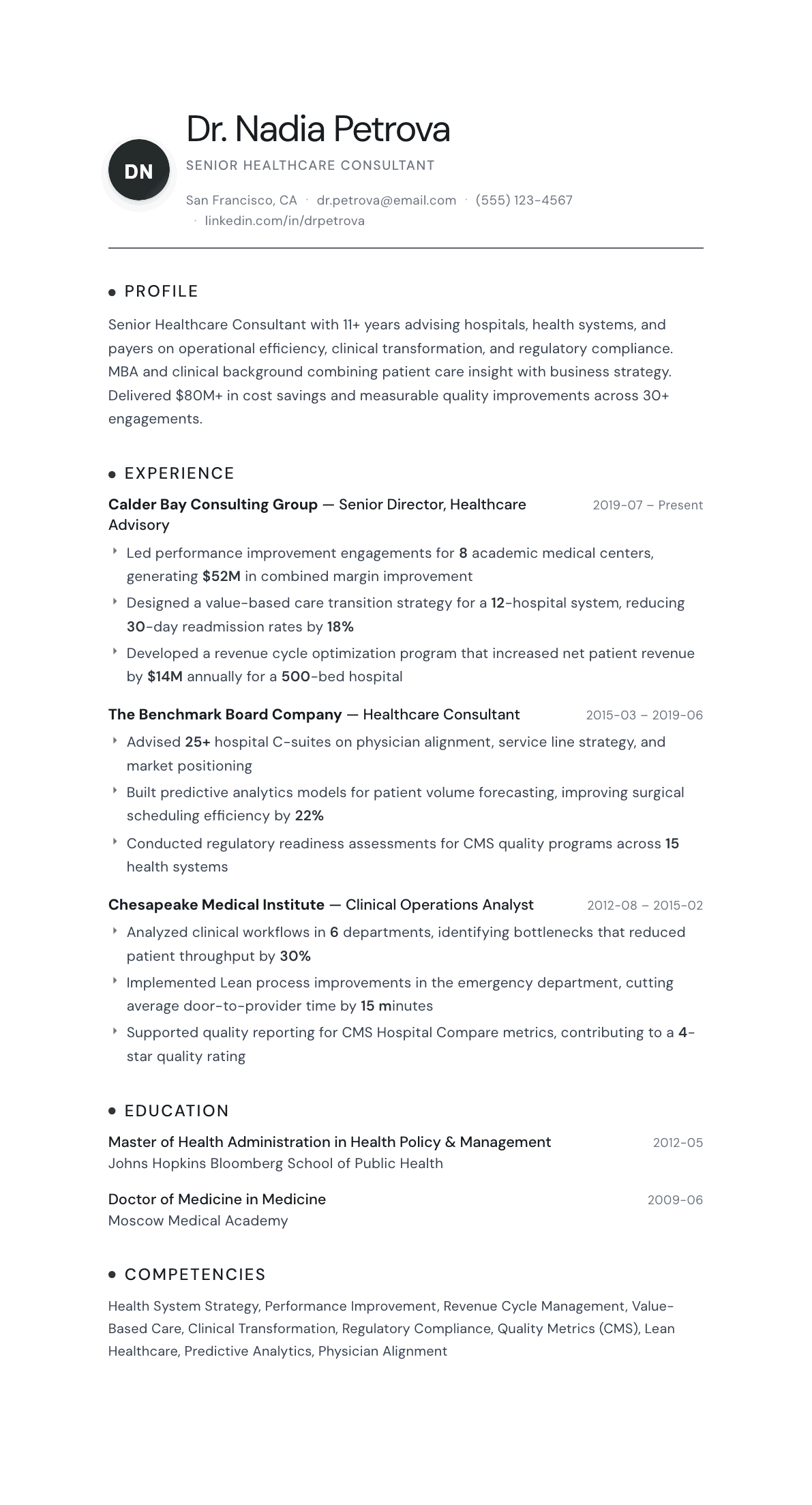
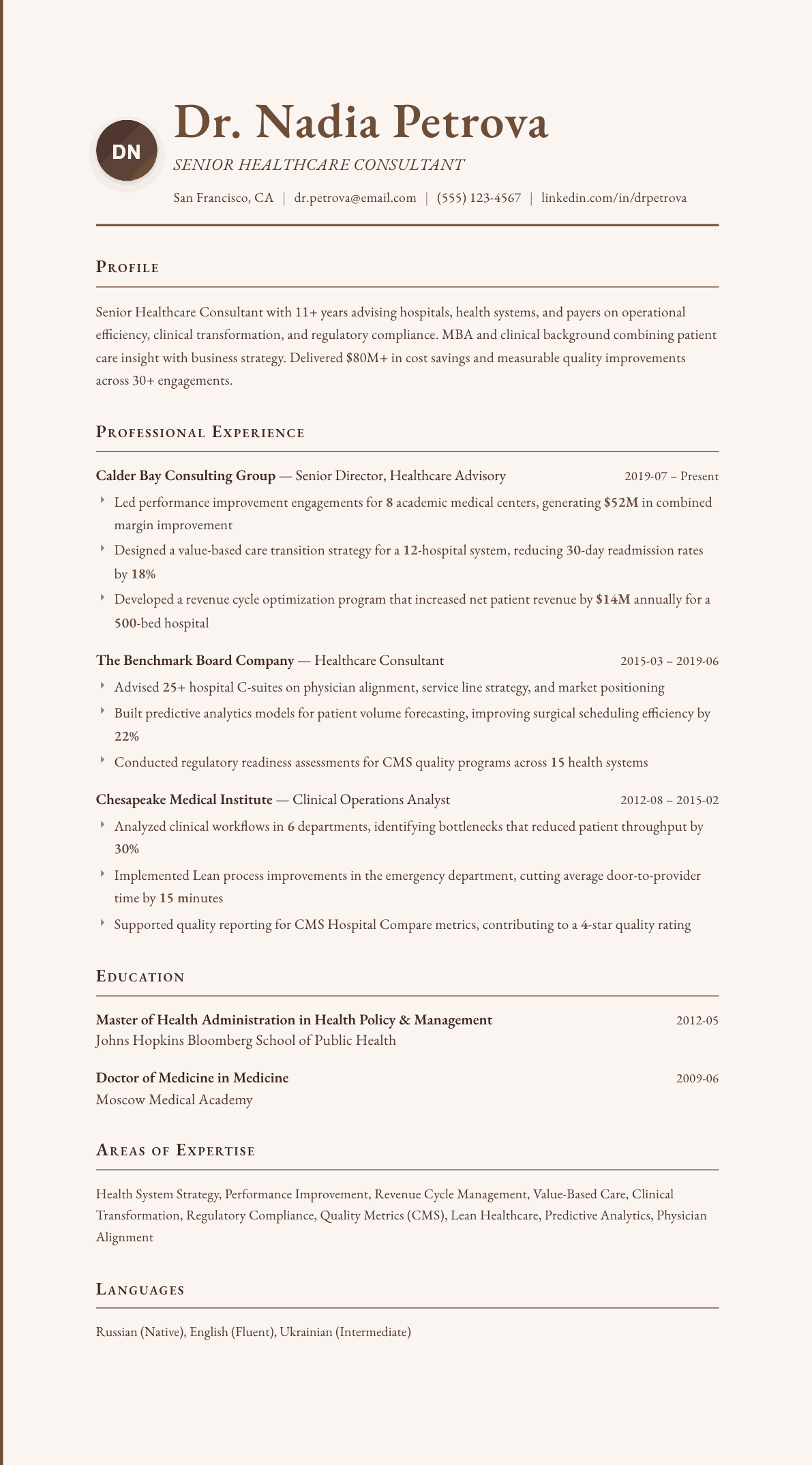
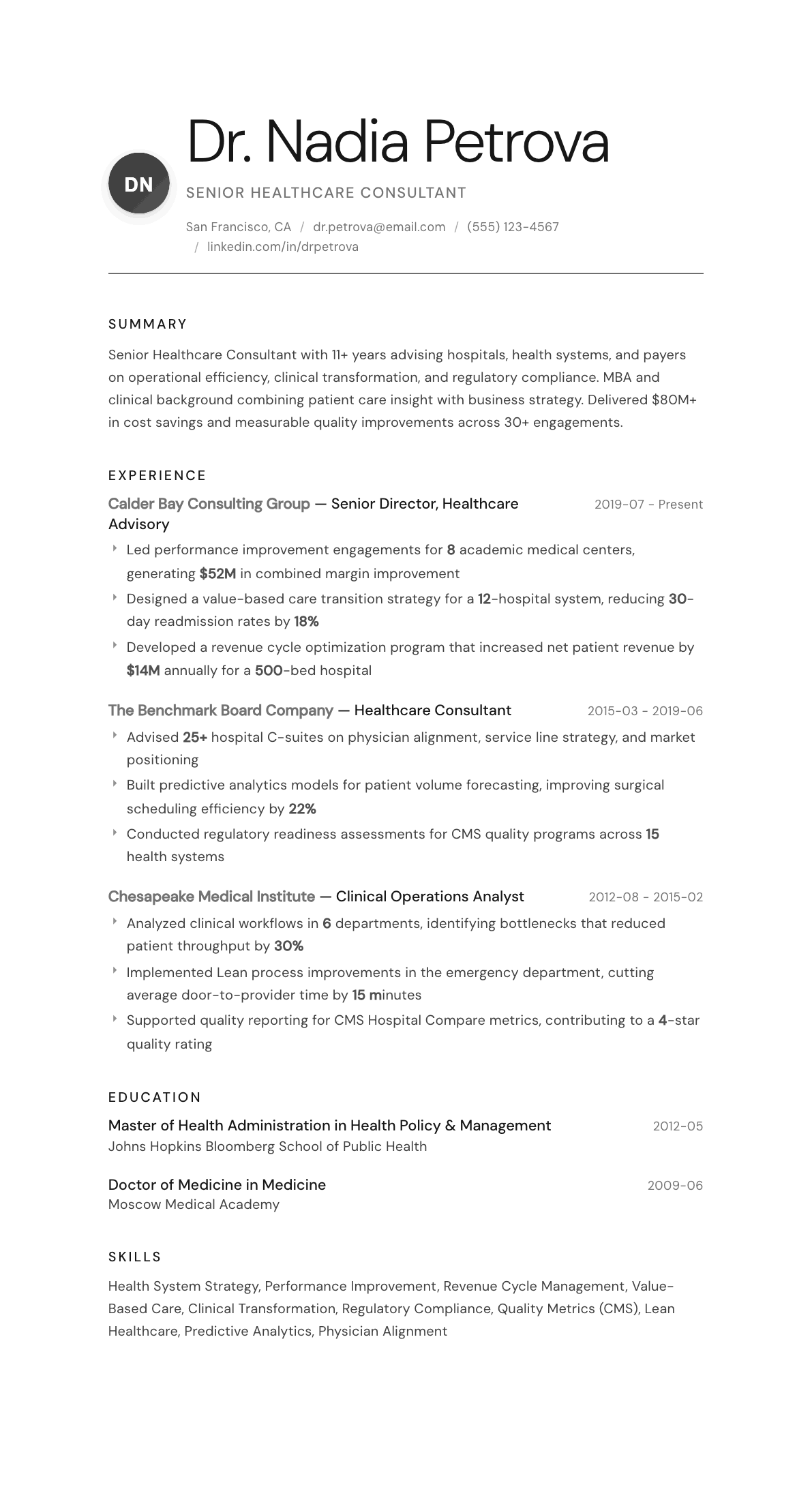
Example Healthcare Consultant summary
Physician turned healthcare consultant, MD and MHA, 11 years advising hospitals, systems and payers on margin, clinical operations and CMS quality programs. Led performance work across eight academic medical centers, cut 30-day readmissions by 18% at a 12-hospital system, and added $14M in annual net patient revenue through revenue cycle redesign.
Skills to list on a Healthcare Consultant resume
- Health System Strategy
- Performance Improvement
- Revenue Cycle Management
- Value-Based Care
- Clinical Transformation
- Regulatory Compliance
- Quality & Patient Safety
- Lean Healthcare
- Health Analytics
- Physician Alignment
- Population Health
- Payer Strategy
What actually gets this resume read
- If you have a clinical license or degree, say so in the first line, because the buyer is deciding whether you can hold a room of physicians.
- Report outcomes the way a hospital board reads them: readmission rate, length of stay, door-to-provider time, OR utilization, and the star or quality rating that moved.
- Name the payment models you have worked inside, such as bundled payments, MSSP, MIPS or a Medicare Advantage contract, and what the client had to change to succeed under them.
- Split financial results into margin, revenue cycle and cost per case, and state the bed count or system size that produced them.
- Describe the regulatory work concretely: a Joint Commission readiness review, a CMS conditions of participation gap analysis, or a HIPAA breach response.
- Show the physician alignment work, since service line and compensation redesign is where these engagements usually stall.
How to write a healthcare consultant resume
The healthcare consultant resume has to pass a credibility test that no other consulting resume faces. Hospital executives are wary of advisors who have never stood in a clinical setting, and clinicians on the client side will test whether you understand what actually happens on a nursing unit at shift change. At the same time the practice leader hiring you needs proof you can build a financial model, run a workstream and hold a fee earning engagement together.
So this file has to carry two currencies at once. Clinical or operational credibility on one side, meaning settings you have worked in, workflows you know, and the language of throughput, acuity and documentation. Financial and analytical credibility on the other, meaning margin, cost per case, denial rates, length of stay and payer mix. A resume strong in only one of them gets screened for a narrower job than you want.
This guide covers the structure a healthcare practice screener expects, how to write engagement entries that carry regulatory and payment context, three summary examples across the path from analyst to engagement leader, before and after bullets, and the questions healthcare consultants ask when they rewrite this document.
Format: engagements under employers, credentials visible
Reverse chronological by firm, with engagements nested beneath. Each engagement needs the client type and size, the problem, your role and team size, and the duration. Client type carries real information here: an academic medical center, a rural critical access hospital, a multi-site physician group, a payer, a post-acute operator and a digital health company are entirely different clients with different economics.
Put clinical licensure and healthcare credentials where they can be seen immediately. A registered nurse license, a pharmacy or therapy license, a fellowship in a healthcare executive body, or a quality credential are exactly the signals that get a resume moved into the interview pile, and burying them at the bottom wastes them.
- Header: name, credentials after the name, city and state, phone, email.
- Order: summary, areas of expertise, consulting experience with engagements, clinical or health system experience, education, licenses and certifications.
- For every engagement, give the setting, the bed count or provider count, and the payment environment.
- Say who the client sponsor was: chief financial officer, chief nursing officer, service line leader, or practice administrator.
Summary: the domain, the setting, the client you serve
Healthcare consulting splits into domains that hire separately. Revenue cycle, clinical operations and throughput, quality and patient safety, service line strategy, physician enterprise and compensation, population health and value based contracting, supply chain, health information technology implementation, and regulatory and compliance. Name yours in the first line rather than describing yourself as a healthcare consultant generally.
Then name the settings you have credibility in. Acute inpatient, ambulatory surgery, emergency department, perioperative services, primary care networks, behavioral health and post-acute settings each have distinct workflows and staffing models, and a client executive can tell within one question whether you have really worked in the setting you claim.
Engagement bullets: workflow, math, and adoption
The strongest bullets in this field move through three stages. What you observed or measured in the current state, what you changed in the workflow or the model, and what the metric did afterward. Length of stay, discharge before noon, operating room first case on time starts, room turnover, emergency department left without being seen, days in accounts receivable, denial rate and cost per case are the numbers hospital leaders live with, and they belong on this page.
Show the financial half explicitly. Margin improvement, labor productivity measured against a benchmark, supply standardization, contract renegotiation, revenue capture from documentation improvement. Say which side of the ledger each result came from, because an executive weighs a recurring cost reduction differently from a one-time revenue catch-up.
Then show adoption, which is where most healthcare projects die. Clinicians trained, a nursing unit that changed its huddle, a physician champion recruited, a workflow rebuilt inside the electronic health record and not merely on paper. A recommendation that was accepted but never implemented should be described as exactly that.
Regulation, payment and the systems clients run on
Show fluency in the environment: quality reporting programs and accreditation surveys, conditions of participation, privacy rules governing protected health information, coding and documentation requirements, and value based payment arrangements including shared savings and bundled arrangements. Clients pay for advisors who already know the constraint set rather than discovering it in week three.
Name the platforms. Epic, Cerner, Meditech and Athenahealth on the clinical and revenue cycle side, plus costing and benchmarking tools, labor productivity systems and analytics platforms. Implementation and optimization experience on a major electronic health record is one of the most reliably searched attributes in this market.
Keywords a healthcare practice screens on
Recurring terms in postings include performance improvement, revenue cycle, length of stay, throughput, clinical documentation improvement, labor productivity, service line strategy, value based care, population health, patient experience, care model redesign, medical group operations and regulatory compliance. Use the ones you can evidence.
Avoid the two extremes that get resumes rejected. Pure clinical language with no financial content reads as a nurse or therapist who has not made the transition to consulting. Pure finance language with no workflow content reads as an analyst who will not survive a conversation with a chief nursing officer.
Healthcare Consultant resume summary examples
Analyst or clinician moving into consulting
Registered nurse with 6 years in perioperative services, now working as a healthcare consulting analyst. Built the block utilization analysis behind a surgical scheduling redesign that lifted first case on time starts from 58% to 81% at a 400 bed community hospital.
Engagement consultant
Healthcare consultant with 6 years in revenue cycle and clinical operations across community and academic hospitals. Led a denials workstream that cut initial denial rate by 4 points and reduced days in accounts receivable from 58 to 41 for a 5 hospital system.
Engagement leader
Engagement leader with 14 years advising health systems on clinical operations and service line performance, owning scopes and client relationships across 3 multi-hospital accounts. Certified professional in healthcare quality and a fellow of a healthcare executive body, leading teams of up to 9.
Work experience bullets: before and after
Before: Worked on a project to improve hospital efficiency.
After: Redesigned discharge planning on 6 medical-surgical units at a 400 bed hospital, moving discharge before noon from 14% to 33% and cutting average length of stay by half a day.
Unit count, hospital size and two linked throughput metrics make an efficiency claim something a chief operating officer can compare against her own data.
Before: Analyzed revenue cycle data for a client.
After: Analyzed 18 months of claims data across 4 payers, traced 60% of denials to three registration and authorization failure points, and rebuilt the front-end workflow with the access team.
Tracing denials to a root cause and fixing the upstream workflow shows consulting work rather than reporting.
Before: Helped implement quality improvement initiatives.
After: Led a sepsis bundle compliance effort with an emergency department physician champion, raising bundle compliance from 61% to 88% over three quarters through order set redesign in Epic and weekly case review.
A clinical champion, a named intervention and a compliance trend prove change at the bedside instead of a program launched.
Before: Recommended cost savings opportunities to hospital leadership.
After: Benchmarked nursing labor against a national productivity standard across 12 units, identified 40 full time equivalents of variance, and built a phased staffing plan the chief nursing officer adopted for the following budget cycle.
Naming the benchmark, the variance and the adoption converts a recommendation into an implemented decision.
Before: Supported an EHR implementation project.
After: Supported an Epic ambulatory rollout across 22 clinics, ran workflow validation with 140 providers, and staffed at-the-elbow support through go-live, holding provider visit volume within 10% of baseline in week one.
Scale, the provider count and the volume recovery measure show the implementation succeeded operationally, not just technically.
Hard skills
- Revenue cycle performance improvement
- Clinical throughput and length of stay analysis
- Labor productivity benchmarking
- Service line strategy and market assessment
- Value based contracting and shared savings models
- Clinical documentation improvement
- Care model and workflow redesign
- Electronic health record optimization (Epic, Cerner)
- Quality reporting and accreditation readiness
- Cost accounting and cost per case analysis
- Physician compensation and alignment models
- Data analysis in SQL and Excel
- Regulatory and privacy compliance
Soft skills
- Earning trust with clinicians
- Facilitating a workgroup of physicians and nurses
- Delivering unwelcome findings to an executive
- Translating clinical detail for a finance audience
- Observing a unit without disrupting care
- Building a client sponsor relationship
Certifications worth listing
- Fellow of the American College of Healthcare Executives (FACHE) (American College of Healthcare Executives)
- Certified Professional in Healthcare Quality (CPHQ) (National Association for Healthcare Quality)
- Certified Healthcare Financial Professional (CHFP) (Healthcare Financial Management Association)
- Certified Revenue Cycle Representative (CRCR) (Healthcare Financial Management Association)
- Certified Professional in Healthcare Information and Management Systems (CPHIMS) (HIMSS)
- Registered Health Information Administrator (RHIA) (American Health Information Management Association)
- Certified Six Sigma Black Belt (CSSBB) (American Society for Quality)
Mistakes that cost healthcare consultant candidates the interview
- Writing only clinical content, which reads as a practitioner who has not yet learned to consult.
- Writing only financial content, which reads as an analyst who will lose the room with a chief nursing officer.
- Omitting the client setting and size, so a rural critical access hospital and an academic system look the same.
- Reporting recommendations delivered without saying whether anything was implemented or adopted.
- Including any detail that could identify a patient or breach a confidentiality obligation to a client.
- Hiding a clinical license at the bottom of the page when it is the strongest credibility signal you have.
- Using acronyms with no expansion, so a screener outside your domain cannot tell what you worked on.
Healthcare Consultant resume questions
Can I move into healthcare consulting from a clinical role?
Yes, and firms actively recruit clinicians. Rebuild your bullets around process and data rather than patient care: workflows you redesigned, committees you sat on, metrics you moved on your unit, and any project where you worked outside your own department.
How specific can I be about client results?
Describe the client by type and size rather than name unless you are cleared to use it, and keep results in the metric language every hospital shares. Never include anything traceable to an individual patient or a confidential contract term.
Which credential helps most in healthcare consulting?
It depends on your domain. Quality and safety work rewards the healthcare quality credential, finance and revenue cycle work rewards the healthcare financial credentials, and executive advisory work rewards fellowship in a healthcare executive body. Pick the one aligned to your practice rather than collecting several.
Should I list the electronic health record I have worked in?
Always, and be precise about your role. Implementation, optimization, reporting and end-user experience are different levels of depth, and clients staffing a go-live are searching specifically for people who have been through one before.
How long should a healthcare consultant resume be?
One page in the first few years, two once you have a real engagement history. Give the last three engagements full treatment with setting, intervention and metric, and reduce older ones to a single line each naming the client type and the domain.
Related resume examples
- Hospital Administrator Resume example
- Health Informatics Specialist Resume example
- Clinical Operations Manager Resume example
- Operations Consultant Resume example
- Business Manager Resume example
- Management Consultant Resume example