Administrative Director Resume Examples: free ATS score
Build an Administrative Director Resume That Runs the Show
By Mustafa Tarabya, founder of CVBooster · Published · Updated
Create an administrative director resume showcasing facility management, operational budgets, and organizational efficiency for executive-level administrative leadership.
Sample resumes for a administrative director
The same administrative director content laid out in three CVBooster templates, so you can see what the finished document looks like before you write a word.
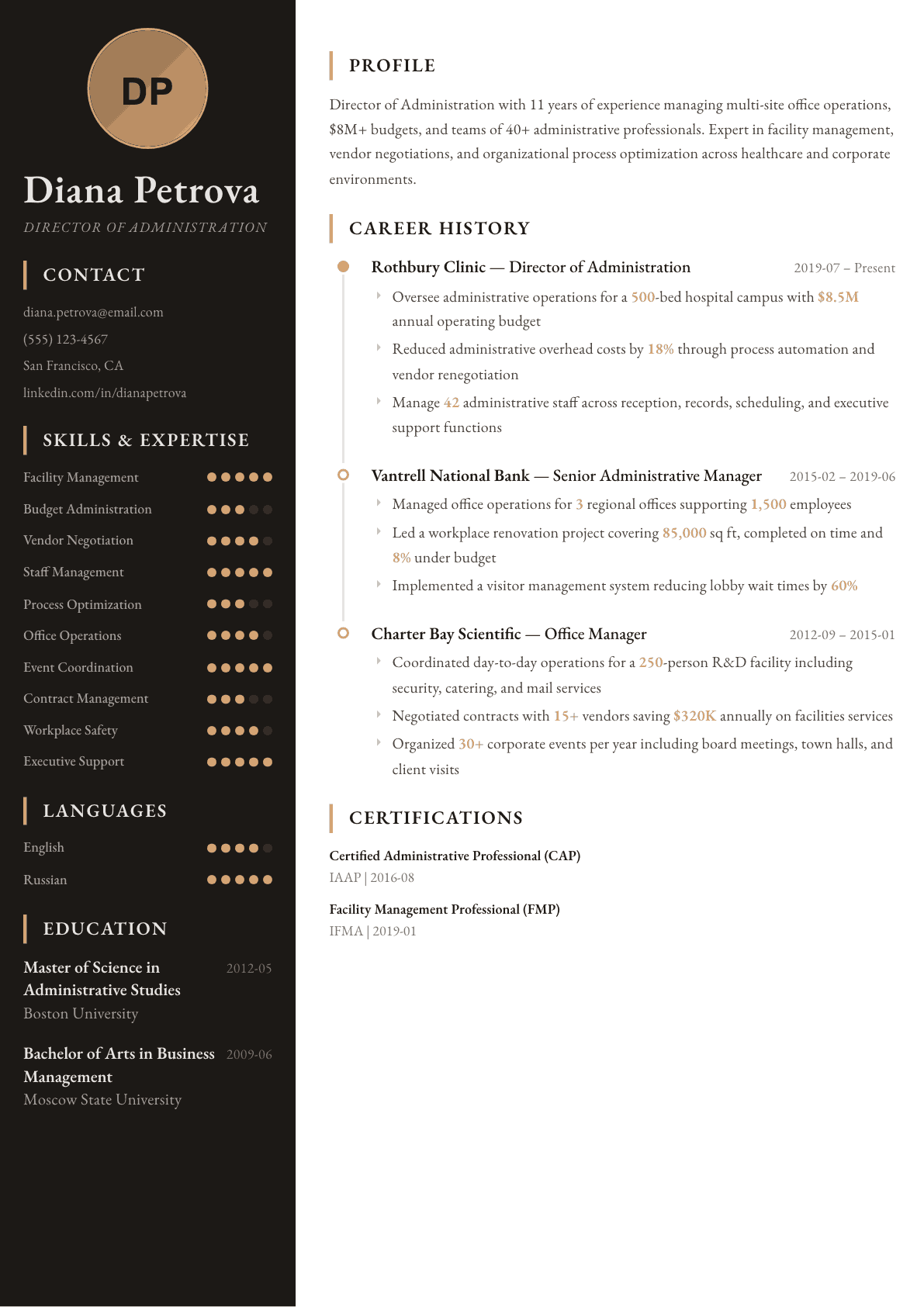
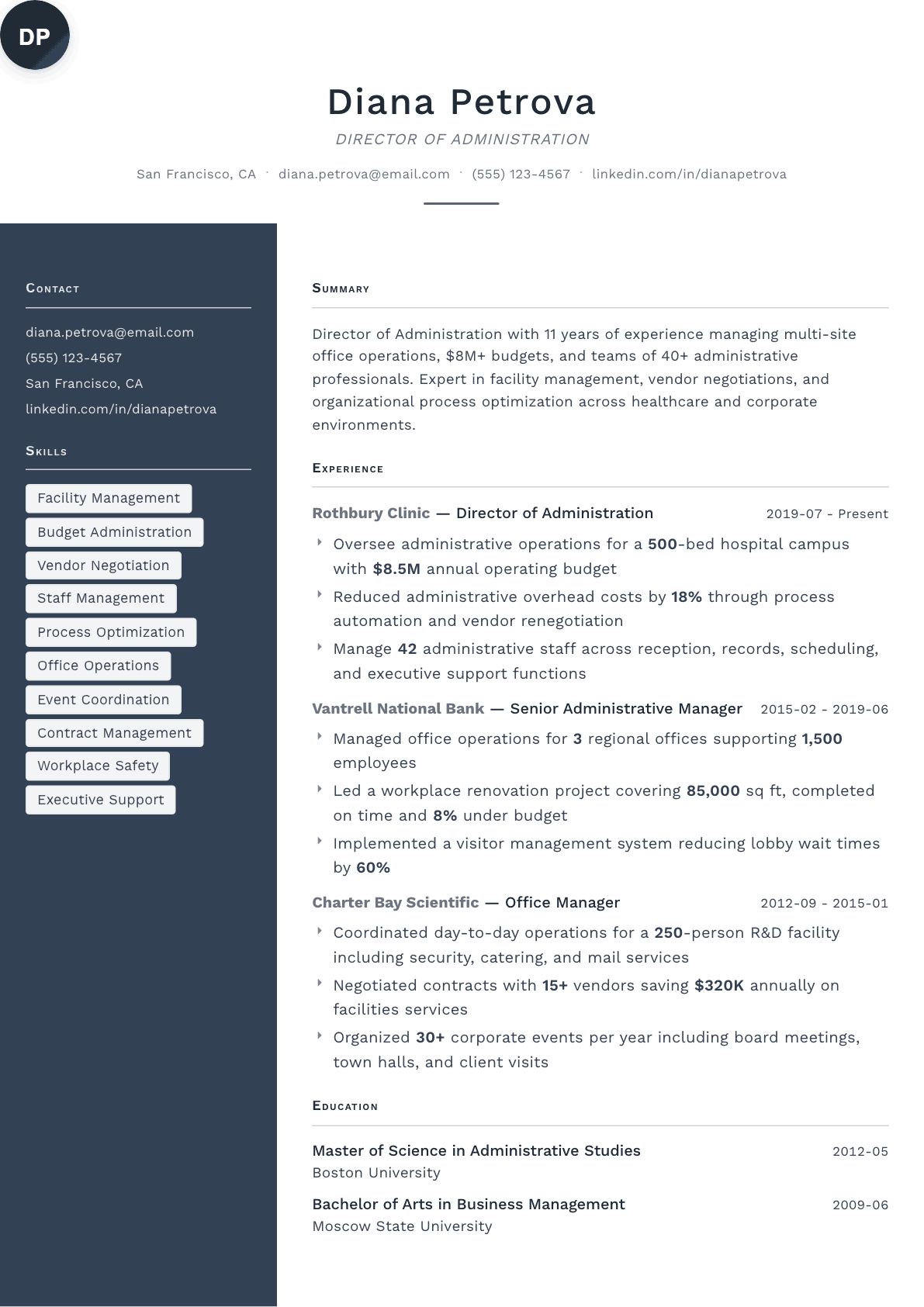
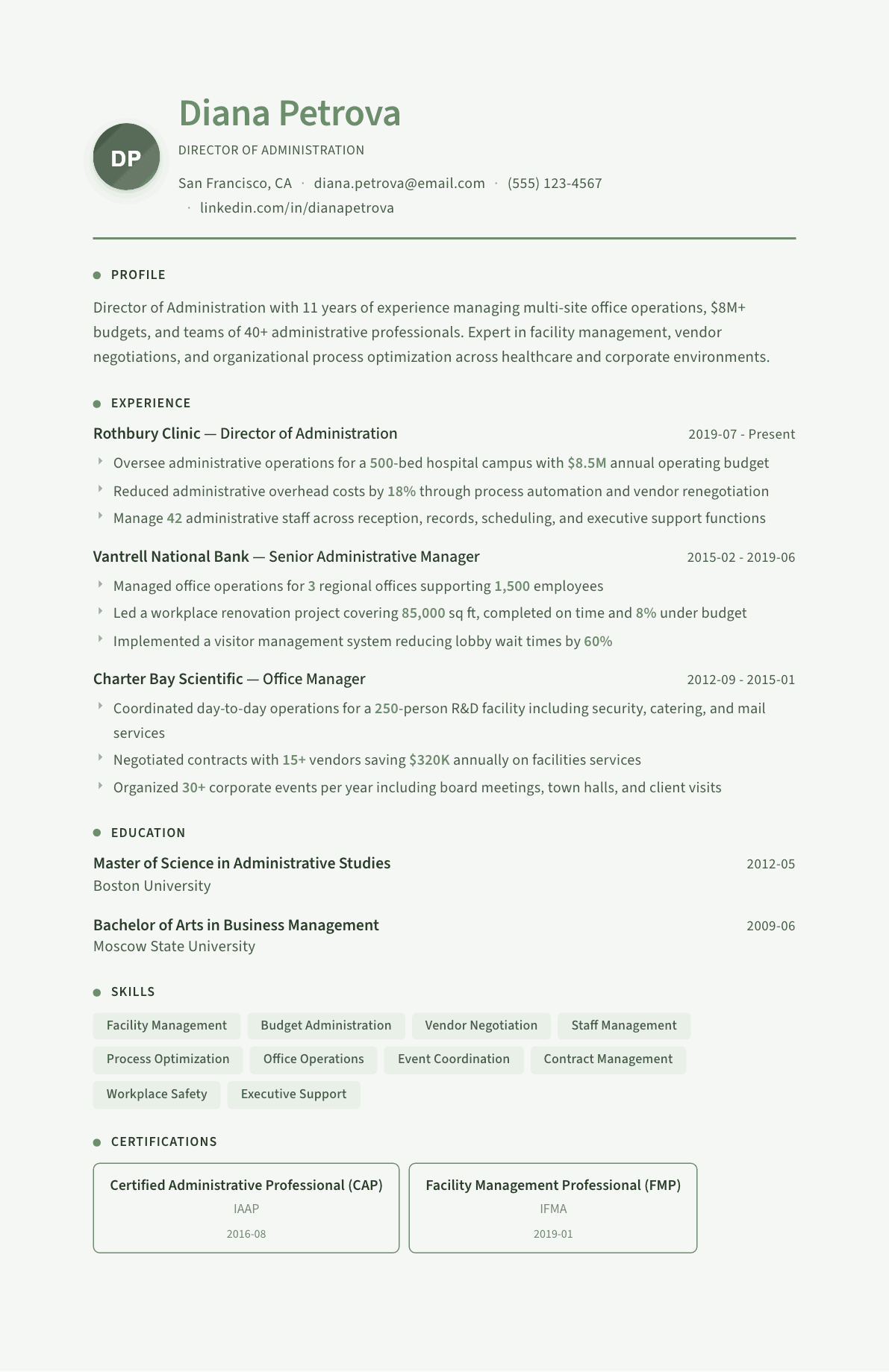
Example Administrative Director summary
Director of Administration with 11 years of experience managing multi-site operations and $8M+ budgets across healthcare and corporate environments. Reduced administrative overhead by 18% through automation and vendor optimization. CAP and FMP certified professional seeking a VP Administration role to drive organizational efficiency at scale.
Skills to list on a Administrative Director resume
- Facility Management
- Budget Administration
- Vendor Negotiation
- Staff Management
- Process Optimization
- Office Operations
- Event Coordination
- Contract Management
- Workplace Safety
- Executive Support
- Records Management
- Space Planning
What actually gets this resume read
- Highlight budget size, number of facilities, and staff count to establish operational scope.
- Quantify cost savings from vendor negotiations, process improvements, and automation.
- Show experience managing diverse functions: facilities, reception, records, executive support.
- Include project management experience (renovations, relocations, technology implementations).
- Demonstrate your ability to support senior leadership and manage confidential operations.
- Use metrics like employee satisfaction scores, vendor SLA compliance, and budget variance.
How to write a administrative director resume
An administrative director sits at the point where facilities, office operations, vendor contracts, records and executive support all report into one budget. The executive hiring for the role, usually a chief operating officer, chief financial officer or hospital administrator, is trying to work out one thing from your resume: how much of the building have you actually been accountable for, and with what authority.
That is why scope belongs at the top of every job on the page. Sites, square footage, headcount supported, staff reporting to you, and the operating and capital budget you signed for. Without those, a director-level resume reads exactly like a senior office manager resume, and it will be sorted into that pile.
This guide covers how to set out scope, which operational numbers survive scrutiny, how to write about vendor and contract work without turning it into a purchasing log, and the questions people ask when they move from office management or from a single site into a multi-site directorship.
Format: two pages, scope line under every employer
Two pages is normal at this level and one page usually signals a smaller job than the title claims. Reverse chronological, standard headings, no columns, since large employers in health systems, universities and financial services all run resumes through parsing software before a person sees them.
Under each employer, write one specification line before the bullets. The organization type, the number of sites, the population supported, the size of your team and the budget you owned. That line does more work than any summary sentence, because it lets the reader calibrate every bullet that follows.
- Header: name, city, phone, email, and a professional profile link.
- Sections: summary, areas of responsibility, experience, education, certifications, systems.
- An areas of responsibility block near the top is useful here because the remit varies so widely between organizations.
Summary: the remit, the scale and the mandate you were given
Four lines at most. Name the functions you own, the number of locations and people supported, and the mandate: were you hired to consolidate offices, cut operating cost, build a shared services function, absorb a merger or professionalize an administration that had grown by accident.
The mandate matters because administrative directorships are usually created to solve a specific problem. An executive reading that you have already done the consolidation they are about to attempt will read the rest of the page differently.
Experience: budget, contracts, projects and the service level you held
Group each job into the same four themes so the reader can compare across employers: budget and cost, vendor and contract management, facilities and projects, and the administrative team itself. Consistency across jobs makes a long career readable in one pass.
On budget, give what you owned and what you changed, and name the mechanism: renegotiated leases, consolidated suppliers, moved a service in house, reduced print and courier spending, or right-sized space after a move to hybrid working. On contracts, name the categories you ran, whether you took them through a formal request for proposal, and the contract term and service levels you negotiated.
Projects are the strongest evidence available to an administrative director. An office relocation, a fit out, a records digitization program, a badge and security system replacement, a business continuity plan tested in a real outage. Each of those has a scope, a timeline, a budget position and a result, which is exactly the shape of a good bullet.
- Operating and capital budget owned, and the cost movement you produced.
- Vendor categories managed, contracts renegotiated, and the service levels you held them to.
- Facilities and workplace projects, with scope, timeline and budget outcome.
- Administrative team: size, structure, turnover and how you developed it.
- Records management, retention policy, and any regulatory or privacy obligation you carried.
Systems and governance: the block that separates director from manager
Name the enterprise systems you have actually worked in: the finance or enterprise resource planning platform where your budget lives, the procurement or purchase-to-pay tool, the human resources system, the space or facilities management platform, the ticketing system your team runs on, and the document and records platform. These are keywords in the posting and they are also a credible signal of the size of the organization you have operated in.
Then governance. Policy ownership, delegation of authority, business continuity and emergency preparedness, health and safety obligations, records retention schedules and audit support. Directors are hired to carry those; managers are hired to execute inside them. Naming them explicitly is how the page announces which one you are.
Education, credentials and the language of the posting
A bachelor's degree is standard and a master's in business, public administration or health administration is common in health systems and universities. Put the degree in a plain block. If you came up without a degree but with a long operating record, lead so hard on scope and results that the reader has stopped asking by the time they reach education.
Administrative director postings repeat a set of phrases across sectors: office operations, facilities management, vendor management, budget administration, process improvement, records management, executive support, business continuity, space planning and cross-functional coordination. Use the ones you can prove, once in the summary and once inside a bullet.
Administrative Director resume summary examples
Stepping up from office manager
Office manager with 6 years running a single 250-person site, now taking on a directorship. Owns facilities, reception, records and events, manages 5 staff, and holds the vendor contracts for catering, cleaning, security and courier services. Led a 2-floor office move delivered on schedule.
Administrative director, single organization
Administrative director responsible for office operations across 3 sites supporting 900 employees, with a team of 14 and an operating budget covering facilities, procurement and records. Consolidated 22 service vendors into 9 master agreements and rebuilt the records retention schedule ahead of an external audit.
Director of administration, multi-site
Director of administration for a health system campus with 5 buildings, 42 administrative staff across scheduling, records, reception and executive support, and full operating and capital budget accountability. Led a records digitization program and the workplace consolidation that followed a service line merger.
Work experience bullets: before and after
Before: Managed office operations and administrative staff.
After: Directed administrative operations across 5 buildings supporting 1,400 staff, leading a team of 42 across reception, records, scheduling and executive support.
Sites, population, team size and function list define the scope; without them a director title is unverifiable.
Before: Reduced administrative costs.
After: Cut administrative operating cost by 18% over 2 budget cycles by consolidating 22 service vendors into 9 master agreements and bringing print and mail back in house.
The reader gets the size of the saving, the time frame and the two mechanisms that produced it.
Before: Handled vendor relationships and contracts.
After: Ran competitive proposals for cleaning, security, catering and facilities maintenance, and negotiated 3-year agreements with defined response times and quarterly service reviews.
Naming the categories, the process and the service terms shows contract ownership rather than order placing.
Before: Oversaw an office renovation project.
After: Led a workplace consolidation moving 3 leased floors into 2 refurbished ones, delivered on schedule and 8% under the approved capital budget with no disruption to clinic hours.
Scope, budget position and continuity are the three things an executive checks on any facilities project.
Before: Improved administrative processes.
After: Replaced a paper request process with a ticketing workflow for facilities and administrative requests, cutting average response time from 3 days to under 8 hours across 5 sites.
A named system change with a measured service level turns process improvement into something the reader can picture.
Hard skills
- Operating and capital budget administration
- Facilities and workplace management
- Vendor and contract negotiation
- Request for proposal management
- Space planning and office moves
- Records management and retention
- Procurement and purchase-to-pay systems
- Policy development and administration
- Business continuity planning
- Executive support team leadership
- Health and safety compliance
- Service level management
- Process automation and workflow design
Soft skills
- Executive stakeholder management
- Negotiation with suppliers
- Cross-department coordination
- Coaching administrative leads
- Discretion with confidential matters
- Decision making under budget pressure
Certifications worth listing
- Certified Administrative Professional (CAP) (International Association of Administrative Professionals)
- Facility Management Professional (FMP) (International Facility Management Association)
- Certified Facility Manager (CFM) (International Facility Management Association)
- Project Management Professional (PMP) (Project Management Institute)
- Certified Records Manager (CRM) (Institute of Certified Records Managers)
Mistakes that cost administrative director candidates the interview
- Omitting sites, headcount supported and budget, which leaves a director title looking like an inflated office manager role.
- Listing duties such as calendar management and supply ordering that belong to the team you lead, not to you.
- Describing cost savings with no mechanism, since an executive wants to know whether the saving was structural or a one-off.
- Leaving out governance work such as continuity planning, retention schedules and audit support, which is what distinguishes the level.
- Writing about projects without the budget and schedule outcome, when those two facts are the whole point of a project bullet.
- Ignoring the enterprise systems you have used, which is often how a recruiter judges the size of organization you have operated in.
Administrative Director resume questions
How is an administrative director different from an office manager on a resume?
Scope and authority. An office manager runs a site and executes inside policies someone else set. A director owns a budget, signs vendor contracts, sets policy and leads managers. Make that visible with budget size, contract authority, staff reporting to you and the number of locations.
Should I include an areas of responsibility block?
Yes, because the remit varies so much between employers. A short block listing the functions you own, such as facilities, procurement, records, reception and executive support, lets a reader confirm in seconds that your version of the role matches the one they are hiring for.
How do I show budget accountability without giving figures I should not share?
Use magnitude rather than exact numbers, describe what the budget covered, and focus on the movement you produced as a proportion. You can also frame it by scale of operation, such as the number of sites and staff the budget supported, which is usually enough for a screening reader.
What certifications matter for an administrative director?
They are helpful rather than required. Facilities and project credentials carry weight where the role is building-heavy, and records or administrative professional certifications help in regulated environments. Operating scope and results still outweigh any certificate on this particular resume.
How do I move from a single site to a multi-site directorship?
Emphasize anything you already ran remotely or across locations: shared vendors, standardized processes, a policy applied beyond your own building, or covering a second site during a vacancy. Then state the multi-site ambition in the summary so the reader is not left to infer it.
Related resume examples
- Office Manager Resume example
- General Manager Resume example
- Operations Manager Resume example
- Operations Director Resume example
- Office Administrator Resume example
- Business Manager Resume example