Cashier Retail Resume Examples: the lines they read
Write a Retail Cashier Resume That Beats the Applicant Pile
By Mustafa Tarabya, founder of CVBooster · Published · Updated
Retail cashier resume examples with register, drawer accuracy, and loyalty signup bullets, plus a guide for first job and career applicants.
Sample resumes for a cashier retail
The same cashier retail content laid out in three CVBooster templates, so you can see what the finished document looks like before you write a word.
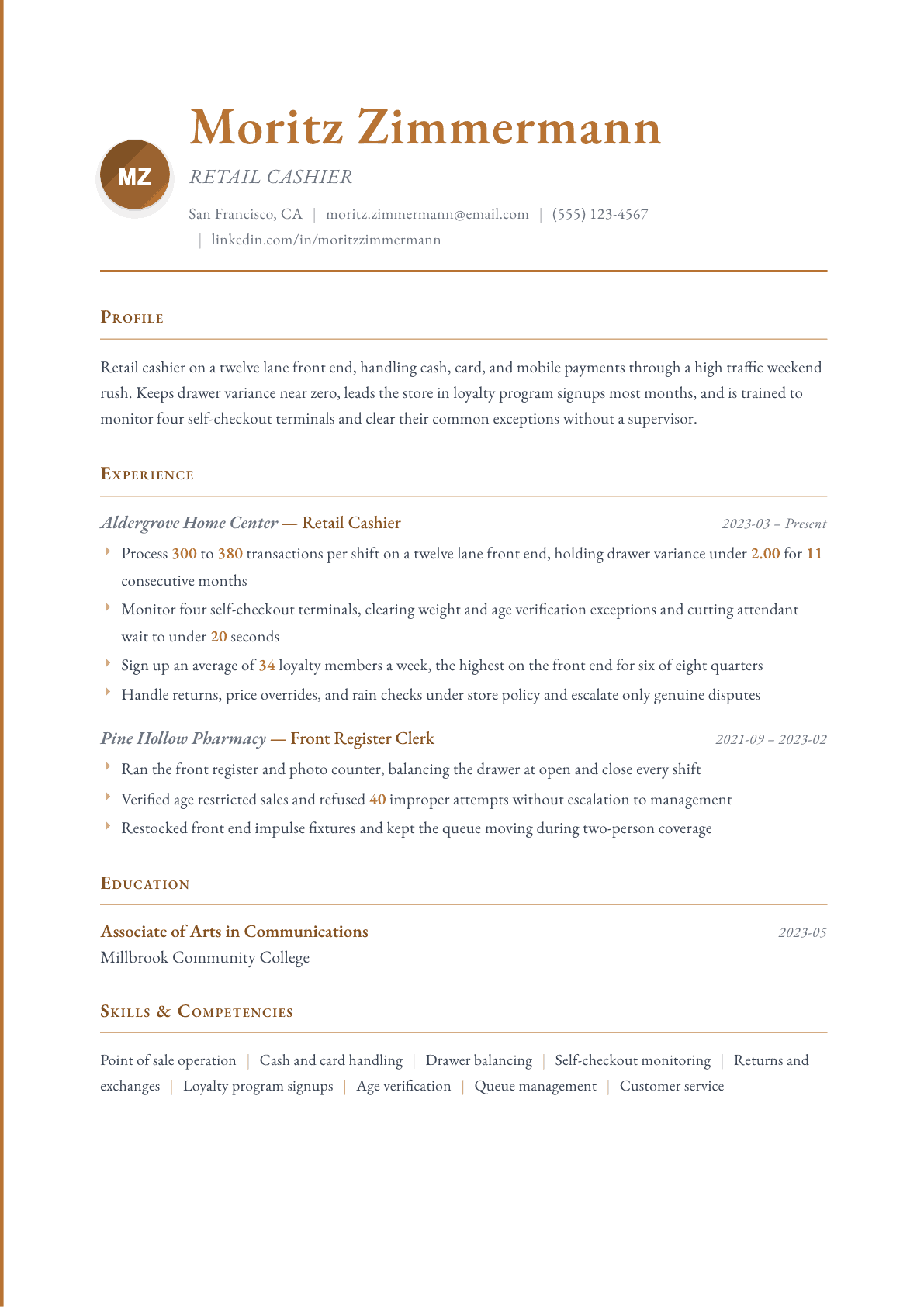
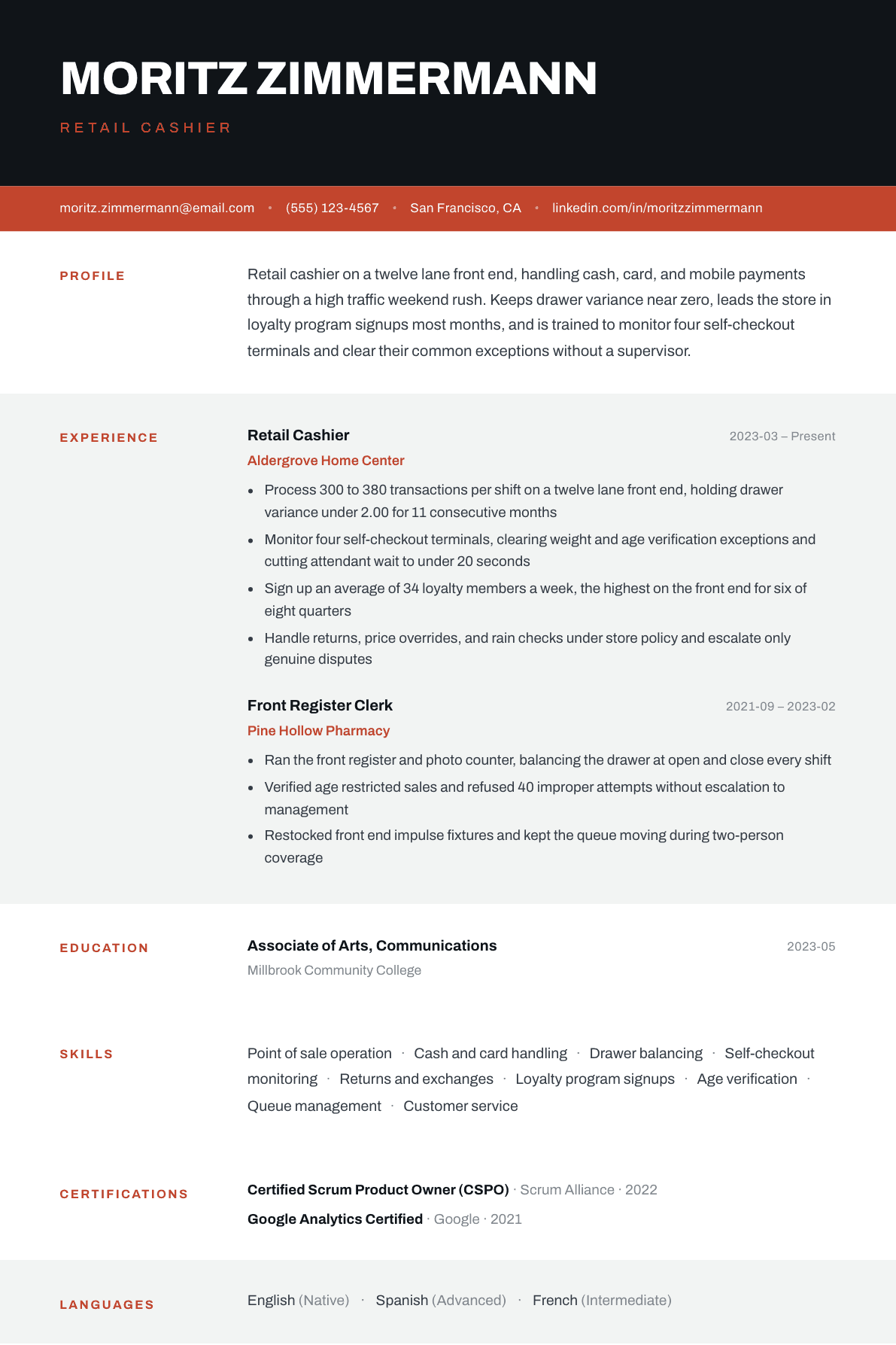
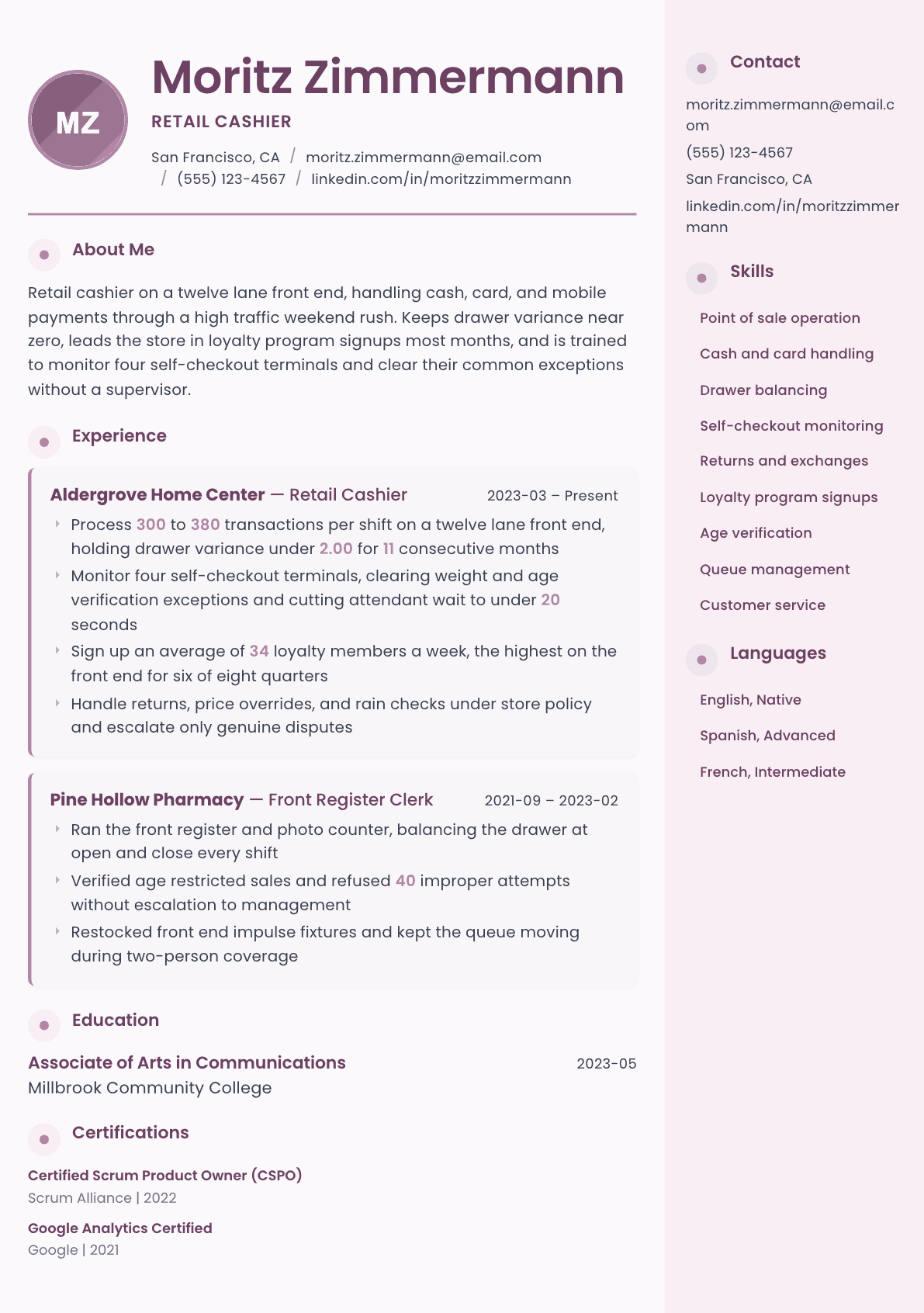
Example Cashier Retail summary
Retail cashier with three years on high volume front ends, processing 300 to 380 transactions a shift across cash, card, and mobile payments. Holds drawer variance under two dollars for eleven months, monitors four self-checkout terminals, and averages 34 loyalty signups a week. Trained in returns, overrides, and age verification.
Skills to list on a Cashier Retail resume
- Point of sale operation
- Cash handling
- Card and mobile payments
- Drawer balancing
- Self-checkout support
- Returns and exchanges
- Price overrides
- Loyalty enrollment
- Age verification
- Queue management
- Front end restocking
- Customer de-escalation
- Shift cash reconciliation
What actually gets this resume read
- Give transaction volume per shift and drawer variance, because accuracy and speed are the whole job.
- Name the point of sale system you trained on, since chains hire faster when the software already matches.
- Add self-checkout monitoring if you have done it, as most front ends now run on fewer staffed lanes.
- Include loyalty, credit, or membership signup numbers, which many retailers score cashiers against directly.
- Show how you handled angry customers and returns, without naming the customer or the outcome dramatically.
- For a first job, put availability, reliability, and any cash handling from school or volunteering up front.
How to write a cashier retail resume
A retail cashier resume is screened for three things in about twenty seconds: can you handle money accurately, can you keep a line moving, and will you be pleasant to the customer standing in front of you at the end of a long day. The front end manager reading it has a schedule with holes and very little patience for a page that does not answer those questions.
Because the job looks simple, applicants describe it simply and disappear into the pile. Operated cash register and provided customer service could be written by someone who has never worked a Saturday rush. Transaction counts, drawer variance, self-checkout coverage, and loyalty signups are the details that prove you have.
This guide sets out the layout, what to do when this is your first job, three summary examples from a first register to a cashier ready for a lead role, before and after bullets, and the questions retail cashiers ask when they sit down to write.
Format: one page, plain, availability stated
One page, single column, ordinary section headings. Almost every chain takes applications through a portal that flattens formatting, and a graphic template will arrive as scrambled text. Put availability under your contact details, because the front end is scheduled by hour and a manager is usually filling specific gaps such as weekend afternoons or the closing shift.
Where you have no work history, education moves above experience and a short section of relevant coursework, school jobs, or volunteering fills the space. Keep the dates in month and year form so the reader does not have to guess how long anything lasted.
- Header: name, city and state, phone, email, and a one line availability statement.
- Section order with experience: summary, experience, skills, education, certifications if you hold any.
- Name the point of sale system you trained on, since matching one shortens the onboarding.
Summary: volume, accuracy, and the extras you cover
Two or three lines. Give the format and the size of the front end, then transactions per shift and your drawer accuracy over a stated period. Add whatever else you cover, such as self-checkout monitoring, returns, or the service desk, because a cashier who can be moved around the front end is worth more to a scheduler than one who cannot.
For a career changer, name the transferable half: cash handling in food service, queue management in hospitality, or age verification in a licensed venue. All three map directly onto a register job and shorten the training conversation.
Experience: money first, speed second, service third
Lead with accuracy. Drawer variance held over a number of months is the single most persuasive line a cashier can write, because it is the risk the store carries every shift. Follow it with volume: transactions per shift, items per minute if your system reports it, and the lane count you worked within.
Then cover the exceptions. Returns, price overrides, rain checks, coupon policy, and refusals on age restricted sales are where an untrained cashier costs the store money or breaks a rule. Showing that you handled these under policy, and escalated only genuine disputes, tells the manager you will not be a constant call to the lane.
Self-checkout is now a large part of the role. If you have monitored terminals, say how many and what exceptions you cleared, since attendant coverage decides whether the front end holds together at peak with fewer staffed lanes.
First job: what counts as evidence
School fundraisers, a concession stand, a market stall, a club treasurer role, or helping in a family shop all involve handling money in front of people. Written in register language, counting a float, reconciling takings, and serving a queue, they answer the same questions a paid job would.
Add anything that shows composure with strangers: tutoring, coaching, hosting, or customer facing volunteering. Front end managers hire for temperament as much as for speed, because the register is where an unhappy shopper finally says something.
Skills, keywords, and the numbers to gather first
Use the posting nouns: point of sale, cash handling, drawer balancing, returns and exchanges, price overrides, loyalty enrollment, age verification, self-checkout support, queue management, and shift reconciliation. Keep the list to real tasks and systems rather than personality words.
Before writing, collect four numbers from memory or from your old schedules: transactions per shift, lanes on the front end, drawer variance over a period, and loyalty or membership signups. Those four turn a generic cashier resume into a specific one without inventing anything.
Cashier Retail resume summary examples
First register job
Applicant seeking a retail cashier position with weekend and evening availability. Handled cash and card payments at a school concession stand and counted the float at open and close for two seasons. Comfortable serving a continuous queue and learning a new point of sale system quickly.
Three years on the front end
Retail cashier processing 300 to 380 transactions a shift on a twelve lane front end across cash, card, and mobile payments. Held drawer variance under two dollars for eleven consecutive months, monitors four self-checkout terminals, and averages 34 loyalty signups a week.
Ready for head cashier
Senior cashier trusted with cash office support, opening tills, and the closing count on a twenty lane front end. Trains new cashiers through their first week, clears self-checkout exceptions without a supervisor, and led the store in membership enrollments for six quarters.
Work experience bullets: before and after
Before: Operated a cash register and took payments.
After: Processed 300 to 380 transactions per shift on a twelve lane front end across cash, card, and mobile payments.
Volume and lane count give the manager a workload picture that the word register does not.
Before: Balanced my drawer at the end of the day.
After: Balanced the drawer at open and close every shift and held variance under two dollars for eleven consecutive months.
A variance figure over a stated period is the accuracy proof a front end manager actually trusts.
Before: Helped customers at self-checkout.
After: Monitored four self-checkout terminals, clearing weight and age verification exceptions and holding attendant response under twenty seconds.
Terminal count and a response time show real attendant coverage rather than occasional assistance.
Before: Signed customers up for the store card.
After: Signed up an average of 34 loyalty members a week, leading the front end in enrollments for six of eight quarters.
A weekly rate and a ranking make a soft target into a measured result the chain already tracks.
Before: Dealt with returns and unhappy customers.
After: Handled returns, price overrides, and rain checks under store policy, escalating only genuine disputes to a supervisor.
Naming the exception types and the escalation threshold shows judgment instead of a vague willingness to help.
Hard skills
- Point of sale operation
- Cash, card, and mobile payment handling
- Drawer counting and balancing
- Self-checkout monitoring and exceptions
- Returns and exchange processing
- Price overrides and rain checks
- Coupon and discount policy
- Loyalty and membership enrollment
- Age restricted sales verification
- Queue and lane management
- Front end restocking
- Shift reconciliation
Soft skills
- Patience through a rush
- Calm de-escalation
- Accuracy under time pressure
- Friendly greeting habit
- Clear handover at shift change
- Discretion with cash
Certifications worth listing
- RISE Up Customer Service and Sales (National Retail Federation Foundation)
- RISE Up Retail Industry Fundamentals (National Retail Federation Foundation)
- TIPS Certification for Off-Premise Alcohol Sales (Health Communications, Inc.)
Mistakes that cost cashier retail candidates the interview
- Describing the register as a task list, when accuracy and volume are the two facts the front end manager wants.
- Never mentioning drawer variance, the one number that tells a store whether you can be trusted with cash.
- Skipping self-checkout experience, even though attendant coverage is now most of what a front end schedule needs.
- Writing excellent customer service in place of the returns, overrides, and refusals you actually handled under policy.
- Leaving availability off the page, so a scheduler filling weekend closes cannot tell whether to call you.
- Using a designed template with columns and icons that the store application portal renders as unreadable text.
Cashier Retail resume questions
What should a cashier put on a resume with no experience?
Anything involving money and people: a concession stand, a fundraiser, a market stall, a club treasurer role, or a family shop. Write it in register language, counting the float, reconciling takings, and serving a continuous queue, then state your availability under the contact details.
How do I prove I am accurate with cash?
Give a variance figure over a stated period, such as balancing to within a small amount every shift for most of a year. If your store did not share numbers, describe the controls you followed: counting the float at open and close, safe drops at a limit, and a witnessed count at shift change.
Does self-checkout experience matter on a cashier resume?
Yes, more each year. Stores staff fewer lanes and expect one attendant to cover several terminals, clearing weight errors, age prompts, and payment failures. Naming the number of terminals you monitored and the exceptions you cleared makes you immediately schedulable.
Should I list the point of sale system I used?
Name it if you know it, because a match shortens onboarding and managers filter for it. If your store used an in-house system, describe the functions instead: tender types, returns, overrides, suspended transactions, and end of shift reconciliation, which transfer across almost any platform.
How do I move from cashier to a supervisor role?
Show the pieces of the lead job you already do: training new hires, covering breaks, opening tills, supporting the cash office, and clearing escalations without calling a manager. Those bullets are what a head cashier or front end supervisor posting is looking for.