Fashion Retail Associate Resume Examples: free ATS score
Create a Fashion Retail Associate Resume That Sells You
By Mustafa Tarabya, founder of CVBooster · Published · Updated
Fashion retail associate resume examples with styling, clienteling and sales keywords, plus a guide to writing bullets that show numbers.
Sample resumes for a fashion retail associate
The same fashion retail associate content laid out in three CVBooster templates, so you can see what the finished document looks like before you write a word.
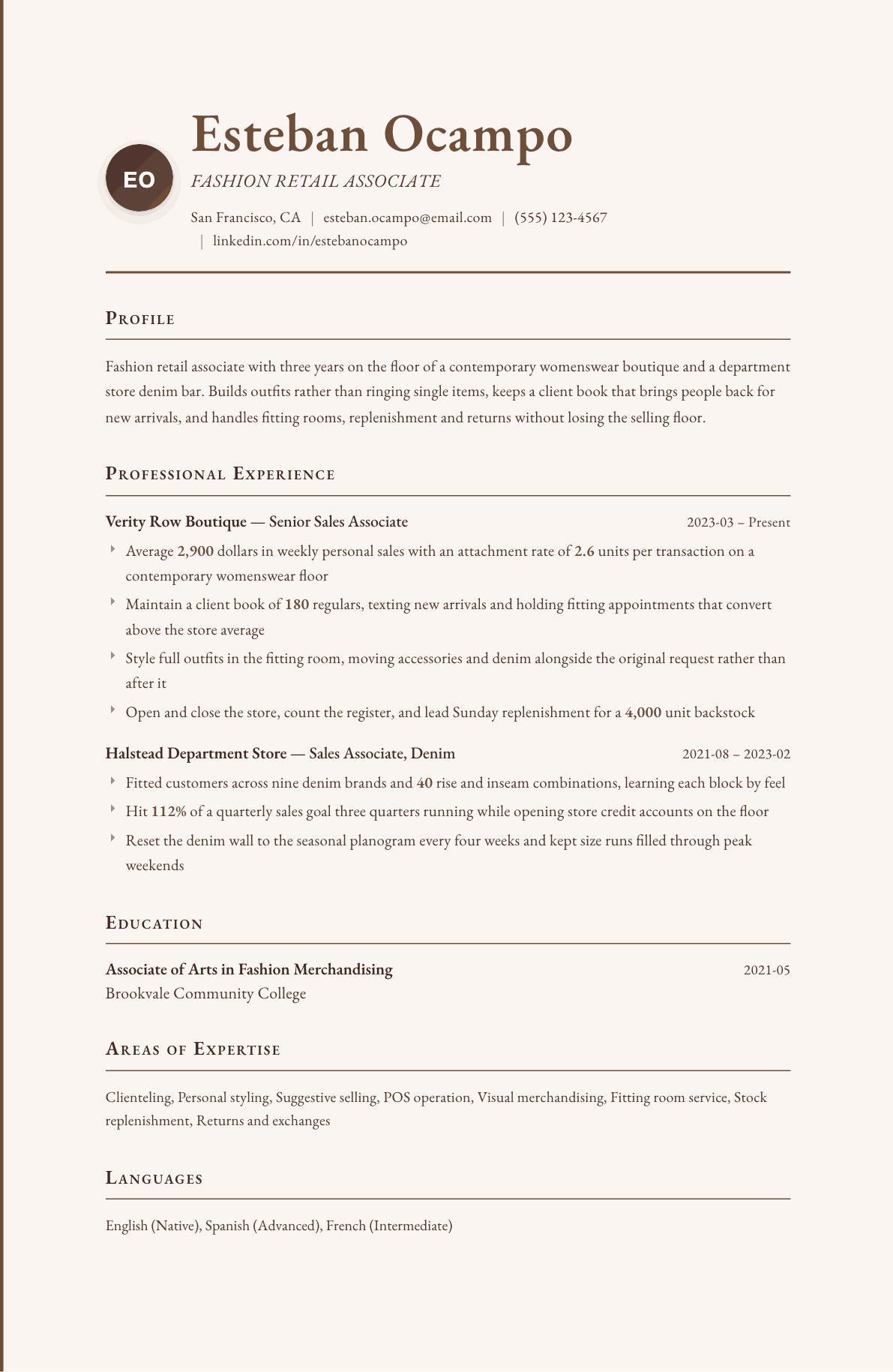
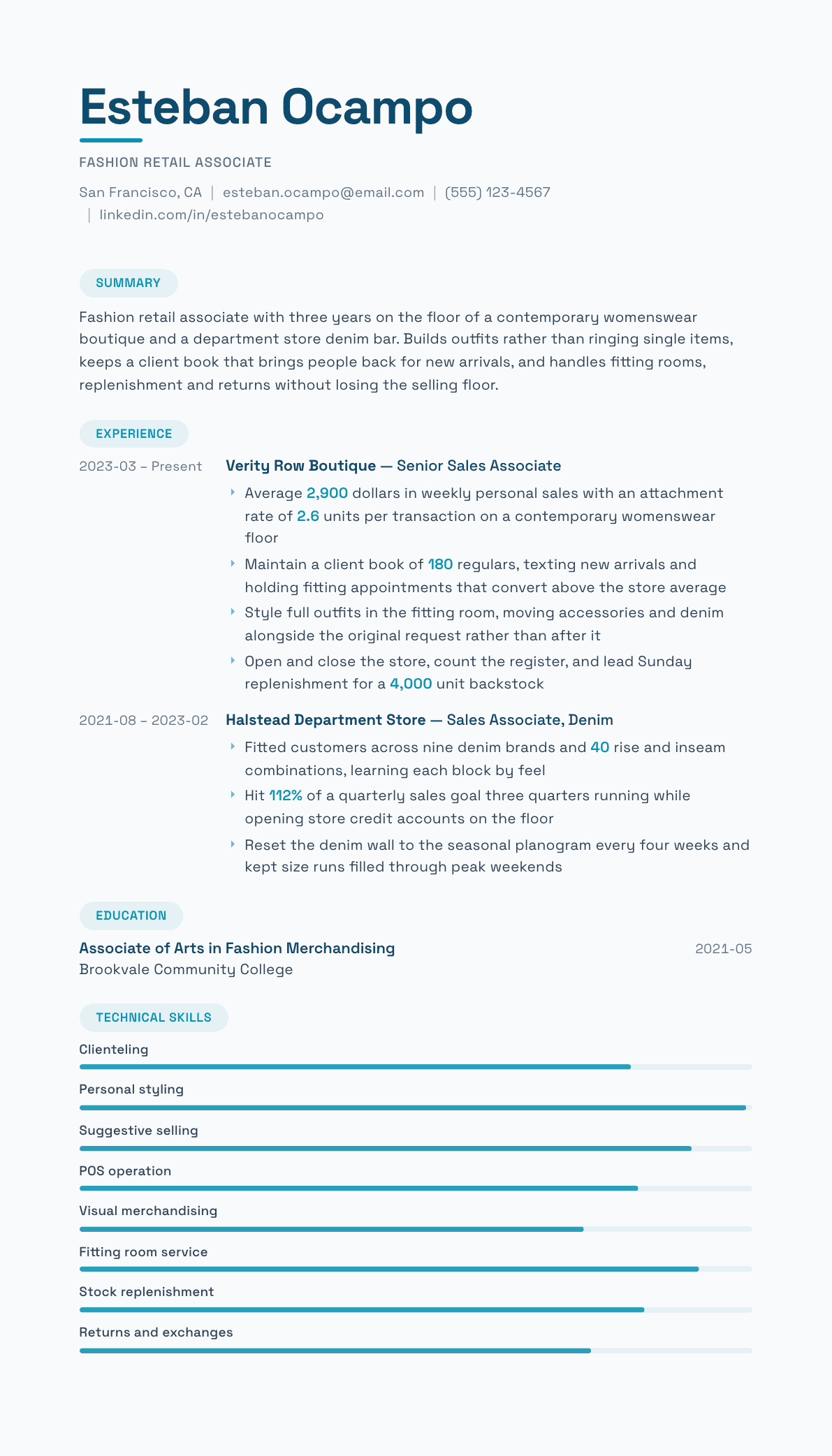
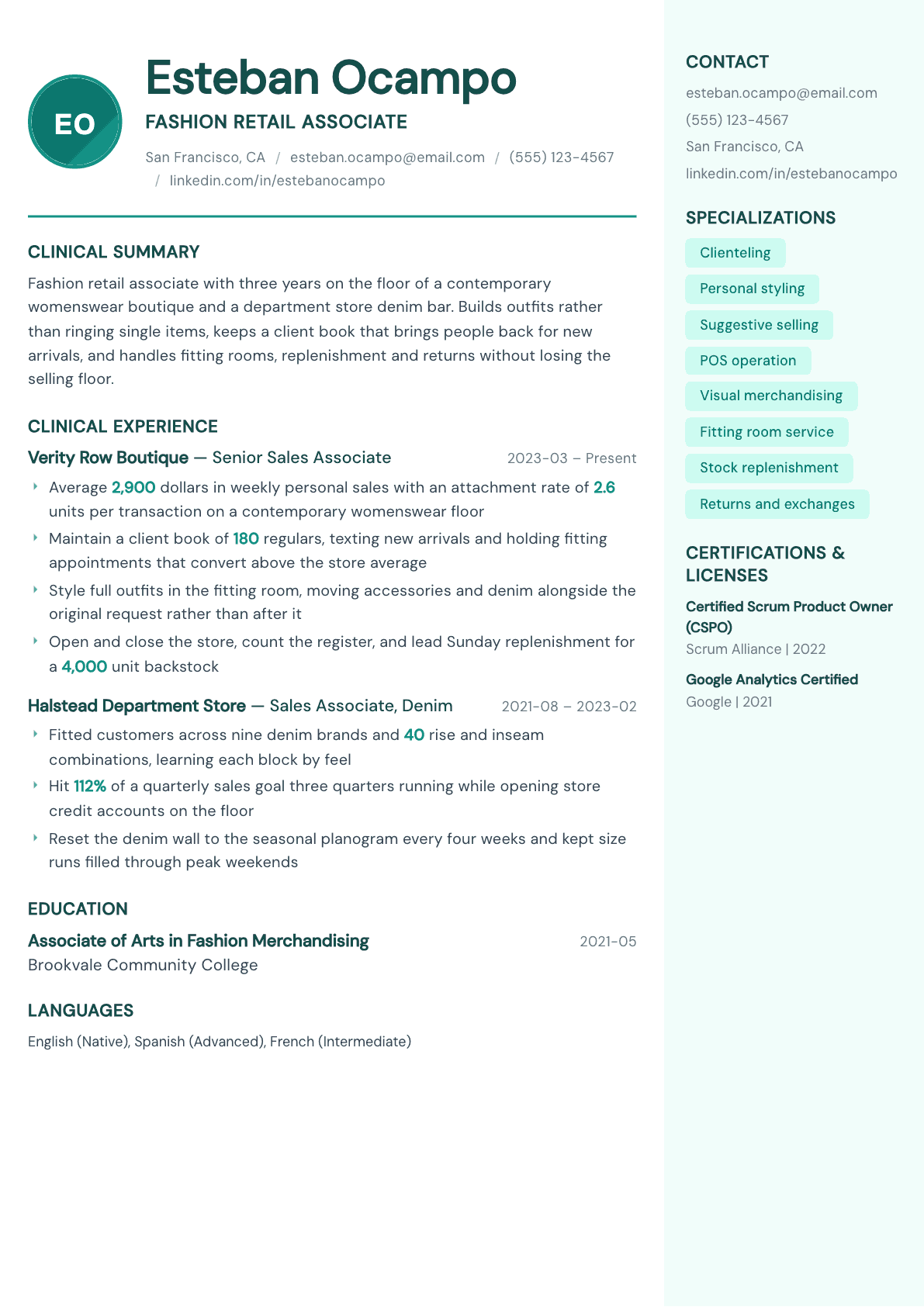
Example Fashion Retail Associate summary
Fashion retail associate with three years selling contemporary womenswear and denim, consistently above store average on units per transaction. Keeps a client book of regulars who shop new arrivals first, styles complete outfits in the fitting room, and holds the floor through replenishment, returns and peak weekends. Trained on point of sale, loyalty enrollment and seasonal floor sets.
Skills to list on a Fashion Retail Associate resume
- Clienteling
- Personal styling
- Suggestive and add-on selling
- Fit and sizing knowledge
- Point of sale systems
- Visual merchandising
- Fitting room management
- Stock replenishment
- Returns and exchanges
- Loyalty program enrollment
- Customer service recovery
- Store opening and closing
- Inventory counts
- Seasonal floor sets
What actually gets this resume read
- Put your sales numbers on the page: weekly volume, units per transaction, and conversion where you know it.
- Describe clienteling with the size of your book and what you actually did to keep those customers returning.
- Name the brands or categories you sold, since fit knowledge in denim or tailoring is a hiring signal.
- Show the unglamorous work too: replenishment, opening the register, and holding standards during peak weekends.
- Use retail verbs like styled, fitted, converted and merchandised instead of the flat verb helped.
- Keep it to one page and lead with the store where you sold the most, not simply the most recent one.
How to write a fashion retail associate resume
A store manager reading fashion retail associate resumes is doing arithmetic. She has a payroll budget, a sales plan and a schedule with holes in it, and she is trying to work out which applicant will sell more per hour than the one she has. Almost every resume in her pile says friendly, hardworking and passionate about fashion, which tells her nothing about the arithmetic.
The ones she calls carry numbers. Weekly personal volume, units per transaction, conversion, loyalty enrollments, the size of a client book. Retail is one of the few entry level fields where the person is measured daily, which means the numbers exist and most candidates simply never ask for them before they leave a job.
This guide covers how to structure the page, how to write summaries for a first job through a senior selling role, how to turn selling floor work into bullets with evidence, and the questions associates ask when they move from one brand to a better one.
Format: one page, selling numbers above the fold
Keep it to a single page and use a clean single column layout. Boutique managers often read applications on a phone between customers, so the first third of the page has to work on a small screen: name, title, a three line summary, and your strongest selling figure.
Avoid decorative templates with sidebars and rating bars. They look designed, but they parse badly in the systems larger chains use, and a boutique owner reading on a phone will lose the right hand column entirely.
- Header: name, city, phone, email, and availability if you can work nights and weekends.
- Section order: summary, experience, skills, education, and any brand or product training.
- Open each job with the store type and category, such as contemporary womenswear or denim.
Summary: category, volume, and how you sell
Three lines. The category you know, how long you have sold it, and the way you actually generate sales. Clienteling, fitting room styling, appointment selling and floor conversion are different methods, and naming yours tells a manager where to slot you on the schedule.
If you are applying with no retail history, use the summary to name the transferable ground: service work under time pressure, cash handling, standing shifts, and any styling you do informally. Then let the rest of the page prove you understand what the job asks physically as well as socially.
Experience: sell, attach, return, restock
The first bullet in every job should be the selling number. Weekly or monthly personal volume, units per transaction, and conversion if the store tracked it. Give the range honestly rather than the single best week, because a manager who suspects you cherry picked will discount everything else you wrote.
The second bullet is method. How you build an outfit in the fitting room, what you do with a client book, how you follow up on new arrivals, and how you handle a customer who came in for one specific item. This is where a senior associate separates from a cashier who stands near clothes.
The rest is operations, and it matters more than candidates think. Replenishment, size runs, floor sets, returns, register close and opening the store are what keep a small team viable. A manager scheduling a Sunday needs to know you can be left with the building.
Product knowledge: fit is the real skill
Fit knowledge is what customers come back for and what most applicants cannot claim. If you fitted denim, say how many brands and how many rise and inseam combinations you worked with. If you sold tailoring, say what you can measure and what alterations you can advise on. If you sold footwear, say the lasts and widths you handled.
Name the brands you sold, unless you are applying to a direct competitor who may find that awkward. Brand training programs are real credentials in this field, and a manager who knows the training you completed knows roughly what you were taught.
Skills and keywords
The recurring terms are clienteling, units per transaction, add on selling, conversion, loyalty enrollment, visual merchandising, point of sale, fitting room and stock replenishment. Put the ones that are true in a short skills block, then make sure at least three of them also appear inside a bullet with a number attached, because the block alone will not convince a person.
Fashion Retail Associate resume summary examples
First retail job
Recent graduate seeking a fashion retail associate role, with two years of weekend cafe service handling registers, rushes and returns. Styles friends and family regularly, learns product quickly, and available for nights, weekends and the full holiday season without restriction.
Three years selling
Fashion retail associate with three years on a contemporary womenswear floor, averaging 2,900 dollars in weekly personal sales at an attachment rate of 2.6 units per transaction. Keeps a client book of 180 regulars, styles complete outfits in the fitting room, and opens and closes the store.
Senior seller
Senior sales associate and floor lead in denim and tailoring, fitting across nine brands and 40 rise and inseam combinations. Hit 112% of quarterly goal three quarters running, trains new associates on the fitting room flow, and runs Sunday replenishment for a 4,000 unit backstock.
Work experience bullets: before and after
Before: Helped customers find clothes and made sales.
After: Averaged 2,900 dollars in weekly personal sales on a contemporary womenswear floor with an attachment rate of 2.6 units per transaction.
Two hard selling metrics replace a description of the job every applicant on the pile could write.
Before: Built relationships with regular customers.
After: Maintained a client book of 180 regulars, texting new arrivals by category preference and holding fitting appointments that converted above the store average.
The book size and the follow up method turn a soft claim into a repeatable sales channel.
Before: Knew a lot about denim.
After: Fitted customers across nine denim brands and 40 rise and inseam combinations, learning each block well enough to size on sight before the fitting room.
Naming the range of fits demonstrates product depth that takes months on a floor to acquire.
Before: Restocked the sales floor and kept it tidy.
After: Led Sunday replenishment for a 4,000 unit backstock, refilling size runs and resetting the denim wall to the seasonal planogram every four weeks.
Volume, cadence and the planogram reference show floor discipline instead of general tidying.
Before: Opened store credit accounts for customers.
After: Enrolled customers in the loyalty and store credit program at the register while hitting 112% of a quarterly sales goal three quarters in a row.
Pairing enrollment with sustained goal attainment shows you can carry two targets at once.
Hard skills
- Clienteling and client book management
- Personal styling and outfit building
- Add on and suggestive selling
- Fit and sizing knowledge
- Point of sale operation
- Loyalty and credit enrollment
- Visual merchandising and floor sets
- Stock replenishment and size runs
- Returns and exchange processing
- Cash handling and register close
- Inventory counts
- Fitting room management
Soft skills
- Reading a customer quickly
- Composure through peak weekends
- Teamwork on a shared sales floor
- Service recovery after a complaint
- Reliability on nights and weekends
Mistakes that cost fashion retail associate candidates the interview
- Writing passionate about fashion in the summary, which appears on nearly every resume in the same pile.
- Leaving out selling numbers when the store measured you daily and could still confirm them in a reference.
- Describing only customer service and never the operational work that keeps a small store staffed.
- Using a template with sidebars and skill bars that larger chain application systems parse badly.
- Listing every short seasonal job in equal detail instead of leading with the store where you sold the most.
- Forgetting to state availability, which is often the first thing a manager needs before scheduling an interview.
Fashion Retail Associate resume questions
What if my old store never told me my sales numbers?
Estimate carefully from what you did see, such as your typical transaction count on a Saturday or how often you led the daily board. Say it is an average rather than an exact figure, and never quote a number you could not defend in an interview.
How do I get a fashion retail job with no retail experience?
Lead with service work of any kind, then availability, then product interest shown concretely. Managers hire heavily on schedule fit for entry roles, so a candidate who can work Friday nights, Saturdays and the whole holiday season starts ahead of a more polished file.
Should I name the brands I sold?
Usually yes, because brand training tells a manager what you were taught about fit, service standards and clienteling. Use judgment when applying to a direct competitor next door, where naming a rival can read as awkward rather than useful.
Does a one page resume look too short for a selling role?
No. One page is the standard here and a longer file usually means duties were padded. Depth comes from numbers inside your bullets, not from adding a second page of tasks any associate on the floor performs.
How do I move from a mall chain to a luxury or designer store?
Rewrite around clienteling, appointment selling and average transaction value rather than volume of customers. Luxury floors hire for relationship depth and discretion, so a client book with follow up detail carries more weight than a high traffic conversion rate.