Bookstore Clerk Resume Examples: the lines they read
Write a Bookstore Clerk Resume Independents Will Read
By Mustafa Tarabya, founder of CVBooster · Published · Updated
Bookstore clerk resume examples with handselling, receiving and point of sale keywords, plus a guide to standing out at an independent.
Sample resumes for a bookstore clerk
The same bookstore clerk content laid out in three CVBooster templates, so you can see what the finished document looks like before you write a word.
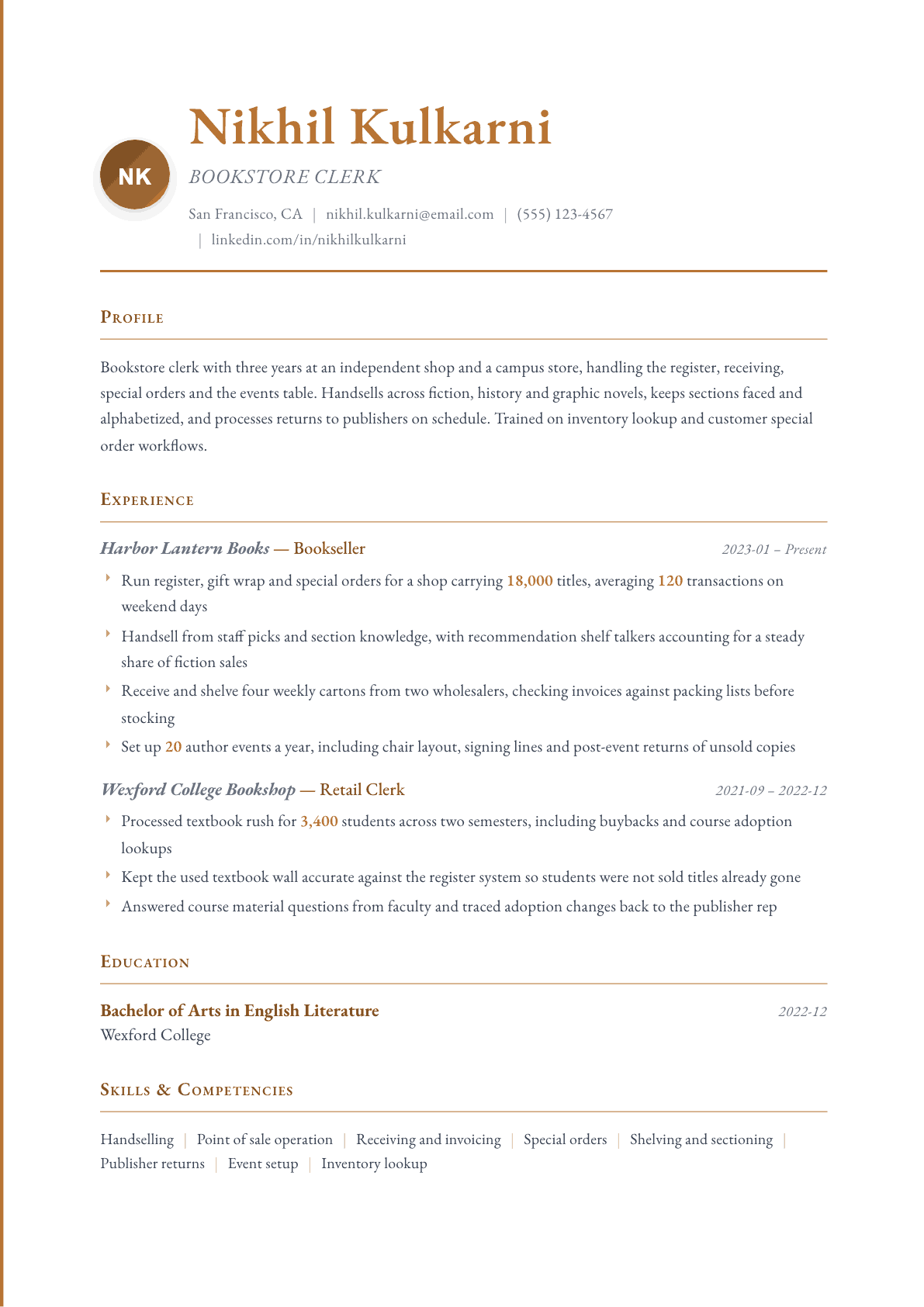
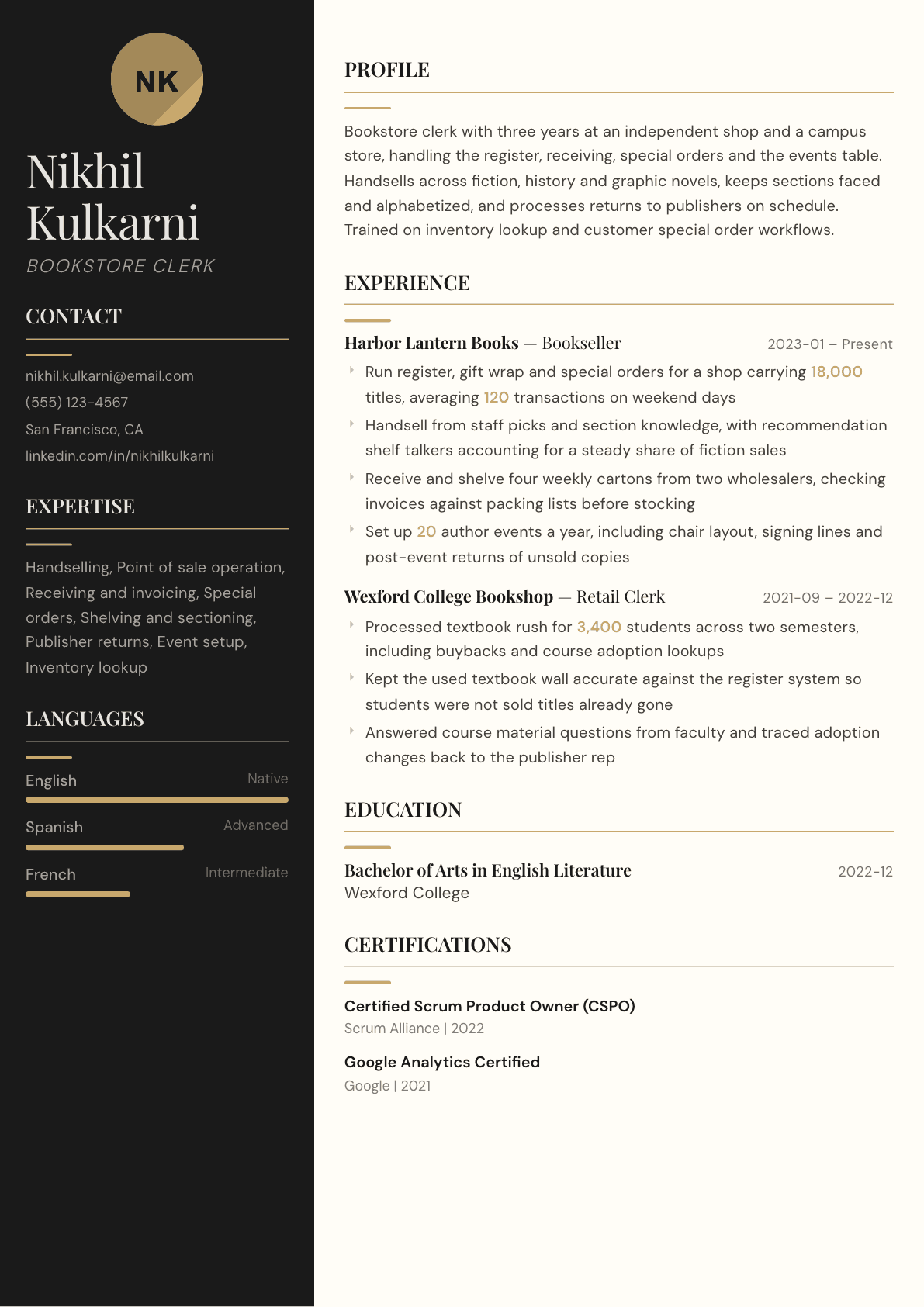
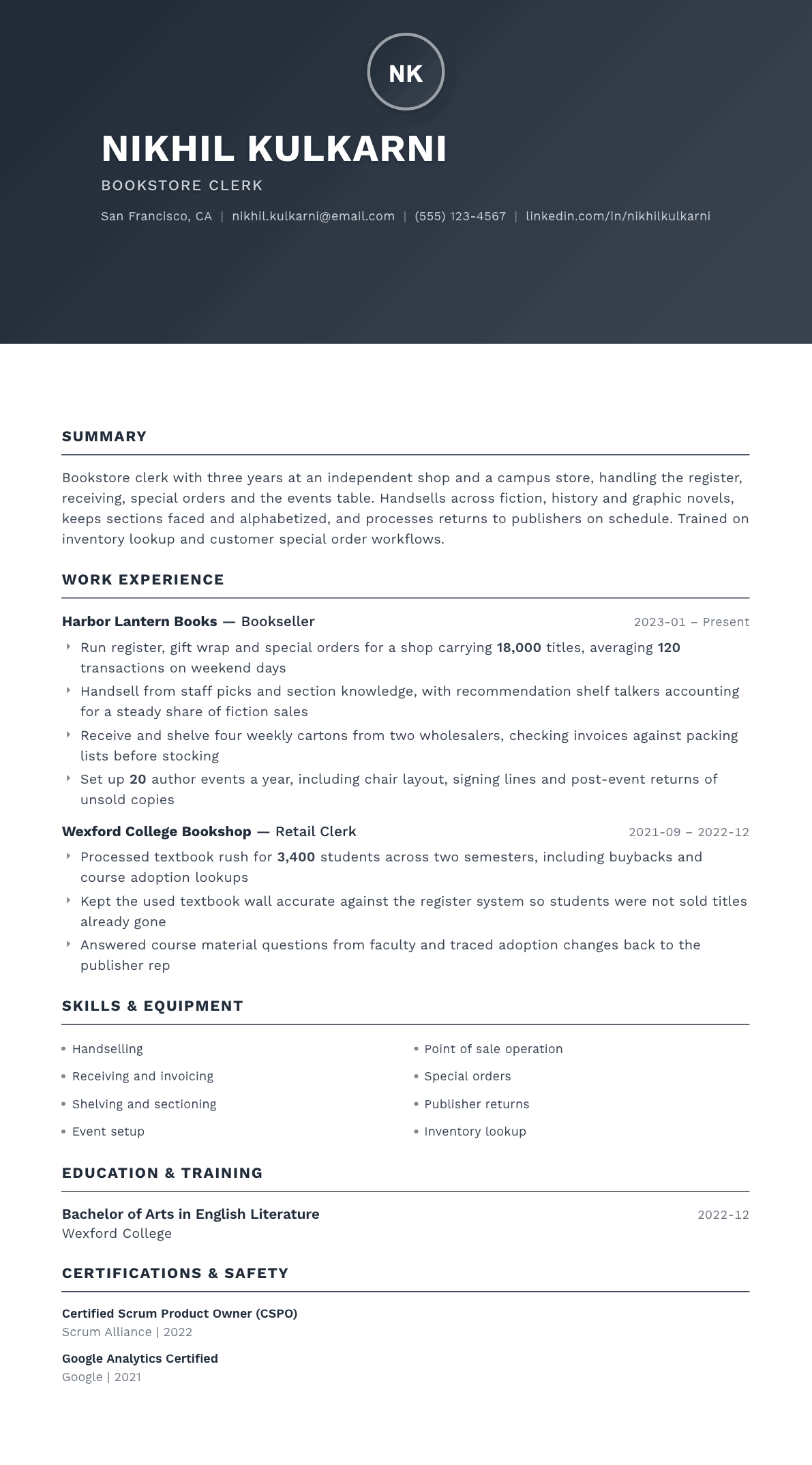
Example Bookstore Clerk summary
Bookstore clerk with three years across an independent shop and a college store, covering register, receiving, special orders and events. Handsells across fiction, history and graphic novels, keeps sections faced and alphabetized, and reconciles cartons against invoices before anything reaches a shelf. Experienced with textbook rush, buyback and author event setup from chairs to unsold returns.
Skills to list on a Bookstore Clerk resume
- Handselling and recommendations
- Point of sale operation
- Receiving and invoice checking
- Special order processing
- Publisher returns
- Shelving and alphabetizing
- Inventory lookup systems
- Event setup and support
- Gift wrapping
- Cash handling
- Section maintenance
- Customer research requests
- Textbook buyback
What actually gets this resume read
- Name the sections you can handsell, because an independent hires for the shelf it needs covered.
- Show the operational side: receiving cartons, checking invoices, and processing returns to publishers.
- Mention the point of sale and inventory system you used, since small shops train slowly and value it.
- Include events work with real detail, because author nights are where an independent makes its margin.
- Add campus bookstore experience if you have it, especially textbook rush, buyback and course adoption work.
- Keep the tone about books but the bullets about work, since enthusiasm alone does not fill a schedule.
How to write a bookstore clerk resume
Almost everyone who applies to a bookstore loves books, so that is not the thing being tested. The owner or manager reading the stack is looking for two harder qualities: whether you can run the unglamorous operations of a small shop, and whether you can put the right book in a stranger hands within about ninety seconds of meeting them.
Independent shops run thin. The same person takes the register, receives the cartons, checks the invoice, chases a special order, sets up the chairs for an author night and returns the unsold copies. A resume that only describes a friendly attitude toward reading leaves the manager guessing on all of that.
This guide covers how to structure the page for an independent, a chain or a campus store, three summaries at different stages, before and after bullets that make bookselling look like the operational job it is, and the questions applicants ask when the shop they want is the only one hiring in town.
Format: one page, plain, and easy to read on paper
Single column, one page, and a font a person would enjoy reading. Many independents still take resumes at the counter or print the email attachment, so the file should look right on paper as well as on a screen. Chain and campus stores route through an applicant system, which is another reason to skip columns and graphics.
Include your availability explicitly. Bookstore staffing lives or dies on weekend and evening coverage, and December volume decides the year for a shop, so an applicant who states holiday availability answers a question the manager was about to ask.
- Header: name, city, phone, email, and your weekly availability in one short line.
- Section order: summary, experience, skills and systems, education, reading interests.
- Name the sections you can handsell in the summary rather than saving them for an interview.
Summary: sections you know, plus the operations you can run
Two or three lines. The kind of store you have worked, the sections you can genuinely recommend from, and the operational tasks you already own. A clerk who can cover register, receiving and special orders while handselling fiction and history is describing most of a shift.
If this is your first bookstore job, name the closest thing you have done. Library shelving, cafe register work, warehouse receiving and any customer research role all transfer. Then add the reading depth as a concrete claim about sections rather than a general statement about loving to read.
Experience: register, receiving, orders, events
Handselling belongs first because it is the differentiator, but write it with substance. The sections you cover, how you learn a new title fast, whether you write shelf talkers, and what happens when a customer describes a book they half remember. That last skill is the one booksellers get asked about at the counter every day.
Receiving and inventory come next. Cartons per week, the wholesalers you received from, invoice checking against a packing list, and returns to publishers, which are a genuine accounting task with deadlines attached. A manager who reads that you have processed returns knows you have seen the back of the shop.
Then events and special orders. Author nights, signings, chair layout, pre-orders and post event returns are real work with real failure modes. Finish with register accuracy, gift wrapping through the holidays, and anything you did that made a peak week survivable.
Systems: the point of sale a shop already runs
Name the point of sale and inventory lookup system you used, since a small shop weighs training time heavily and an applicant who already knows the system starts producing sooner. Wholesaler ordering portals count too, because placing an order correctly is a learned skill.
Add the adjacent tools honestly. A newsletter platform, a social account you posted to, a spreadsheet you kept for event attendance, or the used book pricing system at a campus store. Independents value a clerk who can also do one thing the owner currently does alone.
What to say about reading
Keep it to a short block near the end, framed as coverage rather than personality. Naming four or five sections you can sell from, plus one you are actively learning, tells a manager how you fill a schedule gap. A paragraph about a favorite novel from childhood does not, however sincere it is.
Bookstore Clerk resume summary examples
First bookstore job
Library page and cafe server seeking a bookstore clerk position, with two years shelving by call number and handling a register through morning rushes. Reads widely across fiction, history and graphic novels, and available weekday evenings, both weekend days and the full holiday season.
Three years selling books
Bookseller with three years at an independent carrying eighteen thousand titles, covering register, gift wrap, special orders and receiving. Averages 120 transactions on weekend days, writes staff pick shelf talkers for fiction and history, and receives four wholesaler cartons a week against invoice.
Lead bookseller
Lead bookseller running the events calendar and the returns cycle for an independent shop. Sets up 20 author events a year from chair layout through unsold returns, trains new staff on the point of sale and special order flow, and manages section buying for history and nature writing.
Work experience bullets: before and after
Before: Recommended books to customers.
After: Handsold across fiction, history and graphic novels using staff picks and shelf talkers, and regularly found titles for customers who could only describe a plot and a cover color.
Naming the sections and the hardest version of the task shows real bookselling rather than general enthusiasm.
Before: Received deliveries from suppliers.
After: Received and shelved four wholesaler cartons a week, checking each invoice against the packing list and flagging short receipts before anything was stocked.
Volume plus the invoice check turns unloading boxes into an accounting control the owner cares about.
Before: Helped with author events at the store.
After: Set up 20 author events a year including chair layout, signing line management, stock staging and returning unsold copies to the publisher afterward.
The full event cycle, especially the returns tail, proves you have run the part that costs money if missed.
Before: Worked the register and helped customers.
After: Ran register, gift wrap and special orders through weekends averaging 120 transactions, keeping drawer counts accurate across a full year.
Transaction volume and drawer accuracy give the counter work a standard it can be measured against.
Before: Worked in the campus bookstore during rush.
After: Processed textbook rush for 3,400 students across two semesters, covering buybacks, course adoption lookups and keeping the used wall accurate against the register system.
The student count and the specific rush tasks show you can hold a queue that only appears twice a year.
Hard skills
- Handselling and recommendations
- Point of sale operation
- Receiving and invoice reconciliation
- Special order processing
- Publisher returns
- Shelving and section maintenance
- Inventory lookup systems
- Wholesaler ordering portals
- Event setup and support
- Gift wrapping
- Cash handling and drawer counts
- Textbook buyback and course adoption lookup
Soft skills
- Reading a customer taste quickly
- Patience with vague requests
- Reliability on weekends and holidays
- Care with fragile stock
- Working alone without supervision
Mistakes that cost bookstore clerk candidates the interview
- Writing a paragraph about loving books instead of naming the sections you can actually sell from.
- Leaving out receiving, returns and special orders, which is most of what a small shop needs covered.
- Failing to state availability when weekend and December coverage is the reason the job is posted.
- Listing an English degree as the main qualification with no retail or operational detail beneath it.
- Ignoring the point of sale system by name, when training time is a real cost for a shop with three staff.
- Sending the same file to an independent and a campus store, which hire for very different rhythms.
Bookstore Clerk resume questions
Do I need bookselling experience to get hired at an independent bookstore?
No, but you do need to show the operational half. Library, cafe, register or receiving work all transfer, and pairing that with a specific claim about which sections you can recommend from usually beats a resume built on reading alone.
How should I describe my reading on a resume?
As coverage, in a short block near the end. List four or five sections you can sell from and one you are learning, which tells a manager where you would strengthen the floor. Skip favorite titles unless the shop specifically asks for them.
Does an English or literature degree help for a bookstore clerk job?
It helps a little and never carries the application alone. Managers hire for shift coverage, register accuracy and the ability to receive cartons correctly, so a degree works best as background under bullets that show you can run the shop.
What is worth mentioning about author events?
The parts that go wrong when nobody owns them: pre-order handling, stock staging, chair and signing line layout, and returning unsold copies inside the publisher window. Describing that cycle shows you understand events as inventory, not just as evenings.
Should I mention working at a chain bookstore when applying to an independent?
Yes, and treat it as strength rather than something to explain away. Chain experience brings volume, systems discipline and holiday endurance. Just add a line showing you understand an independent runs on curation and a much smaller team.