Casino Dealer Resume Examples: free ATS score and gap list
Write a Casino Dealer Resume That Shows Game Range and Licensing
By Mustafa Tarabya, founder of CVBooster · Published · Updated
Casino dealer resume examples, keywords and a guide to listing games dealt, table limits, gaming licenses and chip handling accuracy.
Sample resumes for a casino dealer
The same casino dealer content laid out in three CVBooster templates, so you can see what the finished document looks like before you write a word.
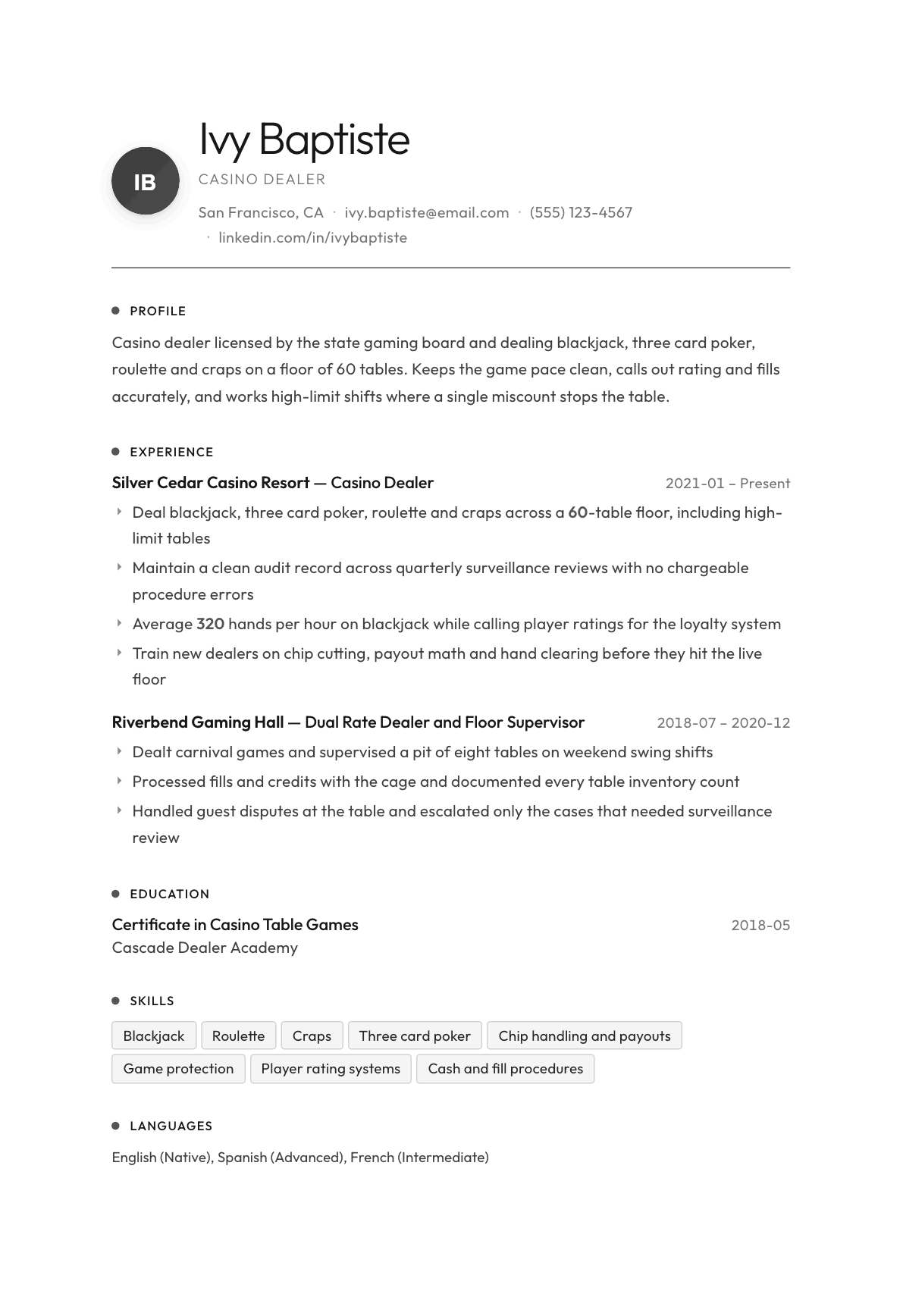
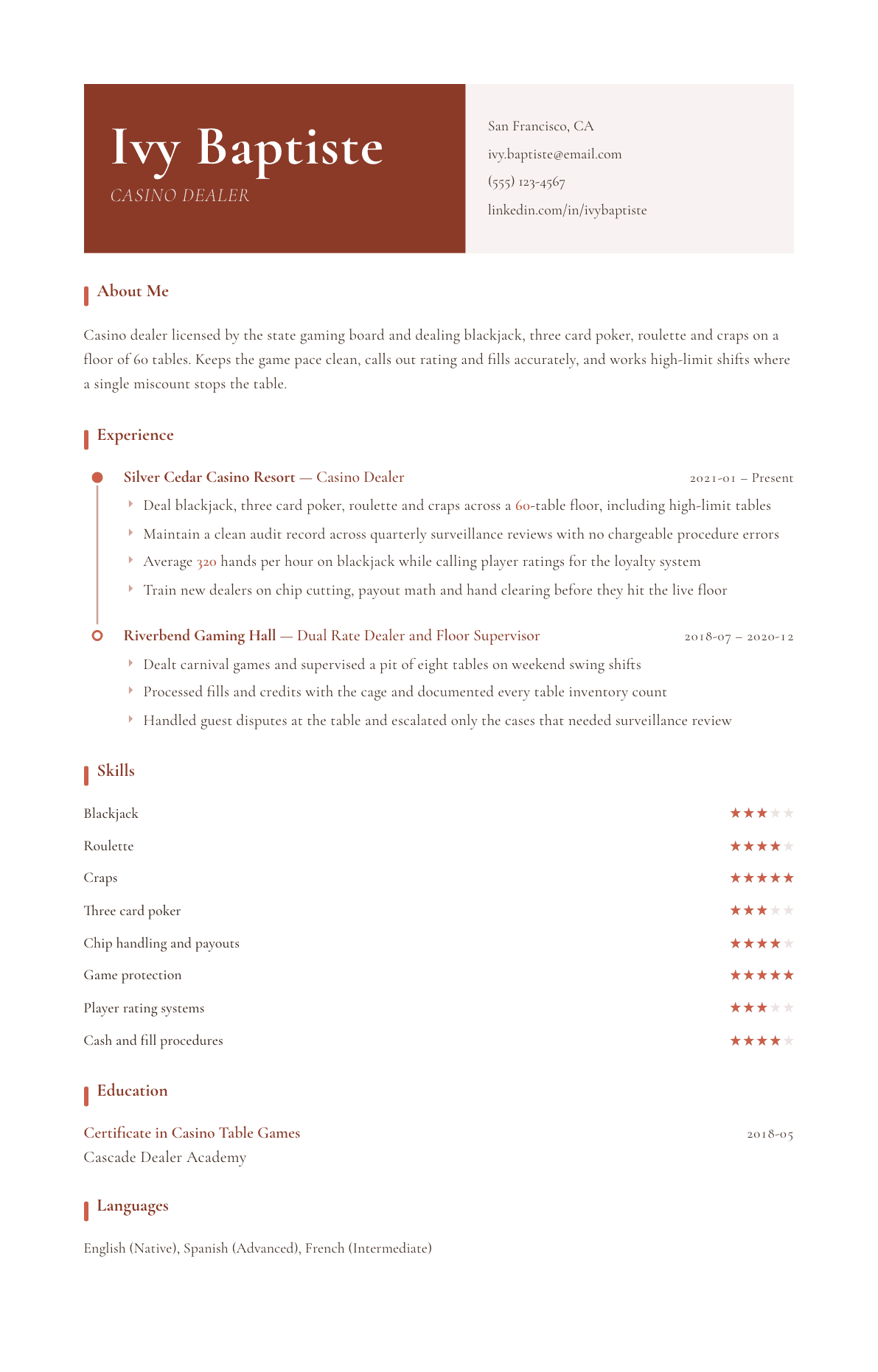
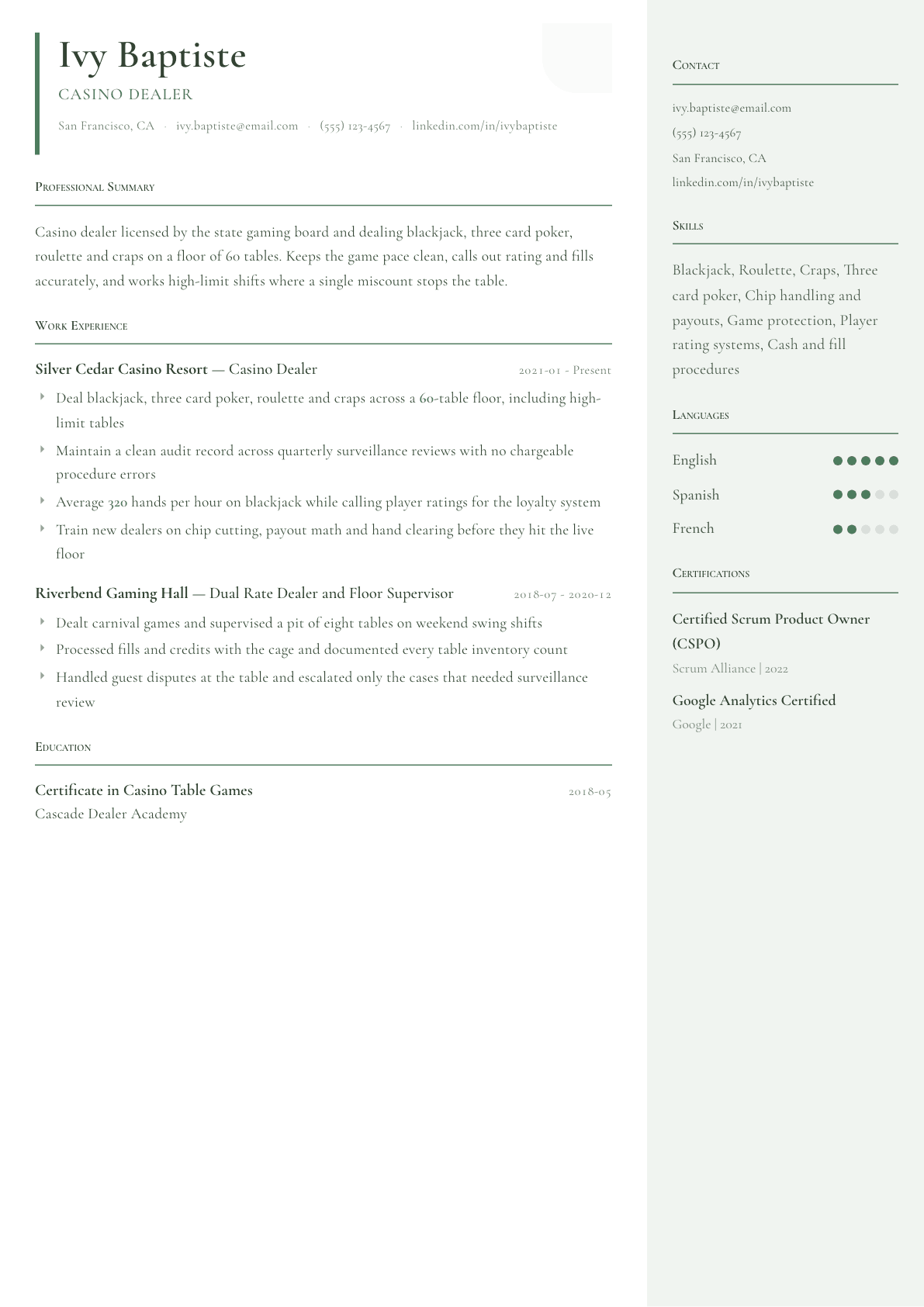
Example Casino Dealer summary
Licensed casino dealer with five years on a large table games floor, dealing blackjack, roulette, craps and carnival games including high-limit assignments. Known for accurate payouts under pressure, clean surveillance reviews and a table that stays pleasant through a long losing shoe. Seeking a dealer or dual rate role at a full-service gaming property.
Skills to list on a Casino Dealer resume
- Blackjack
- Roulette
- Craps
- Baccarat
- Three card poker
- Pai gow poker
- Chip cutting and payouts
- Payout math
- Game protection
- Table inventory counts
- Fills and credits
- Player rating systems
- Gaming regulations
- Guest service at the table
- Dealer training
What actually gets this resume read
- List every game you can deal by name, because the pit schedules from that list before it reads anything else.
- State your gaming license, the issuing board and its status, since no property can schedule you without it.
- Mention high-limit or dual rate experience if you have it, as that decides which shifts you are offered.
- Show game protection work: hand clearing, chip counts, and how you spotted or reported irregular play.
- Include your hands per hour or table pace if you tracked it, because pace drives table revenue.
- Note customer service on the box, since a dealer who keeps a losing table friendly gets kept on the floor.
How to write a casino dealer resume
A casino dealer resume is screened against a schedule. The table games manager building next month's roster needs to know which games you can deal, whether you can be put on a high-limit box, and whether your gaming license is current with the board that regulates her property. Everything you write is read through that filter.
The second filter is trust. Table games is a regulated cash environment under constant surveillance, so a clean procedural record matters as much as pace. Accurate payouts, correct fills and credits, disciplined hand clearing and a documented history without chargeable errors carry real weight, and the interview will include a live audition anyway.
This guide covers the section order pits expect, how to present your game list and license so a scheduler can use them, three summaries across dealer career stages, before and after bullets that turn table duties into evidence of skill, and the questions dealers ask when they move between properties or jurisdictions.
Format: one page, games and license at the top
Keep it to one page in a plain single column. Put two short blocks directly under your contact details, before the experience section. The first is your game list. The second is your license: the issuing board, the type of card and its status.
Those two blocks are the resume as far as the pit is concerned. Everything below them is supporting evidence. A dealer who buries the game list in a paragraph makes the scheduler work, and schedulers under pressure move to the next file.
- Header: name, city and state, phone, email.
- Sections in this order: games dealt, license and credentials, casino experience, training, skills.
- Note dual rate or floor supervision experience directly in the games block if you hold it.
The game list is the most important thing on the page
List every game you can deal live, and be honest about the boundary. Blackjack, roulette, craps, baccarat, pai gow poker, three card poker, Mississippi Stud, Ultimate Texas Hold'em and the carnival games in your market are all schedulable skills, and craps in particular changes which shifts you get offered.
Where a game is trained but not yet dealt live, mark it that way. Pits find out within one down, and a dealer who overstated a game starts the job with a credibility problem that follows them through the audition and the probation period.
License, jurisdiction and portability
State the regulating board, your card type and its expiry. Tribal, state and county jurisdictions each issue their own, and a candidate who already holds a valid card in the property's jurisdiction can be scheduled far sooner than one who has to start the application from the beginning.
If you are moving jurisdictions, say that your application is in progress or that you are eligible to apply, and give the license history that supports it. Being upfront removes the main reason a hiring pit sets a promising file aside.
Experience: pace, protection and paperwork
Open each job with the property scale: number of tables, whether you worked high-limit, and which shifts. Then use bullets for the three things a pit boss cares about. Pace, expressed as hands or decisions per hour where you tracked it. Game protection, meaning hand clearing, chip counts, spotting irregular play and reporting it correctly. Paperwork, meaning fills, credits, table inventory counts and player rating entries.
Add customer service, but attach it to the table. A dealer who keeps a losing table friendly protects the drop far more than one who is simply pleasant, and that is the version of service the pit is actually buying.
Training, dual rate and the words postings use
Dealer school belongs on the resume with the games covered and the hours. Training you gave others belongs higher, because a dealer who can bring new hires up on chip cutting and payout math is worth keeping when the schedule tightens.
Mirror the terms postings use once each: table games, game protection, fills and credits, table inventory, player rating, dual rate, high limit, and the game names themselves. These are the phrases the applicant tracking system was configured with.
Casino Dealer resume summary examples
Dealer school graduate
Dealer school graduate trained on blackjack, three card poker and roulette across 240 classroom hours, with a state gaming card application in progress. Six years of cash handling and guest service in high-volume hospitality. Seeking an entry dealer position with a property that develops new games in house.
Four years on the box
Licensed casino dealer with four years on a 60-table floor dealing blackjack, three card poker, roulette and craps, including high-limit assignments. Averages 320 hands per hour on blackjack, calls player ratings accurately, and has passed every quarterly surveillance review without a chargeable procedure error.
Dual rate dealer and supervisor
Dual rate dealer and floor supervisor with nine years across two properties, dealing the full carnival lineup plus craps and baccarat while supervising a pit of eight tables on weekends. Handles fills, credits and inventory counts with the cage and trains new dealers before their live audition.
Work experience bullets: before and after
Before: Dealt various table games to casino guests.
After: Dealt blackjack, three card poker, roulette and craps across a 60-table floor, including high-limit tables on weekend swing shifts.
Named games plus the floor size and high-limit assignment tell a scheduler exactly where you can be placed.
Before: Followed casino procedures at all times.
After: Maintained a clean audit record across quarterly surveillance reviews with no chargeable procedure errors on hand clearing, chip counts or payouts.
A verifiable review outcome is evidence; following procedures is an assumption every applicant makes.
Before: Handled chips and paid out winning bets.
After: Cut and paid at a pace near 320 hands per hour on blackjack while keeping payout accuracy through split, double and insurance decisions.
Pace with accuracy attached is the actual measure of a dealer, and the two together are what the audition tests.
Before: Worked with the cage on table paperwork.
After: Processed fills and credits with the cage and documented every table inventory count at opener and closer without an unreconciled variance.
The paperwork chain and the clean variance record are what a pit boss checks before trusting a new dealer.
Before: Provided good customer service at the table.
After: Kept a losing table engaged through long shoes by managing pace and conversation, and resolved disputes at the box rather than escalating to the floor.
It shows the specific service behavior that protects the game instead of a generic friendliness claim.
Hard skills
- Blackjack
- Craps
- Roulette
- Baccarat
- Three card poker
- Pai gow poker
- Chip cutting and payout math
- Game protection and hand clearing
- Table inventory counts
- Fills and credits
- Player rating systems
- Gaming regulation compliance
Soft skills
- Composure under a losing table
- Focus across a long down
- Dispute de-escalation
- Clear table communication
- Attention to procedure
- Teaching new dealers
Mistakes that cost casino dealer candidates the interview
- Writing table games instead of naming every game, which leaves a scheduler unable to place you.
- Omitting the gaming license, the issuing board and its status, which is the first thing verified.
- Listing a game you trained on as one you deal live, since one down on the floor exposes it.
- Leaving out craps when you can deal it, because it is the game that opens the best shifts.
- Ignoring the paperwork side, which is where a pit boss decides whether you can be trusted alone.
- Filling the page with hospitality language while the games and license blocks sit at the bottom.
Casino Dealer resume questions
How do I get hired as a dealer with no casino experience?
Lead with dealer school, the games covered and the hours, then show cash handling and guest service from any high-volume job. Many properties run their own dealer development classes, so apply directly to those and say in the summary that you are seeking an in-house program.
Should I list my gaming license on a resume?
Yes, near the top with the issuing board, the card type and the expiry. Properties cannot schedule an unlicensed dealer, so a current card in their jurisdiction is often the difference between an audition this week and a file that waits months.
How do I show hands per hour if my property never tracked it?
Skip the number and describe pace another way. Say which games you dealt at high limit, whether you were placed on the busiest tables, and whether you were used to break in new dealers, since all three signal that supervisors trusted your speed.
What does dual rate mean on a dealer resume?
It means you deal on some shifts and supervise a pit on others. Say so explicitly and give the pit size you covered, because dual rate experience is the recognized path to a floor supervisor role and properties promote from that pool first.
How should I handle moving to a different gaming jurisdiction?
Say where you are licensed now, that the new application is in progress or that you are eligible to apply, and give your clean regulatory history. Hiring pits set aside files that leave licensing status unclear, so answering it in the header removes the doubt.
Related resume examples
- Bartender Resume example
- Concierge Resume example
- Valet Attendant Resume example
- Guest Services Manager Resume example
- Restaurant Supervisor Resume example
- Waiter Resume example