Waiter Resume Examples: what a hiring manager reads first
Resume for a Waiter at a Restaurant, With Samples and a UK CV
By Mustafa Tarabya, founder of CVBooster · Published · Updated
Resume for a waiter at a restaurant: a restaurant waiter resume sample for three rooms, plus a UK waiter CV form laid out section by section.
Sample resumes for a waiter
The same waiter content laid out in three CVBooster templates, so you can see what the finished document looks like before you write a word.
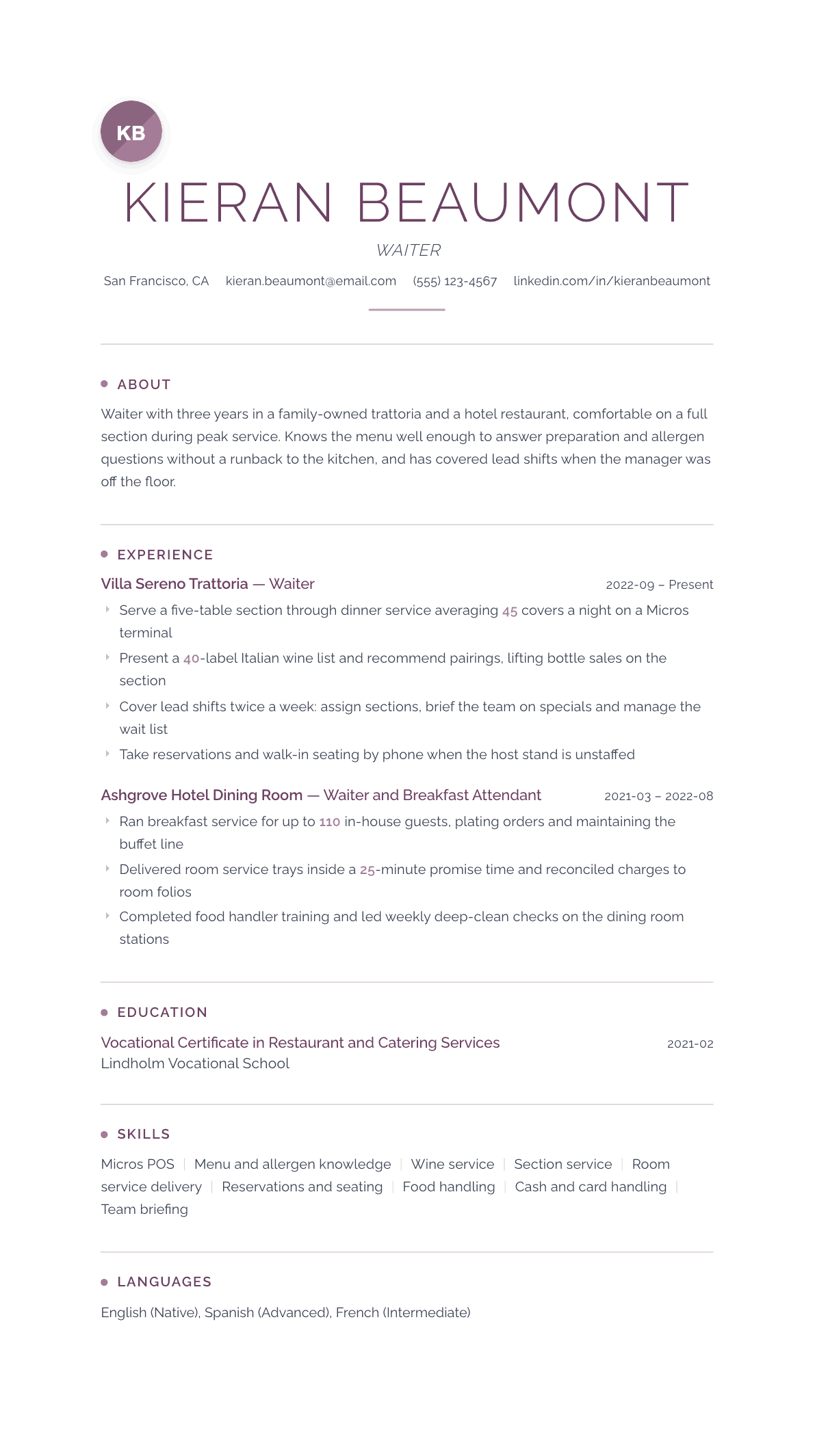
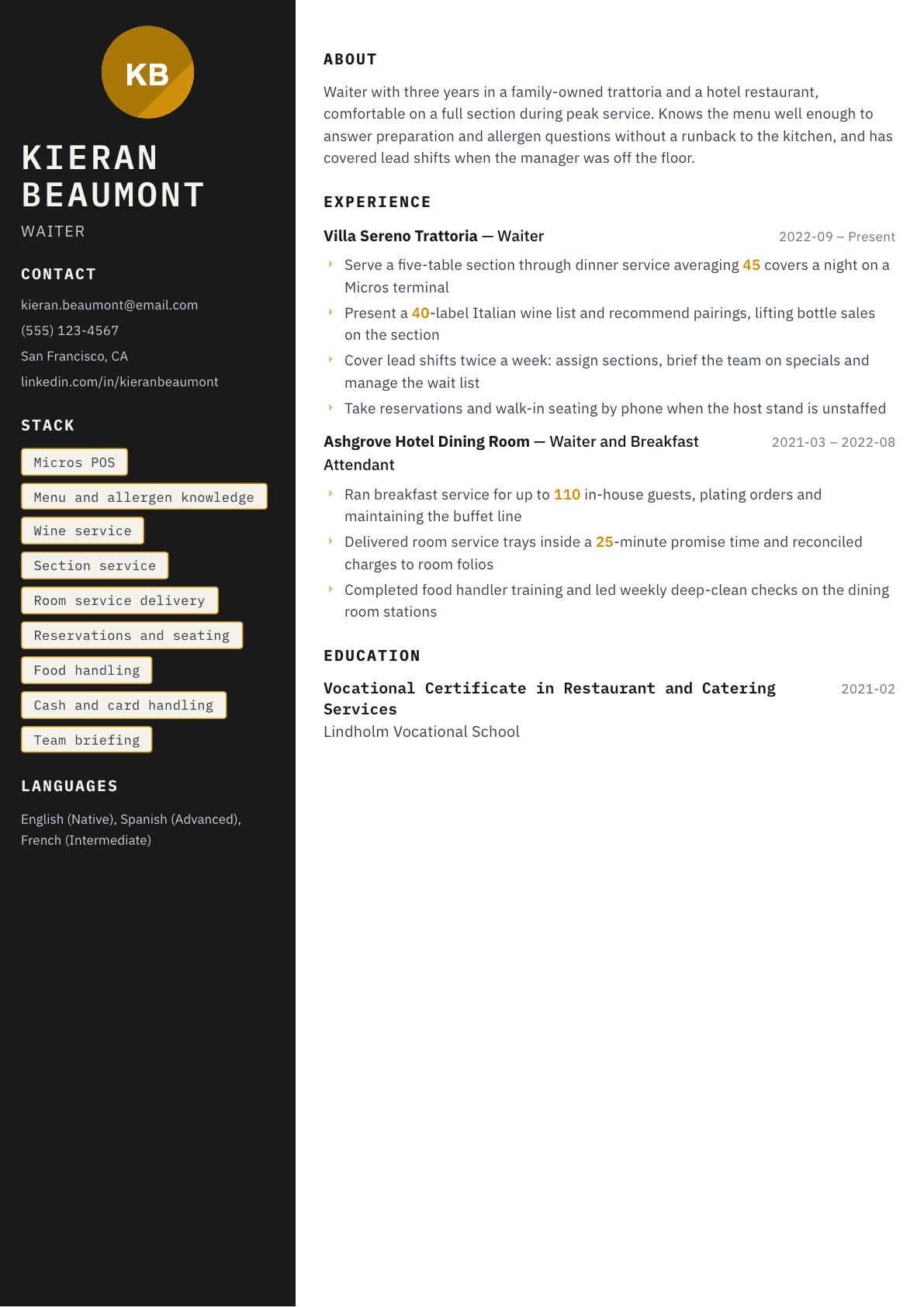
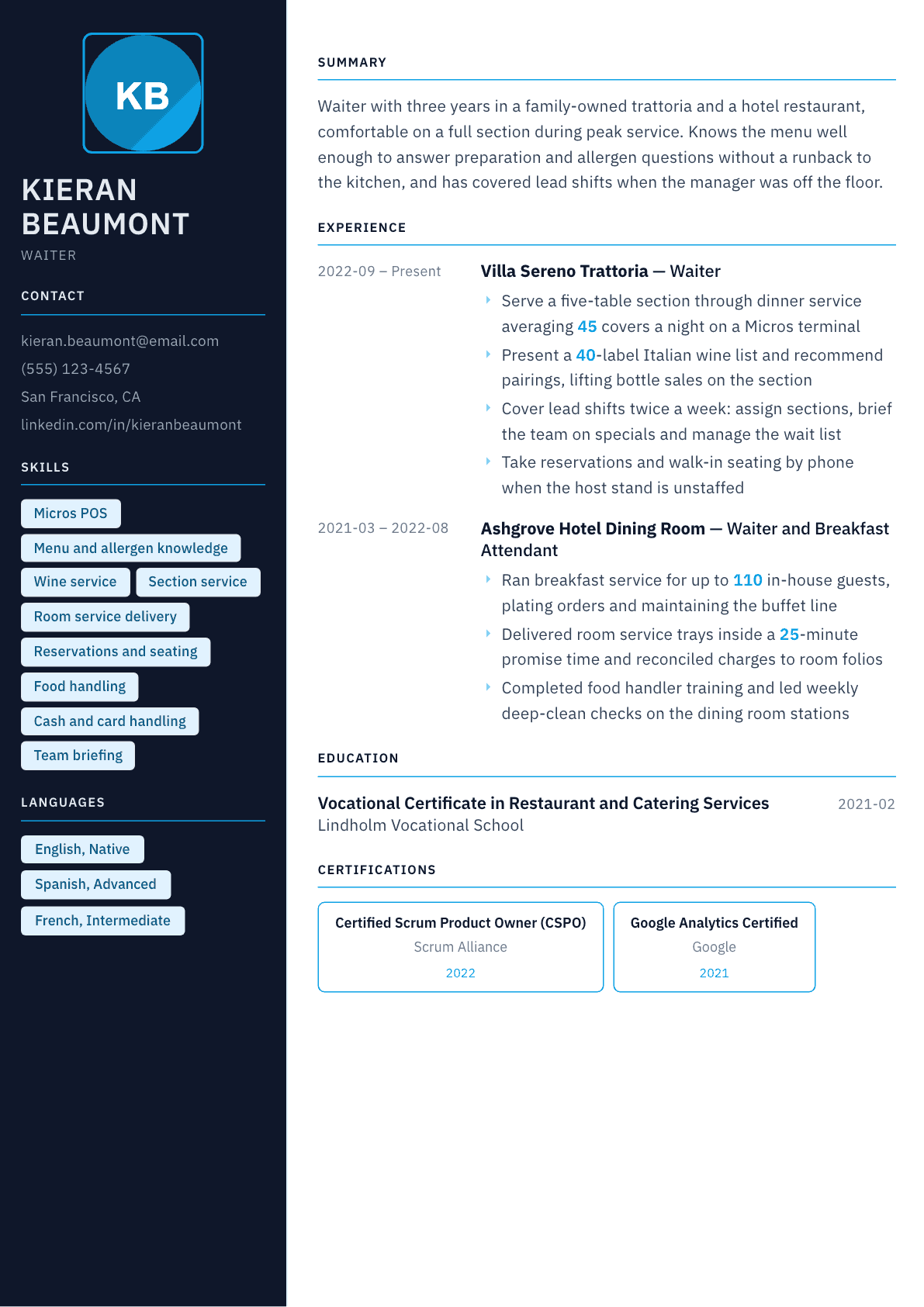
Example Waiter summary
Waiter with three years across a family-owned trattoria and a hotel dining room, serving a five-table section through 45-cover dinner services on Micros. Presents a 40-label wine list with confident pairing recommendations, covers lead shifts twice a week including section assignment and specials briefings, and holds current food handler training. Serves in English, Russian and conversational Italian.
Skills to list on a Waiter resume
- Table service
- Micros POS
- Toast POS
- Menu knowledge
- Wine and beverage service
- Allergen awareness
- Order taking accuracy
- Upselling specials
- Room service
- Reservations and seating
- Cash and card handling
- Food hygiene
- Multilingual service
- Closing duties
What actually gets this resume read
- Say what kind of restaurant you worked in and how many covers a night, because a trattoria section is nothing like a hotel breakfast floor.
- Prove menu knowledge with a detail, such as the number of wine labels you presented or the allergen questions you answered on the floor.
- Include any lead or key-holder shifts you covered, since a waiter who can run the floor without a manager is worth more on the schedule.
- List the languages you serve in, because tourist-heavy venues hire on that alone when the rest of the resume is comparable.
- Mention food handler or hygiene certification with the issuing body, as it removes an onboarding step for the hiring manager.
- Keep the resume to one page and put the restaurant names, service style and dates where the reader sees them without scrolling.
How to write a waiter resume
A waiter resume works hardest when it tells the reader what kind of room you came from. A family trattoria, a hotel dining room, a gastropub and a bistro with a printed wine list all demand different pacing, different menu knowledge and different guest expectations, and the owner or restaurant manager reading your resume is matching you to their room. Leave the concept out and you force them to guess, and guessing usually ends with the next application.
The second thing that gets a waiter hired above an equally experienced candidate is proof of menu and beverage command. Not "excellent menu knowledge", which anyone can type, but a detail that only someone who worked the floor would think to include: the number of labels on the list you presented, the preparations you could describe without a runback to the kitchen, or the languages you could take a table in on a tourist-heavy night.
This guide covers the resume in the order a restaurant owner reads it, how to write a CV as a waiter or waitress for UK restaurants, with restaurant waiter resume sample lines for four kinds of room, example summaries for a first floor job, a three-year waiter and someone covering lead shifts, before-and-after bullets from real table service, and the questions waiters ask when writing.
Format: one clean page, concept and dates easy to find
One page, reverse chronological, single column. Many venues still print applications and pass them across the pass, so keep the type readable and the restaurant names, concepts and dates on the left where the eye lands first.
Under the contact line, write a short strip that answers the schedule question: languages you serve in, food hygiene training, alcohol service certification where you have it, the terminal you know, and your availability including split shifts.
- Header: name, city, phone, email, languages with an honest level for each.
- Sections in this order: summary, credentials and systems, experience, education, skills.
- A first floor job leads with any kitchen, bussing, barista or catering work and describes it in covers.
Summary: concept, section, covers, and what you know cold
Three lines that a reader can picture. Name the restaurant type and cuisine, give the section size and the covers per service, then say what you know without a script: the menu preparations, the wine list, the allergen answers. Close with the languages you can serve in if the venue draws visitors.
If you are moving from a casual room to a more formal one, say so and name the bridge: wine service you have already done, a course sequence you have already run, or a lead shift you have already covered. A hiring manager will not assume the step up on your behalf.
Experience: the room, the service, and the shifts you ran alone
Head each job with the venue, the cuisine or concept, the seat count and the services you worked, whether breakfast, lunch, dinner or all three. A line such as "Waiter, 70-seat family-owned trattoria, dinner service six nights" carries more weight than any adjective, because it fixes the pace in the reader's mind.
Then three to five bullets. Start with section size and covers. Follow with the beverage bullet, which is where the money is: the size of the wine list you presented, the pairings you recommended, the bottle sales you moved. Then a bullet on any responsibility beyond your own tables: lead shifts, section assignment, briefing the team on specials, taking phone reservations when the host stand was unstaffed, running room service or a breakfast buffet.
Leave out the line about providing friendly service to guests. It fills a row, proves nothing, and any owner reading it has already seen it twenty times that week.
A resume for a waiter at a restaurant should read like it was written for that restaurant. Before you send it, look at the menu, the seat count and the service style of the place you are applying to, then reorder your bullets so the closest match sits first. The restaurant waiter resume sample lines below show how the same three years read for four different rooms.
- Casual dining: Served a six-table section through lunch and dinner in a 120-seat family restaurant, turning tables on a 45-minute target and running a Toast terminal.
- Fine dining: Served a four-course tasting menu to a three-table section, followed the course timing set by the kitchen, and poured wine pairings at the table.
- Hotel restaurant: Covered breakfast and dinner in a hotel dining room, charged meals to room folios and handled guest requests in English and Spanish.
- Busy brunch or chain venue: Took weekend brunch orders for up to 30 tables a shift with a handheld terminal, kept allergen notes on every ticket and closed out the cash drawer.
Menu, wine and allergen command: prove it with a detail
The single most persuasive thing a waiter can put on a resume is a fact that only someone who really learned the menu would know to mention. A list with a stated number of labels. A tasting note you gave without a card. Regional dishes you could explain to a guest who had never eaten that cuisine. The specific allergens you were trained to handle and where in the service you flagged them.
Do the same for the drinks side. Say whether you opened and poured bottles at the table, whether you served by the glass from a rotating list, and whether you handled coffee, digestif or dessert wine service at the end of the meal. Those steps are the ones that lift an average check and are the fastest way to look like a floor hire rather than a tray carrier.
- Cuisine and menu type, plus any regional or seasonal menu changes you learned.
- Wine list size and whether you presented, poured or paired from it.
- Allergen protocol and the point in service where you flagged it.
- Point of sale terminal by name: Micros, Toast, Lightspeed or another.
- Reservations, seating and phone work when the host stand was unmanned.
Waiter skills for a resume: credentials, languages and keywords
The waiter skills a resume should list are the ones a manager can test on a trial shift, so write them as one short skills line with detail, not as single words. Written out for an invented server, Tomas Reyes: "Skills: fine dining table service and full sequence of service, six table section, Toast and Micros point of sale, wine service and decanting, allergen and dietary menu knowledge, cash handling and closing duties, conversational Spanish." Each item there is something you could prove on the floor within an hour.
Food hygiene or food handler training with the issuing body removes an onboarding step and belongs near the top. Add alcohol service certification where your state or venue requires it. If you trained through a vocational restaurant and catering course, list it, because in many kitchens that qualification carries real weight with an owner who trained the same way.
For keywords, mirror what restaurant listings ask for: table service, section, covers, menu knowledge, wine service, allergen awareness, order accuracy, upselling specials, cash and card handling, closing duties. Place each one where a bullet supports it, and let the credentials strip carry the rest.
CV as a waiter or waitress in the UK, and the waiter CV form
In the UK the same document is called a CV, and a CV as a waiter or a CV as a waitress follows the same order as this resume: a short profile, then each venue with its concept, covers and services, then training. The UK version adds a line on your right to work, leaves out any photo, date of birth or marital status, and keeps to one page unless you have run a floor or a section for years.
British restaurant managers look for the Level 2 Food Hygiene certificate, allergen awareness training and, for bar shifts, the age verification policy you worked under. Write covers per service, the till or reservation system by name, and whether you worked split shifts, because those are the words a UK listing uses and the questions a manager will ask on the phone.
A waiter CV form is simply this layout filled in from top to bottom: name and contact line, a three line profile, a training strip, then each venue with its dates, covers and services, then education. Some chains and hotel groups ask you to fill in their own application form instead of sending a CV. Copy the same venue lines, covers and certificates into its boxes, and keep your CV ready for the interview, because the manager will often ask for one anyway.
- Profile for a first CV as a waitress: Reliable student with weekend kitchen porter and cafe experience, Level 2 Food Hygiene certificate, available evenings and split shifts, looking for a first front of house role in a busy brasserie.
- Experienced waiter profile: Waiter in a 90 cover gastropub, running a six table section on Friday and Saturday dinner, confident with the full allergen matrix, wine by the glass and card payments at the table.
- Experience line: Waiter, independent Italian restaurant, 60 covers, lunch and dinner, five shifts a week including split shifts.
- Training strip: Level 2 Food Hygiene and Safety, allergen awareness, first aid at work, right to work in the UK.
Waiter resume summary examples
First floor job
Vocational restaurant services graduate with a season of runner and busser work in a 60-seat bistro, moving to a full section. Knows the menu preparations and allergen list, comfortable on a Micros terminal, and holds current food handler training. Serves in English and Russian, available evenings and weekends.
Three years in
Waiter with three years across a family-owned trattoria and a hotel dining room, serving a five-table section through 45-cover dinner services on Micros. Presents a 40-label Italian wine list with confident pairing recommendations, answers preparation and allergen questions without leaving the floor, and holds current food handler training.
Lead shift waiter
Senior waiter with seven years in independent restaurants and hotel dining, covering lead shifts twice a week: section assignment, specials briefing and wait list management. Runs the largest station on the floor, trains new starters on the wine list, and serves in English, Russian and conversational Italian.
Work experience bullets: before and after
Before: Waited tables in an Italian restaurant.
After: Served a five-table section through dinner service averaging 45 covers a night in a 70-seat family-owned trattoria, working a Micros terminal.
Section size, covers, room size and the terminal give a picture of the pace instead of naming a cuisine.
Before: Recommended wine to customers.
After: Presented a 40-label Italian wine list, recommended pairings against the guest's entree choice, and lifted bottle sales on the section over two seasons.
A list size and a pairing method prove beverage command, which is where an average check is won.
Before: Sometimes ran the floor when the manager was away.
After: Covered lead shifts twice a week: assigned sections, briefed the team on specials and eighty-sixed items, and managed the wait list through the second seating.
Naming the three lead duties and their frequency shows real responsibility rather than an occasional favor.
Before: Worked hotel breakfast service.
After: Ran breakfast service for up to 110 in-house guests, plating cooked orders to ticket and holding the buffet line to temperature and presentation standards.
Guest count plus the two distinct service tasks show a real hotel dining workload rather than a shift label.
Before: Delivered room service orders.
After: Delivered room service trays inside a 25-minute promise time and reconciled every charge to the correct room folio before the end of shift.
The promise time and the folio reconciliation show speed and accuracy, which is exactly what hotel dining tracks.
Hard skills
- Table service and sequence
- Micros point of sale
- Toast point of sale
- Menu and preparation knowledge
- Wine and beverage service
- Allergen awareness
- Order taking accuracy
- Upselling specials
- Room service and folio charging
- Reservations and seating
- Cash and card handling
- Food hygiene and station cleaning
- Multilingual guest service
Soft skills
- Menu recall under pressure
- Reading the pace of a table
- Calm handoff between sections
- Briefing a team clearly
- Discretion with regular guests
- Reliability on split shifts
Certifications worth listing
- ServSafe Food Handler (National Restaurant Association)
- ServSafe Alcohol (National Restaurant Association)
- TIPS Alcohol Certification (Health Communications, Inc.)
- Level 1 Award in Wines (Wine & Spirit Education Trust)
Mistakes that cost waiter candidates the interview
- Naming the restaurant but never the concept or seat count, so the reader cannot tell a bistro section from a hotel breakfast floor.
- Claiming excellent menu knowledge without a single detail that proves you learned a specific menu.
- Listing every language as fluent when the first phone screen in that language will settle the question in a minute.
- Leaving lead shift work out because it was not a formal title, when it is the strongest promotion evidence on the page.
- Ignoring food hygiene training, which is a paperwork step a manager would rather not repeat for a new starter.
- Running to two pages by writing full bullet sets for jobs held years ago instead of condensing them to a line each.
Waiter resume questions
What is the difference between a waiter resume and a server resume?
They describe the same work under different regional habits. Use whichever word the posting uses in your title line, and keep the substance identical: concept, section size, covers, beverage command, allergen handling and closing duties.
Should I list the wine list I worked with?
Yes, with its size and your role in serving it. A waiter who presented a forty-label list, poured at the table and recommended pairings is a different hire from one who read drink orders into a terminal, and the resume should make that visible.
How do I get a waiter job in a nicer restaurant?
Lead with the parts of your current job closest to the target room: wine service, coursed pacing, tableside work, allergen protocol and lead shifts. Then name any formal training or wine study, since upscale rooms hire on evidence of learning rather than on years alone.
What should a resume for a waiter at a restaurant include?
A short summary with the restaurant type you know, each job headed by the venue, its seat count and the services you worked, three to five bullets on covers, wine and allergen work, then food handler training and your availability. A restaurant waiter resume sample is a guide to that order, not text to copy, so swap in your own numbers and the terminal you used.
How do I write a CV as a waitress with no experience?
Lead with a short profile that names your availability, then list any work where you served or looked after people: cafe shifts, kitchen porter work, events, retail or volunteering. Add a food hygiene certificate if you can get one before you apply, and keep the whole CV to one clear page.
Related resume examples
- Bartender Resume example
- Restaurant Manager Resume example
- Server Resume example
- Busser Resume example
- Fine Dining Server Resume example
- Casino Dealer Resume example