Bartender Resume Examples: free ATS score and gap list
Bartending Resume Examples for Bartenders, Barmaids and Barbacks
By Mustafa Tarabya, founder of CVBooster · Published · Updated
Bartending resume examples for bartenders, barmaids and barbacks, with sample summaries, volume and pour cost bullets, and the certifications bars check.
Sample resumes for a bartender
The same bartender content laid out in three CVBooster templates, so you can see what the finished document looks like before you write a word.
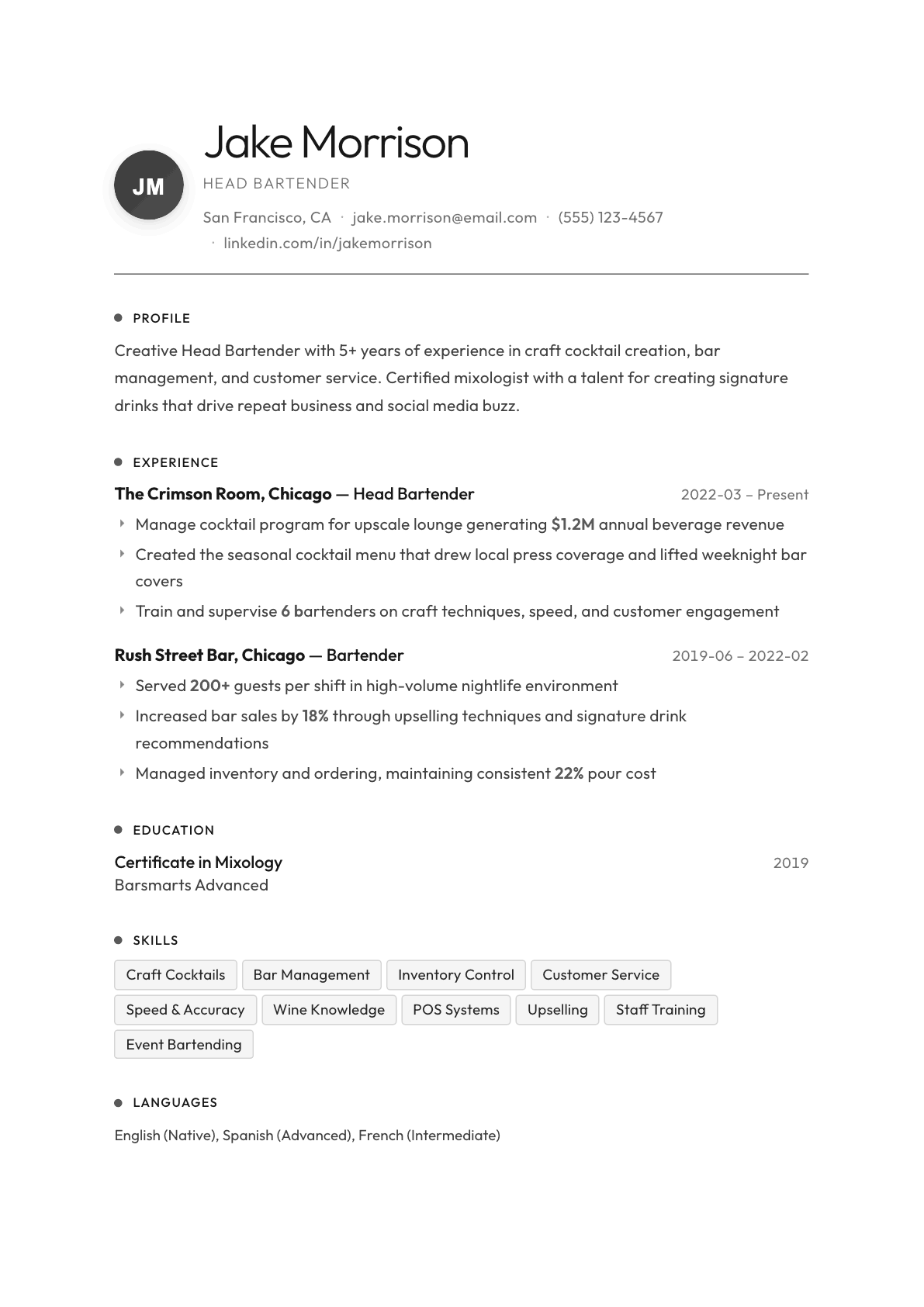
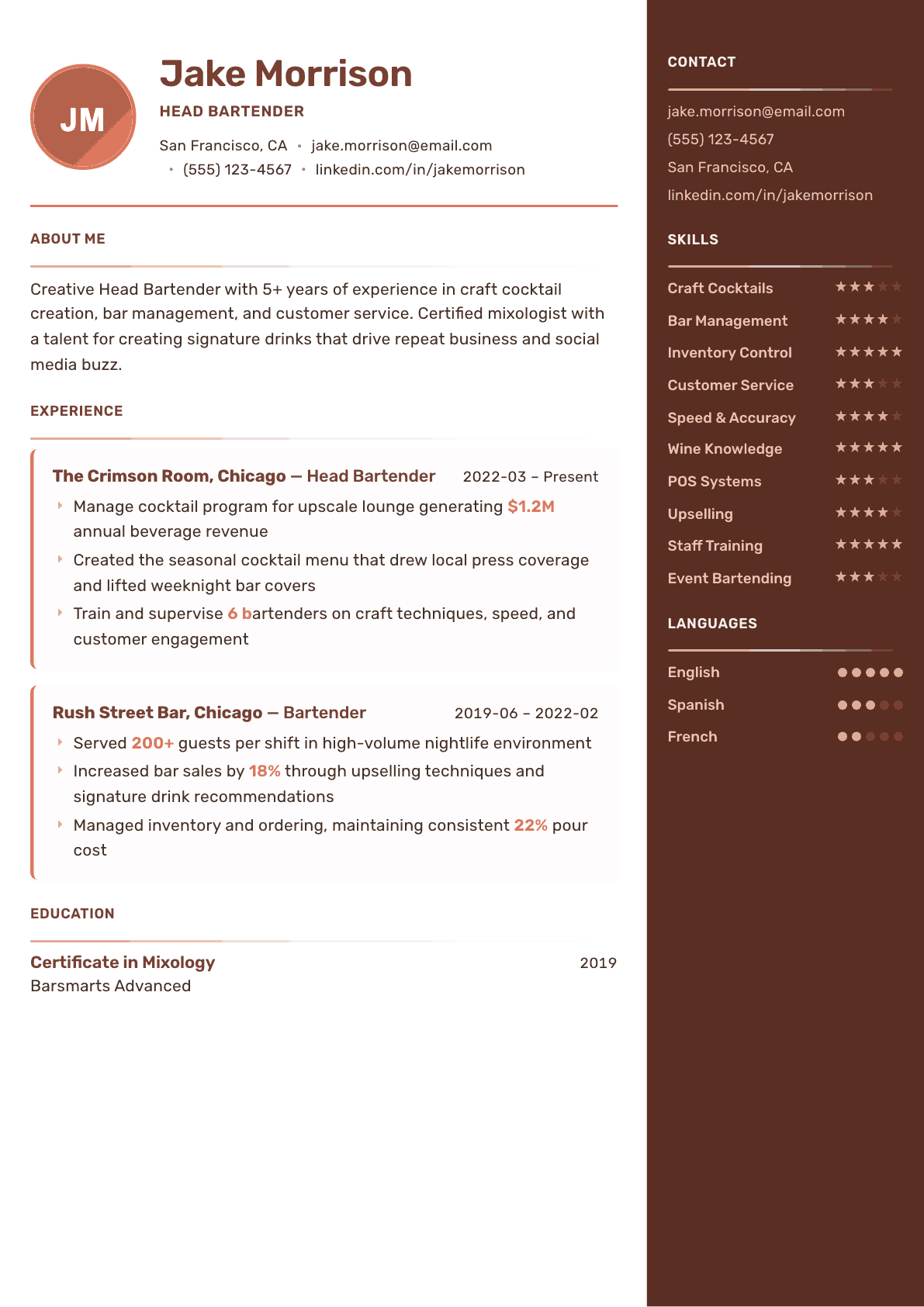
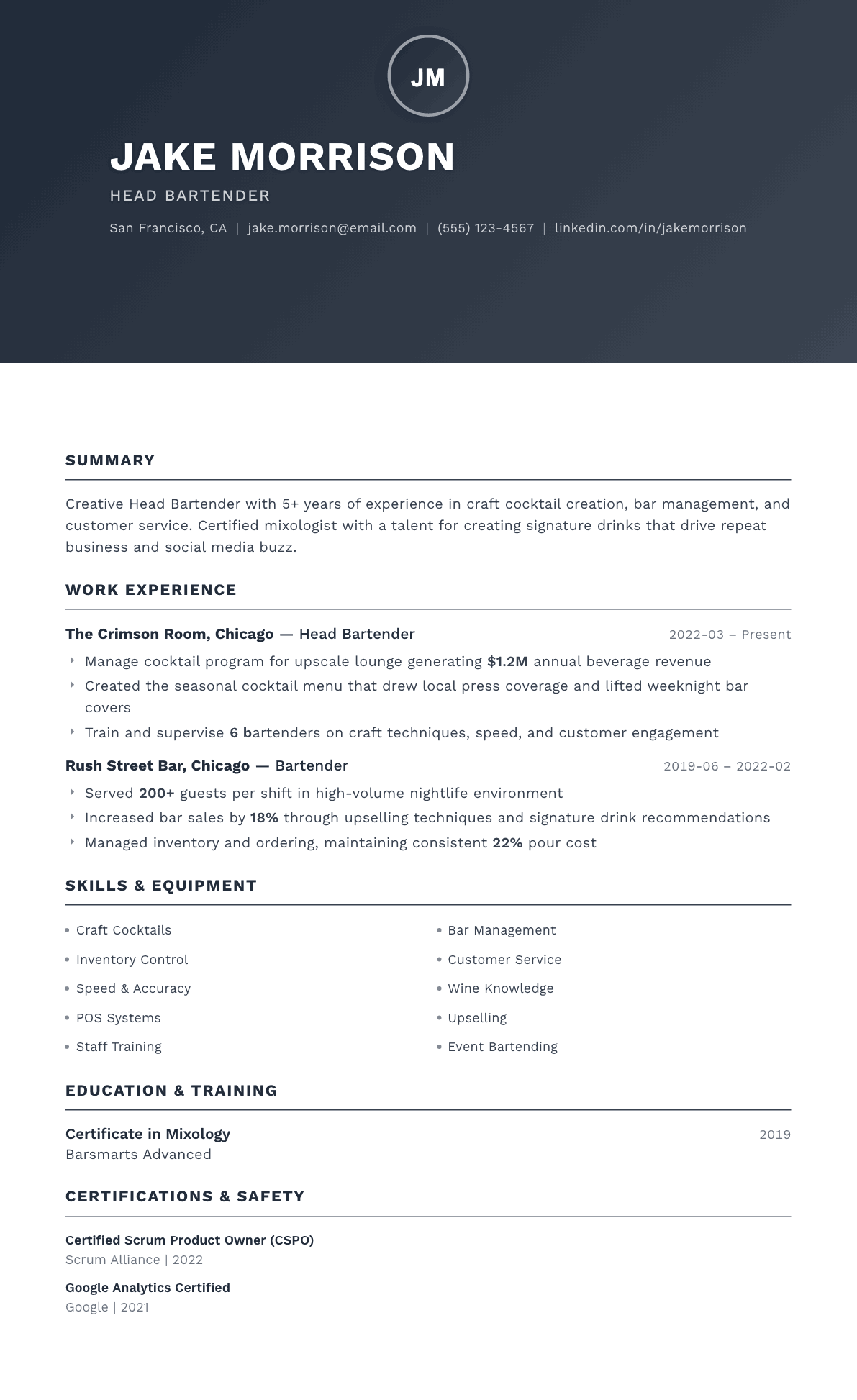
Example Bartender summary
Head bartender, 5 years, running a cocktail program worth $1.2M in annual beverage revenue and training six bartenders on it. Holds pour cost at 22%, writes the seasonal menu, and came up through high-volume service at 200 guests a shift.
Skills to list on a Bartender resume
- Craft Cocktails
- Bar Management
- Inventory Control
- Customer Service
- Speed & Accuracy
- Wine Knowledge
- POS Systems
- Upselling
- Staff Training
- Event Bartending
What actually gets this resume read
- Highlight revenue contributions and sales growth.
- Include cocktail competition wins or press features.
- Show inventory management and cost control skills.
- List certifications (TIPS, ServSafe, Cicerone).
- Mention any signature cocktails or menu development.
How to write a bartender resume
A bartender resume is screened by a bar manager or a general manager who is trying to work out what kind of bar you came from, because the word bartender covers wildly different jobs. A high volume nightclub well, a hotel lobby bar, a neighborhood tavern with a beer and shot crowd, and a cocktail bar with a 40-item spec book all use the same title and hire for opposite skills.
The manager reading you has two concerns behind that. First, speed and accuracy: can you build a round of eight drinks in order without a ticket dying on the rail. Second, money: pour cost, ringing every drink, comps and voids, and not becoming a liability at closing time. A resume that never touches volume, pour cost or alcohol certification is asking the manager to guess about both.
This guide covers the sections in the order a bar manager reads them, with example summaries for a barback moving up, a working bartender and a bar manager, before and after bullets, and the questions bartenders ask when they move between service styles or want their first head bartender job. The same advice covers a barmaid resume, a barman resume and a bartending resume for a first job: the bar manager reads for the same speed, money and certification evidence whatever the title.
Format: one page, availability and certification on top
One page unless you have a decade behind multiple programs. Reverse chronological, plain type, printable. Put your alcohol service certification and your availability in the header, because a bar cannot legally schedule you without the first and cannot build a rota without the second.
Describe each venue in a short line before the bullets: type, seat and standing capacity, service style, and average nightly covers or checks. Cocktail bar with 60 seats, 12-item seasonal menu, roughly 250 checks a night is a sentence a manager can price your experience against.
Bartending resume sample, the top third written out for a pub in Toronto: Chloe Tremblay, Bartender, Toronto, Ontario. Smart Serve certified, food handler certificate, available evenings and weekends. Summary: Bartender with three years behind a busy pub bar, pouring draft, building classic cocktails and closing out cash alone on weeknights. Experience: Bartender, The Lantern Room, a pub with a long draft list and a summer patio; builds rounds for a full patio from the service well, changes kegs mid service, and counts the bar at close against the sales report. In British Columbia the certification line reads Serving It Right instead.
- Header: name, city, phone, email, alcohol certification and expiry, availability including closing shifts.
- Order: summary, experience, bar skills, certifications, education or training.
- Note whether you worked service bar, well, or a guest-facing cocktail station in each job.
Summary: venue type, volume, program depth, and money
Three lines. Give the venue type, the drink volume at peak, the depth of the program you worked, and one commercial number such as pour cost or bar sales per shift. Managers hire against their own venue, so a candidate who says high volume well with 400 drinks a night and a candidate who says 30-cocktail spec book with batching and house syrups are answering two different job postings.
If you are changing service styles, name the transferable half. A nightclub bartender moving to a cocktail bar leads with speed, accuracy and inventory discipline and says openly that they want to build technique. A cocktail bartender moving to volume leads with the opposite.
Experience: speed, spec, inventory and the guest in front of you
Write bullets around what a bar manager measures. Drinks per hour at peak and how many bartenders were on the stick with you. Ring accuracy and void or comp rates. Pour cost by category and what you did to move it. Inventory counts, ordering, par levels and the frequency of the count. Waste from over-pours, broken glassware and spoiled prep.
Then the craft. Menu development and how many drinks you wrote. Batching, house syrups, infusions, clarifications and any prep program you built. Wine by the glass, draft system cleaning and line maintenance, and cocktail service standards such as ice program, glassware and garnish. If you have run a private event or a wedding bar off-site, say so, because event bartending is its own scheduling and setup skill.
Include the responsible service part explicitly. Checking identification, refusing service, managing an intoxicated guest, and calling a ride. Every bar manager has been burned, and a candidate who volunteers that they know how to cut someone off politely is answering a question the manager cannot legally ask outright.
Bar skills: the vocabulary that separates levels
Use the terms your target venue uses. Volume bars want free pour or jigger accuracy, speed rail organization, ticket sequencing, keg changes and register speed. Cocktail bars want dilution, agitation, stirring versus shaking judgment, house tinctures, carbonation, clarification, and knowing a spec book cold.
Name the systems: the point of sale you rang on, the inventory platform you counted in, and any reservation or table management system you worked alongside. Toast, Aloha, Micros, Square, BevSpot and Partender all appear on postings and each one saves a manager training time.
- State your pour method: jigger, free pour, or both, and which the venue required.
- List the spirits categories you know in depth rather than claiming all of them.
- Include draft system work: line cleaning schedule, keg changes, coupler types, gas pressure.
Certifications and formal training
Responsible alcohol service certification is the one credential that is close to universal, and in several states it is required by law before you can pour. Name the program and the expiry date, because managers check. Add a food handler card, which many jurisdictions require for anyone touching garnish and glassware.
Beyond that, real credentials exist and are worth listing when you hold them: the Cicerone program for beer, Wine and Spirit Education Trust levels for wine and spirits, and the Court of Master Sommeliers introductory course for wine service. Competition placements, guest shifts and brand ambassador work are worth a line each, because they show a bartender who is known outside their own bar.
Bartender resume summary examples
Barback moving up
Barback with 2 years at a 200-seat gastropub, stocking three stations through 400-check nights, changing kegs, running the ice and prepping garnish. Alcohol service certified and trained on well drinks and draft pours, now seeking a first bartending shift on a weekday service bar.
Four years behind the bar
Bartender with 4 years across a high volume tavern and a 60-seat cocktail bar, building 150 drinks an hour at peak and executing a 24-item seasonal spec book. Runs weekly inventory, holds liquor pour cost at 19%, and has written five house cocktails that stayed on the menu.
Bar manager
Bar manager for a restaurant group bar program, responsible for two bars, a team of nine bartenders and barbacks, and the full beverage purchase. Rewrote the cocktail menu twice a year, brought overall beverage cost down through batching and par discipline, and trained the group on responsible service.
Work experience bullets: before and after
Before: Made drinks and served customers at a busy bar.
After: Built 150 drinks an hour at Friday peak on a two-bartender stick, sequencing tickets by build time and keeping rail times under four minutes on a 400-check night.
Volume, staffing and ticket times let a manager judge your speed instead of taking your word for busy.
Before: Managed bar inventory.
After: Counted 220 bottles and 14 draft lines weekly in BevSpot, set par levels by day of week, and brought liquor pour cost from 24% to 19% over two quarters.
The count size, the tool and the movement in pour cost make this a commercial result rather than a chore.
Before: Created new cocktails for the menu.
After: Wrote 12 cocktails across two seasonal menus using batched bases and three house syrups, cutting average build time to under 90 seconds while keeping the drinks stirred to spec.
Tying creativity to build time shows you design for service, which is what a manager actually needs.
Before: Trained new bartenders on the bar.
After: Trained six new bartenders through a three-week progression from barback to service bar to guest-facing well, testing each on the spec book and on refusing service before a solo shift.
A structured progression with a test at the end reads as a program rather than a favor.
Before: Followed responsible alcohol service rules.
After: Carded every guest under an obvious age line, refused service and arranged rides on roughly one night in three, and kept the venue clear of incidents through two years of late closes.
Describing what responsible service looks like in practice reassures a manager on the liability question.
Hard skills
- High volume drink production
- Classic and craft cocktail specs
- Batching, syrups and infusions
- Jigger and free pour accuracy
- Draft system maintenance and keg changes
- Wine by the glass service
- Beer style knowledge
- Inventory counts and par levels
- Pour cost control
- Toast and Micros point of sale
- BevSpot and Partender inventory tools
- Responsible alcohol service
Soft skills
- Speed without sloppiness
- Reading a room
- Guest de-escalation
- Upselling without pressure
- Team communication across the bar
- Reliability on late closes
Certifications worth listing
- TIPS Alcohol Certification (Health Communications, Inc.)
- ServSafe Alcohol (National Restaurant Association)
- ServSafe Food Handler (National Restaurant Association)
- Certified Beer Server (Cicerone Level 1) (Cicerone Certification Program)
- WSET Level 2 Award in Wines (Wine & Spirit Education Trust)
- Introductory Sommelier Course (Court of Master Sommeliers, Americas)
Mistakes that cost bartender candidates the interview
- Using the word bartender with no venue type, so a manager cannot tell a nightclub well from a hotel lobby bar.
- Never mentioning pour cost or inventory, which are the two numbers a bar manager is accountable for.
- Leaving alcohol service certification off the header when many states require it before your first shift.
- Listing every spirit category as an expertise instead of naming the two or three you genuinely know deeply.
- Writing a craft-heavy resume for a volume job, or a speed-only resume for a cocktail program.
- Omitting availability for closing and weekend shifts, which is when the bar actually needs people.
Bartender resume questions
How do I write a bartender resume with no bartending experience?
Apply as a barback and write the resume for that job: stocking, ice, glassware, keg changes, garnish prep and speed on the floor. Add alcohol service certification and open weekend availability. Most bars promote from behind their own bar rather than hiring an untested stranger.
Should I put pour cost on a bartender resume?
Yes if you have owned or influenced it, and state the category. Liquor, beer and wine costs move differently. If you only executed someone else's program, describe the inventory counts and par work you did rather than claiming a cost number you did not control.
Should a barmaid resume say barmaid or bartender?
Use the word in the posting. Most bars in Canada and the United States advertise for a bartender, and applicant systems search for the posted title, so write Bartender as your target title and keep barmaid only where it was your actual title at a past employer. The duties, the numbers and the certification belong on the page either way.
How do I move from a high volume bar to a craft cocktail program?
Keep the speed and accuracy numbers, then show technique: any batching, syrups or classic specs you know, plus study you have done on your own. Managers hire fast hands and teach dilution far more often than the reverse, so ask for the training in your summary.
What certifications actually matter for bartenders?
Alcohol service certification first, since it is legally required in many places, then a food handler card. After that, Cicerone for beer and Wine and Spirit Education Trust levels for wine genuinely differentiate you at venues with a serious beverage list.
Related resume examples
- Restaurant Manager Resume example
- Chef Resume example
- Server Resume example
- Bar Manager Resume example
- Sommelier Resume example
- Barista Resume example