Brand Manager Resume Examples: free ATS score and gap list
Brand Management Resume Examples, from Brand Manager to Brand Director
By Mustafa Tarabya, founder of CVBooster · Published · Updated
Create a standout brand manager resume with brand strategy expertise, campaign results, and cross-functional leadership skills that attract top employers.
Sample resumes for a brand manager
The same brand manager content laid out in three CVBooster templates, so you can see what the finished document looks like before you write a word.
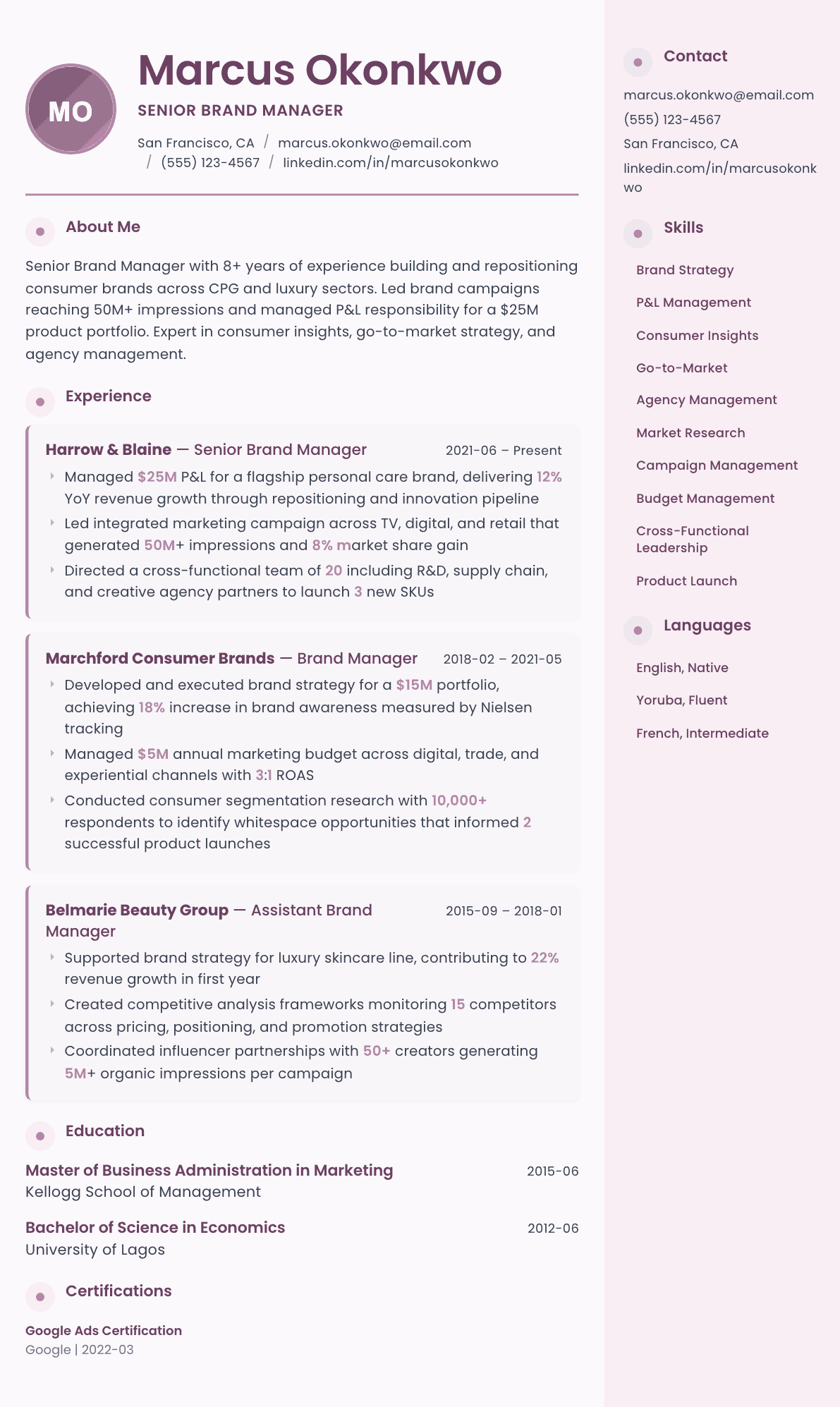
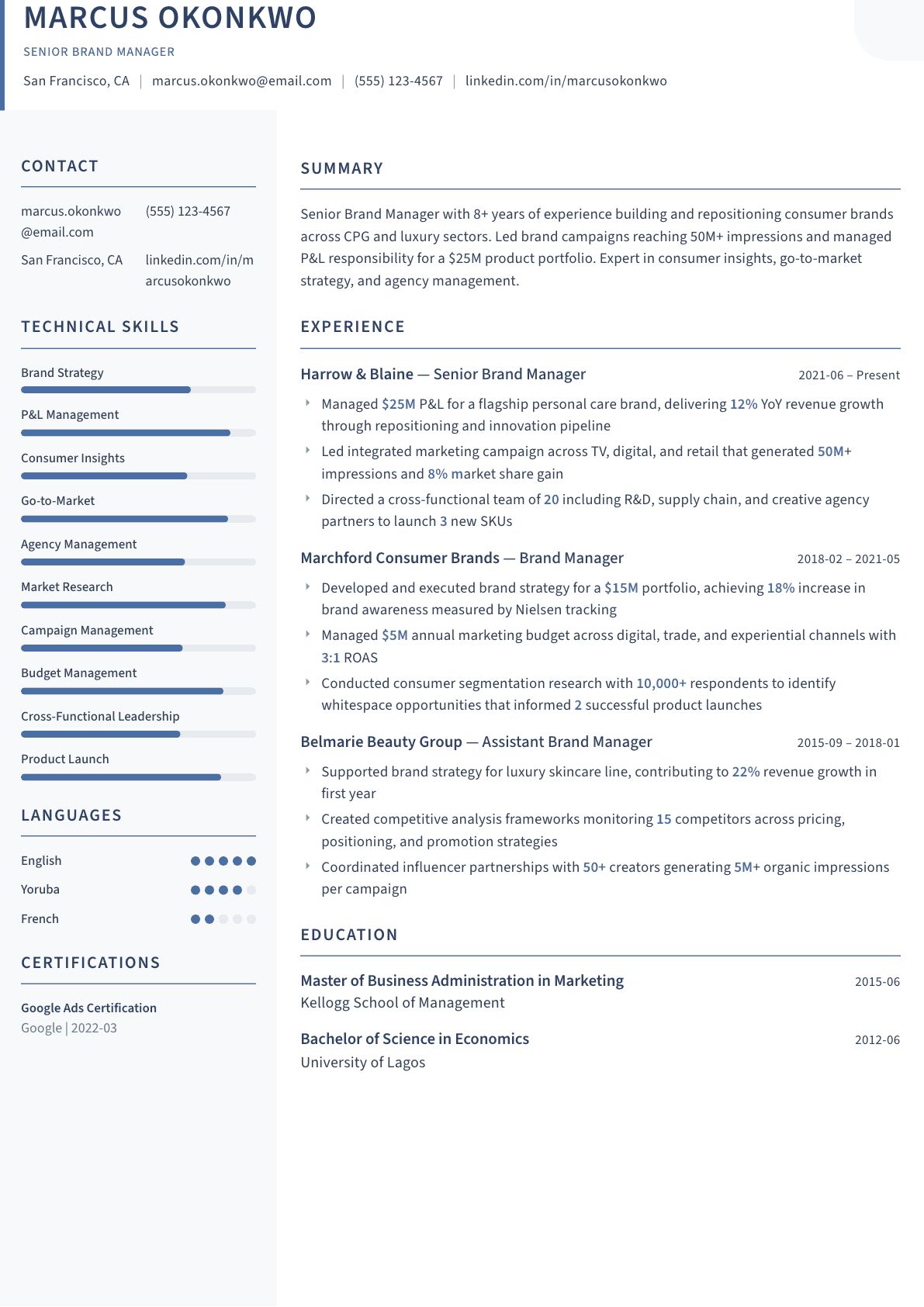
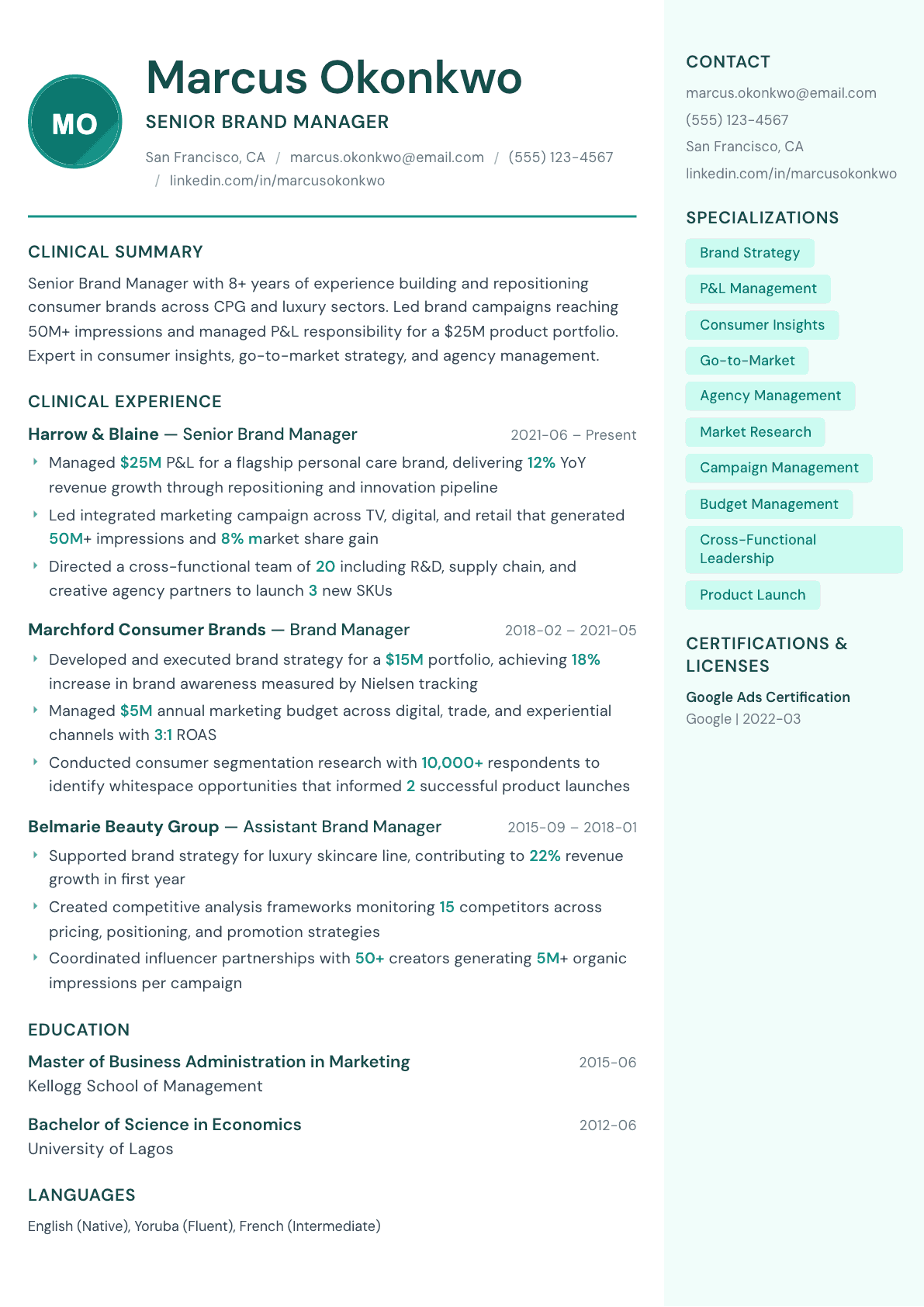
Example Brand Manager summary
Brand Manager with 8 years growing personal care and beauty brands under $25M P&L responsibility. Delivered 12% YoY revenue growth through repositioning and integrated campaigns reaching 50M+ impressions and an 8% share gain. MBA in marketing, strong in consumer insights, innovation and go-to-market strategy.
Skills to list on a Brand Manager resume
- Brand Strategy
- P&L Management
- Consumer Insights
- Market Research
- Go-to-Market Strategy
- Campaign Management
- Agency Management
- Product Launch
- Budget Management
- Competitive Analysis
- Brand Positioning
- Cross-Functional Leadership
- Nielsen / IRI Data
- Digital Marketing
What actually gets this resume read
- Lead with P&L responsibility and revenue impact to demonstrate business acumen, not just creative skills.
- Quantify brand metrics: awareness lift, market share gains, NPS improvements, campaign reach and ROAS.
- Highlight cross-functional leadership experience managing agency partners, R&D, sales, and supply chain.
- Showcase consumer insight methodology: how you gathered data and translated it into brand strategy.
- Include specific industries and product categories to help recruiters match you to relevant opportunities.
- Mention innovation pipeline contributions: new product launches, line extensions, brand repositioning.
How to write a brand manager resume
Brand manager is a general management job wearing a marketing title. The person hiring you, usually a marketing director or a category lead, is deciding whether to hand you responsibility for a product line: its positioning, its pricing architecture, its innovation pipeline and, in most consumer goods companies, its profit and loss statement. The resume is read as evidence of commercial ownership.
This is why brand resumes written as campaign lists fall flat. Running a launch campaign is a brand manager task, but so is deciding which product gets the investment, arguing for a price increase, killing an underperforming variant, and rebuilding a positioning that the market has stopped believing. The page has to show those decisions.
A brand management resume is judged on those decisions, whatever the exact title on the posting. This guide covers the structure category leaders expect, how to write about share, distribution and margin without inflating anything, three summaries from assistant brand manager to senior brand manager, before and after bullets, and the sections that are commonly left out. The same structure works for a branding manager resume at a smaller company, where the job leans toward identity and creative work, and for a brand director resume, where the page has to show a portfolio of brands and the people who ran them.
Format: brand, business size, and scope of ownership
Reverse chronological, one page early, two pages once you have owned a profit and loss statement and led launches. Consumer goods and retail recruiters read fast and compare candidates by scope, so make scope visible at a glance.
A brand management resume reads differently at each step. An assistant brand manager shows analysis and execution: the retail data pulled each week, the launch timeline run, the packaging change shepherded through legal. A brand manager shows decisions on one brand: price, promotion, distribution and which variant to cut. A senior brand manager or portfolio lead shows several brands, a team and the profit and loss behind them.
For every role, give a scope line before the bullets: the brand or portfolio, the category, the revenue scale, the channels it sold through, and what you controlled. Owning the marketing budget is different from owning the profit and loss, and the difference decides which level you are read at.
- Header: name, city, phone, email, and languages if the role covers more than one market.
- Order: summary, experience, education including any business degree, skills, certifications.
- Name the channels the brand sold through: grocery, mass, specialty, direct to consumer, or wholesale.
Summary: category, scope, and what you changed about the brand
Three lines. Years, categories, the scale of the business you have owned, and the type of brand work you are strongest at. Repositioning a tired brand, launching into a new segment, defending share against a private label competitor and building a brand from nothing require different instincts.
Close on a business result stated as a business would state it: share, revenue growth, margin improvement or distribution gained. Avoid describing yourself as passionate about brands, a line every reader in this category has seen thousands of times.
Brand director resume sample summary, written out: Brand director with twelve years in packaged snacks, leading a portfolio of three brands and a team of five brand managers. Rebuilt the positioning of the largest brand after two years of declining share, set the pricing architecture across the range, and moved annual planning from a list of campaigns to a portfolio plan agreed with sales and finance. A branding manager summary follows the same order but names the identity system, the brand guidelines and the agencies managed.
Experience: the four things a brand manager is judged on
Organize bullets around the real accountabilities. First, commercial performance: revenue, share, margin and the pricing or promotional decisions behind them. Second, consumer understanding: the research you commissioned or ran, the segmentation you used, and the insight that changed a decision rather than decorated a deck.
Third, the innovation pipeline: concepts developed, products launched, the cross-functional work with research and development, packaging, regulatory and supply, and what happened after launch. Include the products you stopped, since portfolio pruning is a mark of seniority.
Fourth, the go-to-market execution: the positioning and messaging you set, the agencies you briefed and managed, the campaigns that ran, and the retail or trade activation that got the product in front of a shopper. Say who you influenced without authority, because that is most of the job.
Numbers a category leader trusts
Use the measures the industry reports on. Revenue and volume growth, market share by value and by unit, distribution measured as weighted or numeric coverage, price per unit and promotional depth, gross margin, and repeat purchase or household penetration where you had panel data.
Attribute honestly. Brand results are collective, so write bullets that show your contribution inside a team outcome: the analysis you ran, the recommendation you made, the decision that followed. An interviewer will ask what exactly was yours, and a resume that already answers that reads as senior.
Skills, tools and the vocabulary of brand postings
Recurring terms: brand strategy, positioning, consumer insights, go-to-market, portfolio management, pricing, innovation, agency management, cross-functional leadership, commercial planning and category management. Use the ones the posting names, once in the skills list and once where you show them at work.
Name the tools without hiding behind them: retail measurement and panel data sources, consumer research methods such as concept testing, segmentation studies and qualitative work, brand tracking, media planning software, and the planning and forecasting systems your company ran. Say which analyses you built yourself.
Brand Manager resume summary examples
Assistant brand manager
Assistant brand manager with 2 years supporting a household care brand, running monthly share and pricing analysis, managing packaging updates through regulatory approval and coordinating agency briefs. Built the shopper insight deck that shaped the following year commercial plan for the category team.
Brand manager, five years
Brand manager with 5 years in personal care, owning a mid-size portfolio and its annual marketing budget. Repositioned a declining line around a single clear consumer benefit, relaunched with new packaging and messaging, and returned the brand to growth with share up 3 points in two years.
Senior brand manager
Senior brand manager with 9 years and profit and loss ownership of a portfolio in the tens of millions. Leads a cross-functional team across research, supply, sales and agency partners, sets pricing architecture across channels, and has taken four new products from concept to national distribution.
Work experience bullets: before and after
Before: Managed brand strategy and marketing for the product line.
After: Owned the profit and loss for a personal care portfolio, setting pricing architecture, promotional depth and the annual marketing budget across grocery and mass channels.
Naming what you controlled establishes scope, which is how brand candidates are ranked against one another.
Before: Used consumer research to inform brand decisions.
After: Commissioned a segmentation study and concept test that showed the brand was competing on a benefit shoppers did not value, then rewrote positioning around convenience before the relaunch.
The insight and the decision it changed prove research was used, not just purchased.
Before: Launched new products successfully.
After: Took three new products from concept through research and development, packaging and regulatory review to national listing, and reached full distribution in the target retailers within two quarters.
The launch path and the distribution outcome show you understand a launch ends at the shelf, not the campaign.
Before: Worked with the agency on advertising campaigns.
After: Briefed and managed the creative and media agencies on an integrated relaunch, holding the positioning consistent from television through retail displays, and reviewed performance against the brand tracking study each quarter.
Consistency across touchpoints plus a tracking review shows brand stewardship rather than campaign supervision.
Before: Analyzed sales data to find growth opportunities.
After: Analyzed retail measurement data by region and pack size, found that a mid-tier pack was cannibalizing the premium line, and recommended discontinuing it, which lifted portfolio margin.
A specific finding leading to a hard portfolio decision is what separates a brand manager from an analyst.
Hard skills
- Brand positioning and architecture
- Profit and loss management
- Pricing and promotional strategy
- Consumer segmentation and research
- Retail measurement data analysis
- Innovation and stage gate processes
- Go-to-market planning
- Packaging and claims development
- Trade and shopper marketing
- Forecasting and demand planning input
- Agency briefing and management
- Brand tracking and health measurement
Soft skills
- Influence without direct authority
- Presenting to commercial leadership
- Judgment under incomplete data
- Cross-functional facilitation
- Comfort killing a project
- Coaching assistant brand managers
Certifications worth listing
- Professional Certified Marketer, Marketing Management (American Marketing Association certification program)
- Pragmatic Marketing Certified, Foundations (Pragmatic Institute)
- Certified Product Manager (Association of International Product Marketing and Management)
- Project Management Professional (Project Management Institute)
Mistakes that cost brand manager candidates the interview
- Writing the resume as a list of campaigns, which reads as a communications role rather than a business owner.
- Leaving out the size of the business you managed, forcing the reader to assume it was small.
- Claiming brand results without saying what your specific contribution to them was.
- Ignoring pricing, margin and distribution, three things a category leader considers core to the job.
- Describing research as conducted without ever naming the decision it changed.
- Never mentioning a product or project you stopped, which makes the portfolio judgment look one-directional.
Brand Manager resume questions
Do I need an MBA to be a brand manager?
Large consumer goods companies often recruit brand managers from business schools, so an MBA helps in those pipelines. Plenty of brand managers arrive from sales, category management or agency roles instead, and a resume showing commercial ownership competes well without one.
How do I show profit and loss ownership on a resume?
State the revenue scale of the business, then name the levers you controlled such as pricing, promotional spend, marketing budget and portfolio mix. Add the outcome in the measures a finance partner would recognize, which is usually revenue, share and gross margin.
What if my brand results were driven by the whole team?
They always are, so write bullets that separate your contribution from the collective result. Name the analysis you did, the recommendation you made and the decision that followed, then state the team outcome afterward rather than claiming it as personal.
What changes on a brand director resume compared with a brand manager resume?
Scope and people. A brand manager resume proves decisions on one brand, while a brand director resume proves decisions across a portfolio, the brand managers you hired and developed, and the investment trade-offs between brands. Lead each role with the portfolio and team size, then show one decision per brand that changed its direction.
What should a brand management resume include?
A scope line per role with the brand, category, revenue scale and channels, then bullets on positioning, pricing, distribution and launches with the result of each decision. Add the research that changed a call, the agencies you briefed and managed, and any product you stopped. Keep campaign lists short; the reader is hiring a business owner.