Purchasing Manager Resume Examples: the lines they read
Build a Purchasing Manager Resume That Proves Cost Control
By Mustafa Tarabya, founder of CVBooster · Published · Updated
Purchasing manager resume examples with buying, supplier and inventory bullets, plus ATS keywords and a guide to every section of the page.
Sample resumes for a purchasing manager
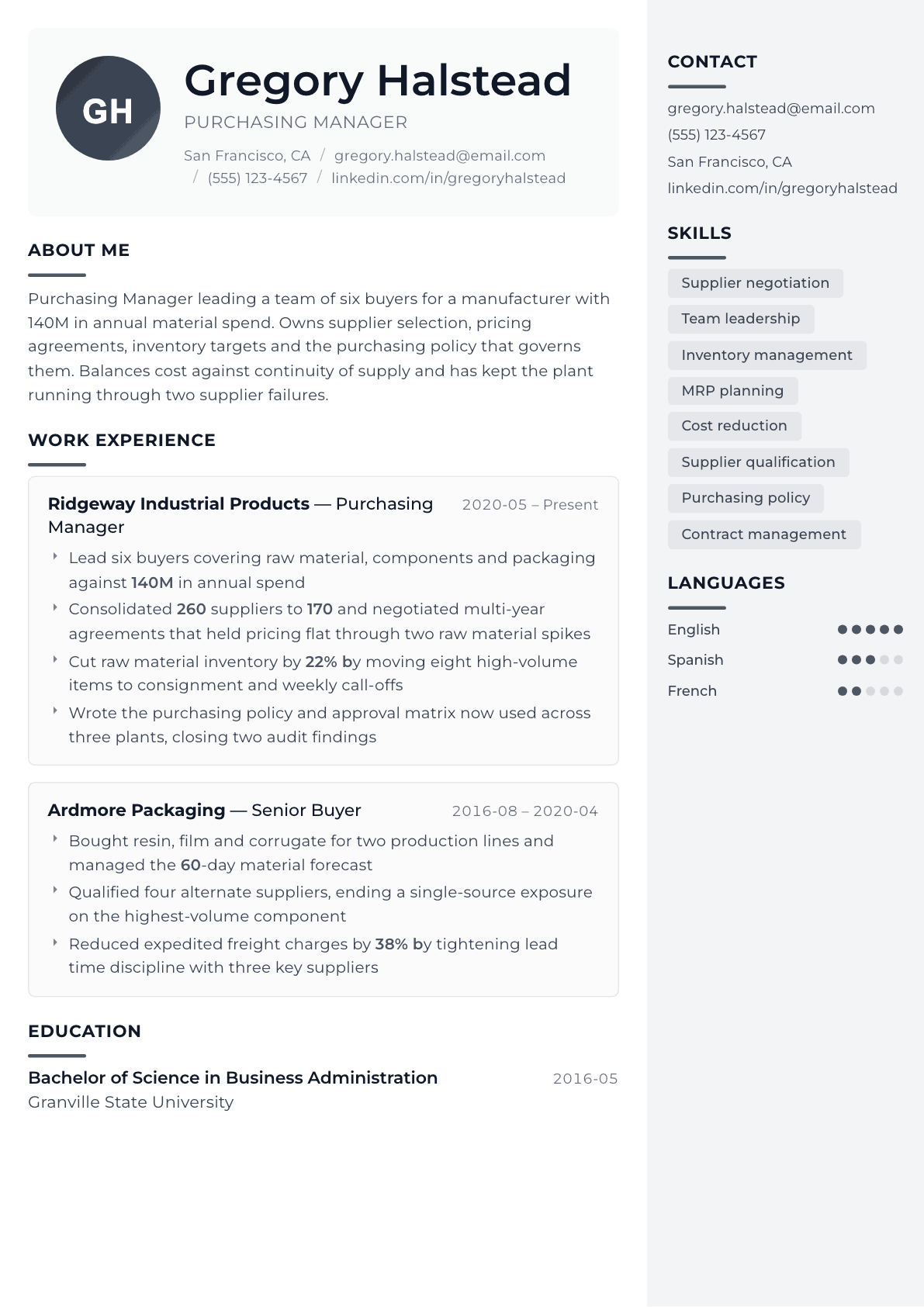
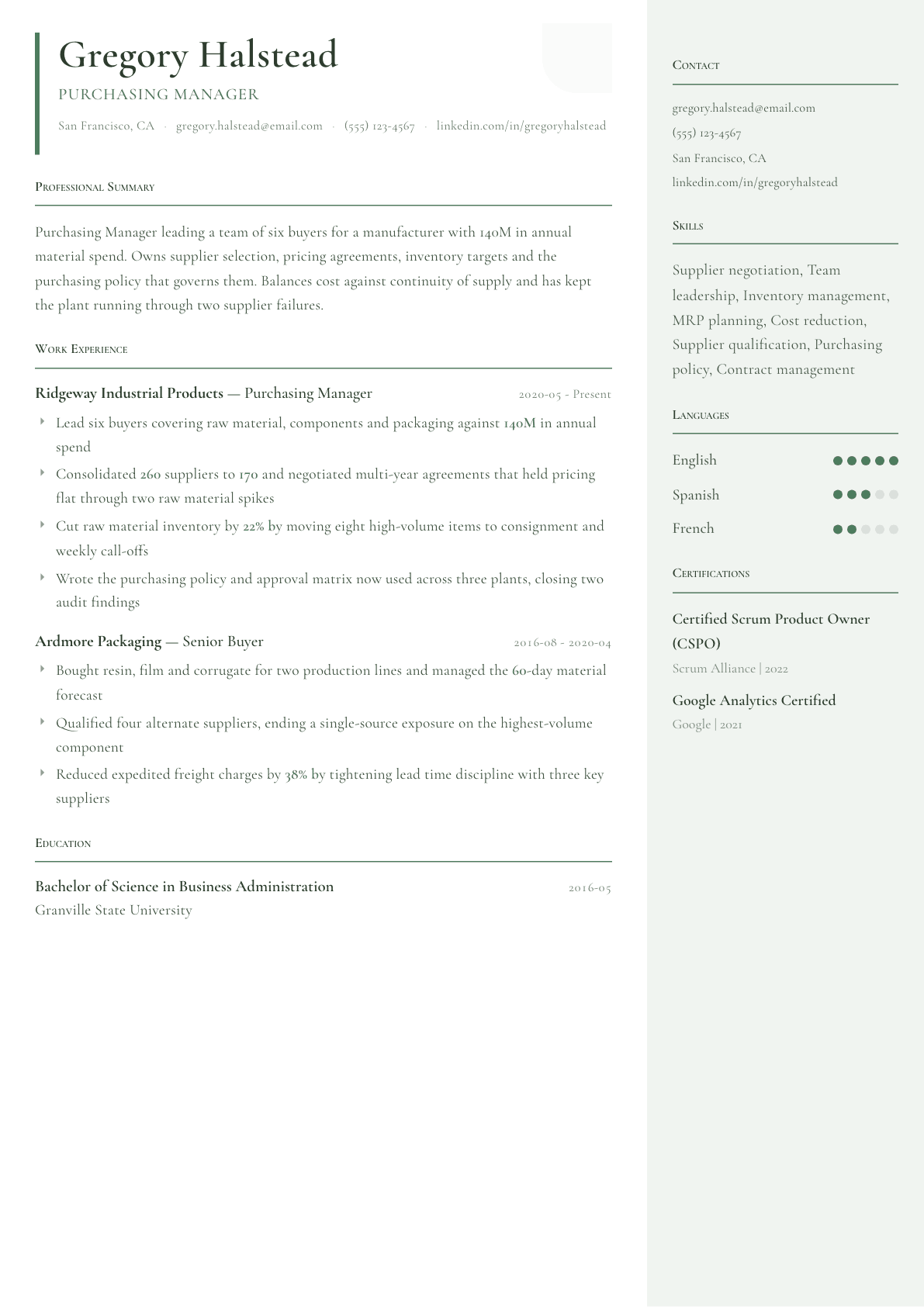
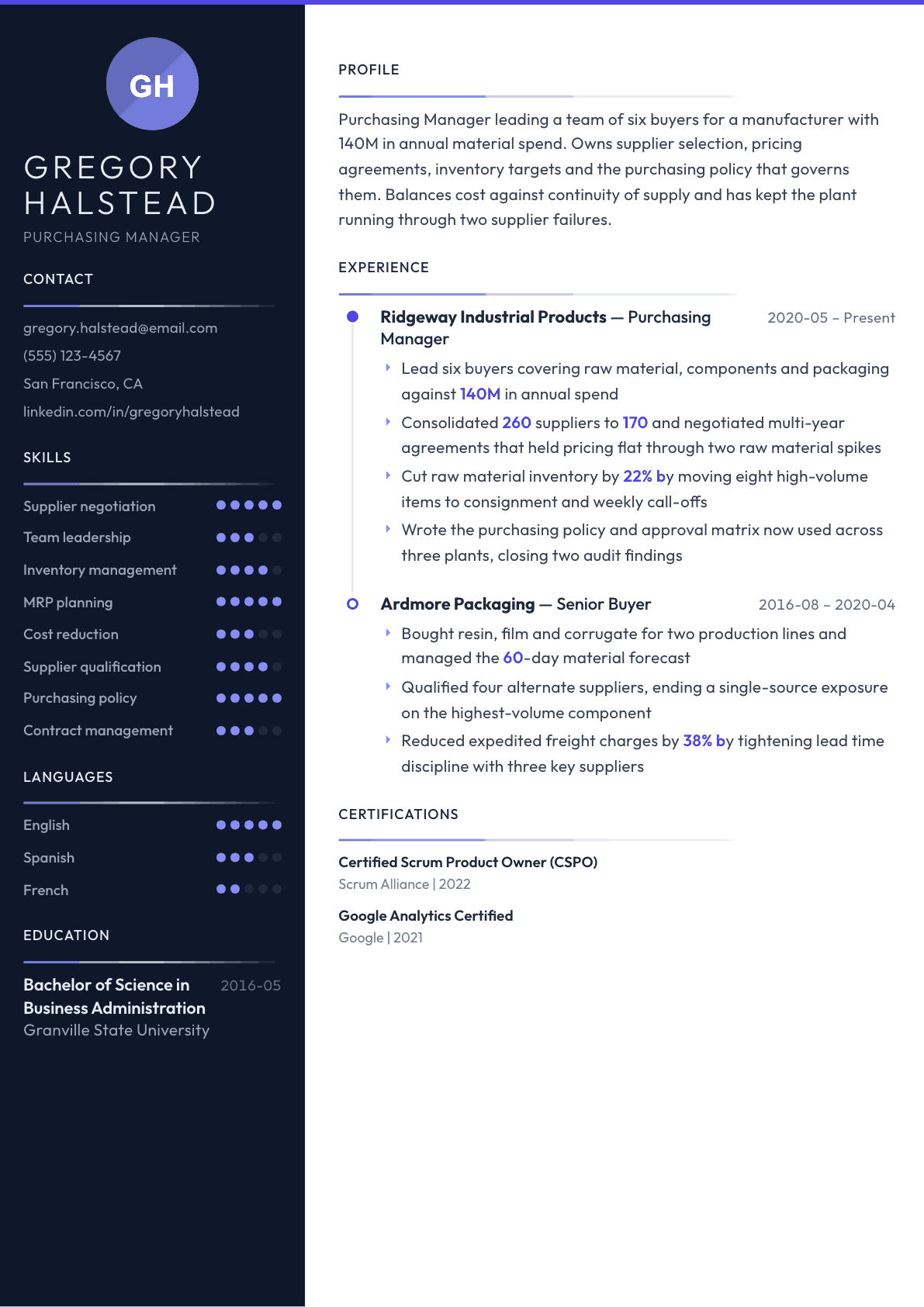
The same purchasing manager content laid out in three CVBooster templates, so you can see what the finished document looks like before you write a word.
Example Purchasing Manager summary
Purchasing Manager with nine years in industrial manufacturing, currently leading six buyers against 140M in annual material spend. Consolidated the supplier base from 260 to 170, held pricing flat through two raw material spikes with multi-year agreements, and cut raw material inventory by 22% using consignment and weekly call-offs. Wrote the purchasing policy now used across three plants.
Skills to list on a Purchasing Manager resume
- Purchasing management
- Supplier negotiation
- Spend under management
- Inventory optimization
- MRP and material planning
- Supplier qualification
- Cost reduction
- Contract management
- SAP
- Oracle ERP
- Team leadership
- Supplier risk
- Purchasing policy
- Lead time management
- Vendor consolidation
What actually gets this resume read
- Lead with spend under management, team size and the categories you buy, all three in the first line of each role.
- Show cost work and continuity work together, because a purchasing manager is judged on both at the same time.
- Quantify inventory in turns, days of supply or dollar reduction, not just as a general improvement claim.
- Name the ERP and planning system you run purchasing from, such as SAP, Oracle, NetSuite, Epicor or Infor.
- Include supplier consolidation, qualification of alternate sources and any recovery from a supplier failure.
- Mention the policy and controls you own: approval matrix, competitive bid thresholds and audit outcomes.
How to write a purchasing manager resume
A purchasing manager is hired to do two things that pull against each other: reduce what the company pays and make sure material never stops arriving. Every strong resume for this role shows both. The operations director or plant manager reading your file is looking for evidence that you cut cost without creating a single source exposure, and that you protected supply without letting inventory swell.
Scope comes first. Spend under management, team size and the categories you buy tell the reader your level faster than any summary paragraph. A purchasing manager running 12M with two buyers and one running 300M with a team of fifteen do not compete for the same job, and the resume should make that obvious in the first line of each role.
This guide covers the section order that suits the role, how to write about cost and continuity in the same breath, three summaries at different levels of scope, and the questions purchasing managers ask when they move between manufacturing, distribution and services.
Format: scope line, then evidence
Reverse chronological and single column. Manufacturing and distribution employers often run older applicant tracking systems that mangle tables and text boxes, so keep the file plain and let the content carry it.
Put a scope line under each title with spend under management, number of direct reports, categories, and the number of plants or sites supported. Then four to six bullets. Two pages is expected once you have led teams, but the second page must hold results, not a longer list of duties.
- Scope line: annual spend, buyers managed, categories, sites supported.
- Section order: summary, core competencies, experience, systems, education, certifications.
- Name the industry in the summary, because component buying and services buying hire separately.
Summary: spend, team, and the balance you hold
Four lines. Spend under management, team size, the categories, and one sentence proving you manage both sides of the job. Something that pairs a cost result with a continuity result reads far stronger than either alone.
If your background is heavier on one side, say what you did about the other. A manager known for negotiation should name the dual sourcing or safety stock work that kept the line running; a manager known for supply continuity should name the consolidation or index pricing work that held cost.
Experience: cost, continuity, inventory, and the policy you own
Cost. Multi year agreements, supplier consolidation, index based pricing, tooling amortization, freight terms and payment terms. Give the mechanism, not just the result, because the mechanism is what the interviewer probes.
Continuity. Alternate source qualification, dual sourcing, supplier capacity reviews, safety stock policy and recovery from a supplier failure. A manager who has brought a plant through a supplier going dark has a story worth two bullets.
Inventory and working capital. Say what you did to turns, days of supply or the dollar value of raw material on hand, and how, whether through consignment, vendor managed inventory, weekly call offs or shorter lead times.
Policy and controls. The approval matrix, competitive bid thresholds, delegation of authority, and audit findings you closed. Purchasing managers are the control owners in most companies, and audit outcomes are hard evidence.
Finally, the team. How many buyers, how you developed them, what you standardized. Hiring managers assume you can buy; they need to see you can run a function.
Systems and planning: how orders actually get created
Name the enterprise system and how material requirements planning drives your orders. A purchasing manager who understands planning parameters, lot sizing, reorder points and lead time offsets can fix root causes; one who only reacts to a shortage report cannot.
Include the sourcing and analytics layer if you have it: spend cubes, supplier scorecards, should cost models and total cost of ownership analysis. These separate a strategic manager from an order desk supervisor.
- Enterprise systems: SAP, Oracle, Infor, Epicor, NetSuite, Microsoft Dynamics.
- Planning: material requirements planning parameters, safety stock, lot sizing, lead time offsets.
- Analysis: should cost models, total cost of ownership, spend cubes, supplier scorecards.
Keywords a purchasing posting is built from
The recurring vocabulary is spend under management, supplier negotiation, supplier consolidation, dual sourcing, material requirements planning, inventory turns, lead time reduction, total cost of ownership, purchase price variance and supplier qualification. Add the material words the industry uses: resin, castings, corrugate, electronic components, or whatever the posting names.
Purchase price variance deserves a mention if your company tracks it, since it is the number finance uses to judge purchasing and few candidates put it on the page.
Purchasing Manager resume summary examples
Senior buyer stepping up
Senior Buyer with five years buying resin, film and corrugate for two production lines, now supervising two junior buyers. Qualified four alternate suppliers to end a single source exposure and reduced expedited freight charges by 38% through lead time discipline. Seeking a first purchasing manager role.
Site purchasing manager
Purchasing Manager leading six buyers against 140M in annual material spend for an industrial manufacturer. Consolidated 260 suppliers to 170, held pricing flat through two raw material spikes with multi year agreements, and cut raw material inventory 22% using consignment and weekly call offs.
Multi site purchasing leader
Purchasing leader with fourteen years in manufacturing, currently accountable for 480M across five plants and a team of eighteen. Built the category strategy and supplier risk framework used group wide, brought two plants through a sole source failure with no line stoppage, and standardized the approval matrix.
Work experience bullets: before and after
Before: Responsible for purchasing and vendor relationships.
After: Led six buyers covering raw material, components and packaging against 140M in annual spend across three plants.
Team size, categories, spend and site count give the reader your level in one line.
Before: Reduced supplier costs through negotiation.
After: Consolidated 260 suppliers to 170 and signed multi year agreements with index based pricing that held unit cost flat through two raw material spikes.
The mechanism explains how the saving survived a rising market, which is the harder achievement.
Before: Improved inventory levels.
After: Cut raw material inventory 22% by moving eight high volume items to consignment and converting three suppliers to weekly call offs.
The reader can see exactly which techniques produced the working capital release.
Before: Dealt with supply issues when they came up.
After: Recovered from a sole source casting supplier entering insolvency by qualifying an alternate in eleven weeks and airfreighting bridge stock, with no production stoppage.
A crisis with a timeline and an outcome is the single most persuasive story on a purchasing resume.
Before: Created purchasing procedures for the company.
After: Wrote the purchasing policy and approval matrix adopted across three plants, closing two internal audit findings on competitive bid documentation.
Naming the audit outcome turns a document into proof that the controls actually held.
Hard skills
- Supplier negotiation
- Spend under management
- Supplier consolidation and qualification
- Dual sourcing and supply risk
- Material requirements planning
- Inventory turns and working capital
- Total cost of ownership analysis
- Purchase price variance
- Contract management
- SAP and Oracle purchasing modules
- Lead time reduction
- Purchasing policy and approval controls
Soft skills
- Team leadership and buyer development
- Negotiation
- Decision making under supply pressure
- Cross-functional work with operations and finance
- Coaching
- Escalation judgment
Certifications worth listing
- Certified Professional in Supply Management (CPSM) (Institute for Supply Management)
- Certified in Planning and Inventory Management (CPIM) (ASCM)
- Certified Supply Chain Professional (CSCP) (ASCM)
- Certified Six Sigma Green Belt (CSSGB) (American Society for Quality)
Mistakes that cost purchasing manager candidates the interview
- Leaving out spend under management and team size, the two facts that set your level.
- Writing only about savings, which reads as a manager who has never carried a continuity failure.
- Ignoring inventory and working capital, when finance judges purchasing partly on both.
- Presenting supplier consolidation as a headcount reduction with no statement of what it did to cost or risk.
- Skipping the enterprise system and planning parameters, so the reader cannot judge technical depth.
- Filling the second page with duties instead of the audit results, recoveries and agreements you own.
Purchasing Manager resume questions
How many pages should a purchasing manager resume be?
One page while you are still a senior buyer or leading a small team. Two pages once you manage buyers across sites, provided the second page carries agreements, recoveries and policy work rather than repeated duty statements.
Should I put spend under management on my resume?
Yes, in the scope line of every role. It is the fastest way for a reader to size your experience. If the figure is confidential, give a range or describe it as annual material spend for a site of a given production volume.
How do I show supply chain risk management on a purchasing resume?
Name the exposures you found and what you did about them: alternate sources qualified, dual sourcing put in place, capacity reviews run, supplier financial health monitored, and any failure you brought the business through without stopping production.
Is purchasing manager experience transferable between industries?
Largely yes for the process skills, less so for the categories. Highlight negotiation, planning parameters, supplier development and controls, then bridge the gap by naming any comparable material characteristics such as commodity linked pricing or long lead times.
What certifications help a purchasing manager?
Supply management and inventory planning credentials are the recognized ones, and a quality improvement belt helps in manufacturing settings. None replace evidence of managed spend and a functioning supplier base, so list them after your experience.
Related resume examples
- Supply Chain Manager Resume example
- Operations Manager Resume example
- Buyer Resume example
- Procurement Specialist Resume example
- Procurement Manager Resume example
- Vendor Manager Resume example