COO Resume Examples: what a hiring manager reads first
Create a Chief Operating Officer Resume That Commands the C-Suite
By Mustafa Tarabya, founder of CVBooster · Published · Updated
Build a chief operating officer resume demonstrating enterprise-wide operational leadership, P&L ownership, and transformational business impact at the highest level.
Sample resumes for a coo
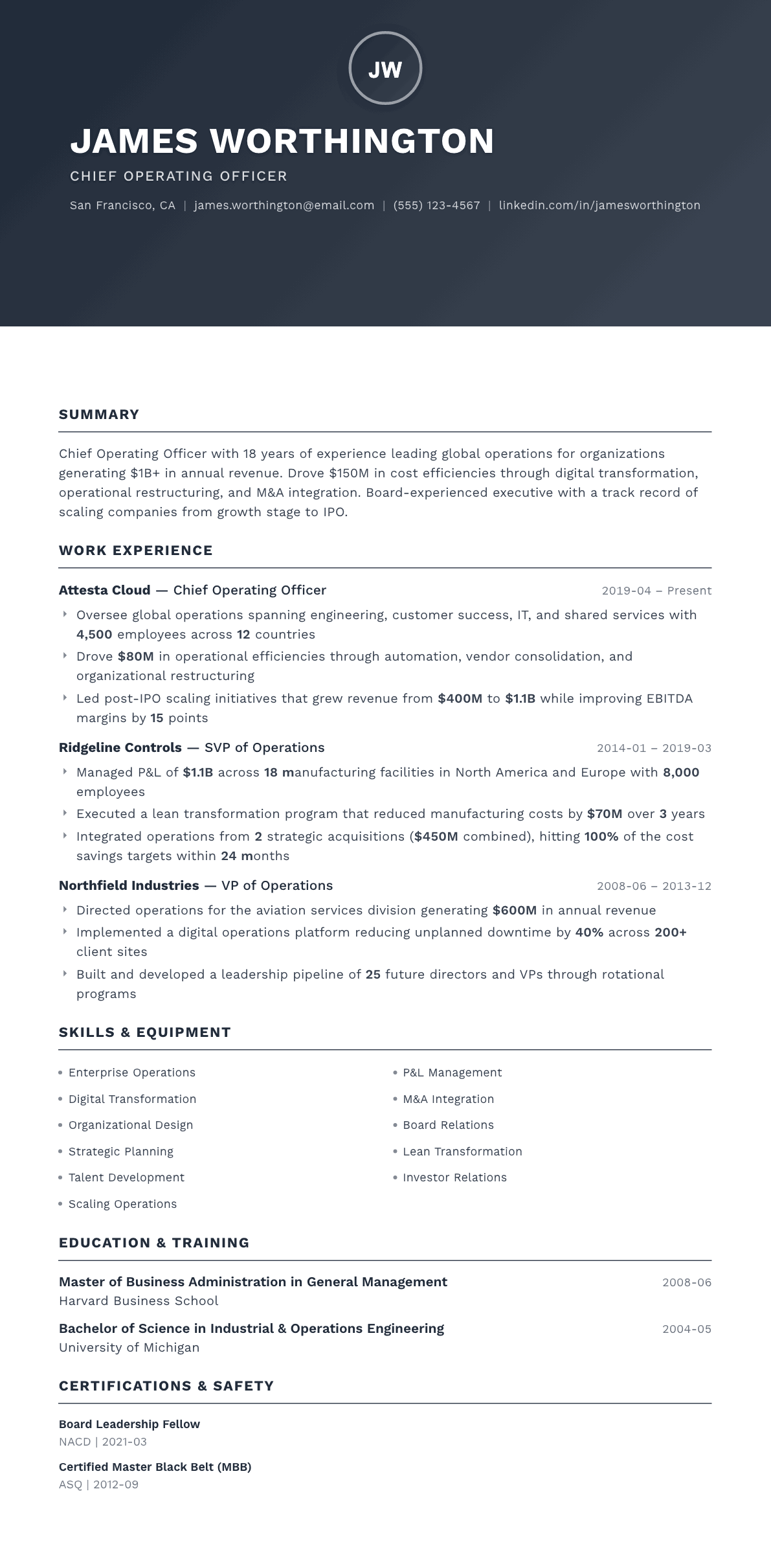
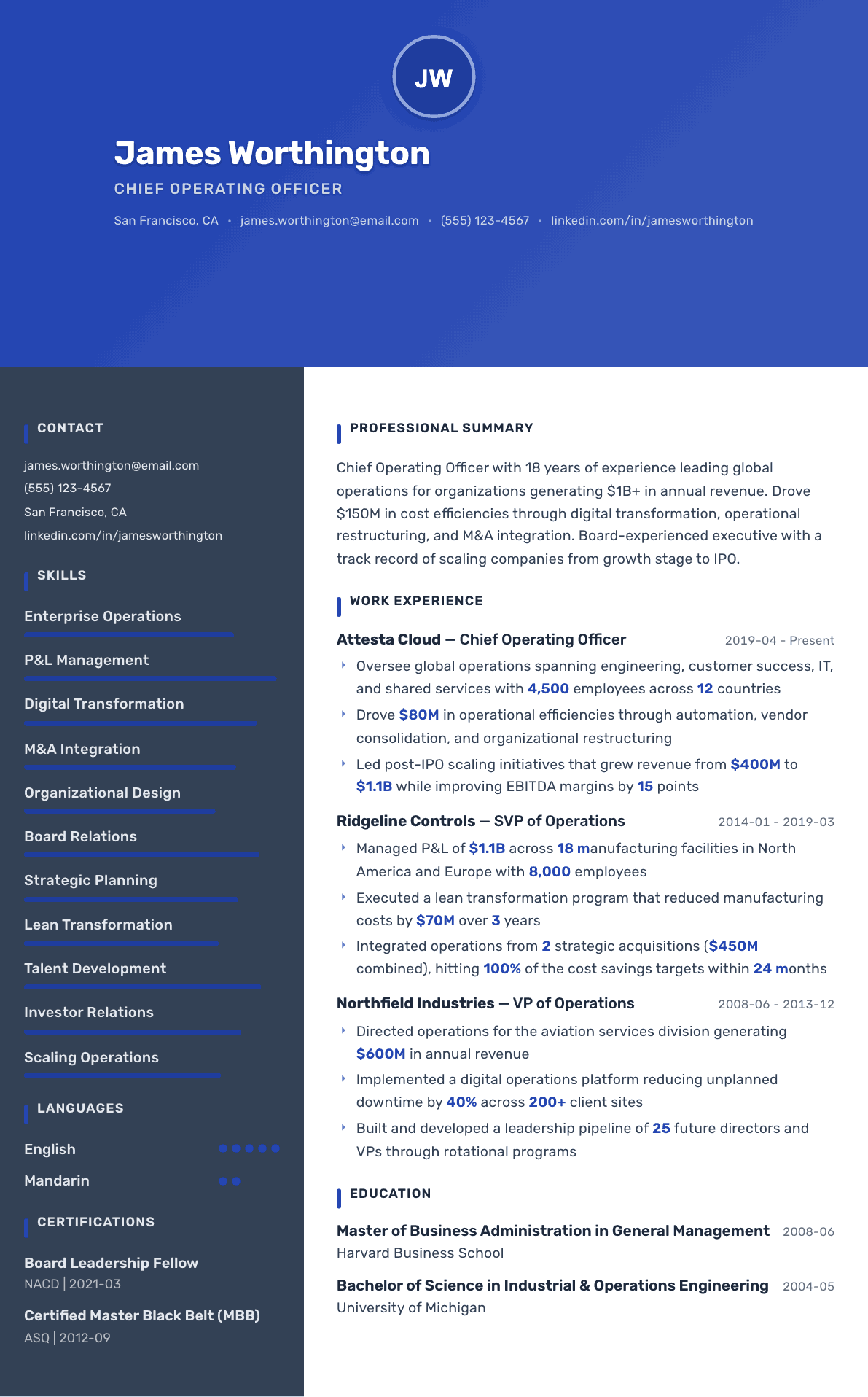
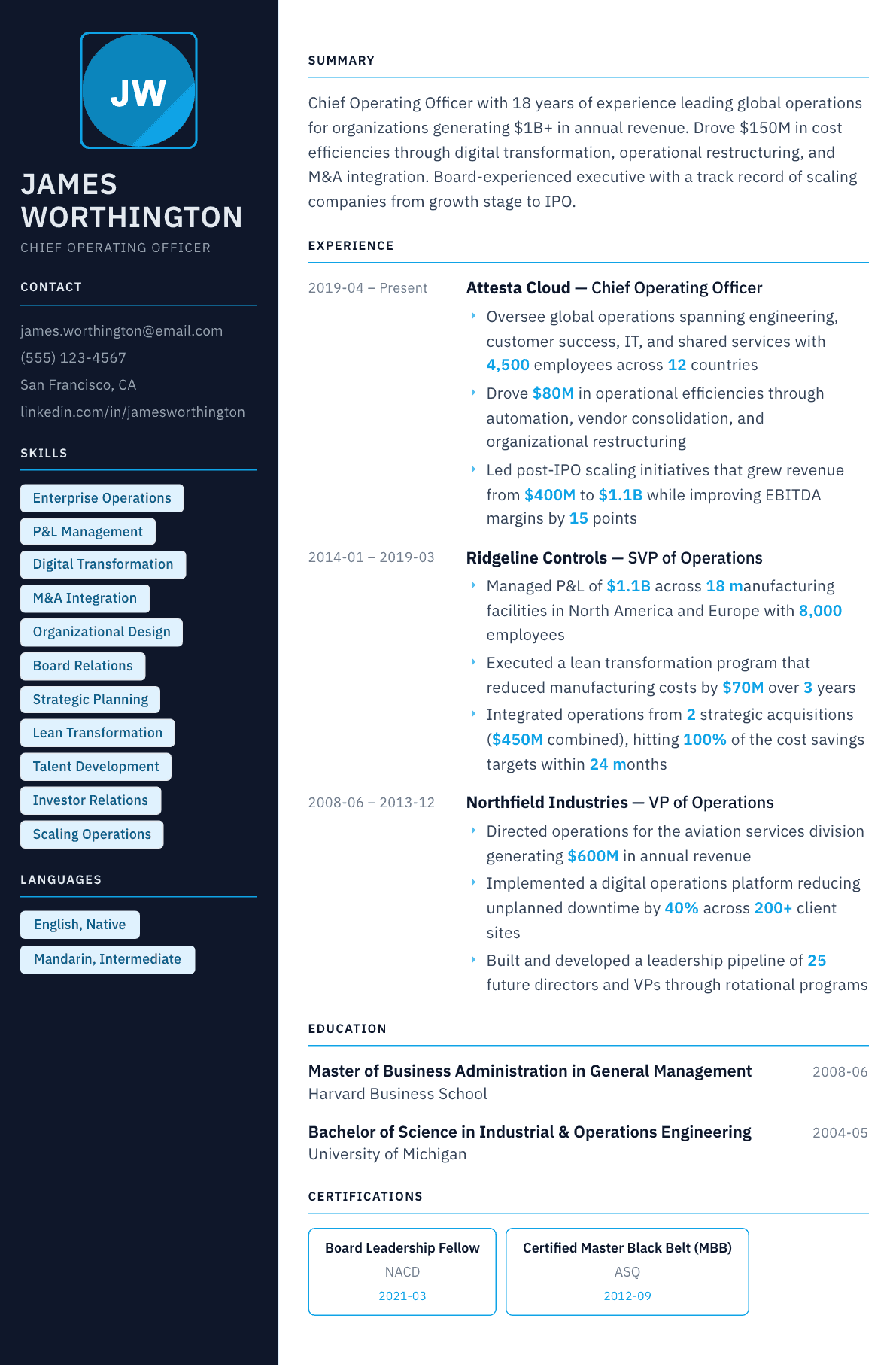
The same coo content laid out in three CVBooster templates, so you can see what the finished document looks like before you write a word.
Example COO summary
Chief Operating Officer with 18 years of experience leading global operations for $1B+ revenue organizations across technology and manufacturing. Drove $150M in cost efficiencies through digital transformation, lean operations, and M&A integration. Board-experienced executive who scaled a company from $400M to $1.1B in revenue through IPO. Seeking a COO or CEO role at a high-growth enterprise.
Skills to list on a COO resume
- Enterprise Operations
- P&L Management
- Digital Transformation
- M&A Integration
- Organizational Design
- Board Relations
- Strategic Planning
- Lean Transformation
- Talent Development
- Investor Relations
- Scaling Operations
- Change Management
- Revenue Growth
- Operational Excellence
What actually gets this resume read
- Lead with enterprise scope: total revenue, headcount, countries, and business functions overseen.
- Quantify transformational impact: cost savings, revenue growth, margin improvement, and savings captured from integrations.
- Highlight board experience, investor relations, and IPO or M&A involvement.
- Show progression from VP to SVP to COO with increasing scope at each level.
- Include digital transformation, organizational design, and talent development as strategic themes.
- Use a premium executive template that conveys authority and gravitas.
How to write a coo resume
A COO resume is usually read by three audiences before anyone picks up the phone: a retained search consultant screening against a position specification, the CEO who needs a partner to run the business while she sells it, and a board member or investor checking that your scope is real. Each of them is looking for the same thing from a different angle, which is proof that you have already carried the operating load the company is about to hand you.
The mistake almost every operating executive makes is describing responsibility instead of ownership. A chief operating officer who writes that he oversaw operations has told the reader nothing about revenue under management, functions reporting in, headcount, geographies, or the shape of the operating model he inherited versus the one he left behind.
This guide covers the structure a search firm expects, how to state scope in a way a board recognizes, three summary examples across the path from divisional leader to sitting COO, before and after bullets, and the questions operating executives ask when they finally sit down to write.
Format: two pages, scope line first, no exceptions
Two pages is the working standard at this level. One page reads as if the scope was small; three reads as if you cannot prioritize, which is the exact judgment a COO is hired for. Reverse chronological, standard margins, one typeface, no photograph in the United States, and no skills bar charts. A search consultant will copy your content into a candidate profile document, so keep it parseable text.
Under each company name, give a one line company descriptor before the bullets: sector, revenue band, ownership structure, and employee count. A reader who has never heard of the business cannot size your job without it. Private equity backed, venture backed, family owned and publicly listed are four different operating jobs, and the reader wants to know which one you have done.
- Header: name, city and state, phone, email, board memberships if you hold any.
- Order: executive summary, core scope or competencies, professional experience, board and advisory roles, education, executive programs.
- Give each role a company descriptor line, then a short scope line, then four to six achievement bullets.
- Move detail from roles more than fifteen years old into a short early career block.
The summary: your operating thesis in four lines
An executive summary is not a career history in miniature. It is a claim about the kind of operating problem you solve, backed by the largest true scope you have carried. Name the sector, the revenue scale, the functions that reported to you, and the situation type you are known for: scaling a growth company, integrating acquisitions, turning around a margin problem, or professionalizing a founder led business.
Situation type matters more here than in any other role. A CEO hiring a COO to prepare a company for sale and a CEO hiring one to fix a broken supply chain are looking for opposite resumes. If the posting or the search brief describes one of those situations, the first sentence should answer it directly rather than making the reader infer the fit.
Experience: scope, then the change you drove
Open each role with a scope line rather than a bullet: functions owned, direct reports, total headcount, revenue or P&L under management, sites and countries. Something like operations, customer success, IT, procurement and shared services, nine direct reports, twenty two hundred employees across five countries. That single line does more work than three achievement bullets.
Then write bullets that show the delta. Margin points gained, cost taken out and where it came from, order to cash cycle shortened, capacity added without proportional headcount, integration completed on a stated timeline, attrition brought down in a specific function. A COO is measured on the difference between the operating state at entry and the operating state at exit, so say what that difference was.
Include the operating mechanics you installed, because the CEO reading your resume is buying a system and not only results. Quarterly business reviews, an operating cadence, a management dashboard, an integration management office, a demand planning process, a services delivery model. These are the artifacts that survive after you leave and they are what a board asks about in the second interview.
Board, transactions and investor exposure
If you have presented to a board, name it plainly: monthly operating reviews to the board, audit committee reporting, quarterly lender covenant reporting, diligence support in a sale process. Transaction exposure carries real weight, so state the deal type and your role in it: buy side diligence, integration lead across a set of acquisitions, carve out of a business unit, readiness work for an initial public offering.
Non executive directorships and advisory seats belong in their own short section under experience. List the organization, the seat, and any committee. Keep nonprofit boards if they show governance experience, and drop them if the list starts competing with your operating record for space.
Keywords a search database is actually indexed on
Search firms run boolean queries across their candidate databases before they ever read a file. The recurring terms for this role are chief operating officer, P&L ownership, operating model, organizational design, integration, shared services, supply chain, commercial operations, enterprise resource planning implementation, workforce planning and operating leverage. Use the ones that are true of you in the summary and again inside a bullet where the claim is evidenced.
Avoid the abstraction trap. Words like transformation, excellence and strategic vision appear on every executive resume in the stack and separate no one. If a phrase cannot be followed by a number, a system name, or a date, replace it with one that can.
Chief operating officer resume example, start to finish
A chief operating officer resume reads best when you can see the whole page, so here is one complete example for a sitting COO in a mid sized company. The person and companies are invented; the order is what to copy. A first time COO keeps the same order and puts the broadest general manager scope in the scope line.
Scope line: Elena Marsh, Chief Operating Officer. Runs operations, supply chain, customer service and IT for a privately held consumer products company with four plants, two distribution centers and about two thousand employees, reporting to the CEO and presenting monthly to the board.
- Current role, Chief Operating Officer, Harrow Brands, four years: owns the operating budget for every function outside sales and finance, with six vice presidents reporting in.
- Redesigned the operating model from plant by plant management to three shared functions, cutting the management layers between the plant floor and the executive team from five to three.
- Led the integration of two acquired brands into the existing plants and systems, finished inside the plan the board approved.
- Moved the company onto one enterprise resource planning system and one order to cash process, retiring four legacy systems.
- Previous role, Senior Vice President, Operations, Lindell Foods, six years: three plants, procurement and logistics; rebuilt the sales and operations planning cycle.
- Board and transactions: monthly operating review to the board; operating lead in diligence for the sale of a minority stake to a private equity investor.
- Education and competencies: MBA; BS in Industrial Engineering; P&L ownership, operating model design, acquisition integration, supply chain, ERP implementation, workforce planning.
COO resume summary examples
Stepping up from VP Operations
Operations executive with 12 years across manufacturing and distribution, currently running a business unit of 600 employees and four plants. Cut unit cost by 9% while lifting on-time delivery to 98%. Ready for a first COO seat in an industrial company with a growth agenda.
Divisional COO
Divisional COO for a software business of 900 employees, owning customer success, professional services, support and IT. Grew gross margin by 7 points in three years by rebuilding the services delivery model and automating onboarding. Comfortable in private equity backed environments with quarterly lender reporting.
Enterprise COO
Enterprise COO with 20 years of operating leadership, eight of them in the chief operating officer seat across two companies. Integrated six acquisitions, took an operating model from single country to nine, and lifted EBITDA margin by 11 points. Board experience through a sale process and an initial public offering.
Work experience bullets: before and after
Before: Responsible for all company operations.
After: Owned operations, IT, procurement, quality and customer support for a 2,200 person business across five countries, with nine direct reports and a 340 million euro cost base.
Naming the functions, the headcount, the geography and the span converts an empty claim into a scope a board can size.
Before: Led a cost reduction program that saved money.
After: Took 18% out of indirect spend over two years by consolidating 240 suppliers to 60, insourcing field service, and moving three back office teams into a shared services center.
The reader now sees where the savings came from, which tells him whether the same play works at his company.
Before: Managed integration of acquired companies.
After: Ran an integration management office across four acquisitions, closing each systems and payroll migration within 120 days and retaining 91% of acquired engineering staff through the first year.
A named mechanism, a cycle time and a retention figure prove the integrations worked rather than merely happened.
Before: Improved company culture and employee engagement.
After: Cut voluntary attrition in field operations from 34% to 19% by rebuilding the supervisor career path, moving to a four day scheduling pattern, and adding a quarterly skip level review.
Culture becomes credible only when it is expressed as a metric and the specific interventions behind it.
Before: Worked closely with the board and investors.
After: Presented monthly operating reviews to the board and the sponsor, owned covenant reporting through a refinancing, and led operational diligence across an 11 week sale process.
Naming the forums and the transaction shows governance exposure instead of proximity to it.
Hard skills
- P&L ownership
- Operating model design
- Organizational design and span of control
- Post-merger integration
- Supply chain and procurement
- Enterprise resource planning implementation
- Working capital management
- Shared services and outsourcing
- Capacity and workforce planning
- Pricing and margin management
- Operating cadence and business reviews
- Board and investor reporting
- Lean and continuous improvement
- Commercial operations
Soft skills
- Executive presence with a board
- Partnering with a founder CEO
- Decision making under incomplete data
- Talent assessment and succession
- Conflict resolution across functions
- Communicating change to a whole company
Certifications worth listing
- NACD Directorship Certification (National Association of Corporate Directors)
- Certified Six Sigma Black Belt (CSSBB) (American Society for Quality)
- Certified Manager of Quality/Organizational Excellence (American Society for Quality)
- Project Management Professional (PMP) (Project Management Institute)
- Certified Supply Chain Professional (CSCP) (Association for Supply Chain Management)
Mistakes that cost coo candidates the interview
- Listing responsibilities rather than the operating state you inherited and the one you handed over.
- Omitting the company descriptor line, so the reader cannot tell a venture backed startup from a listed industrial group.
- Burying the functions that reported to you, which is the single fact a CEO uses to judge fit.
- Filling the summary with abstractions like excellence and vision that appear on every other executive resume.
- Running to three or four pages because every role from early career is still fully detailed.
- Claiming board experience without saying which forum, how often, or what you owned in it.
- Ignoring the situation type the search brief describes, which is the fastest way to be screened out as the wrong profile.
COO resume questions
What does a chief operating officer resume look like?
Two pages that open with a scope line naming the revenue band, functions, headcount, sites and reporting line, then a four line summary, then experience with the operating changes you drove under each role. Board and transaction work gets its own short block. The complete chief operating officer resume example on this page shows the order.
How long should a COO resume be?
Two pages. Search consultants expect it and boards read it that way. Keep the last three roles detailed, compress anything older than fifteen years into an early career block of two or three lines, and move publications or speaking into a single line.
How do I show P&L ownership without disclosing confidential numbers?
Use bands rather than exact figures. Writing that you owned a cost base in the mid hundreds of millions, or a business unit in the two hundred to three hundred million range, gives a board the scale it needs while keeping you inside any confidentiality obligation you carry.
What if I have never carried the chief operating officer title?
Lead with scope instead of title. A general manager or senior vice president of operations who owned multiple functions, a P&L and several sites has done the job. State the functions and the span in the scope line and let the summary say plainly that you are seeking a first COO seat.
Do I need a separate core competencies block?
A short one helps, because search databases index it and the CEO scans it. Keep it to about twelve operating capabilities in two or three lines, drop generic leadership words, and make sure every capability listed there is evidenced somewhere in the experience section.
Related resume examples
- VP Operations Resume example
- General Manager Resume example
- Strategy Director Resume example
- Executive Resume example
- Chief of Staff Resume example
- CEO Resume example