Executive Resume Examples: free ATS score and gap list
Executive Level Resume Examples and Chief Officer Resumes
By Mustafa Tarabya, founder of CVBooster · Published · Updated
Examples of executive level resumes for turnaround, growth and first executive seats, plus chief officer resume guidance for CEO, COO and CFO roles.
Sample resumes for a executive
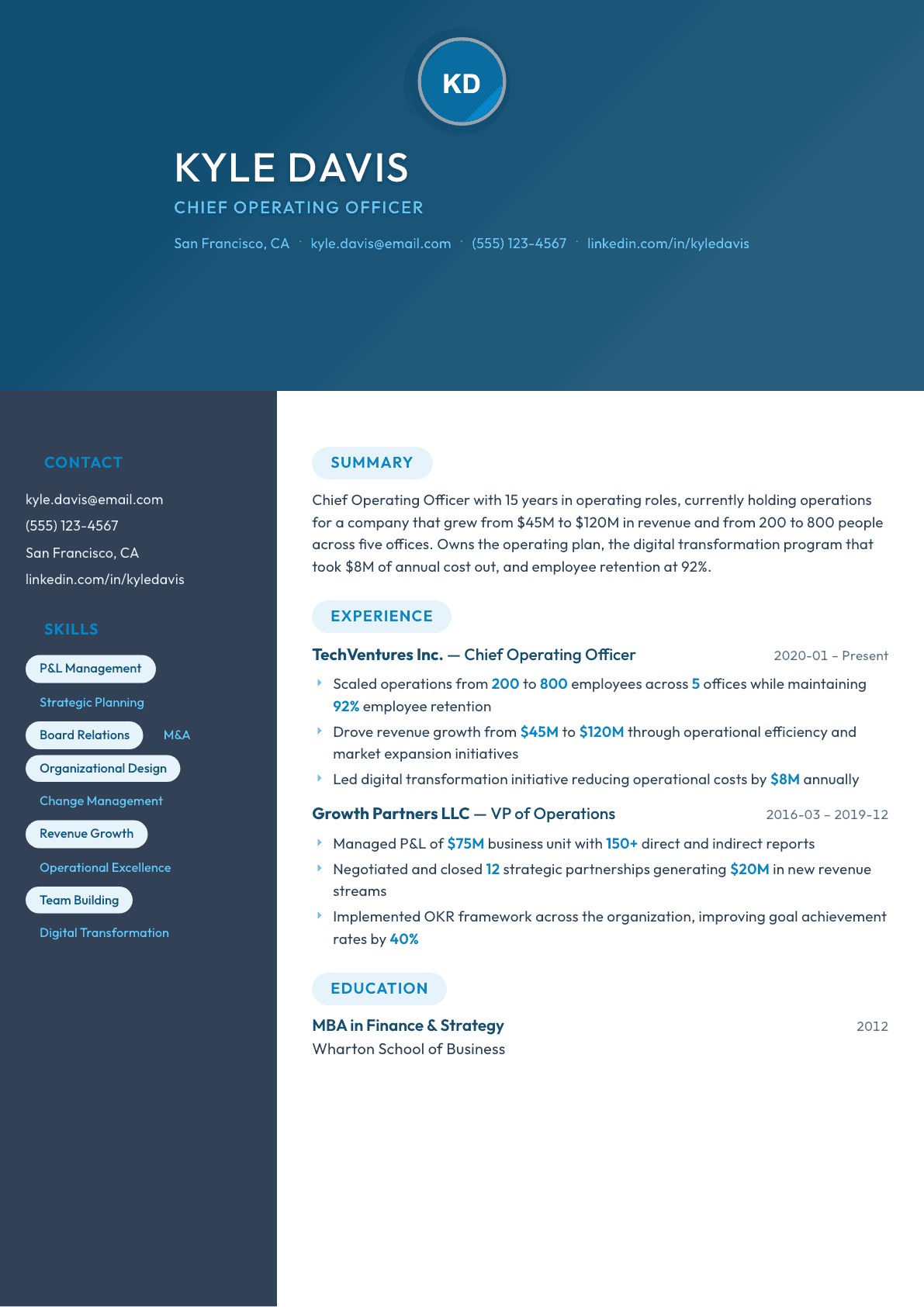
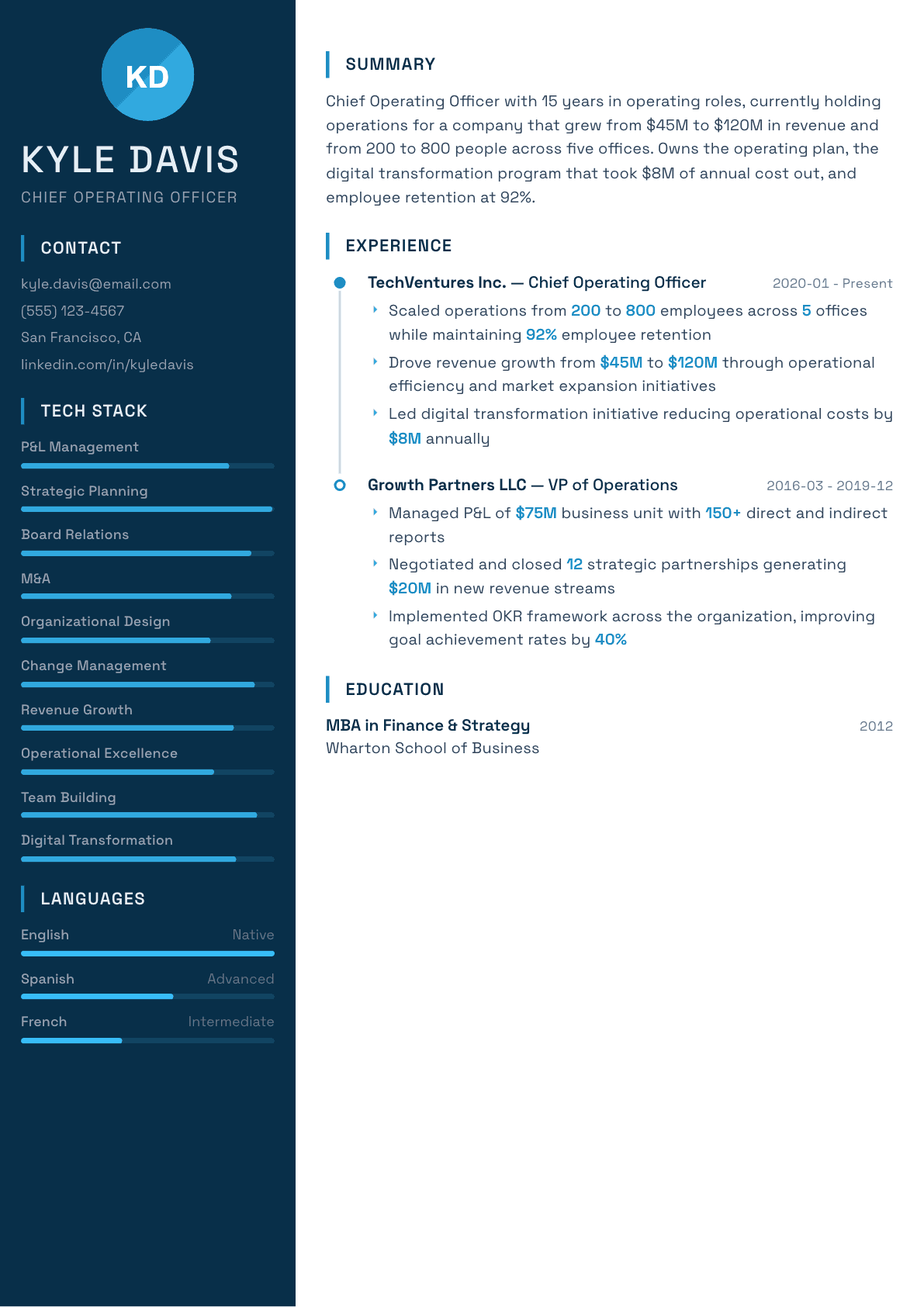
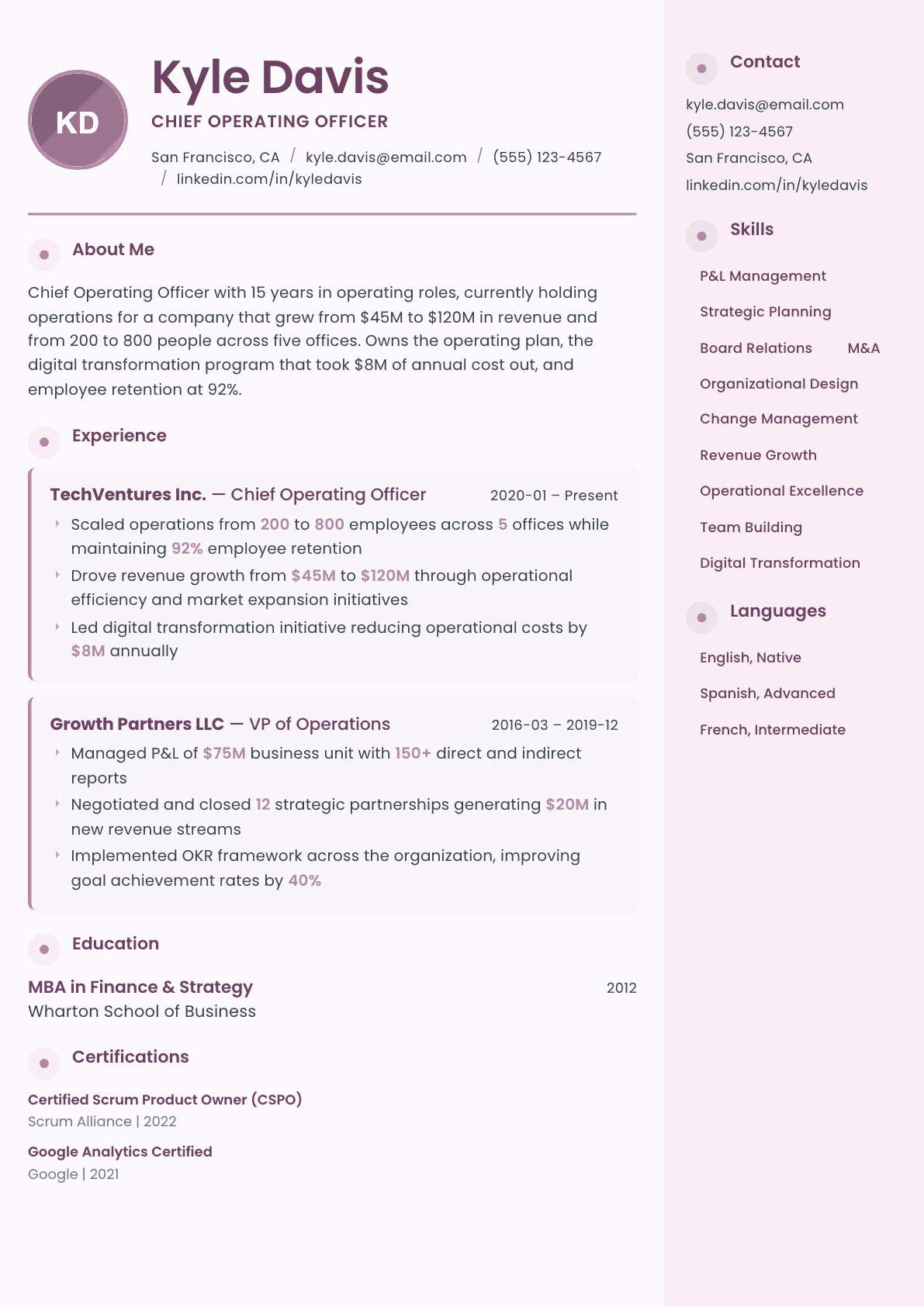
The same executive content laid out in three CVBooster templates, so you can see what the finished document looks like before you write a word.
Example Executive summary
Operating executive, 15 years, currently COO of an 800-person company after running a $75M business unit with 150 reports. Took revenue from $45M to $120M, closed 12 partnerships worth $20M in new revenue, and installed the OKR system that lifted goal attainment 40%.
Skills to list on a Executive resume
- P&L Management
- Strategic Planning
- Board Relations
- M&A
- Organizational Design
- Change Management
- Revenue Growth
- Operational Excellence
- Team Building
- Digital Transformation
What actually gets this resume read
- Lead with your executive brand: what transformation do you drive?
- Quantify revenue growth, P&L responsibility, and team sizes.
- Include board-level experience and investor relations.
- Show both strategic vision and operational execution capability.
- Keep to 2 pages maximum. Executives are judged by impact, not length.
How to write a executive resume
An executive resume is a positioning document, not a career record. By the time someone reaches the senior leadership tier, nobody doubts that the work was done. What a board, a chief executive or a search partner is deciding is narrower and harsher: what kind of leader is this, at what scale, in what situation, and does that match the problem we are hiring against right now.
Executives get screened out for two opposite reasons. Some files are too modest, listing functions held and committees joined with no evidence of a business that moved. Others are too promotional, opening with a paragraph of adjectives that could describe any senior person in any industry. The version that works reads like an operating record with a point of view attached.
This guide covers the document set a senior search actually uses, how to build a leadership narrative across a non-linear career, four examples of executive level resumes by situation, how a chief officer resume changes by seat, three summary examples across the step into and through the executive tier, before and after bullets, and the questions senior leaders ask when they write this file for the first time in a decade.
Format: two pages, and know what the other documents are for
Two pages, reverse chronological, plain text that a search database can parse. Executives often maintain three related documents and confuse their jobs. The resume is the screening artifact. The executive biography is a one page narrative in third person used for introductions, board packets and speaking. The profile a search consultant builds is their own document, assembled from yours. Write the resume for screening and keep the biography separate.
Anchor every organization with a descriptor line: sector, revenue scale, ownership, headcount, and whether it was growing, flat or in distress when you arrived. Executive judgment is context dependent, and a leader who doubled a business in a rising market and one who held margin through a contraction are being evaluated for different jobs.
- Header: name, city and state, phone, email, and board seats if you hold them.
- Order: leadership summary, areas of impact, professional experience, board and governance, education, executive education.
- Give each role a descriptor line, a mandate line, and four to six results.
- Compress everything beyond roughly fifteen years into a short early career section with titles and companies only.
Executive level resume examples: the summary by situation
Four lines at most. State the leadership tier you operate at, the scale of business you have run, the two or three capabilities you are genuinely known for, and the situation type you fit. Growth acceleration, turnaround, professionalizing a founder led business, carve out, market entry and post acquisition consolidation are the situations executives are recruited into, and naming yours is the fastest way to be read as the right candidate rather than a generic senior applicant.
Resist the temptation to claim every capability. An executive who says he is equally strong in commercial growth, operations, technology and finance is asking the reader to believe a fourfold claim with no evidence behind it. Two capabilities, evidenced hard, beat six asserted.
Most examples of executive level resumes online show the layout and skip the thinking. The four invented samples below show the part that decides a shortlist: the headline, the summary line and the first result, written for four different situations. Notice that each one names the scale and the situation before any skill.
Executive level resume samples and executive level CV examples follow the same logic. Outside the US the document is usually called a CV, often runs to three pages, and lists board and non-executive roles in their own section. A sample profile, written out: Chief operating officer, consumer goods, three countries and four plants. Took over an operation missing its delivery promise, rebuilt planning and supplier terms, and handed on a business delivering on time with a lower cost base.
- Turnaround, general manager: Headline: General Manager, turnaround and restructuring, industrial distribution. Summary: Took over a loss making regional business with about 400 staff and returned it to profit in two years by closing two branches and repricing the contract base. First result: Moved the division from an operating loss to a positive margin by the second full year, with no customer losses in the top twenty accounts.
- Growth, vice president of sales: Headline: Vice President, Commercial, software for logistics firms. Summary: Built the enterprise sales team from six to 38 people and opened two new regions. First result: Grew annual recurring revenue roughly threefold in four years, mainly through a new partner channel that now brings in about a third of new deals.
- Founder led business, chief operating officer: Headline: Chief Operating Officer, scaling founder led consumer brands. Summary: Second in command to the founder of a fast growing food brand, owning supply chain, finance operations and people. First result: Put in the company's first planning cycle, board reporting pack and leadership team, which the investors named as a condition of their second funding round.
- First executive seat, director stepping up: Headline: Operations Director ready for a chief operating officer role, healthcare services. Summary: Runs 12 clinics and about 300 staff for a regional provider, reporting to the chief executive. First result: Cut patient waiting lists across all 12 sites by redesigning the booking process and moving two clinics to extended hours.
Experience: the mandate you were given and the result you left
Open each role with the mandate in one sentence, because at this level the assignment is the story. Recruited by the board to prepare a family owned distributor for external investment. Brought in to stabilize a business unit after two failed system implementations. Hired to open a market where the company had no operating history. A mandate line tells the reader why you were there before it tells them what you did.
Then results, in the currency of the business. Revenue trajectory, margin, cash conversion, market share, customer retention, safety record, regulatory standing, leadership bench built. Pair each with the mechanism, because the mechanism is what transfers. Growth without saying whether it came from pricing, new segments, channel expansion or acquisition tells a board nothing about what you would do for them.
Include the difficult entries rather than hiding them. A business that was sold, a unit that was closed, a role that lasted eighteen months because ownership changed. Search consultants check anyway, and a short honest framing under your control is far better than a gap that invites a worse guess.
People, governance and the things boards ask about
Senior hiring turns on organizational judgment as much as commercial results. Show the team you built: leaders hired into which seats, succession created, layers removed, spans widened, attrition in the leadership tier. A chief executive reading your file wants evidence that strong people chose to work for you and stayed.
Governance exposure belongs in its own short section. Non executive directorships, committee membership such as audit or remuneration, advisory board seats, and reporting relationships into a sponsor or a group board. Where you have handled a regulatory matter, an investigation, a major incident or a restructuring, say so plainly. Boards hire executives partly for what they have already survived.
Chief officer resume: what changes for CEO, COO, CFO and other C-suite seats
A chief officer resume follows the executive structure above, but each seat is read for a different first fact. The board or search partner wants to see, in the summary and the first role, the one result that seat exists to produce. Put that fact in the opening lines and let the rest of the file support it. The lines below are invented samples of a first bullet for each seat; replace the company type, scale and result with your own.
Titles also vary more than people expect. Chief officer, president, managing director and general manager can describe the same mandate in different companies. Use the title you actually held, and add the scope in plain words beside it, such as full P&L, board reporting or a named region, so the reader can compare you fairly with candidates from larger or smaller businesses.
- Chief executive officer: owned full P&L for a family owned manufacturer with about 1,100 staff, set a three year plan with the board, and sold two non core divisions to fund entry into a new market.
- Chief operating officer: ran plants, supply chain and customer service across four countries, consolidated two distribution centers into one, and cut late orders to the lowest level in the company's reporting history.
- Chief financial officer: led the finance, treasury and investor relations teams, refinanced the company's debt ahead of a rate rise, and prepared the business for an audit committee chaired by an independent director.
- Chief people officer or chief human resources officer: rebuilt the leadership pipeline, introduced a succession plan for every executive seat, and ran the culture work through an acquisition that doubled headcount.
- Chief technology or digital officer: replaced the core platform on a fixed budget, moved the company's main services to the cloud and set up product teams reporting to the business owners.
Keywords, and the trap of executive filler
Search databases are queried on concrete terms: P&L, general management, turnaround, market entry, mergers and acquisitions, restructuring, governance, commercial strategy, operating model, succession planning, sector names and geography names. Those belong in the summary and the areas of impact block.
The filler to cut is the vocabulary that shows up on every senior file: visionary, results driven, proven track record, dynamic leader, thought leader. None of it survives a partner scan. Replace each with a fact that only you could write, and the file starts sounding like a specific person rather than a category.
Executive resume summary examples
First executive seat
Commercial leader stepping into a first executive role, currently running a 180 person sales and service organization across 3 regions. Grew recurring revenue by 34% in two years by rebuilding the account coverage model and moving service onto contracts rather than call-out billing.
Sitting executive, business unit
Executive with 15 years in industrial services, currently leading a business unit of 1,400 people and 5 countries. Took the unit from flat to 12% annual growth through pricing discipline and two bolt-on acquisitions, and rebuilt the leadership team with 6 external hires.
Group executive and board director
Group executive with 22 years across consumer and retail, including 7 as chief executive of a listed subsidiary. Led a turnaround that restored operating margin by 9 points, executed a carve-out, and now serves as a non-executive director on two boards including an audit committee.
Work experience bullets: before and after
Before: Proven track record of driving growth and operational excellence.
After: Grew revenue from 90 to 210 million over four years, two thirds organic through channel expansion into 3 new markets and one third from a single acquisition integrated within 8 months.
Splitting organic from acquired growth is the first question a board asks, and answering it up front signals commercial honesty.
Before: Built and led a high-performing leadership team.
After: Rebuilt the executive team with 5 external hires and 2 internal promotions, removed a management layer, and kept leadership attrition under 10% through a change of ownership.
Naming the hires, the structural change and the retention gives evidence of organizational judgment instead of a compliment to yourself.
Before: Responsible for turning around an underperforming business.
After: Recruited to a business losing money on a 140 million revenue base, exited 2 unprofitable product lines, renegotiated the 3 largest supply contracts, and returned it to positive operating profit in 7 quarters.
A turnaround is only credible when the reader can see the specific decisions and the time it took.
Before: Reported to the board on company performance.
After: Owned the board reporting pack, chaired a monthly operating review with the sponsor, and led the presentation to lenders during a covenant renegotiation.
Naming the forums and the hardest conversation shows governance experience rather than attendance at meetings.
Before: Championed digital initiatives across the organization.
After: Replaced a 20 year old order management system across 12 sites, moved 40% of orders to self-service, and cut order entry headcount by redeployment rather than redundancy.
A named system, an adoption figure and the human consequence beat a vague sponsorship claim.
Hard skills
- P&L and balance sheet ownership
- General management
- Commercial and pricing strategy
- Turnaround and restructuring
- Mergers, acquisitions and carve-outs
- Market entry and expansion
- Operating model and organizational design
- Capital allocation
- Board and governance reporting
- Succession planning and leadership development
- Investor and lender relations
- Risk and regulatory oversight
Soft skills
- Setting direction under uncertainty
- Building trust with a board
- Difficult people decisions
- Negotiation at principal level
- Communicating hard news credibly
- Listening below the leadership layer
Certifications worth listing
- NACD Directorship Certification (National Association of Corporate Directors)
- Chartered Director (Institute of Directors)
- Certified Public Accountant (CPA) (State Board of Accountancy)
- Chartered Financial Analyst (CFA) (CFA Institute)
Mistakes that cost executive candidates the interview
- Opening with a paragraph of adjectives that would fit any senior leader in any industry.
- Omitting the company descriptor, so the reader cannot tell whether you ran a division or a small private firm.
- Presenting growth as a single number without separating what was organic from what was acquired.
- Hiding a short tenure or a sold business, which a search consultant will find and interpret less kindly than you would.
- Confusing the executive biography with the resume and submitting a narrative document into a screening process.
- Claiming four or five strong capabilities at once, which reads as unevidenced rather than versatile.
- Detailing roles from twenty years ago at the same length as the current one.
Executive resume questions
Are executive level CV examples different from executive resume samples?
The content is the same: mandate, scale, result and governance, which is also what separates an executive file from a senior manager one. The differences are local. A US executive resume is two pages with no photo; a UK or European executive CV often runs to three pages, lists board and non-executive roles separately and may close with education and languages. Search firms in both markets read the first half page first, so the summary carries the decision either way.
What do good examples of executive level resumes have in common?
They open with the situation and the scale, not with adjectives. Each role has a one line mandate, then four to six results in business terms such as revenue, margin, cash or leaders hired. The file fits two pages and leaves a board in no doubt about which problem this person solves. Even when a network introduction opens the door, this is the document a search partner circulates.
What should a chief officer resume include?
Your title with its scope, such as full P&L or group finance, a summary that states the mandate and scale, and for each role the situation you inherited and the result you left. Add board work, major transactions and the leaders you hired. Keep it to two pages and put the one result your seat exists to deliver first.
How do I handle a career that is not a straight line?
Give the file a theme rather than an apology. Group unrelated moves under a leadership thesis such as taking on businesses that need repositioning, and use the mandate line for each role to show that the sequence was chosen rather than accidental.
How much detail should I give about confidential financials?
Enough for scale, not enough to breach an obligation. Bands, growth rates and margin point movements convey the size and direction of a business without disclosing figures you are not free to share, and any board will accept that framing.
Related resume examples
- Operations Manager Resume example
- Project Manager Resume example
- Consultant Resume example
- COO Resume example
- Chief of Staff Resume example
- CEO Resume example