Chemist Resume Examples: free score, then the gap list
Formulate a Chemist Resume with the Right Elements
By Mustafa Tarabya, founder of CVBooster · Published · Updated
Create a compelling chemist resume showcasing analytical techniques, synthesis expertise, and quality control skills with ATS-optimized templates for pharmaceutical, chemical, and materials industries.
Sample resumes for a chemist
The same chemist content laid out in three CVBooster templates, so you can see what the finished document looks like before you write a word.
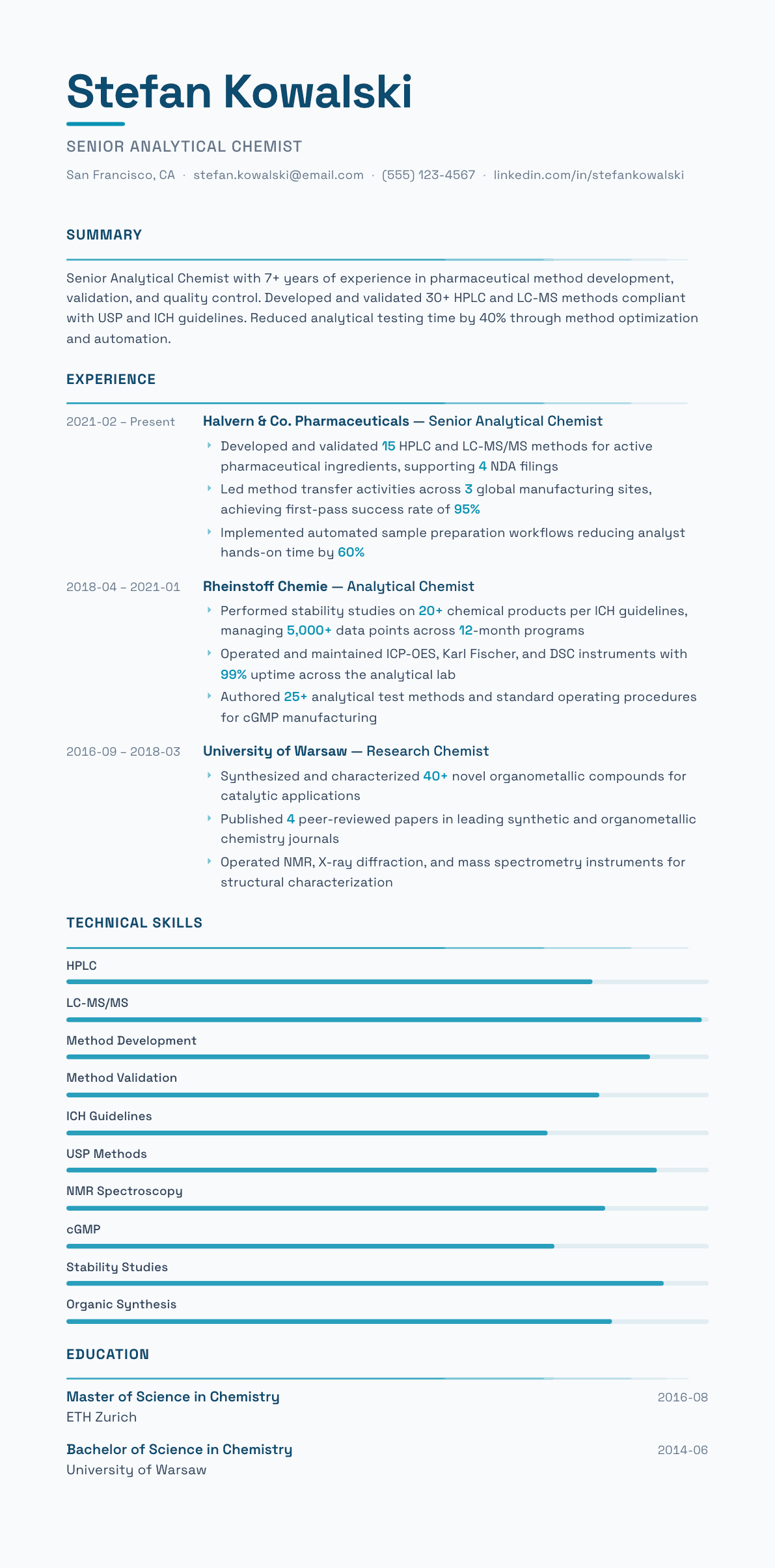
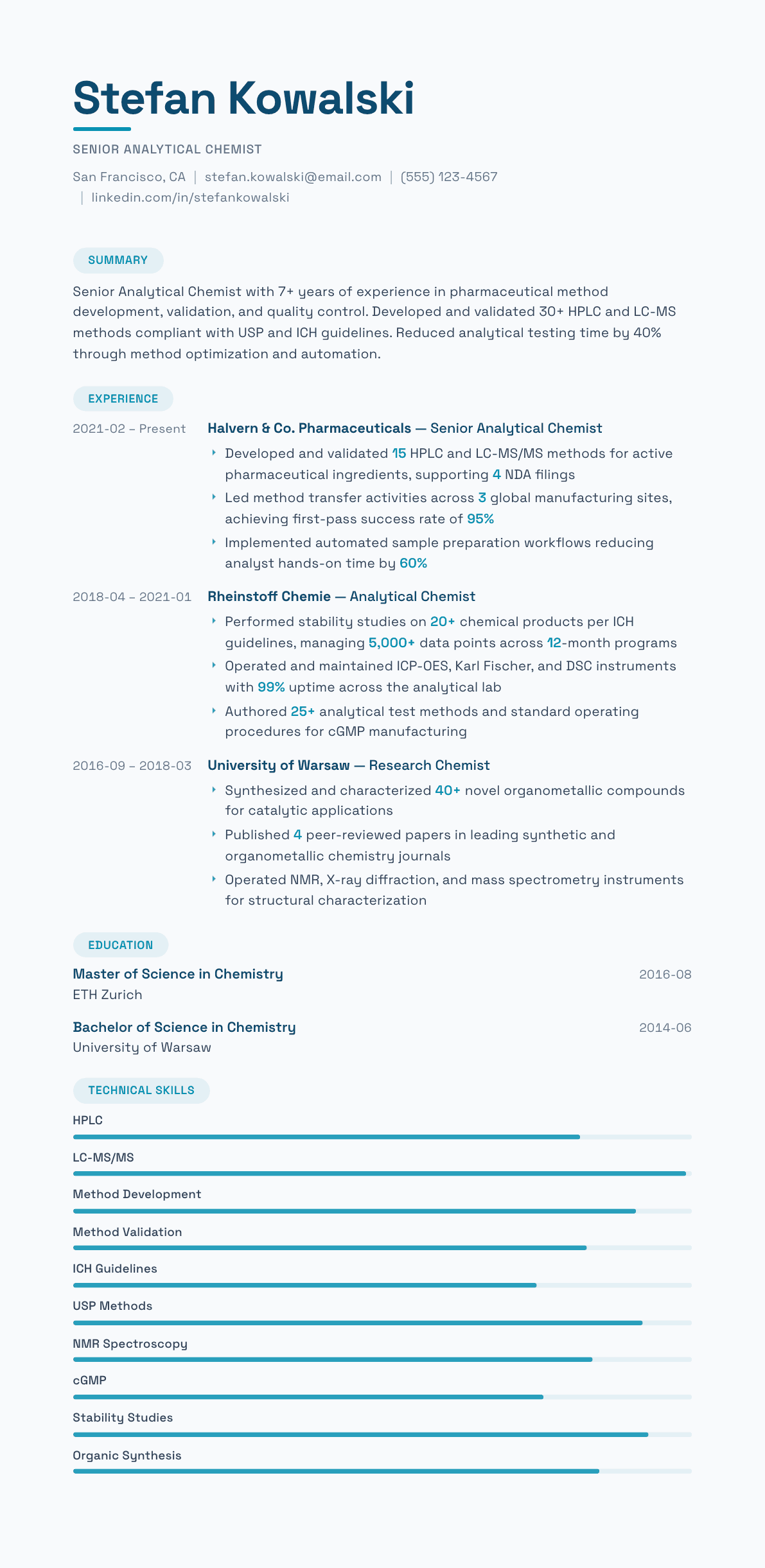
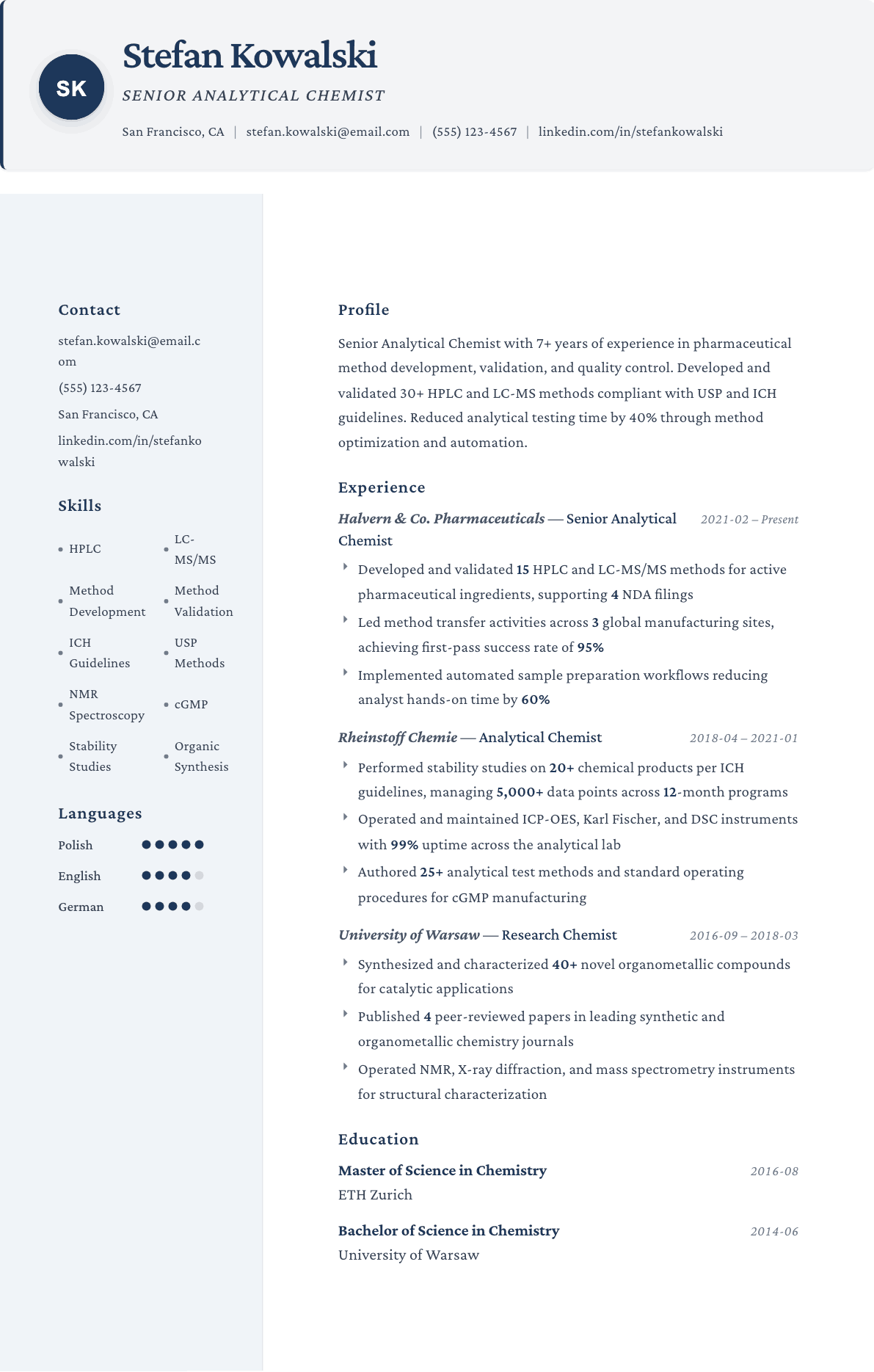
Example Chemist summary
Chartered Chemist with 7+ years in pharmaceutical analytical method development and quality control. Developed and validated 30+ HPLC and LC-MS methods compliant with USP/ICH guidelines. Reduced testing time by 40% through automation. Expert in cGMP manufacturing, stability studies, and regulatory submissions.
Skills to list on a Chemist resume
- HPLC
- LC-MS/MS
- GC-MS
- NMR Spectroscopy
- Method Development
- Method Validation
- ICH Guidelines
- USP Methods
- cGMP
- Organic Synthesis
- Stability Studies
- Quality Control
What actually gets this resume read
- List analytical instruments prominently: HPLC, GC, LC-MS, NMR, ICP-OES, FTIR, UV-Vis.
- Highlight method development and validation experience with specific counts and regulatory frameworks.
- Include regulatory compliance knowledge: ICH, USP, FDA, EMA, cGMP guidelines.
- Quantify efficiency improvements: testing time reduction, throughput increases, or cost savings.
- Mention stability studies, method transfers, and cross-site harmonization experience.
How to write a chemist resume
Chemist covers several jobs that hire on different evidence. An analytical chemist develops and validates methods and defends data. A quality control chemist runs release and stability testing to a written procedure and lives inside an audited system. A synthetic or medicinal chemist builds molecules and is judged on routes, scale and yields. A formulation chemist makes a product stable and manufacturable. A materials chemist characterizes what something is and why it fails. The instrument list overlaps; the day does not.
The reader is usually a laboratory manager who needs a specific bench covered. She is scanning for the techniques you can run unsupervised, the instrument platforms and software you already know, and the regulatory environment you have worked in. Good manufacturing practice, good laboratory practice, an accredited testing laboratory and an academic group have very different expectations about documentation, and moving between them is a real adjustment that hiring managers plan for.
This guide covers how to present techniques honestly, how to write method development and validation work, how to handle data integrity and investigations, and how to make academic bench experience readable to an industrial manager.
Format: techniques block near the top, graded by depth
One page early, two once you have several roles or a publication record. Put an instrumentation and techniques block immediately after the summary. Laboratory managers scan it first, and burying it under three jobs costs you interviews for benches you could genuinely cover.
Grade the list rather than flattening it. Separate techniques you can operate, troubleshoot and maintain from those you have run under supervision, and from those you have only had results handed to you from. Interviews in this field go directly to a practical question, such as what you do when a peak tails or a baseline drifts, and an inflated list is exposed within minutes.
- Header: name, target title, city, phone, email.
- Sections in order: summary, instrumentation and techniques, experience, education, certifications, publications and patents.
- Graduates give the research project its own block with the chemistry, the techniques and the outcome.
Summary: the chemistry, the environment, the sample type
Say what you analyze or make, in what regulatory environment, and on what sample matrix. Matrix is the detail candidates skip and managers care about, because extracting a trace analyte from plasma, from soil, from a polymer or from a finished tablet are four separate problems with different sample preparation, recovery and interference challenges.
Name the environment plainly: current good manufacturing practice, good laboratory practice, an accredited testing laboratory, a research group or a production support laboratory. Somebody who has worked in a regulated laboratory understands why a second analyst reviews her data, and hiring managers pay for that habit.
Method development and validation: the strongest evidence you have
Running a method somebody else wrote is a technician skill. Developing one is a chemist skill, so write about it in detail: the separation problem, the column chemistry and mobile phase you settled on, how you handled resolution between critical pairs, the detection you chose and why, and the sample preparation that made it reproducible.
Validation is the other half and it has a defined vocabulary. Specificity, linearity and range, accuracy and recovery, repeatability and intermediate precision, detection and quantitation limits, robustness and system suitability. Naming which of these you executed, against which guideline, tells a reader you have done validation rather than heard about it. Transfer between sites and instruments is worth adding, because a method that works only in your hands is not finished.
Data integrity, investigations and the audited habits
In regulated laboratories, how you handle a bad result matters more than how you handle a good one. Say whether you have written or investigated an out of specification result, performed a laboratory investigation, identified an assignable cause, handled a deviation, or written a corrective and preventive action. Managers hire people who will not quietly repeat an injection until the number improves.
Say which systems you worked in as well. A laboratory information management system, a chromatography data system with its own audit trail and review workflow, and an electronic laboratory notebook all leave a record, and familiarity with review by a second analyst, audit trail review and electronic signature requirements is a genuine differentiator. Add any audit or inspection you have supported and what you were responsible for during it.
- Chromatography data systems and how you handled review and audit trails.
- Out of specification and deviation investigations you led or supported.
- Stability programs, including protocol design and pull point management.
- Instrument qualification, calibration and preventive maintenance ownership.
Synthesis, formulation and materials work
For synthetic work, describe routes rather than reactions. The number of steps, the scale you have run, the purification approach, the yields you carried and how a route changed when it moved from milligram to multi-gram all say something. Add characterization by the data you interpret yourself, whether that is proton and carbon spectra, mass spectrometry, or crystal structure determination, and say whether you have handled air-sensitive or hazardous chemistry and at what containment level.
For formulation and materials, the currency is stability and manufacturability. Excipient and additive selection, compatibility studies, thermal analysis, rheology, particle size, dissolution, accelerated aging and failure analysis are the specifics. Say what a formulation had to survive and whether it made it to a scaled batch, because a formulation that only works at bench scale is a study, not a product.
Chemist resume summary examples
New graduate
Chemistry graduate with a synthetic research project producing 12 novel organometallic compounds across 4-step routes, characterized by nuclear magnetic resonance and mass spectrometry. Six months of internship experience running release testing in a quality control laboratory under written procedures.
Analytical chemist
Analytical chemist with 6 years in pharmaceutical quality control and method development, having developed 15 chromatographic methods for active ingredients and impurities in tablet and plasma matrices. Runs stability programs, closes out of specification investigations and works to recognized validation guidelines.
Senior chemist
Senior analytical chemist with 12 years across specialty chemicals and pharmaceutical manufacturing, leading method development, validation and transfer to 3 global sites. Owns the laboratory instrument qualification program, supported 4 regulatory inspections and mentors 5 analysts.
Work experience bullets: before and after
Before: Performed HPLC testing on samples.
After: Ran roughly 40 chromatographic assays a week for release and stability testing across 3 tablet products, resolving a critical impurity pair with a modified gradient and a different column chemistry.
Throughput, sample type and a specific separation problem show a working analyst rather than an instrument operator.
Before: Developed and validated analytical methods.
After: Developed and validated 15 chromatographic methods for active ingredients and related impurities, covering specificity, linearity, accuracy, precision, detection limits and robustness, and transferred 6 of them to 2 other sites.
Naming the validation parameters and the transfer proves the full lifecycle rather than a phrase from the posting.
Before: Investigated failed results.
After: Led 9 out of specification investigations to assignable cause, tracing 4 to a sample preparation step and rewriting the procedure, after which the failure rate on that assay dropped to zero for a year.
Root causes, a procedural change and a durable result are what a quality manager wants from an investigation.
Before: Synthesized compounds for the research group.
After: Synthesized 40 organometallic compounds over 3 to 5 step routes at gram scale, purified by column chromatography and recrystallization, and characterized every target by nuclear magnetic resonance and high resolution mass spectrometry.
Route length, scale, purification and characterization make synthetic productivity concrete.
Before: Maintained laboratory instruments.
After: Owned qualification, calibration and preventive maintenance for 6 chromatographic and spectroscopic instruments, holding uptime through 2 audit cycles with no observations against the instrument program.
Instrument ownership tied to audit outcomes shows responsibility that a general maintenance line does not.
Hard skills
- High performance liquid chromatography
- Gas chromatography and mass spectrometry
- Liquid chromatography tandem mass spectrometry
- Nuclear magnetic resonance spectroscopy
- Infrared and ultraviolet spectroscopy
- Inductively coupled plasma analysis
- Karl Fischer titration
- Thermal analysis by differential scanning calorimetry
- Method development and optimization
- Method validation and transfer
- Stability study design
- Sample preparation and extraction
- Organic synthesis and purification
- Laboratory information management systems
Soft skills
- Documentation discipline
- Second analyst review
- Troubleshooting under a release deadline
- Explaining data to non-chemists
- Laboratory safety awareness
- Training junior analysts
Certifications worth listing
- Certified Chemist (National Registry of Certified Chemists)
- Certified Quality Auditor (CQA) (American Society for Quality)
- Certified Six Sigma Green Belt (CSSGB) (American Society for Quality)
- Hazardous Waste Operations and Emergency Response training (Occupational Safety and Health Administration authorized provider)
Mistakes that cost chemist candidates the interview
- Listing every instrument in the building as if you can run all of them unsupervised.
- Leaving out the sample matrix, which is often the hardest part of the analysis and the reason a method took months.
- Describing method work without naming a single validation parameter you executed.
- Omitting the regulatory environment, so a manager cannot tell whether you have worked under audited documentation.
- Skipping investigations and deviations, which are the clearest evidence of scientific judgment in a regulated laboratory.
- Writing an academic bench resume for an industrial job with no mention of procedures, review or throughput.
- Putting proprietary structures, formulations or specification limits on a resume held in a recruiting system.
Chemist resume questions
How do I list instruments without overstating my experience?
Split the list into techniques you operate and troubleshoot independently, those you have run under supervision, and those you have only interpreted data from. Interviewers ask practical failure questions, so an honest grading protects you and still shows breadth.
How do I move from academic research into industry?
Translate the bench into industrial language: throughput, procedures followed, documentation, instrument ownership and troubleshooting. Emphasize technique depth and characterization, then add anything that shows you can work to a written method rather than an improvised one.
What matters most for a quality control chemist role?
Reliability inside a system. Managers look for testing to written procedures, documentation habits, second analyst review, investigation experience and instrument qualification. Method development is a bonus there; consistency and data integrity are the requirement.
Should I include publications and patents?
Yes, in a short section at the end for industrial roles, with counts and a few selected entries. For research positions, list them in full. Patents are especially valuable to industry readers because they show applied work that reached a filing.
How do I show method validation experience?
Name the parameters you personally executed, the guideline you validated against, how many methods you took through the process, and whether you transferred any to another site or instrument platform. That level of specificity is rare and reads as real experience.