Microbiologist Resume Examples: the lines they read
Build a Microbiologist Resume That Cultures Success
By Mustafa Tarabya, founder of CVBooster · Published · Updated
Create a standout microbiologist resume highlighting pathogen identification, aseptic techniques, and regulatory compliance with templates designed for life sciences hiring.
Sample resumes for a microbiologist
The same microbiologist content laid out in three CVBooster templates, so you can see what the finished document looks like before you write a word.
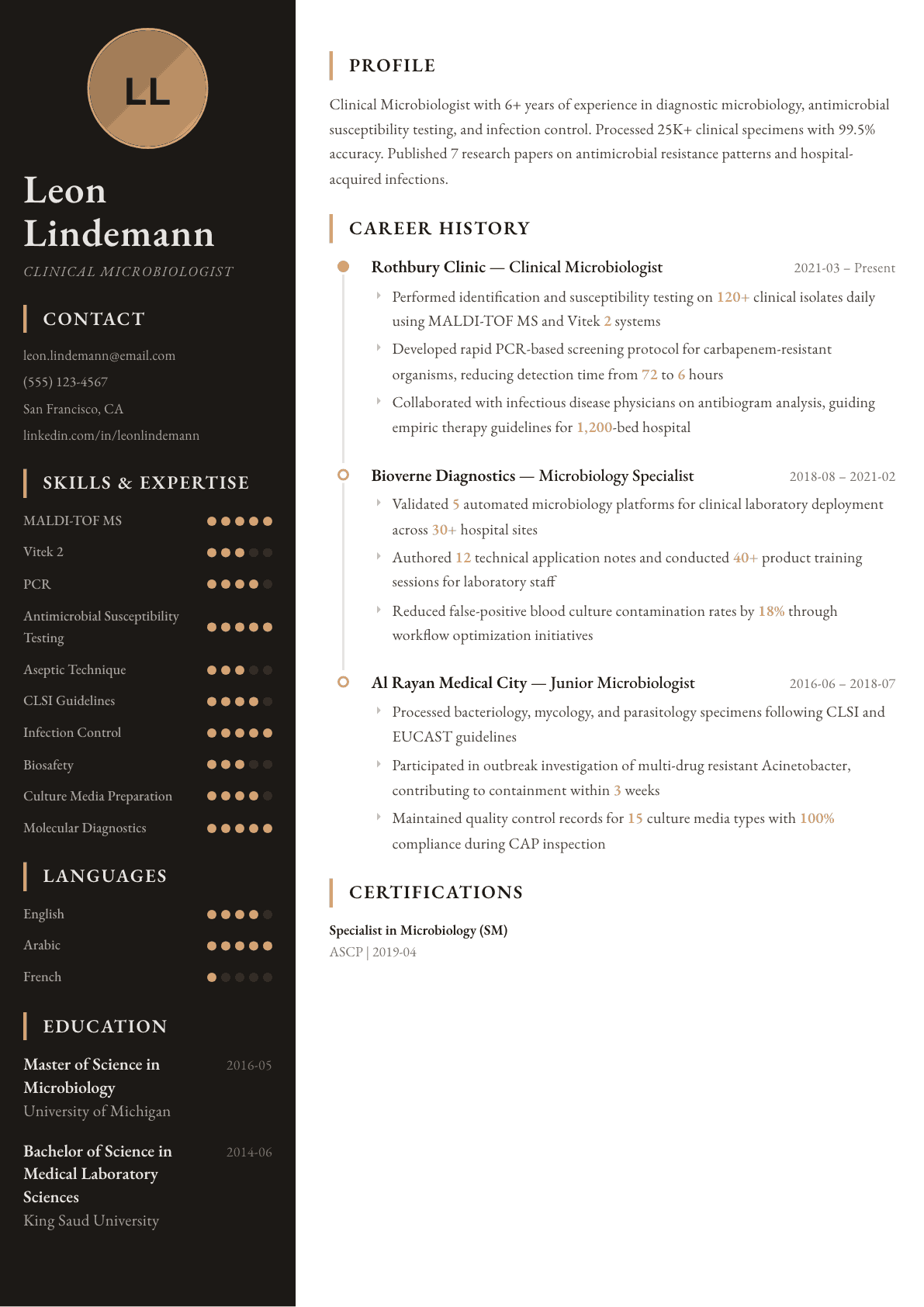
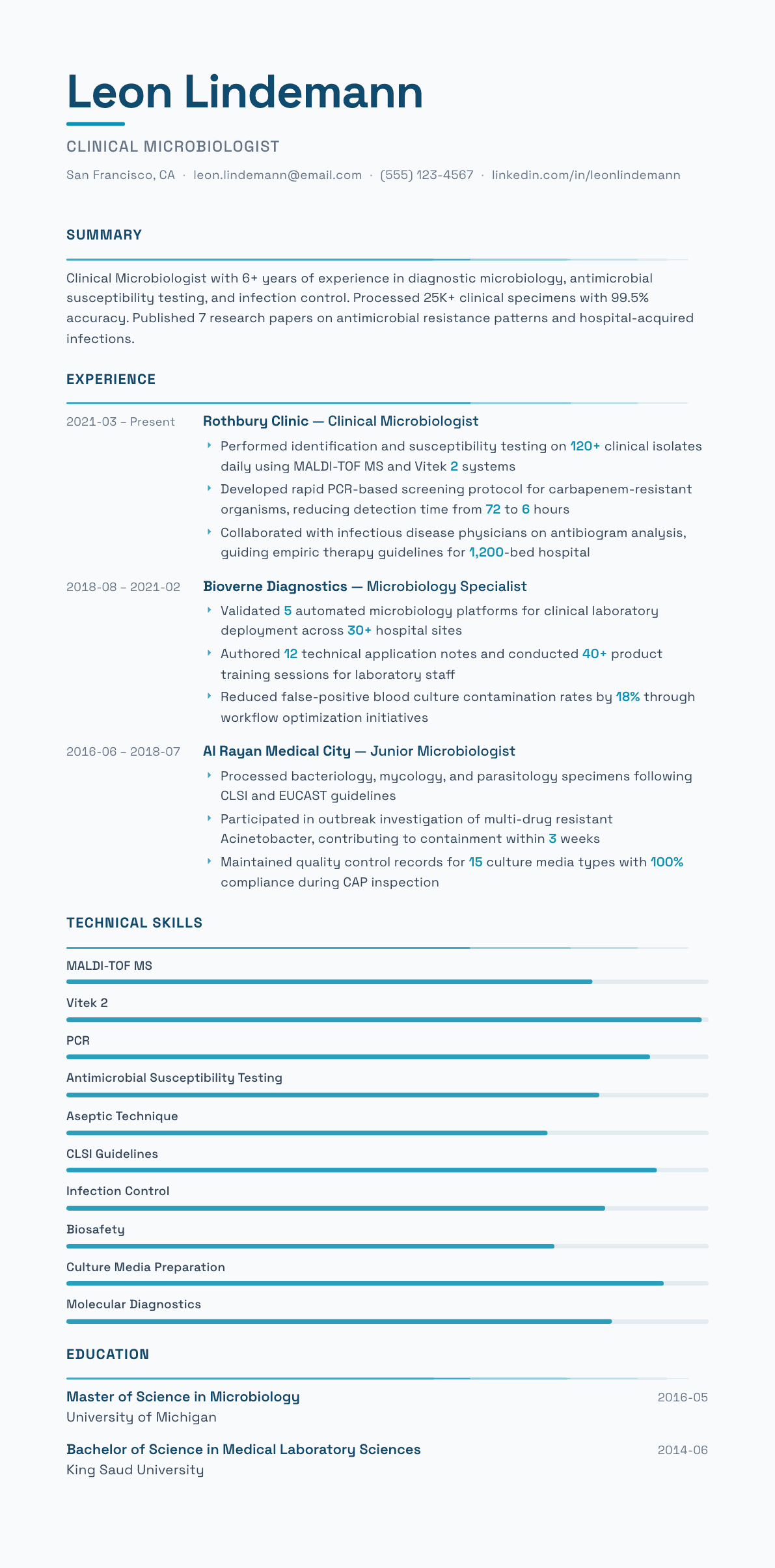
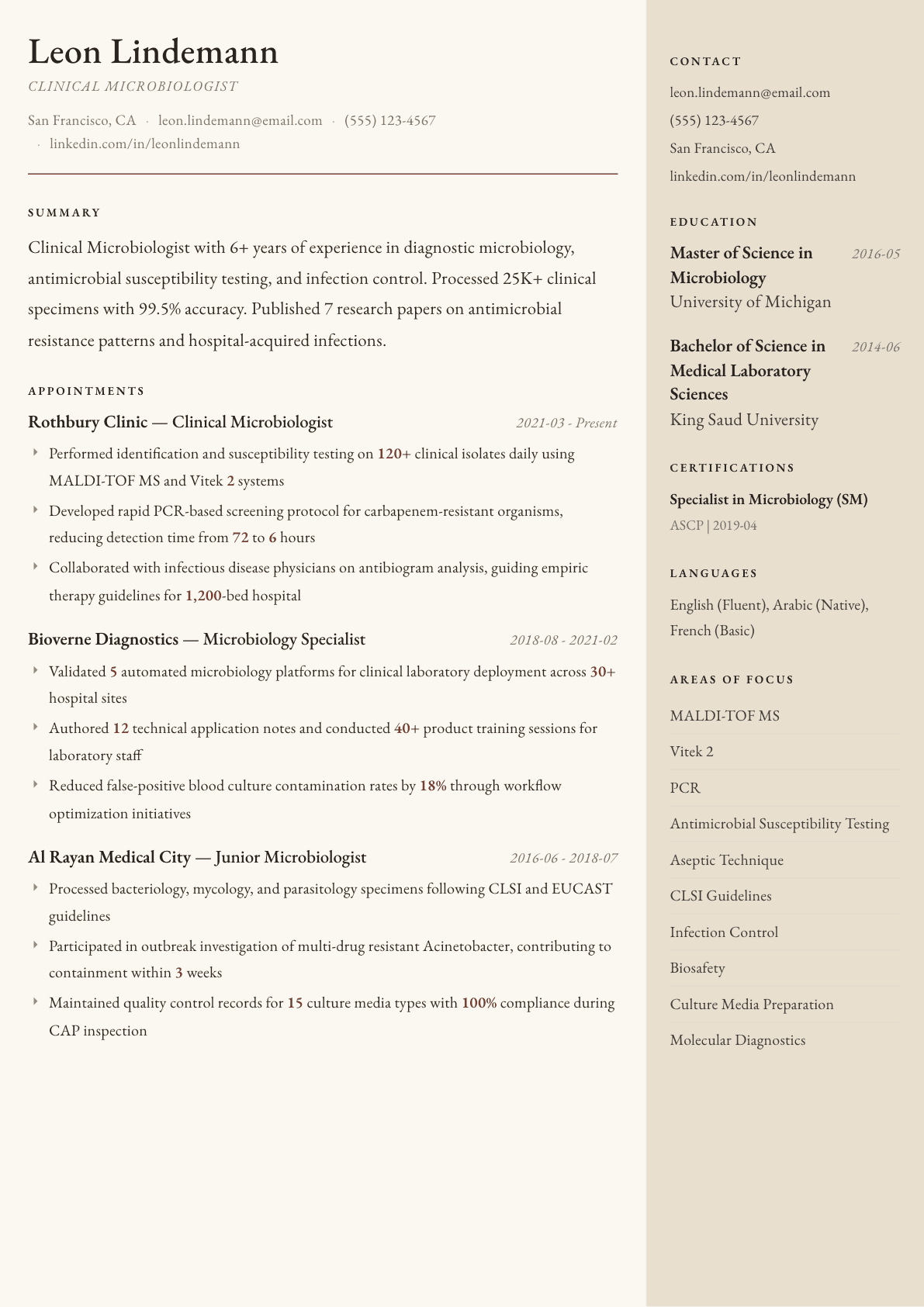
Example Microbiologist summary
Board-certified Clinical Microbiologist with 6+ years of expertise in diagnostic microbiology, molecular diagnostics, and antimicrobial resistance surveillance. Processed 25K+ clinical specimens with 99.5% accuracy and published 7 peer-reviewed papers. Runs MALDI-TOF MS, Vitek 2, and PCR-based rapid diagnostics daily.
Skills to list on a Microbiologist resume
- Diagnostic Microbiology
- MALDI-TOF MS
- PCR / RT-PCR
- Antimicrobial Susceptibility
- Vitek 2
- Blood Culture Systems
- Parasitology
- Mycology
- Infection Control
- CLSI / EUCAST
- Quality Assurance
- Biosafety Protocols
What actually gets this resume read
- Highlight specific microbiology platforms and techniques: MALDI-TOF, Vitek, PCR, culture methods.
- Quantify specimen throughput, accuracy rates, and turnaround time improvements.
- Include regulatory framework knowledge: CLSI, EUCAST, CAP, CLIA standards.
- Mention publications, posters, or conference presentations to differentiate from other candidates.
- Describe your role in outbreak investigations or infection control committees.
How to write a microbiologist resume
Microbiologist resumes go to four very different desks. A clinical laboratory director wants specimen throughput, identification and susceptibility platforms, and accreditation readiness. A pharmaceutical quality control manager wants environmental monitoring, sterility assurance and data integrity under good manufacturing practice. A food safety manager wants pathogen testing, sampling plans and audit history. A research group wants molecular technique and publication. The same page cannot serve all four.
Whichever desk yours lands on, the reader is checking the organisms you have handled, the containment level you have worked at, the platforms you have run, and whether your documentation would hold up during an inspection. Microbiology is a regulated craft, and the paperwork is part of the science.
This guide covers how to structure the document, how to describe technique so it reads as independent bench competence, summaries from a first laboratory role to a supervising microbiologist, and the questions people ask when moving between clinical, industrial and research microbiology.
Format: sector first, technique block near the top
Use a plain single column, reverse chronological resume of one to two pages for clinical, industrial and food roles. Research and academic positions expect a curriculum vitae with publications and presentations listed in full, so keep both versions maintained rather than trying to convert one into the other under time pressure.
Place a techniques and platforms block directly under the summary. The reader is looking for whether you can run identification and susceptibility on their systems, or whether you have performed sterility and endotoxin testing, and that answer should not be buried in a job from three positions ago.
- Header: name, city and state, phone, email, and your board certification abbreviation if you hold one.
- Order: summary, techniques and platforms, laboratory experience, education, certifications, publications if relevant.
- State biosafety level worked at and any select agent or containment training in the skills block.
Summary: setting, organisms, platforms, standards
The first line should place you in a laboratory type. Diagnostic bacteriology in a hospital core laboratory, sterility assurance in an injectable manufacturing plant, pathogen testing in a food production environment, and environmental or water microbiology all have distinct daily work.
Then the organisms and the platforms. Say whether you work with bacteria, mycobacteria, fungi, parasites or viruses, and name the identification and susceptibility systems: mass spectrometry based identification, automated identification and susceptibility instruments, molecular panels and quantitative polymerase chain reaction. Finish with the standard you interpret against, since susceptibility breakpoint interpretation and compendial method work are separate skill sets.
Experience: independence at the bench, and what you own beyond it
Open each role with laboratory type and scope: bed count for a hospital laboratory, the products released for a manufacturing site, or the sample streams for a contract laboratory. Then say what section you covered and whether you worked days, nights or a rotating on-call schedule, because round the clock competence is a real differentiator in clinical microbiology.
Write bench bullets so a reader sees judgment. Reading a mixed plate and knowing what to work up, recognizing a contaminant against a true pathogen, calling a critical result and knowing who to call, and holding a report when a control fails are all decisions rather than tasks. Include aseptic technique, media preparation and growth promotion, staining, culture workup, identification, susceptibility testing and molecular methods, but always attached to a decision or a volume.
Then show what you own above the bench. Method verification and validation, writing and revising procedures, quality control review, proficiency testing, corrective and preventive actions, instrument qualification, training and competency assessment of other staff, and audit or inspection support. In industrial settings add environmental monitoring programs, trending of excursions, investigations into contamination events, and media fill support.
For infection prevention or public health work, name the collaborations: antibiogram production, resistance surveillance, outbreak investigation with typing methods, and reporting to public health authorities. These bullets travel well across all sectors because they demonstrate interpretation rather than execution.
Skills: technique, instruments, biosafety, data
Separate technique from platform. Technique includes aseptic handling, streaking for isolation, anaerobic and mycobacterial culture, Gram and acid fast staining, biochemical identification, broth microdilution and disk diffusion, minimum inhibitory concentration determination, nucleic acid extraction, polymerase chain reaction and sequencing, and microbial enumeration methods.
Platforms and systems should be named specifically, including the laboratory information system, since it drives result entry and turnaround discipline. Add biosafety training, cabinet certification awareness, decontamination and spill response, and any containment level two or three experience.
Data skills increasingly matter. Trending environmental monitoring results, building an antibiogram, working with sequencing data, or using statistics to justify a limit are all evidence that you can support decisions rather than just generate results.
Education, certification and regulatory keywords
A bachelor or master degree in microbiology, biology or medical laboratory science is the norm, with doctorates common in clinical laboratory direction and research. Put the degree below experience once you have worked, and name the coursework or thesis organism system only if it is directly relevant.
Mirror the regulatory language of the sector once in the summary and once in a bullet. Clinical laboratories run on laboratory accreditation and proficiency testing. Manufacturing runs on good manufacturing practice, compendial chapters for sterility and microbial enumeration, data integrity and deviation handling. Food runs on hazard analysis, preventive controls and third party audit schemes. Using the right dialect is the fastest signal that the resume was written for that job.
Microbiologist resume summary examples
First laboratory role
Microbiology graduate with laboratory experience in aseptic technique, media preparation, Gram staining and culture workup, plus a research project using polymerase chain reaction and sequencing for bacterial identification. Trained in biosafety level 2 practices. Seeking a bench microbiologist position in clinical or quality control testing.
Four years at the bench
Clinical microbiologist working all benches in a hospital laboratory, processing about 250 specimens per shift with mass spectrometry identification and automated susceptibility testing. Verified two molecular respiratory panels, revised 9 procedures, and maintained 100% acceptable proficiency testing results across three survey years.
Supervising microbiologist
Microbiology supervisor with 11 years across clinical diagnostics and sterile manufacturing. Runs environmental monitoring and sterility assurance for an injectable site, leads contamination investigations, and manages a team of 8 analysts. Led the laboratory through two regulatory inspections with no microbiology observations.
Work experience bullets: before and after
Before: Performed microbiological testing on samples.
After: Worked up respiratory, wound and blood culture specimens through Gram stain, culture and identification, and released about 200 results per shift against defined turnaround targets.
Specimen types, the workflow and a throughput figure let a laboratory manager judge whether you can hold a bench alone.
Before: Used automated systems for identification and susceptibility.
After: Ran mass spectrometry identification and automated susceptibility testing on around 120 isolates daily, applied current breakpoint standards, and escalated resistance patterns that required confirmatory testing.
Applying breakpoints and escalating unusual results shows interpretation, which the instrument itself cannot do.
Before: Helped with environmental monitoring in the cleanroom.
After: Ran the viable and non-viable environmental monitoring program for two grade A filling lines, trended excursions monthly, and traced a recurring alert to a gowning step that was corrected in the procedure.
Owning the program and finding a root cause in the trend data is a different job from taking the plates.
Before: Involved in an outbreak investigation.
After: Supported an outbreak investigation of a multidrug-resistant organism by typing 18 isolates, building the case timeline with infection prevention, and producing the ward-level antibiogram used to revise empiric therapy.
Naming the typing work and the deliverable shows you contributed evidence rather than attended meetings.
Before: Trained new staff on lab procedures.
After: Wrote the training plan and competency assessments for three benches, trained 6 new technologists, and documented annual competency for the section ahead of the accreditation inspection.
Written assessments and inspection readiness turn informal training into a quality system contribution.
Hard skills
- Aseptic technique and sterile handling
- Culture, isolation and colony morphology
- Gram and acid fast staining
- Anaerobic and mycobacterial culture
- Antimicrobial susceptibility testing
- Mass spectrometry organism identification
- Polymerase chain reaction and sequencing
- Sterility and bioburden testing
- Endotoxin testing
- Environmental monitoring and trending
- Media preparation and growth promotion
- Method verification and validation
- Biosafety level 2 practice
- Laboratory information system use
Soft skills
- Judgment on ambiguous plates
- Strict documentation habits
- Communicating critical results
- Working night and weekend rotations
- Training and competency coaching
- Composure during investigations
Certifications worth listing
- Technologist in Microbiology, M(ASCP) (ASCP Board of Certification)
- Specialist in Microbiology, SM(ASCP) (ASCP Board of Certification)
- Registered Microbiologist (National Registry of Certified Microbiologists, American Society for Microbiology)
- Registered Biosafety Professional (RBP) (ABSA International)
- Medical Technologist (American Medical Technologists)
Mistakes that cost microbiologist candidates the interview
- Using one resume for clinical, pharmaceutical and food microbiology when each sector screens on different standards and different daily work.
- Listing organisms and techniques with no volume, no setting and no decision attached, which reads as coursework rather than employment.
- Leaving the quality system work off the page, when method verification, procedure writing and inspection support are often what the posting is really hiring for.
- Failing to state biosafety level and containment training, which a hiring supervisor needs before assigning you to a bench.
- Overstating molecular experience. Running a closed cartridge panel and building a laboratory developed assay are very different, so say which one you did.
- Omitting the board certification abbreviation for clinical positions where it is a licensure or accreditation requirement rather than a preference.
Microbiologist resume questions
What certification do I need to work as a clinical microbiologist?
Most hospital laboratories expect board certification as a technologist, and some states add their own personnel licensure on top. Read the posting for the exact credential and personnel qualification wording, and put the abbreviation next to your name as well as in a certifications section.
How do I move from research microbiology into industry?
Reframe your bench work around repeatability, documentation and compliance rather than discovery. Industry wants analysts who follow a validated method identically, log everything contemporaneously and raise deviations, so highlight any protocol writing, quality control review or audit exposure you already have.
Should a microbiologist resume list publications?
On a research or academic curriculum vitae, list them fully. On an industry or clinical resume, keep a short selected list of the most relevant work and use the space instead for method verification, procedure authorship and inspection outcomes, which those employers weight more heavily.
How do I describe environmental monitoring experience?
Name the grades or classifications of the areas, the sample types including viable air, surface and personnel monitoring, the frequency, and what you did with the results. Trending, alert and action limit handling, and investigation of excursions are the parts that show program ownership.
Is a master degree needed to advance in microbiology?
It helps for supervisory, validation and laboratory direction paths, and it is often required for clinical laboratory leadership. Bench and quality control advancement frequently rests on certification, breadth across benches and demonstrated ownership of methods and investigations instead.