Research Scientist Resume Examples: the lines they read
Research Scientist Resume and Scientist CV Examples, Bench to Group Lead
By Mustafa Tarabya, founder of CVBooster · Published · Updated
Research scientist resume and scientist CV examples: the two page industry resume and the academic CV order for postdocs, staff scientists and group leads.
Sample resumes for a research scientist
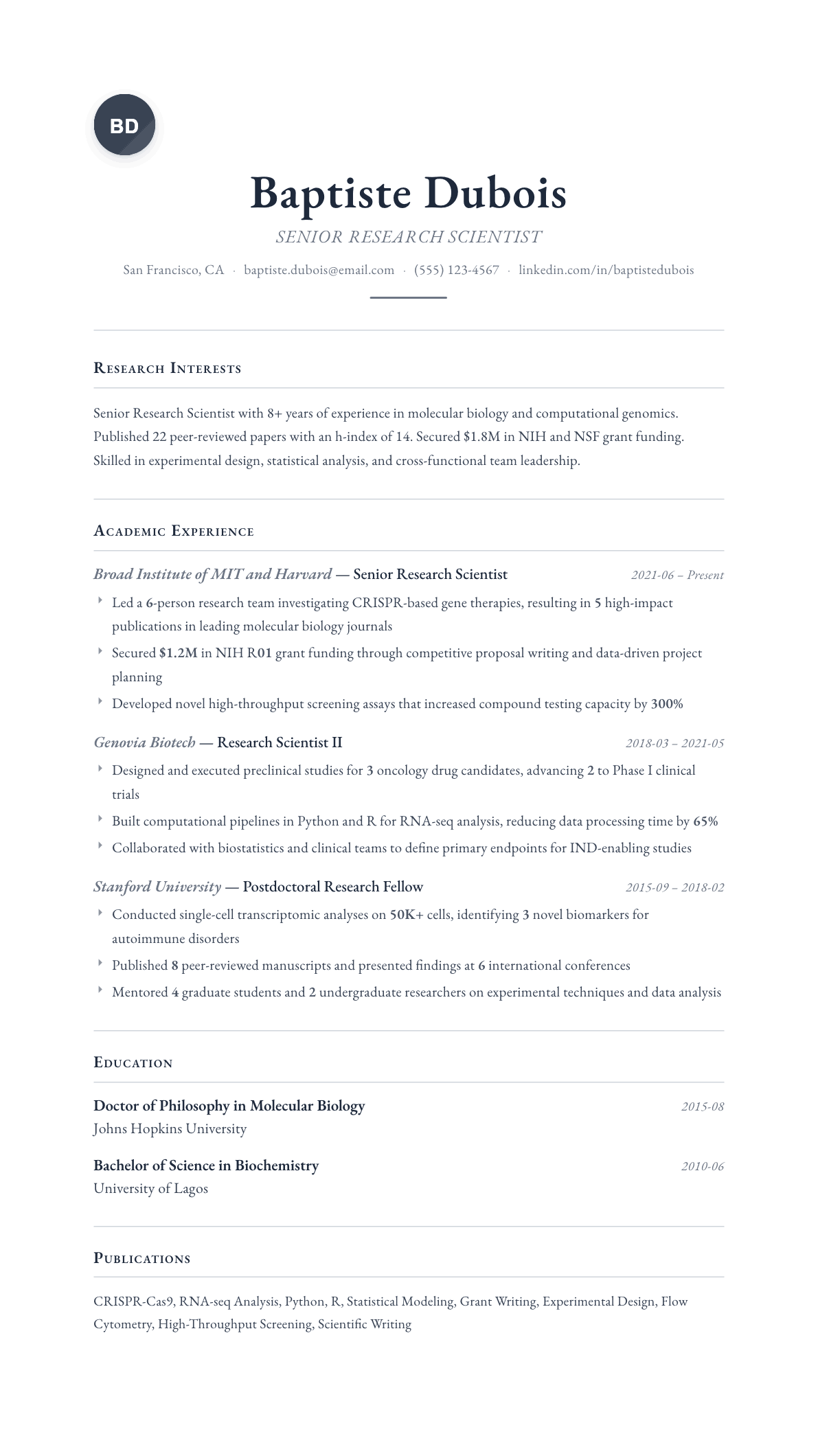
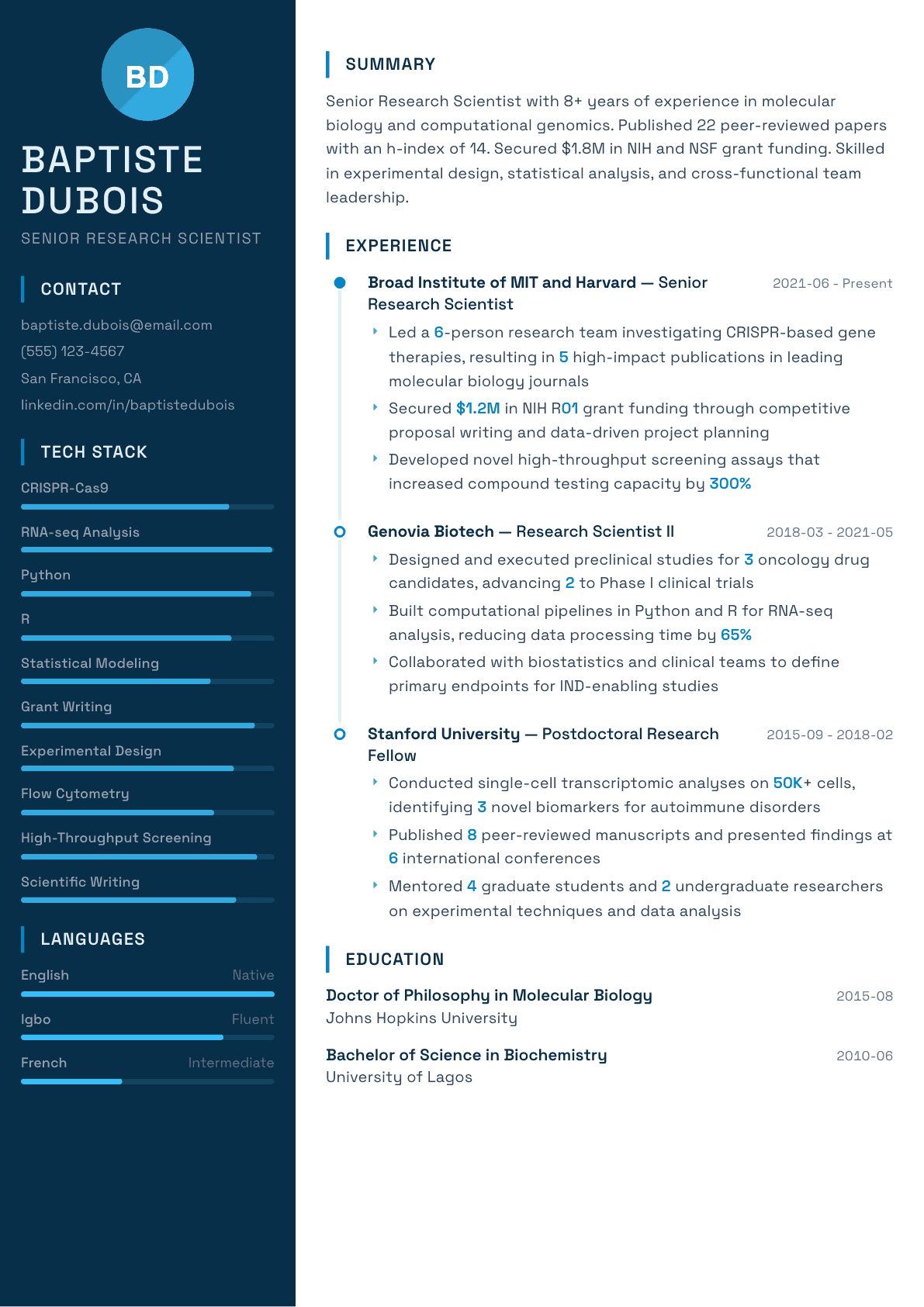
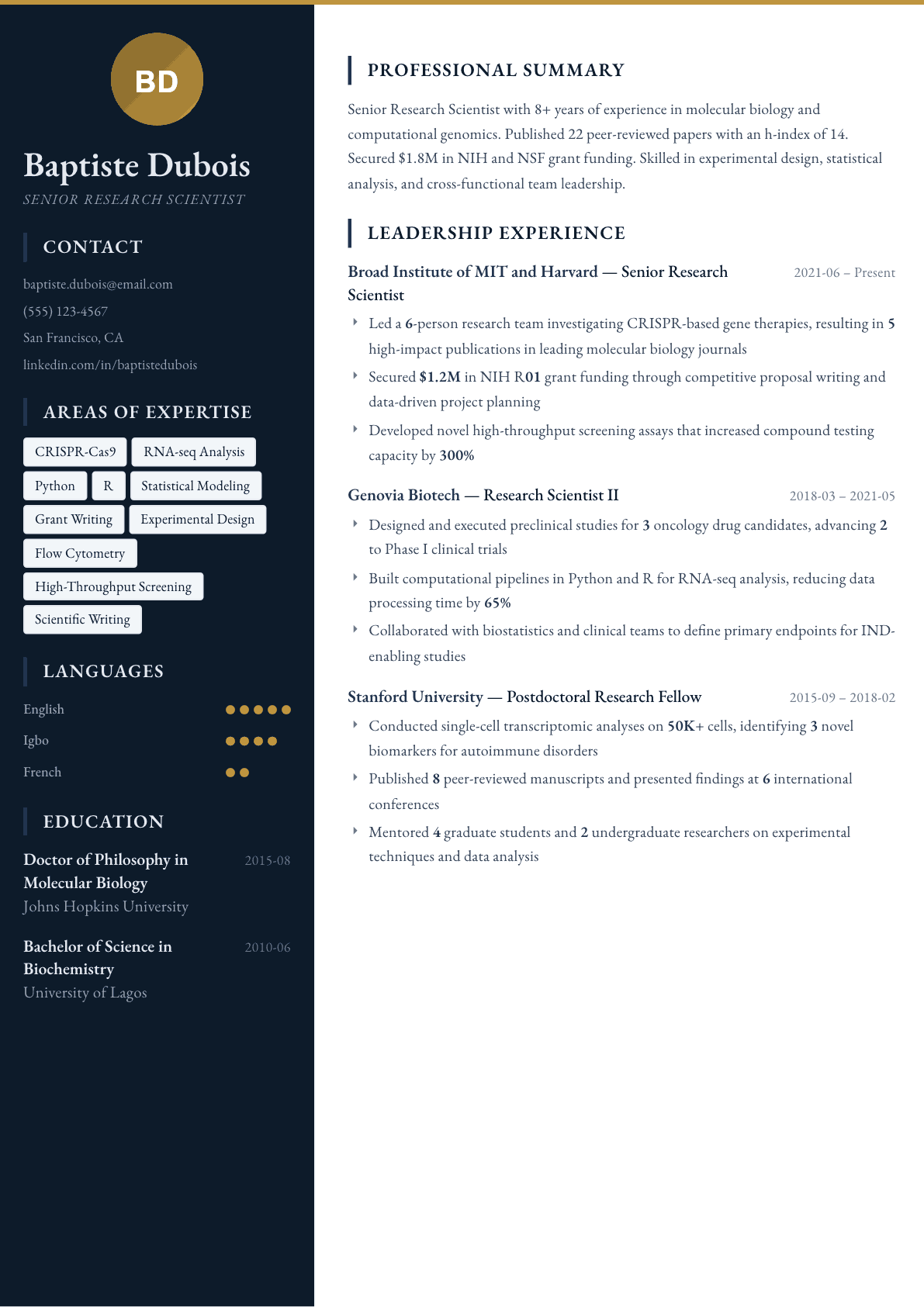
The same research scientist content laid out in three CVBooster templates, so you can see what the finished document looks like before you write a word.
Example Research Scientist summary
Published Research Scientist with 8+ years of experience in molecular biology and genomics. Authored 22 peer-reviewed papers (h-index 14) and secured $1.8M in NIH/NSF funding. Expert in CRISPR, RNA-seq, and computational biology, with two preclinical oncology candidates advanced to Phase I.
Skills to list on a Research Scientist resume
- Experimental Design
- Statistical Analysis
- Python
- R Programming
- CRISPR-Cas9
- RNA-seq
- Flow Cytometry
- Grant Writing
- Scientific Writing
- Peer Review
- Data Visualization
- High-Throughput Screening
What actually gets this resume read
- Lead with your publication count, h-index, and total grant funding secured to establish credibility immediately.
- Include a dedicated Publications section or link to your Google Scholar profile.
- Quantify research impact: number of compounds screened, patients studied, datasets analyzed, or experiments completed.
- Highlight both wet-lab and computational skills since modern research demands both.
- Mention mentorship and supervision experience to show leadership capability.
How to write a research scientist resume
A research scientist resume is judged on evidence of independent output. The reviewer, usually a principal scientist or a group head, is looking for a line of work you owned end to end: a question you framed, a system you built to answer it, data you generated, and a conclusion somebody acted on. Publications and grants are proxies for that, not substitutes.
In industry the calculus shifts. A biotech or materials company hires a research scientist to move a program forward against a timeline, so the reviewer wants project ownership, technique breadth, and evidence you can hand your work to development without it falling apart. Academic-style pages that list every technique alphabetically and every poster ever presented read as unfocused.
If you searched for scientist CV examples, the section below on the academic CV shows the order a hiring committee expects, entry by entry, for a postdoc, a staff scientist and a group leader. This guide also covers how to choose between a resume and a curriculum vitae, how to write the techniques and platforms section so it survives keyword screening, how to describe results without overstating them, and the questions scientists ask when they move from the bench to the job market.
Resume for industry, curriculum vitae for academia
For a company position, hold the document to two pages and structure it like an engineering resume: summary, technical platforms, research experience with outcomes, education, selected publications and patents. For a university or institute position, use the full academic record with complete publications, funding, teaching and service.
The cut is not cosmetic. On two pages, each position gets three to five bullets, and each bullet has to earn its place by showing a decision, a deliverable or a capability. Anything that only proves you were in a laboratory should be removed.
- Header: name, degree, city, phone, email, and a professional profile link if you maintain one.
- A techniques and platforms block directly under the summary, grouped by category.
- Patents and disclosures listed separately from publications, since industry reviewers weight them differently.
Scientist CV examples: what goes in the academic version
In the United States a CV for a scientist is the long academic record, not a short resume, and the order of its sections is close to standard. Education comes first for early career scientists and moves down once you hold a faculty or staff scientist post. Under each entry, give the institution, the group or advisor, the dates and one line on the research question, because the committee reads the CV to follow your line of work across positions.
A postdoc CV example leads with the doctorate and postdoctoral position, then publications split into refereed articles, preprints and manuscripts in revision, then fellowships and awards, talks, teaching and mentoring. A staff scientist CV adds the platforms and core facilities you run and the collaborations you support. A group leader CV opens with current appointment and funding, then publications, then trainees supervised with where they went next.
- Postdoc: education, research positions, publications by type, fellowships, invited talks, teaching, mentoring, service.
- Staff scientist: appointment, platforms and methods owned, collaborations supported, publications, training delivered.
- Group leader: appointment, grants as principal investigator, publications, trainees and their next positions, review and editorial service.
- Every version: your name in bold in each author list, and the status of every manuscript stated plainly.
Write research as ownership, not activity
Each position should open with the group, the program area and your role in it, then move into what you personally drove. Say whether you designed the study, executed it, analyzed it, or all three. A reviewer who cannot separate your contribution from your supervisor's will assume the smaller one.
The strongest bullets show a full arc: a hypothesis, an assay or model built to test it, a result, and the program decision that followed. Advancing a candidate, killing a candidate, changing a formulation, or redirecting a screening strategy are all decisions, and naming one proves your work mattered outside your notebook.
Include the operational side of research: assay development and qualification, reagent and sample management, instrument ownership, protocol writing, and the technology transfer that hands your method to another team. Companies value scientists whose methods survive being handed over.
Techniques and platforms: grouped, specific, honest
This block is what keyword screening reads. Group by category so it stays legible: molecular biology, cell culture and cell-based assays, protein and biochemistry, analytical and imaging instrumentation, in vivo work, and computational analysis. Then name the specific methods and platforms inside each group.
Be honest about depth. If you have run a technique twice under supervision, it does not belong beside the assay you developed. Interviewers probe this list line by line, and an inflated entry costs the whole document its credibility in one question.
Add the computational layer even if you are primarily an experimentalist: statistical analysis, the language you script in, the pipelines you use for sequencing or imaging data, and the electronic laboratory notebook and data systems you have worked in.
Publications, patents and funding
On an industry resume, list up to five publications under a heading that marks them as selected, and put first-author or corresponding-author work first. Add patents and filed applications with the status, because in a company a granted patent often carries more weight than another paper.
Funding matters for academic and institute roles: name the program, your role, and the period. On an industry document, condense it to a single line about competitive proposals awarded, since the reviewer reads it as evidence you can argue for resources and deliver against a commitment.
Regulated environments and team leadership
If you have worked under laboratory quality frameworks, say so precisely: good laboratory practice, good manufacturing practice, validated methods, controlled documentation, or a specific animal care and use protocol. Companies filing with regulators need scientists who can generate data that will survive an audit.
Leadership on a research resume is not headcount alone. Name the students, technicians or associates you supervised, the projects you ran across functions, and the collaborations you managed with external partners or contract laboratories, which is now a large part of how research actually happens.
Research Scientist resume summary examples
New PhD
Molecular biologist completing a doctorate on transcriptional regulation, with 5 years of independent bench work covering CRISPR editing, RNA sequencing and confocal imaging. First author on 3 papers and experienced in analyzing sequencing data in R. Seeking a research scientist position in target discovery.
Five years in industry
Research scientist with 5 years in preclinical oncology, owning assay development and in vitro pharmacology for two programs. Built and qualified a cell-based potency assay now used across the site, and generated the data package supporting advancement of a lead series into in vivo studies.
Principal scientist
Principal research scientist with 12 years in biologics discovery, leading a group of 6 and accountable for platform strategy from screening to candidate selection. Inventor on 5 patent families, author of 24 refereed papers, and program representative to development and regulatory teams.
Work experience bullets: before and after
Before: Performed experiments to support the research program.
After: Designed and ran the in vitro screening cascade for a 400-compound series, triaging on potency and selectivity and delivering the dataset that selected 3 compounds for animal studies.
Scale, criteria and the selection decision show you drove the program rather than supplying data to it.
Before: Experienced in cell culture and molecular biology techniques.
After: Developed and qualified a luminescence-based potency assay in primary cells, reducing plate-to-plate variability enough to cut the replicate count per compound from six to three.
One developed and qualified method with a measured effect beats a list of techniques anyone can claim.
Before: Published research in peer-reviewed journals.
After: First author on 3 refereed papers and inventor on a filed patent application covering the screening method, presented as an invited talk at an international meeting.
Authorship position and intellectual property show output an industry reviewer can weigh directly.
Before: Analyzed data using computational tools.
After: Built an R pipeline for differential expression across 60 sequencing samples, standardizing quality control and cutting the turnaround from raw reads to reviewed results to two days.
Sample count, tool and turnaround make computational work a delivered capability, not a familiarity.
Before: Supervised junior lab members.
After: Trained and supervised 2 research associates and 4 rotating students, writing the protocols and onboarding checklist the group now uses for new joiners.
The artifacts that outlived the mentoring prove the supervision produced something durable.
Hard skills
- Experimental design and hypothesis testing
- Assay development and qualification
- Cell culture and cell-based assays
- Molecular cloning and CRISPR editing
- Protein expression and purification
- Flow cytometry
- Microscopy and image analysis
- Chromatography and mass spectrometry
- Next-generation sequencing analysis
- Statistical analysis in R
- Python for data analysis
- Protocol and technical report writing
- Laboratory information and notebook systems
Soft skills
- Framing a research question independently
- Presenting to cross-functional teams
- Collaboration with external partners
- Scientific judgment on negative results
- Mentoring associates and students
Mistakes that cost research scientist candidates the interview
- Sending an academic record with a full publication list to a company that asked for a two-page resume.
- Listing every technique ever touched, so the reviewer cannot tell which methods you could set up alone tomorrow.
- Writing bullets that describe the project without separating your contribution from the group's.
- Reporting results with no downstream consequence, which leaves the reviewer unsure whether anything came of the work.
- Omitting patents, disclosures and technology transfer, which are the industry equivalents of publications.
- Using laboratory jargon and internal program codes that nobody outside your former employer can decode.
Research Scientist resume questions
How do I convert an academic CV into a research scientist resume?
Cut to two pages, replace the publication list with five selected entries, move techniques into a grouped block near the top, and rewrite each position around what you owned and what decision your data supported rather than the topic you studied.
How many publications should a research scientist list?
Five at most on an industry resume, chosen for relevance and led by first-author work. Include patents and applications separately. On an academic document, list everything, grouped by refereed articles, preprints and conference proceedings.
Should I include failed projects or negative results?
Yes, when the outcome saved the program time or money. A study that closed a hypothesis cleanly demonstrates rigor and judgment, which is exactly what a hiring scientist wants. Write it as a decision supported, not as a project that did not work.
What if my publications are still under review?
List them honestly with their status: manuscript submitted, in revision, or a preprint with the repository named. Never list a paper as published before it is. Reviewers check, and an unverifiable citation ends the application.
What does a good scientist CV example look like?
It reads as one line of research across positions. Education and appointments with the group and dates, then publications grouped by type with your name in bold, then funding, talks, teaching and trainees. Postdoc positions sit under research experience, written like jobs. For industry applications, cut the same record to a two page resume.