Food Scientist Resume Examples: the lines they read
Cook Up a Food Scientist Resume That Impresses
By Mustafa Tarabya, founder of CVBooster · Published · Updated
Build a food scientist resume highlighting product development, food safety, and quality assurance expertise with ATS-optimized templates for CPG and manufacturing roles.
Sample resumes for a food scientist
The same food scientist content laid out in three CVBooster templates, so you can see what the finished document looks like before you write a word.
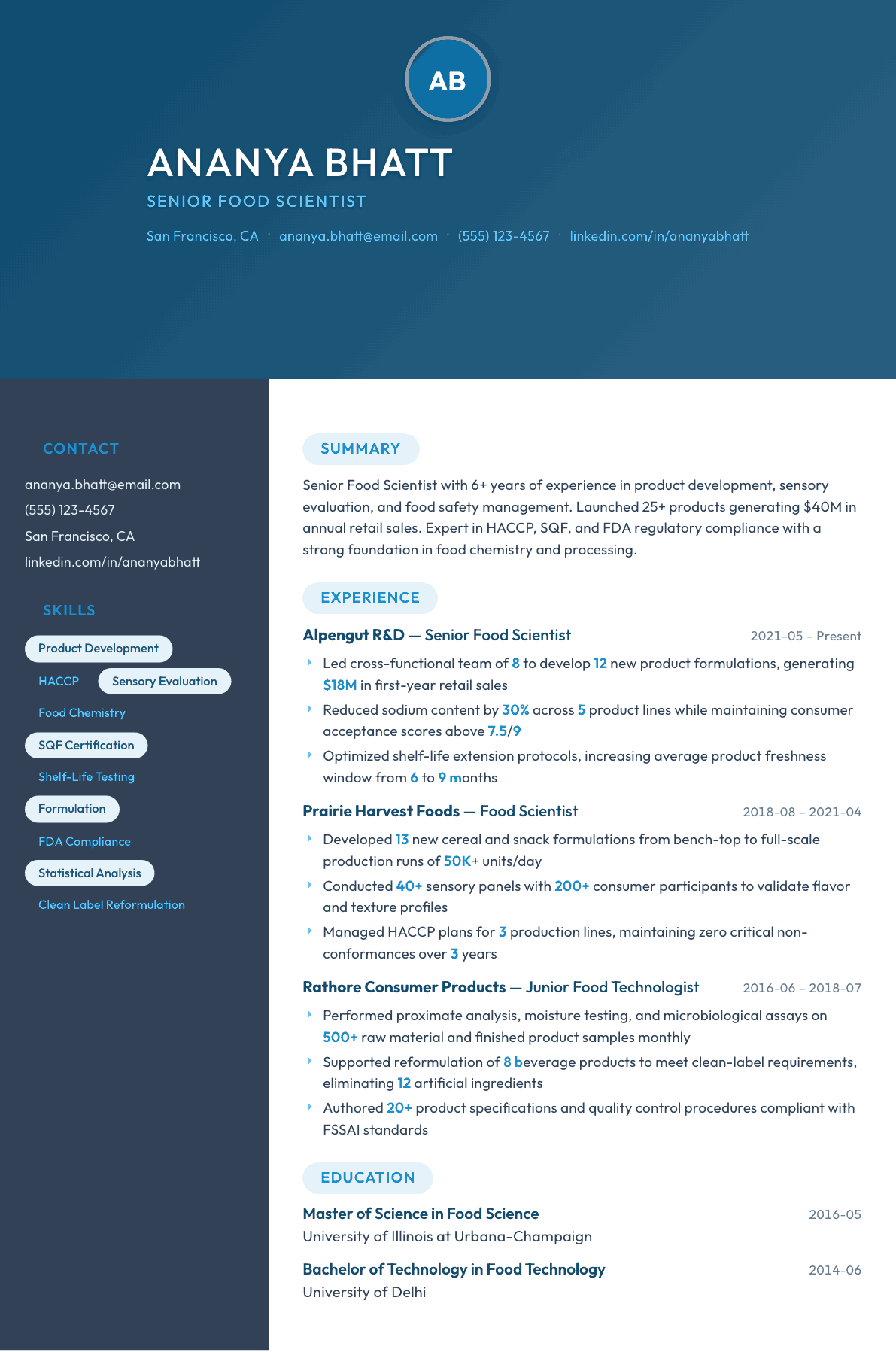
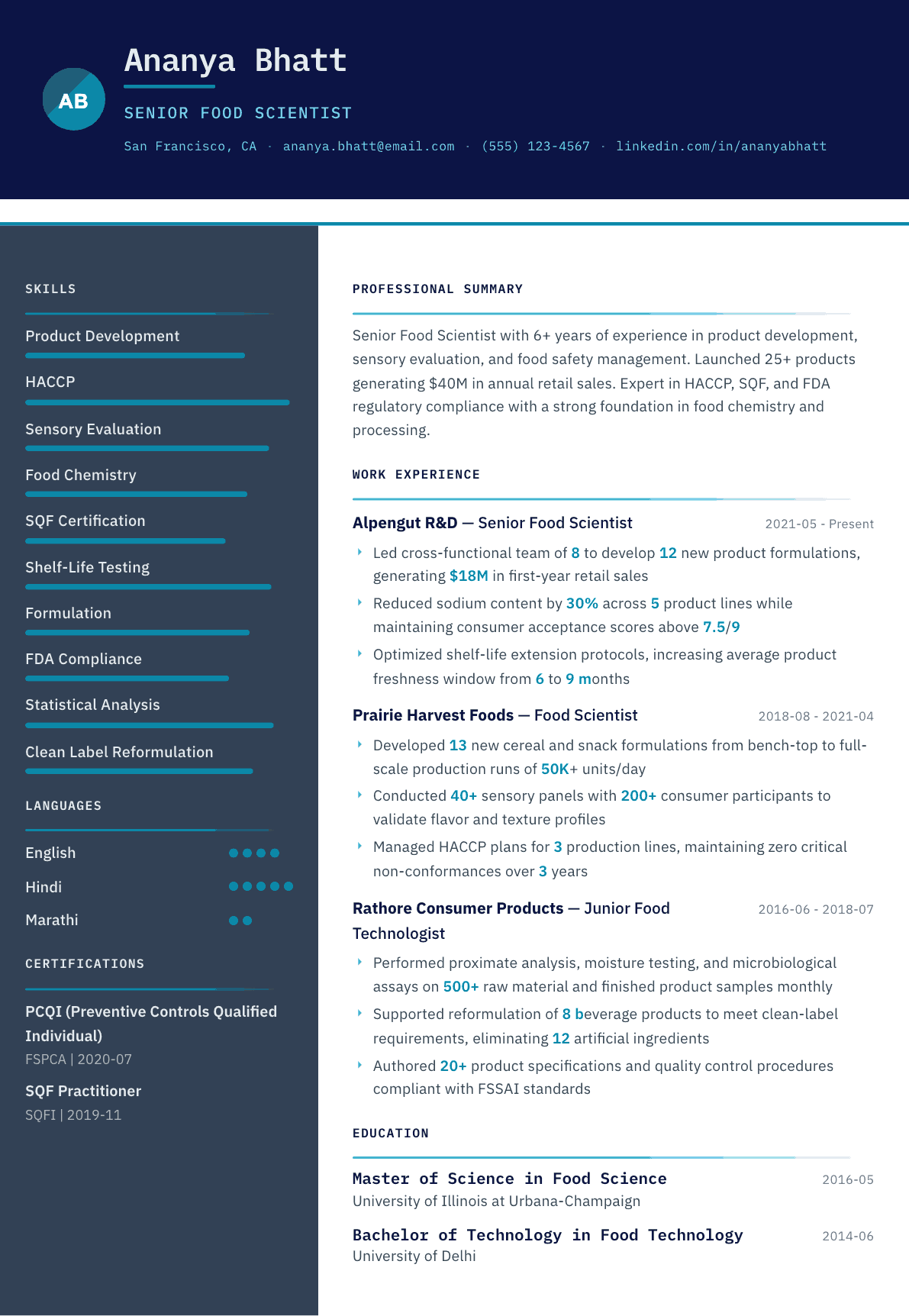
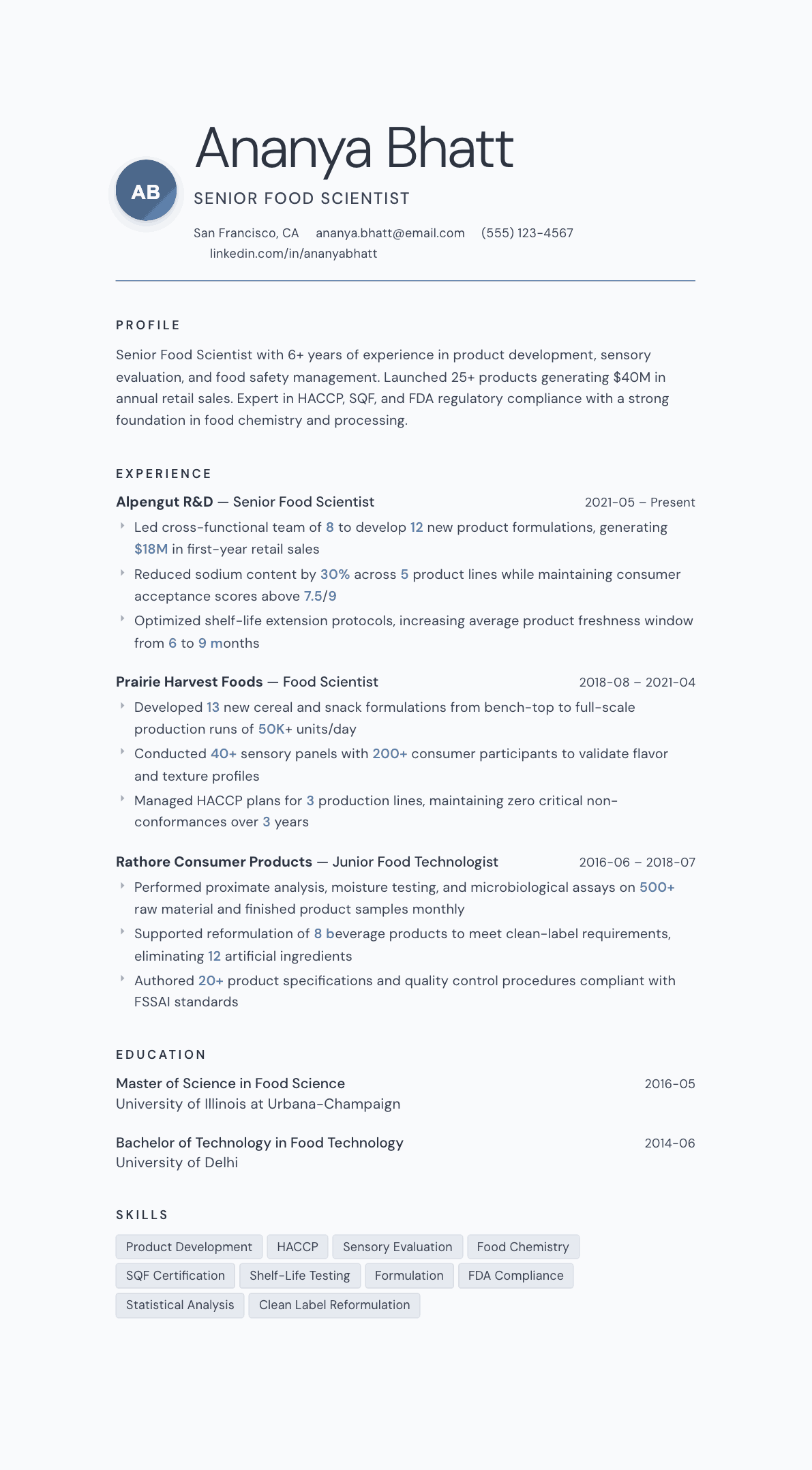
Example Food Scientist summary
PCQI-certified Food Scientist with 6+ years of experience in product development, food safety, and quality assurance. Launched 25+ products generating $40M in annual sales for top-tier CPG brands. Expert in HACCP, SQF, and clean-label reformulation with strong sensory evaluation and shelf-life optimization capabilities.
Skills to list on a Food Scientist resume
- Product Development
- HACCP
- SQF
- Sensory Evaluation
- Food Chemistry
- Shelf-Life Testing
- Formulation
- FDA / EFSA Compliance
- Clean Label
- Microbiological Testing
- Process Optimization
- Nutritional Analysis
What actually gets this resume read
- Quantify product launches: number of products, revenue generated, and market performance.
- Highlight food safety certifications: HACCP, SQF, PCQI, FSSC 22000, or BRC.
- Include sensory evaluation experience: panel size, methodologies, and consumer acceptance outcomes.
- Describe shelf-life extension, cost reduction, or clean-label reformulation achievements with metrics.
- Mention regulatory compliance across markets: FDA, EFSA, FSSAI, or Codex Alimentarius.
How to write a food scientist resume
Food science hiring splits into product development, quality and food safety, and process or applications work. A consumer goods company filling a development bench wants somebody who can take a concept from a bench formula to a plant trial without the texture falling apart at scale. A manufacturer filling a quality role wants somebody who can hold an audit, run the preventive controls plan and close a corrective action.
Both readers are checking whether you have been in a plant. Bench work alone is a common resume pattern and a common reason for rejection, because the expensive failures happen during scale up, not in the pilot kitchen. Say what you have run on real equipment at real line speeds.
This guide sets out how to structure a food scientist resume around products, processes and audits, three summaries covering a bench scientist through a development manager, before and after bullets from formulation and safety work, and the questions that come up when moving between research and development and quality.
Format: category, process, and food safety credentials up front
One page early, two once you have launched products or owned a plant program. Under your name, state the categories you know: bakery, dairy, beverage, confectionery, meat and poultry, plant based protein, sauces and dressings, snacks, pet food, or nutritional supplements. Category knowledge does not transfer as easily as candidates assume, and hiring managers screen on it hard.
Then the food safety credentials, because they are a hard gate for many roles. Preventive controls qualified individual training, hazard analysis certification, and practitioner status under a recognized certification scheme all belong near the top with the issuing program named.
- Header: name, categories, food safety credentials, location, phone, email.
- Order: summary, food safety and quality credentials, experience, product launches, technical skills, education.
- Add a launches block naming the product type, the process and your role for the products closest to the posting.
Summary: what you formulate, on what process, at what scale
Name the product form and the unit operations, since that is how the work is really organized. Emulsions, high acid and low acid thermally processed foods, extruded products, baked systems, frozen and chilled formats, dry blends, fermented products and aseptically filled beverages each carry their own constraints.
Then state scale honestly and specifically: bench only, pilot plant, or commercial line trials at a named line speed or batch size. Ending the summary with a commercial launch you formulated is the strongest position available on this resume.
Experience: bench, pilot, plant trial, launch
Order bullets along that path. Bench work should name the technical problem, not just the product: replacing an emulsifier system, cutting sodium without losing binding, stabilizing a protein beverage against sedimentation, reformulating for a clean ingredient statement, or matching a gold standard sample on texture and flavor after a supplier change.
Then pilot and plant. Name equipment and parameters: mixers and homogenizers, plate and scraped surface heat exchangers, retort or aseptic processing with the schedule that was validated, extruder configuration, spray drier inlet and outlet conditions, and fill and seal parameters. Say what you changed during a trial to make the product run, since that is the story a development manager listens for.
Close with validation and launch. Shelf life studies with the storage conditions and the endpoints measured, water activity and pH controls for safety, microbiological challenge or validation studies, sensory testing with the method and panel type, nutrition and ingredient statement development, and the specification and process documentation handed to the plant. State how many products actually went to market, since that number separates development from experimentation.
Food safety and quality: name the scheme and the outcome
Be exact about the framework you have worked in. A hazard analysis plan with critical control points identified and validated, a food safety plan under preventive controls rules with hazards, preventive controls, monitoring, verification and corrective actions, an environmental monitoring program with zone based sampling, allergen control and changeover validation, and supplier approval programs.
Then name the certification scheme and the audit history: an audit under a recognized global food safety scheme with the outcome, a customer audit, or a regulatory inspection. Audits closed without a major finding, and corrective actions you wrote and verified, are the concrete evidence quality managers hire on.
Technical skills, methods and regulatory literacy
Split analytical from formulation. Analytical: texture analysis, rheology and viscosity, water activity, moisture and proximate analysis, chromatography for specific analytes, colorimetry, and microbiological plating and rapid methods. Formulation and data: formulation management software, nutrition and labeling software, statistical design of experiments and response surface work in a package such as Minitab or JMP, and sensory analysis software.
On labeling, name what you have actually produced: nutrition facts panels, ingredient statements in descending order of predominance, allergen declarations, and claims substantiation. Regulatory literacy that stops at a general phrase about compliance is not persuasive to anyone who has defended a label.
Food Scientist resume summary examples
Bench scientist, first years
Food scientist with a degree in food science and 2 years at the bench in sauces and dressings. Developed 30 bench prototypes, ran texture and water activity testing, supported 6 pilot plant trials, and prepared nutrition panels and ingredient statements for 12 product concepts.
Product developer, six years
Food scientist with 6 years developing refrigerated dairy and plant based beverages. Scaled 14 formulas from bench to commercial line, validated thermal processes with the process authority, ran accelerated and real time shelf life studies, and launched 9 products across 3 manufacturing sites.
Development manager
Food science manager with 12 years across snacks and bakery, leading a 6 person development group. Owns the product pipeline from concept through commercialization, has commercialized 40 items on extrusion and baking lines, and directs the food safety plan and audit readiness at 2 plants.
Work experience bullets: before and after
Before: Developed new food products for the company.
After: Developed 9 refrigerated plant based beverages from bench formula through commercial launch, solving protein sedimentation with a revised stabilizer system and homogenization pressure change that held through 90 day shelf life.
The technical problem, the fix and the shelf life result show development rather than participation in a project.
Before: Ran plant trials with manufacturing.
After: Led 12 commercial line trials on a scraped surface and aseptic filling line, adjusted hold time and fill temperature to eliminate a viscosity drift that had caused 2 hour startup losses on every previous run.
Equipment, the parameter changed and the loss eliminated turn a trial into a documented process improvement.
Before: Responsible for HACCP and food safety programs.
After: Owned the food safety plan for a ready to eat facility: reassessed the hazard analysis, validated 3 critical control points, rebuilt the zone based environmental monitoring program, and closed a scheme audit with no major nonconformance.
Naming the plan elements, the validation and the audit result is the evidence a quality director looks for.
Before: Performed sensory evaluation of products.
After: Ran descriptive analysis with a trained 10 member panel plus triangle tests against the gold standard, and used the results to defend a supplier ingredient change that saved a formula without a detectable difference.
The panel type, the test method and the business decision show sensory work applied, not just conducted.
Before: Worked on cost savings for existing products.
After: Reformulated 6 legacy items to a lower cost fat and starch system using a designed experiment in Minitab, held texture and flavor within specification on consumer testing, and implemented the change across 3 plants without a customer complaint spike.
The experimental method, the specification constraint and the multi plant rollout prove a real reformulation program.
Hard skills
- Product formulation and reformulation
- Pilot plant and commercial scale up
- Thermal process and retort validation
- Shelf life and accelerated stability studies
- Water activity and pH control
- Sensory descriptive and discrimination testing
- HACCP and food safety plan development
- Environmental monitoring programs
- Allergen control and changeover validation
- Nutrition labeling and ingredient statements
- Design of experiments in Minitab or JMP
- Texture analysis and rheology
- Microbiological testing methods
- Supplier and ingredient qualification
Soft skills
- Working with plant operators during trials
- Cross functional work with marketing and procurement
- Hosting auditors and customers
- Documenting decisions for regulated files
- Managing a project pipeline against launch dates
Certifications worth listing
- Preventive Controls Qualified Individual (PCQI) (Food Safety Preventive Controls Alliance)
- HACCP Certification (International HACCP Alliance accredited course)
- SQF Practitioner (Safe Quality Food Institute)
- Certified Food Scientist (CFS) (Institute of Food Technologists)
- Certified Quality Auditor (CQA) (American Society for Quality)
- Better Process Control School certificate (University program recognized by regulators)
Mistakes that cost food scientist candidates the interview
- Presenting only bench work, which leads a hiring manager to assume you have never watched a formula fail at line speed.
- Listing product categories you touched once alongside ones you know deeply, with no way for the reader to tell them apart.
- Saying you supported food safety without naming the plan elements, the validations or the audit outcome.
- Counting prototypes instead of launches, when the number that matters is what reached a shelf.
- Leaving out shelf life and stability work, which is where most product failures actually occur.
- Describing sensory testing without the method or panel type, which makes the results impossible to weigh.
Food Scientist resume questions
How do I show scale up experience if I have only worked in a pilot plant?
Be precise about the pilot equipment and the parameters you controlled, then describe any commercial trial you attended and what you learned there. Honest pilot experience plus clear understanding of the plant constraints reads far better than implying commercial work you did not do.
Which food safety certification should I get first?
Preventive controls qualified individual training is the broadest and is named in many postings. Add hazard analysis certification if you own a plan, and practitioner status under your employer's certification scheme if you are being pulled into audit preparation.
Should I list products by name?
Only if they are public and your agreement allows it. Otherwise describe the product form, the process and the retail channel, which gives a reviewer everything they need to judge relevance without breaking confidentiality.
How do I move from quality into product development?
Lead with the formulation adjacent work you already do: reformulations for supplier changes, specification setting, shelf life studies and plant trial troubleshooting. Then add bench evidence, since development managers want to see that you can build a formula rather than only judge one.
Does a masters degree help in food science?
It helps most for research heavy roles in ingredient companies, process authority work and specialized areas such as thermal processing or lipid chemistry. For mainstream product development, a bachelors plus launched products is usually the stronger profile.