Forensic Scientist Resume Examples: the lines they read
Build a Forensic Scientist Resume That Stands Up to Scrutiny
By Mustafa Tarabya, founder of CVBooster · Published · Updated
Create a forensic scientist resume showcasing crime lab expertise, evidence analysis, and courtroom testimony skills with ATS-optimized templates for law enforcement and laboratory roles.
Sample resumes for a forensic scientist
The same forensic scientist content laid out in three CVBooster templates, so you can see what the finished document looks like before you write a word.
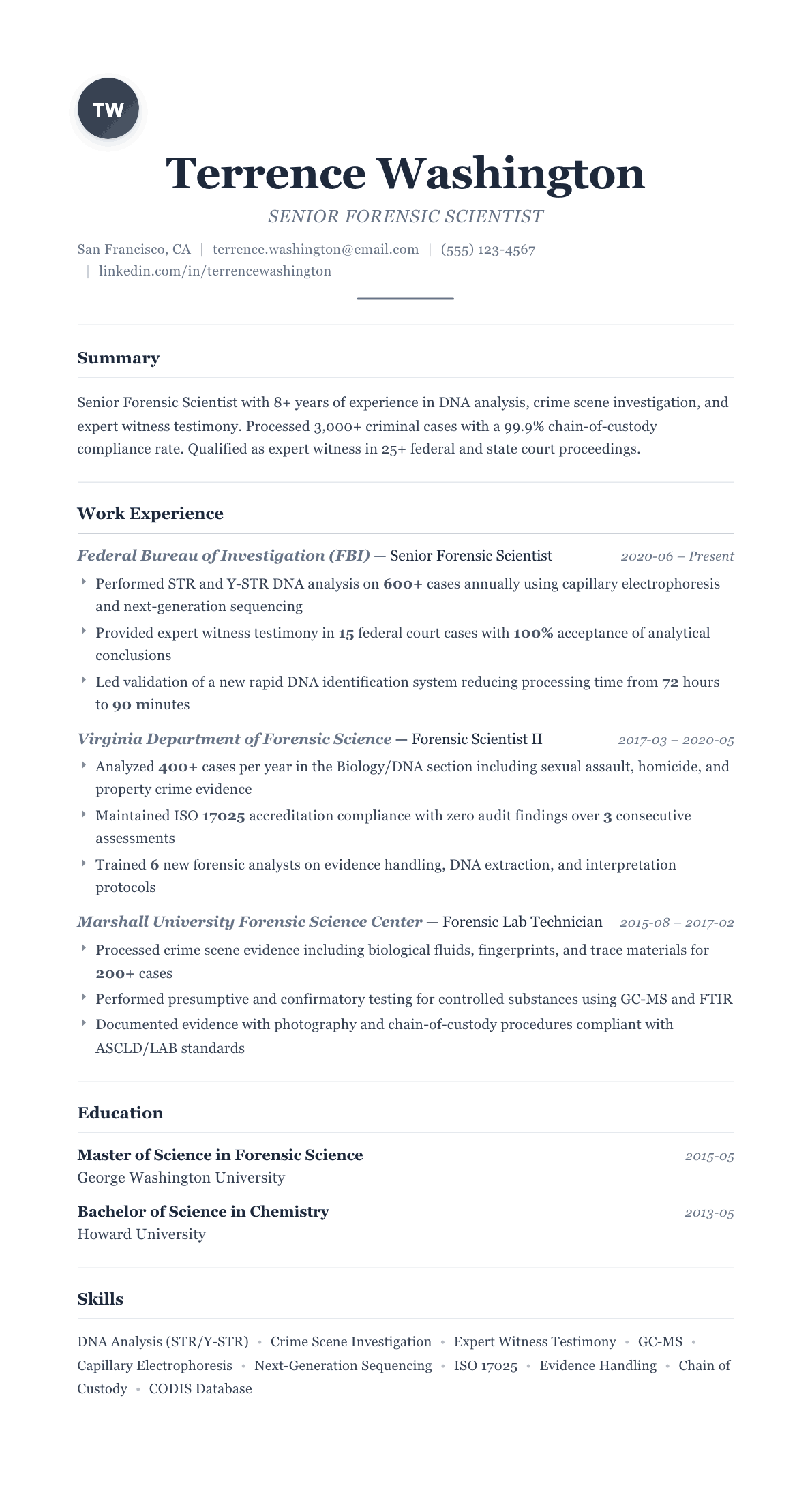
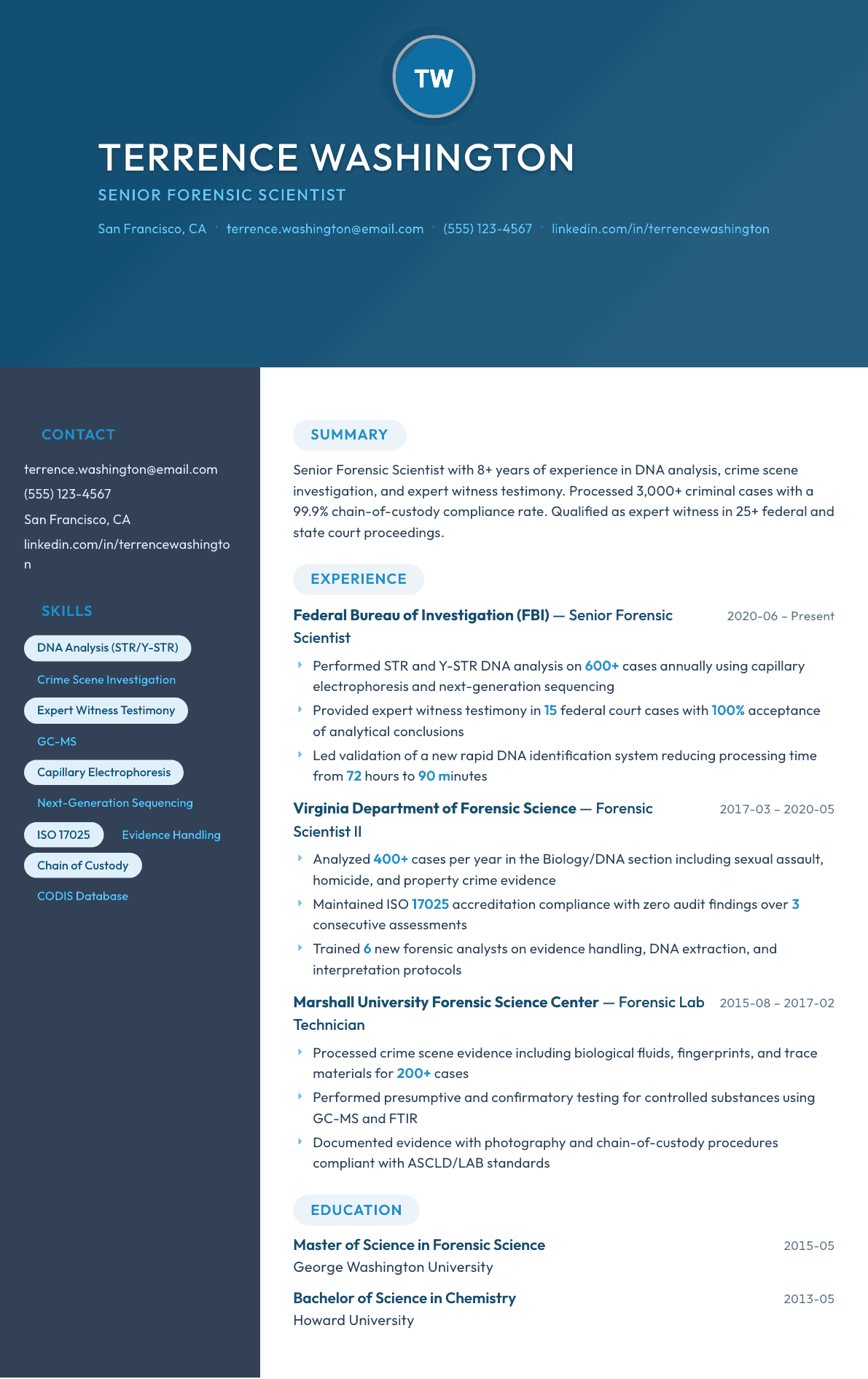
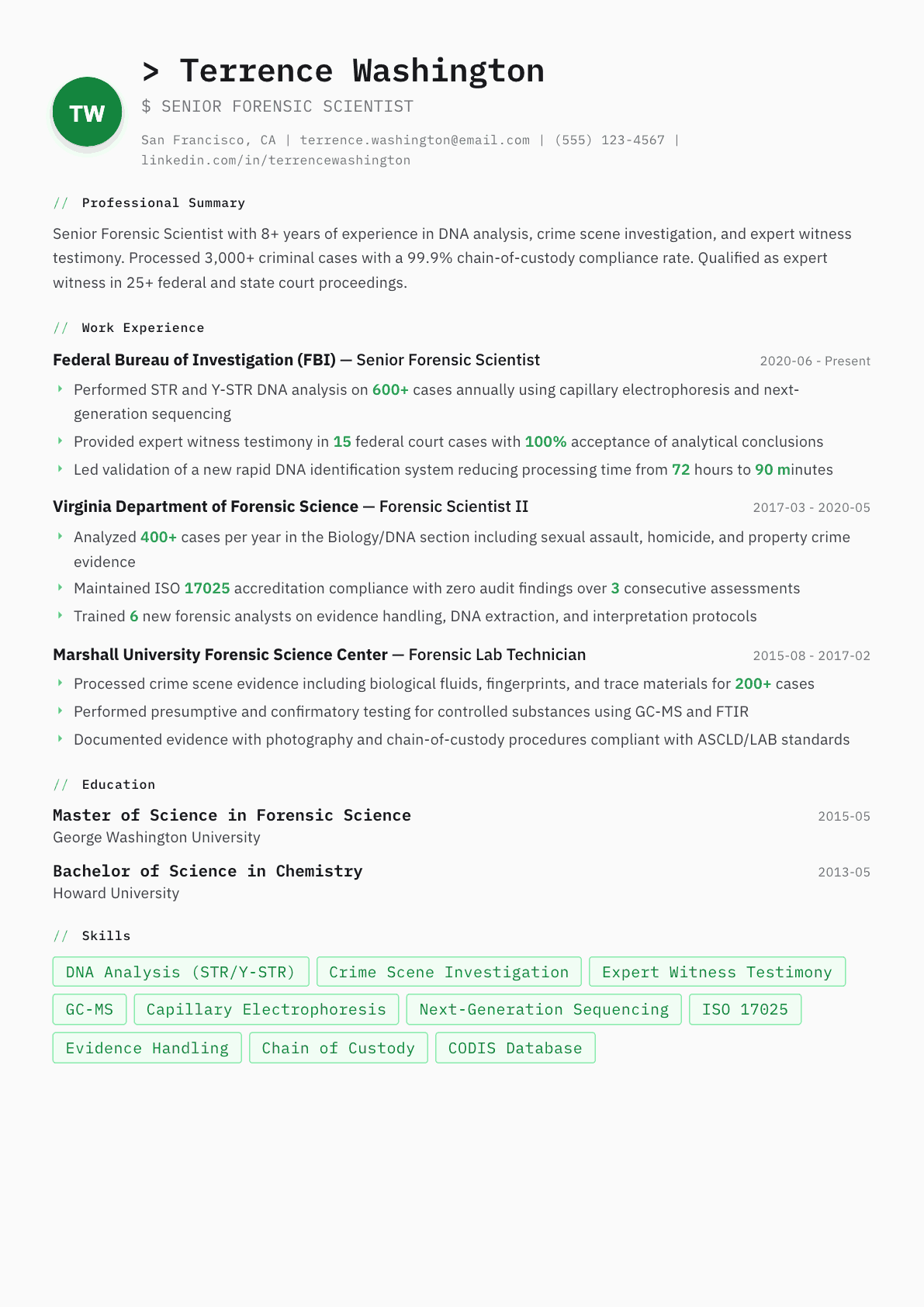
Example Forensic Scientist summary
Board-certified Senior Forensic Scientist with 8+ years of DNA analysis and crime scene investigation experience. Processed 3,000+ criminal cases with 99.9% chain-of-custody compliance. Testified as expert witness in 25+ federal and state proceedings. Proficient in STR analysis, NGS, and rapid DNA technologies.
Skills to list on a Forensic Scientist resume
- DNA Analysis
- Crime Scene Investigation
- Expert Witness Testimony
- GC-MS
- FTIR
- Capillary Electrophoresis
- Next-Generation Sequencing
- ISO 17025
- CODIS
- Evidence Handling
- Toxicology
- Fingerprint Analysis
What actually gets this resume read
- Highlight specific forensic disciplines: DNA, toxicology, trace evidence, firearms, digital forensics.
- Quantify caseload: cases processed per year, evidence items examined, and conviction support rate.
- Include expert witness testimony experience with number of court appearances and jurisdictions.
- Mention accreditation standards: ISO 17025, ASCLD/LAB, and quality assurance protocols.
- List forensic databases and systems: CODIS, AFIS, NIBIN, or forensic LIMS platforms.
How to write a forensic scientist resume
Forensic laboratories hire by discipline, and the disciplines barely overlap. A DNA unit, a toxicology unit, a latent print unit, a firearms and toolmark unit, a seized drug unit and a digital forensics unit each have their own instruments, their own competency requirements and their own court expectations. A resume that says forensic scientist without naming the discipline cannot be routed to a hiring supervisor.
The second thing a laboratory director checks is whether you can be qualified quickly. That means documented training in a discipline, competency and proficiency testing history, work under an accredited quality system, and court testimony. Every hire costs the laboratory months of training, so evidence that you have already been through that process is the strongest thing on the page.
This guide covers how to structure a forensic scientist resume around casework, quality systems and testimony, three summaries covering a trainee analyst through a technical leader, before and after bullets built from real casework, and the questions analysts ask when they move between disciplines or between public and private laboratories.
Format: discipline first, then casework volume and accreditation
Put the discipline immediately under your name, along with your qualification status: qualified analyst, trainee, or technical reviewer. Then state the accreditation your laboratory holds, because working inside an accredited quality system is a different professional experience from working outside one and hiring supervisors screen for it.
Keep formatting plain. Public laboratory hiring often runs through a government human resources system that scores against minimum qualifications, so mirror the posting language for degree requirements, coursework in the natural sciences, and hours of specific subjects when the posting lists them.
- Header: name, discipline, qualification status, location, phone, email.
- Order: summary, discipline and qualifications, casework experience, testimony, instrumentation and methods, training and certification, education.
- List the semester hours in chemistry, biology, statistics or genetics when a posting sets them as a minimum.
Summary: discipline, method, caseload, court record
Four facts belong in the first three lines: the discipline, the primary methods you are qualified on, the annual caseload you carry, and how many times you have testified. A supervisor reading a stack of applications is triaging on exactly those four, and everything else can wait.
If you are moving between disciplines, say so and name the transferable competency. An analytical chemist moving into toxicology should lead with mass spectrometry method validation and quality documentation rather than hoping the reader infers the connection.
Casework: volume, complexity, and turnaround
Give the numbers a laboratory actually tracks. Cases completed per year, evidence items examined, backlog reduced, average turnaround time, and the case types you handle. Then show complexity, because a straightforward single source sample and a complex mixed sample are not the same work.
In biology, that means extraction, quantitation, amplification and capillary electrophoresis, interpretation of single source and mixed profiles, probabilistic genotyping software, and database entry and hit confirmation. In toxicology, screening by immunoassay and confirmation by chromatography and mass spectrometry, quantitation with calibrators and controls, and interpretation of concentrations in a case context. In chemistry, identification schemes and instrumental confirmation. Name the discipline specific chain so it is clear you performed the analysis rather than assisting with it.
Chain of custody, evidence handling and documentation deserve their own line. Laboratories lose cases on documentation more often than on chemistry, and a candidate who talks about their case record discipline is signaling that they understand this.
Quality system, validation and technical review
Work under an accreditation standard is a distinguishing qualification, so describe the parts you owned. Method validation studies with the parameters evaluated, proficiency tests completed, internal audits participated in, corrective action investigations, nonconformance documentation, and instrument performance checks and calibration records.
Technical and administrative review of another analyst's case file is a senior responsibility and should be counted, since it is the step before a laboratory promotes someone to technical leader. Say how many case files you have reviewed and in what discipline.
Testimony and communication with the legal system
Give the count and the venues: how many times you have testified, at what court levels, and whether you have been qualified as an expert. Add depositions, pretrial conferences with attorneys, admissibility hearings, and the reports you write, since the report is the deliverable that gets read long before you take the stand.
Training and outreach also count here. Teaching investigators how to collect evidence, presenting at a professional meeting, and instructing new analysts all show that you can explain the science outside the laboratory, which is the skill a courtroom tests.
Forensic Scientist resume summary examples
Trainee analyst
Forensic science graduate with a chemistry degree and 1 year as a trainee in a seized drug unit. Completed the training manual and competency testing, performed color testing, microcrystalline analysis and confirmation by gas chromatography mass spectrometry, and processed 200 items under a qualified analyst.
Qualified DNA analyst, six years
Qualified forensic DNA analyst with 6 years in an accredited crime laboratory. Completes about 180 cases a year across sexual assault and property crime, interprets single source and mixed profiles using probabilistic genotyping, and has testified as an expert 14 times in state court.
Technical leader
Technical leader for a forensic biology section with 14 years of casework and 5 years of oversight. Owns method validations, training programs and technical review for 9 analysts, has testified in 45 proceedings including 3 admissibility hearings, and led the section through 2 successful accreditation assessments.
Work experience bullets: before and after
Before: Analyzed DNA evidence in criminal cases.
After: Completed about 180 forensic biology cases a year: body fluid identification, extraction and quantitation, amplification and capillary electrophoresis, and interpretation of single source and mixed profiles with probabilistic genotyping software.
The full analytical chain plus annual volume shows a qualified analyst rather than a laboratory assistant.
Before: Testified in court about laboratory results.
After: Testified as an expert witness 14 times in state and federal proceedings, including 2 admissibility hearings on mixture interpretation, and prepared attorneys through pretrial conferences before each appearance.
Counts, venues and the hearing type demonstrate a court record a prosecutor can rely on.
Before: Followed laboratory quality procedures.
After: Performed method validation for a new extraction chemistry, evaluating sensitivity, reproducibility, contamination and mixture performance, and wrote the standard operating procedure adopted by the section.
A validation study with named parameters and an adopted procedure is quality work you owned, not policy you followed.
Before: Reviewed other analysts' work.
After: Conducted technical review of 300 case files a year, verifying interpretation, statistics and documentation against the procedure manual, and mentored 3 trainees through competency testing to qualification.
Review volume and trainee outcomes are the responsibilities a laboratory promotes technical leaders on.
Before: Helped reduce the case backlog.
After: Reworked sample batching and instrument scheduling on the extraction robot, cutting average turnaround from 92 days to 54 across the sexual assault kit queue over 3 quarters.
A named operational change with before and after turnaround is the metric laboratory directors report upward.
Hard skills
- DNA extraction, quantitation and amplification
- Capillary electrophoresis and STR interpretation
- Probabilistic genotyping software
- CODIS entry and hit confirmation
- Gas chromatography mass spectrometry
- Liquid chromatography tandem mass spectrometry
- Microscopy and microcrystalline testing
- Latent print processing and comparison
- Crime scene documentation and evidence recovery
- Chain of custody and evidence handling
- Method validation under ISO 17025
- Technical and administrative case review
- Expert witness testimony
Soft skills
- Explaining technical findings to a jury
- Working under subpoena deadlines
- Impartiality under adversarial questioning
- Meticulous case documentation
- Training and mentoring analysts
Certifications worth listing
- Diplomate or Fellow in Criminalistics (American Board of Criminalistics)
- Certified Latent Print Examiner (International Association for Identification)
- Certified Forensic Toxicologist (American Board of Forensic Toxicology)
- AFTE Certification in Firearm and Toolmark Identification (Association of Firearm and Tool Mark Examiners)
- GIAC Certified Forensic Examiner (GCFE) (Global Information Assurance Certification)
Mistakes that cost forensic scientist candidates the interview
- Writing forensic scientist with no discipline named, which stops a laboratory from routing the application to the right unit supervisor.
- Omitting qualification status, so a supervisor cannot tell whether you can work cases independently or need a full training program.
- Leaving testimony off the resume, when court experience is one of the few things that cannot be trained quickly.
- Describing instrument use without the interpretation step, which reads as technician work rather than analyst work.
- Ignoring the quality system, validations and proficiency testing that accredited laboratories are built around.
- Using a decorated template with graphics for a public laboratory application scored against minimum qualifications.
- Overstating crime scene experience when your actual work was in the laboratory, a claim defense counsel would enjoy examining.
Forensic Scientist resume questions
How do I get hired into a crime laboratory with no forensic experience?
Match the minimum qualifications exactly, since public laboratory applications are scored against them before a human reads the resume. Highlight coursework in the required subjects, instrumentation you have run, and any quality system experience from a clinical, environmental or industrial laboratory.
Should I list every case type I have worked?
List the case types and give annual volume rather than enumerating cases. A supervisor wants to know your throughput, the complexity you handle and whether your experience matches their queue, and a long case list buries all three.
How much testimony experience do I need for a senior role?
There is no fixed number, but a consistent court record with expert qualification is expected before technical leader or supervisor positions. State the count, the court levels and any admissibility hearings, which carry more weight than routine appearances.
Can I move between forensic disciplines?
Yes, and laboratories do retrain analysts, though every move means a new training manual and new competency testing. Make the transferable pieces obvious: instrumentation, statistics, quality documentation and testimony experience all carry across disciplines.
Do private laboratories value the same things as public ones?
Largely yes, with more emphasis on turnaround, client communication and defense or civil casework. Accreditation, validation experience and testimony remain central, so keep them prominent in both versions of the resume.