Clinical Scientist Resume Examples: the lines they read
Build a Clinical Scientist Resume That Advances Careers
By Mustafa Tarabya, founder of CVBooster · Published · Updated
Create a clinical scientist resume highlighting clinical trial management, translational research, and regulatory expertise with templates designed for pharma, biotech, and CRO hiring.
Sample resumes for a clinical scientist
The same clinical scientist content laid out in three CVBooster templates, so you can see what the finished document looks like before you write a word.
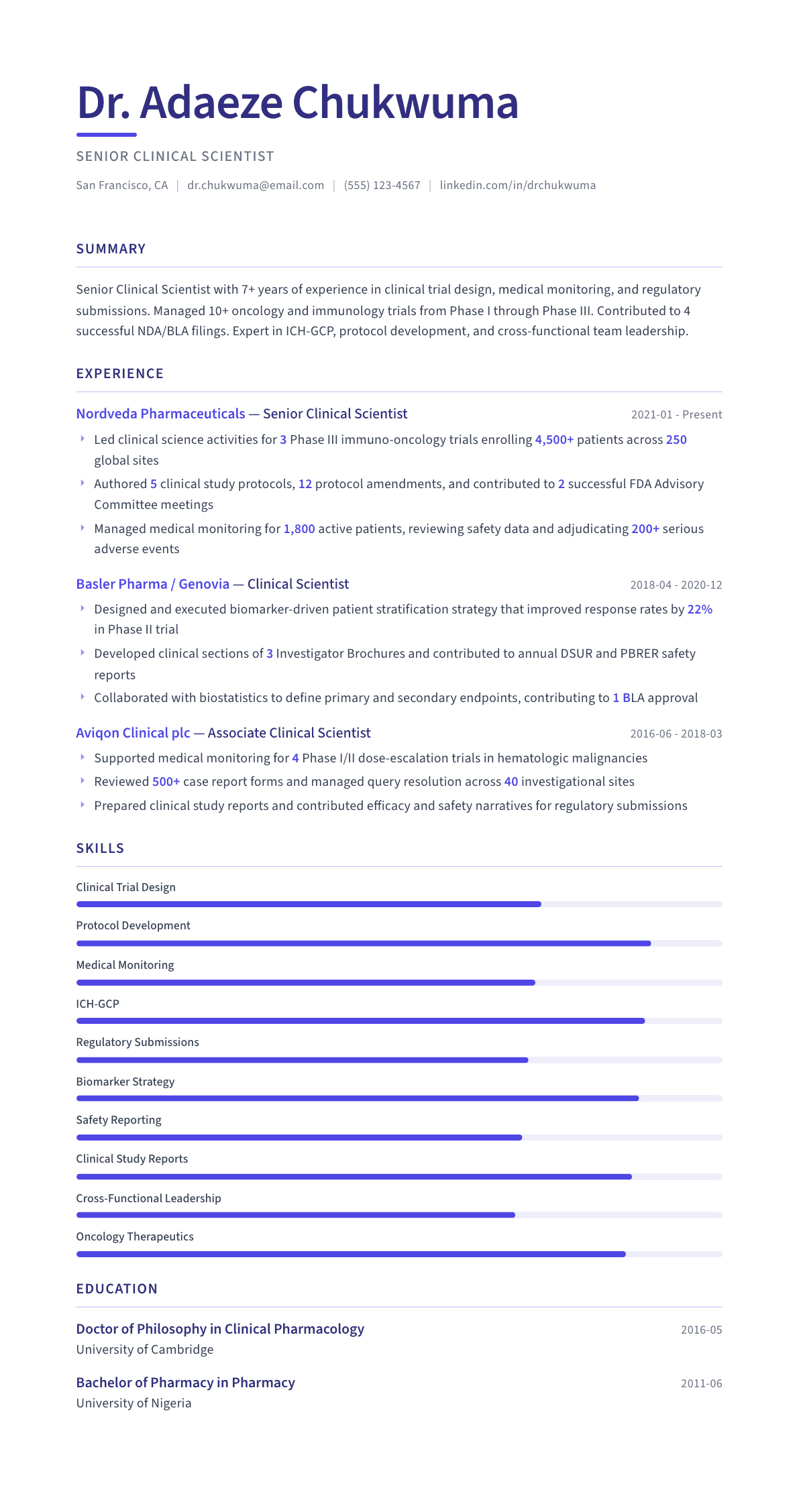
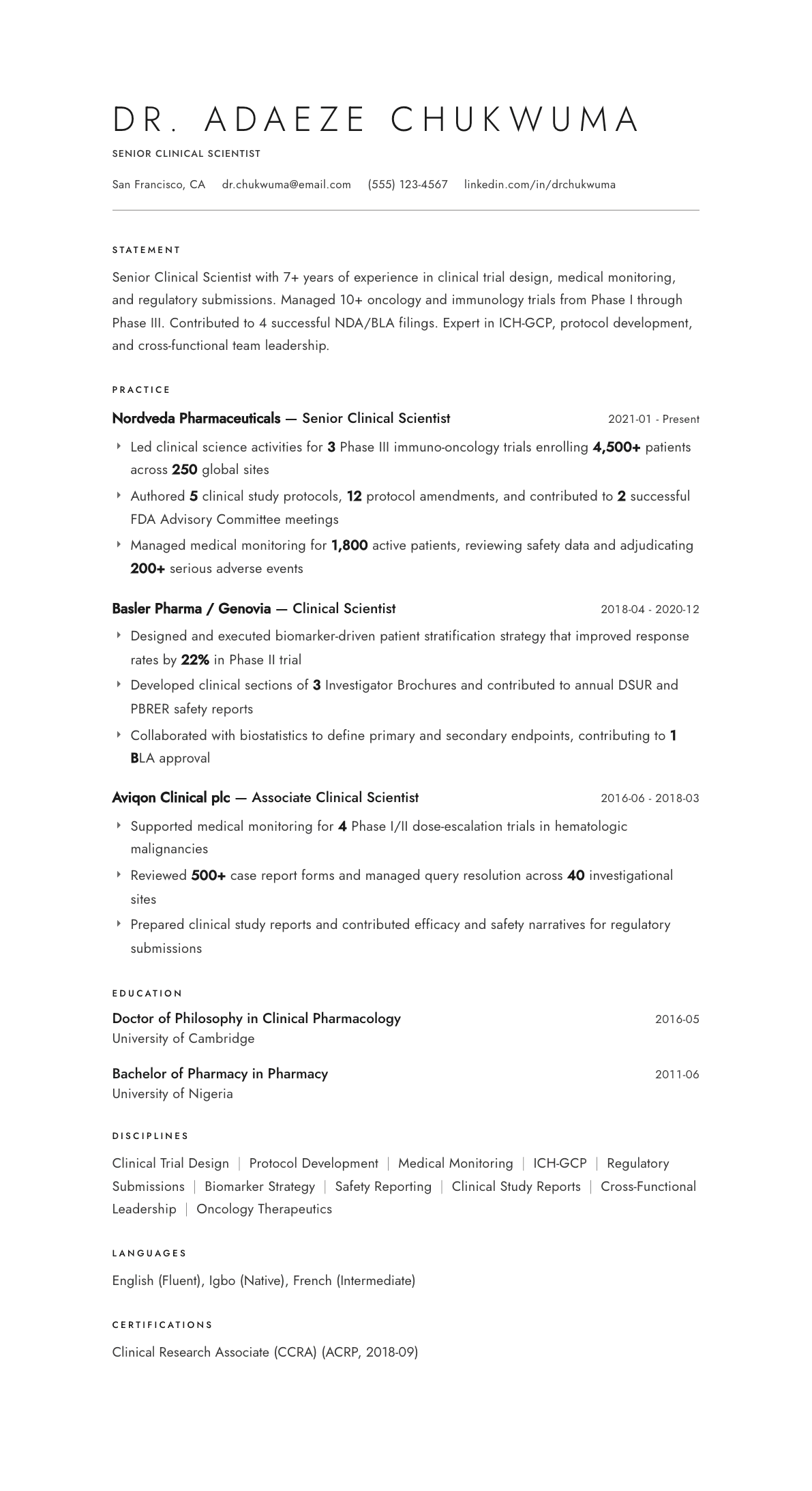
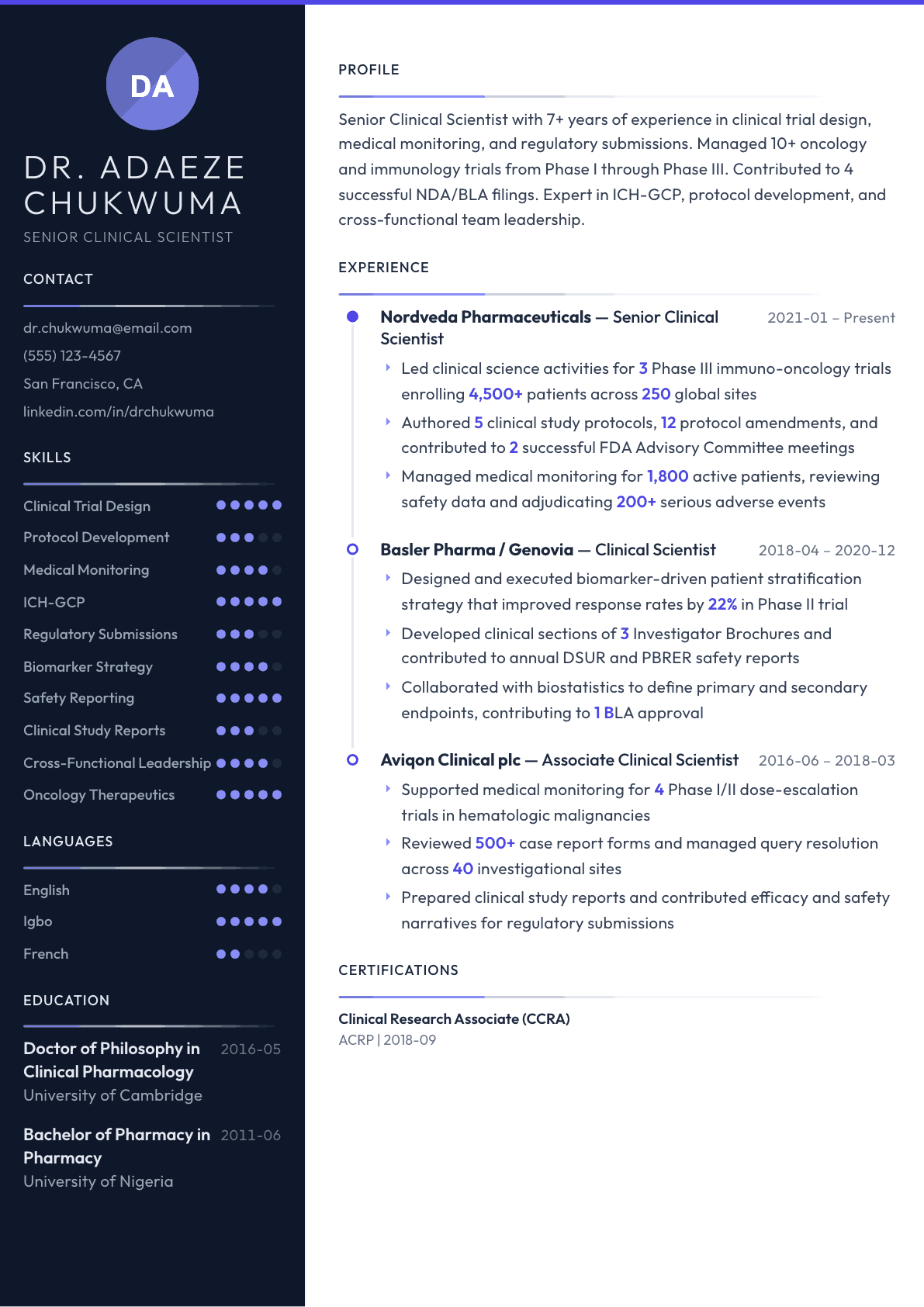
Example Clinical Scientist summary
GCP-certified Senior Clinical Scientist with 7+ years managing oncology and immunology trials from Phase I through Phase III. Contributed to 4 successful NDA/BLA filings. Authored 5 protocols and monitored 1,800+ active patients. Expert in protocol development, biomarker-driven design, and regulatory submissions.
Skills to list on a Clinical Scientist resume
- Clinical Trial Design
- Protocol Development
- Medical Monitoring
- ICH-GCP
- NDA / BLA Submissions
- Investigator Brochure
- Clinical Study Reports
- Biomarker Strategy
- Safety Reporting (DSUR/PBRER)
- Oncology
- Immunology
- Cross-Functional Leadership
What actually gets this resume read
- Highlight trial phases managed and therapeutic areas: oncology, immunology, CNS, rare disease.
- Quantify trial scope: patients enrolled, sites managed, and regulatory milestones achieved.
- Include protocol development, IB authorship, and CSR contributions in your experience section.
- Mention ICH-GCP training, ACRP/SoCRA certification, and regulatory submission experience.
- Describe cross-functional collaboration with biostatistics, regulatory affairs, and clinical operations.
How to write a clinical scientist resume
A clinical scientist sits between the protocol and the data, and the people hiring for the role read a resume to find out which of those two ends you are strong at. A sponsor filling a medical monitoring gap wants safety review and adjudication experience. A sponsor building a program wants protocol authorship, endpoint definition and biomarker strategy. A contract research organization wants both, on many studies at once.
Because trial work is documented work, this is one of the few resumes where a reader will silently check your claims against the study registry and the label. Name therapeutic areas, phases and the deliverables you personally wrote, and never let a program milestone your whole team reached read as if you delivered it alone.
This guide covers the section order sponsors and clinical research organizations expect, three summaries for an associate, a clinical scientist and a senior on submission programs, before and after bullets built from real study deliverables, and the questions that come up when a bench scientist moves into clinical development.
Format: a two page development resume, not an academic CV
Two pages is the norm and nobody objects to it. What kills a clinical scientist resume is a ten page academic CV with a publication list ahead of the trial work. Move the trials up, keep a short selected publications block at the end with the ones relevant to your therapeutic area, and put conference abstracts in a single line rather than one per poster.
Degrees carry weight here, so credentials go after the name: "Sara Meyer, PharmD" or "Ravi Nair, PhD". If you hold a medical degree without a monitoring license in the hiring region, say what you can and cannot sign, because medical monitoring responsibilities are assigned differently in each company.
- Order: summary, therapeutic area and phase experience, clinical development experience, education, technical and regulatory skills, selected publications.
- A compact phase and indication table near the top saves the reviewer from reconstructing your history.
- Keep the publication list to work that supports the indication you are applying into.
Summary: therapeutic area, phase range, and what you authored
The first three lines should let a hiring manager decide whether to keep reading. Give the therapeutic areas, the phase range you have worked across, the study sizes and geographies, and the documents you have written yourself. Protocol, amendment, investigator brochure, statistical analysis plan input, clinical study report and briefing book are the words that matter here.
If you have supported a filing, be exact about what your contribution was. Contributing safety narratives to a submission is real work and is credible. Claiming a regulatory approval as a personal achievement is not, and interviewers in this field ask follow up questions specifically to test it.
Experience: study by study, with scope a reviewer can picture
Under each employer, group by study rather than by task. For each study give the phase, indication, design, enrollment target, number of sites and countries, and the role you held on it. A line such as "Phase II randomized double blind study in moderate to severe atopic dermatitis, 240 patients, 46 sites in 8 countries, clinical science lead" tells the reader more than a paragraph of duties.
Then show the work only a clinical scientist does. Endpoint and eligibility criteria definition, protocol deviation review, blinded data review meetings, medical monitoring and eligibility queries, dose escalation committee support, independent data monitoring committee packages, adjudication charters, and the review of tables, listings and figures before database lock.
Add the operational glue that separates candidates who have run studies from candidates who have watched them: EDC systems you have worked in such as Medidata Rave or Veeva, safety database interaction, query volumes handled, and the interfaces you owned with biostatistics, clinical operations, pharmacovigilance and regulatory affairs.
Regulatory and quality: prove ICH-GCP is more than a training slide
Everyone lists ICH-GCP. Separate yourself by naming the guidance you have actually applied: the ICH E6 requirements you built into monitoring plans, ICH E9 estimands in an endpoint discussion, ICH E3 structure when authoring a clinical study report, and the safety reporting cadence behind a DSUR or PBRER.
Name inspection and audit exposure if you have it. Supporting a regulatory inspection, a sponsor audit or a corrective and preventive action plan is a differentiator, because it shows your documentation survives outside review.
Skills and keywords sponsors screen on
Recruiters filter on indication first, then phase, then document type. Make sure the exact indication vocabulary of the posting appears once in your summary and once inside a study description: not just oncology, but non small cell lung cancer, not just immunology, but ulcerative colitis. Add the assessment scales your indication uses, because they prove you know the disease and not only the process.
Clinical Scientist resume summary examples
Associate clinical scientist
PhD in immunology with 2 years supporting Phase I and II studies in inflammatory disease. Reviewed 400 case report forms, managed query resolution across 22 sites, drafted sections of 2 protocols and prepared blinded data review packages for the study team. GCP trained.
Clinical scientist, five years
Clinical scientist with 5 years in oncology development across Phase I dose escalation and Phase II expansion cohorts. Authored 3 protocols and 7 amendments, defined response endpoints with biostatistics, supported a dose escalation committee, and led blinded data review for a 180 patient study.
Senior clinical scientist on filings
Senior clinical scientist with 9 years in rare disease and immuno oncology, leading clinical science on 3 Phase III programs enrolling over 3,000 patients. Authored protocols and investigator brochures, contributed clinical sections to 2 marketing applications, and supported a regulatory inspection with no critical findings.
Work experience bullets: before and after
Before: Worked on Phase III oncology trials.
After: Served as clinical science lead on a Phase III randomized open label study in advanced renal cell carcinoma, 620 patients across 90 sites in 14 countries, owning eligibility criteria interpretation and blinded data review.
Design, enrollment, geography and your named role turn a generic claim into a study a reviewer can locate.
Before: Helped write protocols and amendments.
After: Authored 2 protocols and 6 amendments, including a substantial amendment that added a biomarker defined cohort and cleared ethics review in 9 countries without a second round of questions.
Counting the documents and naming what an amendment changed shows authorship rather than assistance.
Before: Reviewed safety data for the study.
After: Performed ongoing medical monitoring for 900 active patients, reviewed and coded 210 serious adverse events with pharmacovigilance, and prepared quarterly safety summaries for the independent data monitoring committee.
Patient volume, event volume and the committee output make the monitoring load concrete.
Before: Collaborated with biostatistics.
After: Worked with biostatistics to define the primary estimand and sensitivity analyses, reviewed the statistical analysis plan and checked 140 tables, listings and figures against the protocol before database lock.
Estimands, the analysis plan and output review are the specific handoffs that prove real collaboration.
Before: Contributed to regulatory submissions.
After: Drafted the clinical overview efficacy sections and 60 patient narratives for a marketing application, and prepared answers to 18 health authority questions during the review cycle.
Naming the modules you wrote and the question responses avoids implying you owned the approval.
Hard skills
- Protocol and amendment authorship
- Investigator brochure authorship
- Clinical study report contribution
- Medical monitoring and eligibility review
- Endpoint and estimand definition
- ICH-GCP and ICH E6
- Safety reporting including DSUR and PBRER
- Independent data monitoring committee support
- Blinded data review and TLF review
- Medidata Rave and Veeva EDC
- Biomarker and translational strategy
- Regulatory response preparation
Soft skills
- Cross functional study leadership
- Investigator communication
- Scientific writing under review
- Prioritizing across concurrent studies
- Negotiating scope with clinical operations
Certifications worth listing
- Certified Clinical Research Professional (CCRP) (Society of Clinical Research Associates)
- ACRP Certified Professional (ACRP-CP) (Association of Clinical Research Professionals)
- Certified Clinical Research Associate (CCRA) (Association of Clinical Research Professionals)
- Regulatory Affairs Certification (RAC) (Regulatory Affairs Professionals Society)
- Project Management Professional (PMP) (Project Management Institute)
Mistakes that cost clinical scientist candidates the interview
- Submitting an academic CV with publications ahead of trial work, which makes a development team assume you have never run a study.
- Listing therapeutic areas without indications, so a recruiter screening for a specific disease cannot match you.
- Claiming a regulatory approval rather than the documents and analyses you personally produced for it.
- Omitting phase, enrollment and site counts, which leaves the reader unable to judge the scale you have carried.
- Treating ICH-GCP as a bullet by itself instead of showing where you applied a specific guidance in a study decision.
- Hiding medical monitoring behind the phrase "safety oversight", which reads as governance rather than clinical judgment.
Clinical Scientist resume questions
What is the difference between a clinical scientist and a clinical research associate on a resume?
A clinical research associate resume is built on site monitoring visits and data quality at sites. A clinical scientist resume is built on the science of the protocol: endpoints, eligibility, safety review and the documents that define the study. Write to whichever half the posting describes.
How do I move from bench research into clinical development?
Lead with disease area expertise, assay and biomarker work that supports clinical endpoints, and any protocol or translational plan you contributed to. Add documented GCP training and, if you can, a certification, then apply into associate clinical scientist and translational roles rather than senior openings.
Should I list every trial I supported?
List the studies that match the target indication and phase in full, and compress the rest into one line giving counts by phase and area. Reviewers want depth on relevant studies, not a complete inventory of everything you have ever touched.
Do I need a PhD or a medical degree for this role?
Most postings ask for an advanced degree, commonly a PhD, PharmD or medical degree, but experienced candidates move up from clinical operations and data management with a masters. Medical monitoring signatures are the responsibility usually reserved for a physician.
How should I describe work done at a contract research organization?
Name the sponsor type and the scope you owned rather than the sponsor if your contract prevents naming it. State how many concurrent studies you carried, since running several programs at once is the specific strength sponsors hire from research organizations.