Lab Technician Resume Examples: the lines they read
Lab Tech Resume Samples and Laboratory Resume Templates
By Mustafa Tarabya, founder of CVBooster · Published · Updated
Lab tech resume samples and laboratory resume templates for clinical, environmental, quality control and research labs, plus a full lab technician example.
Sample resumes for a lab technician
The same lab technician content laid out in three CVBooster templates, so you can see what the finished document looks like before you write a word.
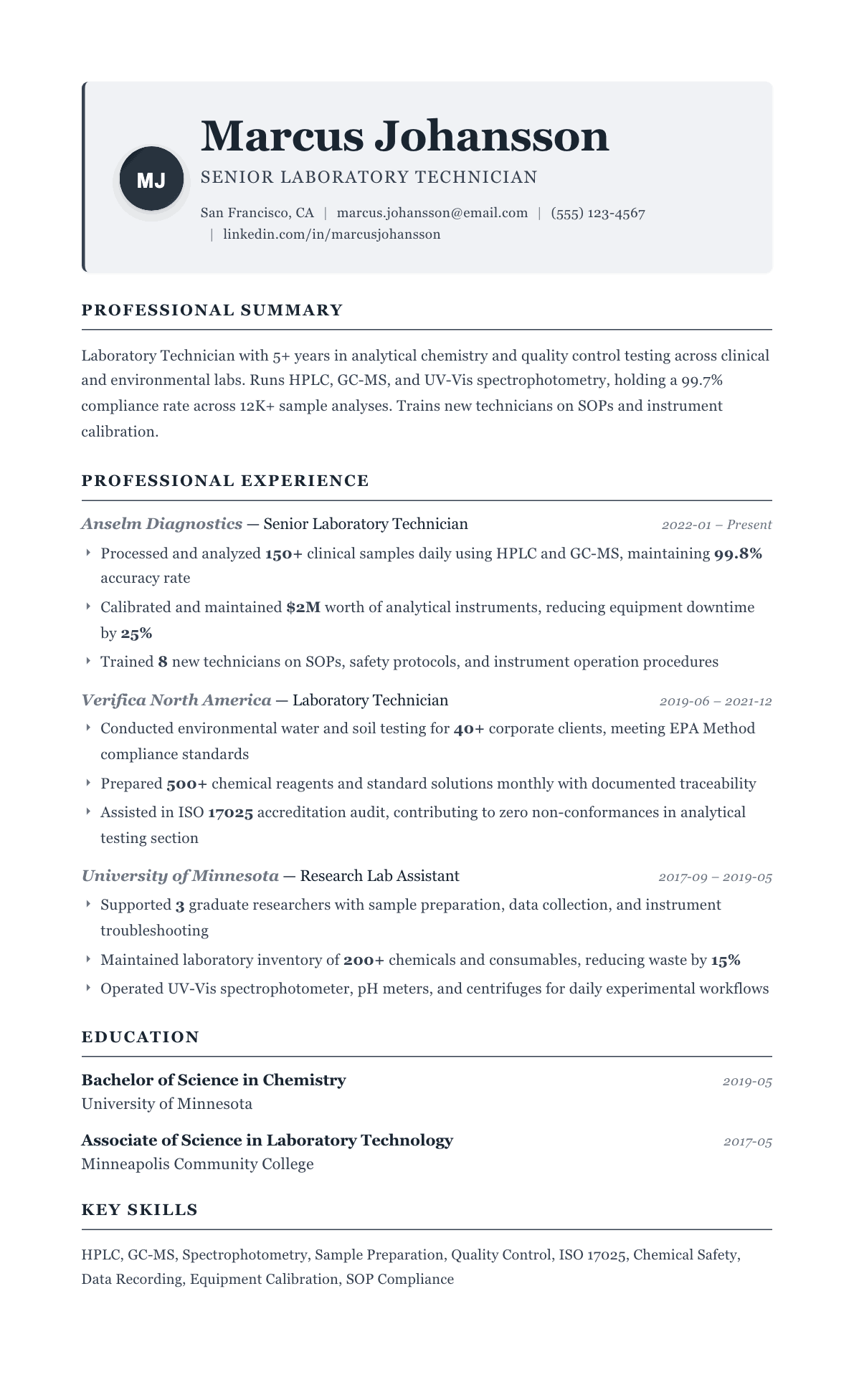
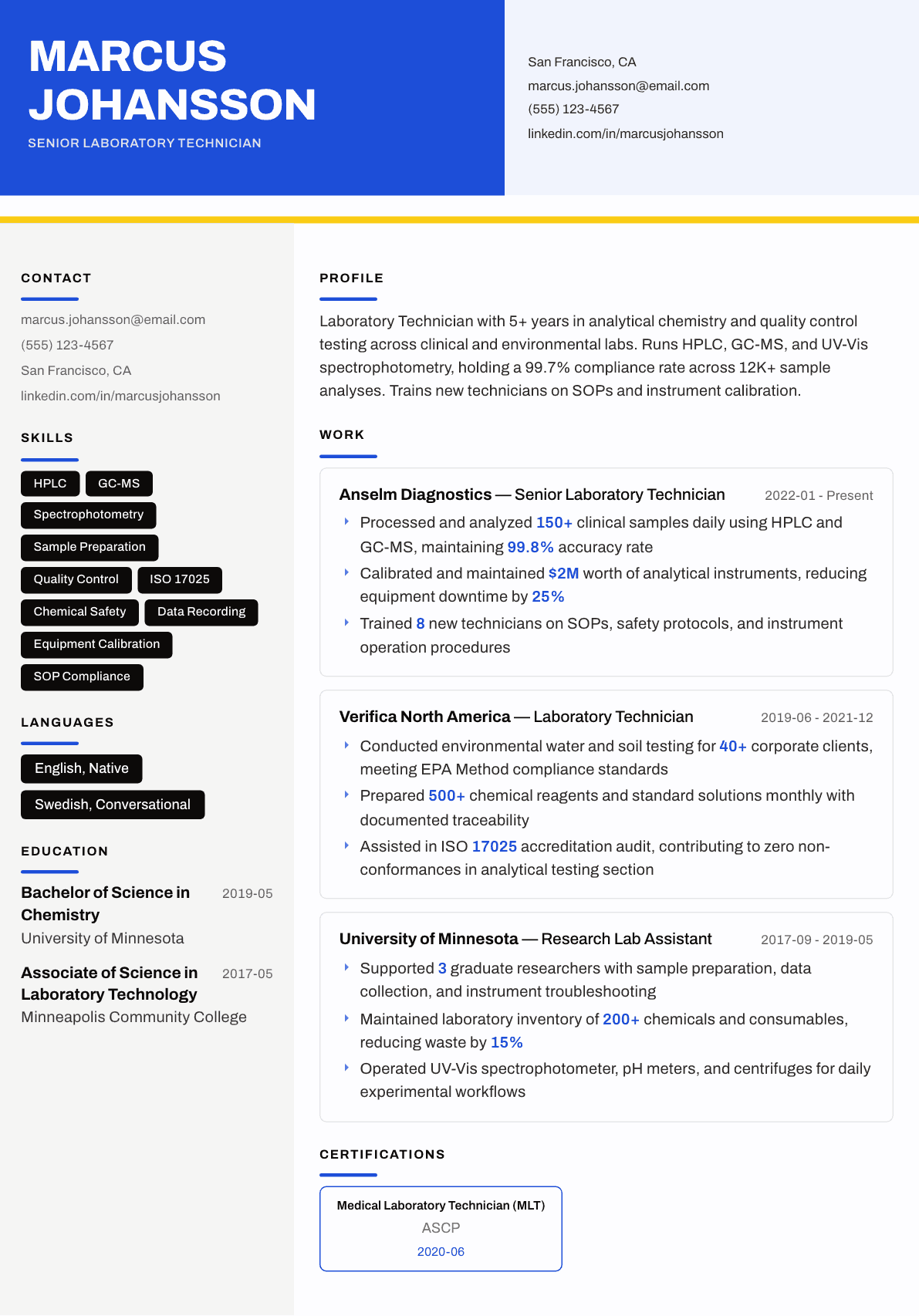
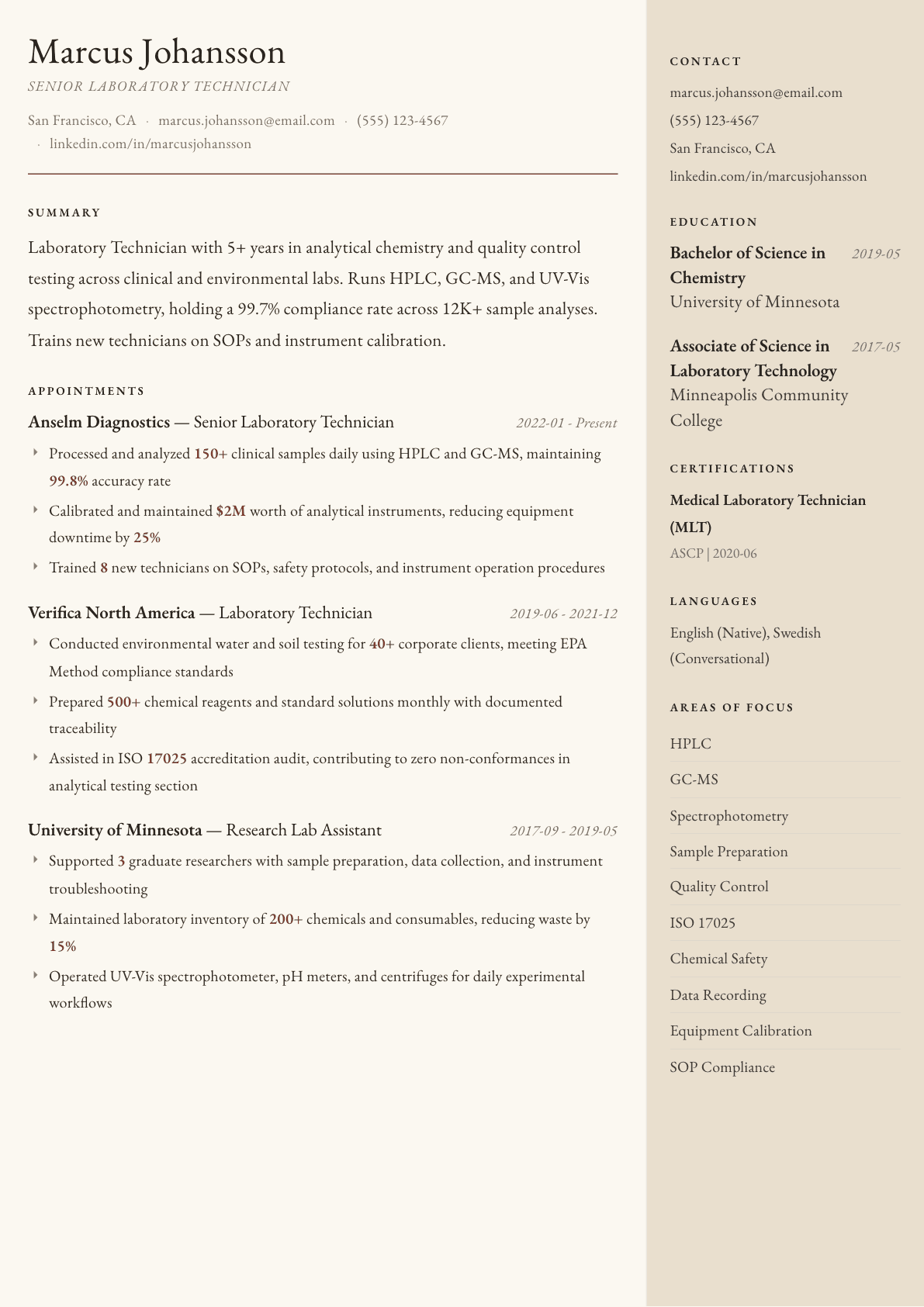
Example Lab Technician summary
Lab Technician with 5+ years in analytical chemistry and clinical diagnostics, processing 150+ samples a day on HPLC and GC-MS. Holds a 99.7% accuracy rate across 12K+ analyses and cut instrument downtime 25% through a calibration schedule. Worked through an ISO 17025 accreditation audit with zero non-conformances.
Skills to list on a Lab Technician resume
- HPLC
- GC-MS
- UV-Vis Spectrophotometry
- Sample Preparation
- Quality Control
- ISO 17025
- GLP/GMP
- Chemical Safety
- LIMS
- Equipment Calibration
- Data Analysis
- SOP Development
What actually gets this resume read
- List specific instruments and analytical methods you are proficient with, including model numbers when relevant.
- Quantify your throughput: samples processed per day, accuracy rates, and turnaround times.
- Highlight compliance knowledge: GLP, GMP, ISO 17025, CLIA, or EPA methods.
- Include any training or mentoring experience to demonstrate progression beyond entry-level tasks.
- Mention LIMS systems and any data management software you have used.
How to write a lab technician resume
Lab technician, or lab tech on most postings, is one job title covering at least five different jobs. A hospital bench, a contract environmental lab, a pharmaceutical quality control unit, a food safety lab and an academic research group all hire technicians, and they screen for almost nothing in common. The first job of your resume is to make clear which of those worlds you come from and which one you are applying to.
After that, a lab manager reads for three things: the instruments you have run unsupervised, the regulatory framework you have worked under, and whether your documentation habits will survive an audit. Sample throughput and turnaround time come fourth. Personality comes last, if at all.
Applying in the UK, Ireland, India or the Gulf, the same document is a CV for a laboratory technician, often two pages, with instruments and accreditation listed the same way. This guide sets out the section order lab hiring managers expect, how to write instrument experience so it reads as competence rather than exposure, summaries for a first job through a senior bench role, and the questions technicians ask when moving between clinical, environmental and manufacturing labs.
Laboratory technician resume example: a complete sample
This laboratory technician sample resume is for a technician with three years in a contract testing lab. The lab manager reading it checks the sample types, the instruments you run alone, the volume and the quality system you work under, so the summary carries all four.
Summary: Laboratory technician with three years in a GMP contract testing lab, running HPLC, UV-Vis and Karl Fischer analysis on raw materials and finished product. Processes about 40 samples a week, documents to ALCOA principles and supports two internal audits a year.
Laboratory technician resume format and template: one page, reverse chronological, in this order. Header with name, city, phone and email. Summary with sector, sample types, key instruments and quality system. Technical skills with techniques, instruments, LIMS and safety training. Experience with four to six bullets per job, each with a volume or a standard. Education, then the certifications the posting asks for. Keep a single column if the employer uses an online application system, because a plain layout keeps every heading readable.
In the UK and many other countries the same document is called a CV, and this laboratory technician CV sample uses the same order. Laboratory technician resumes for clinical, environmental and food labs follow the same pattern; only the instruments and the quality system change.
The experience entry for this sample, Laboratory Technician, Brookfield Analytical Services, reads as the bullets below.
- Run HPLC and UV-Vis assays on raw materials and finished product, about 40 samples a week, to written SOPs.
- Prepare reagents, standards and mobile phases, and record every lot in the lab inventory system.
- Perform daily calibration checks on balances, pH meters and the HPLC systems.
- Record results in the LIMS and flag out of specification results to the supervisor the same day.
- Support internal audits by pulling batch records and training files on request.
Resume format for a lab assistant or lab technician: instruments near the top
A single column reverse chronological document is right for almost every technician. Laboratory hiring runs through corporate applicant tracking systems that mangle columns, and a manager who reviews forty applications for one bench opening will not hunt for the analyzer list.
Give instrumentation its own labeled block above or immediately below the summary. This is the section the reader scans first, and burying an instrument in a paragraph of a job from four roles ago means it will be missed.
A laboratory resume uses the same skeleton in every sector; what changes is which block sits second and which training goes last. The four laboratory resume templates below give the order for clinical, environmental, quality control and research labs, so you can start from the one that matches the posting.
Resume format for a lab assistant, written out in order: name and contact line; a two line summary naming the lab type and the sample work; an instruments and techniques block such as pipetting, centrifuge, autoclave, pH meter and specimen accessioning; experience with sample volumes and the SOPs you followed; education with relevant lab courses; then safety training such as bloodborne pathogens or chemical hygiene. A lab assistant who prepares media, washes glassware and logs specimens should say so plainly, because those are the tasks the posting lists.
- Header: name, city and state, phone, email, and any license or board certification abbreviation you hold.
- Order: summary, instrumentation and techniques, laboratory experience, education, certifications and training.
- For a clinical role, add the license state and the certifying body next to your name.
- Laboratory resume template, clinical lab: header with license and certifying body, summary, instruments and analyzers by department, experience by shift and section, education, proficiency testing and safety training.
- Laboratory resume template, environmental or contract testing lab: summary with matrices and accreditation, instruments and methods, experience with sample volume and turnaround, education, then hazardous waste and transport training.
- Laboratory resume template, pharmaceutical or food quality control: summary with GMP or food safety system, techniques and instruments, experience with batches released and audits supported, education, then documentation and data integrity training.
- Laboratory resume template, research lab: summary with research area and techniques, experience by project and principal investigator, publications or posters if you have them, education, then animal or biosafety training.
Summary: sector, sample type, instruments, compliance regime
Four facts in three lines. What kind of lab, what you analyze, what you run it on, and under which standard. A technician who writes analytical chemistry, drinking water and wastewater, ICP-MS and ion chromatography, accredited to ISO 17025 has already answered most of the screening questions.
If you are switching sectors, say the transferable core out loud. Sample preparation, chromatography, calibration curves and documented traceability behave the same way whether the matrix is soil, plasma or a tablet, but the reader will not make that leap for you.
Three lab tech resume examples, summary lines written out by sector. Clinical: lab tech in a hospital core lab, runs chemistry and hematology analyzers unsupervised on nights under CLIA. Environmental: laboratory technician in a contract lab, prepares water and soil samples for metals by ICP and runs the daily calibration checks under ISO 17025. Quality control: QC lab tech for generic tablets, HPLC assay and dissolution under GMP, with records that have passed two client audits.
Experience: what you ran alone, at what volume, to what standard
Open each job with the lab type and scope: a hospital core lab running specimens around the clock, a commercial testing lab with a client list, a quality control unit releasing batches. Then state your section, whether chemistry, microbiology, hematology, molecular, metals or organics.
Write instrument bullets so the reader can tell operation from ownership. Running samples on a gas chromatograph mass spectrometer is a technician task. Tuning it, running the daily performance check, troubleshooting a failing detector, changing a column and requalifying is what a lab wants to buy. Say which you do.
Documentation is the part candidates skip and managers care about most. Writing and revising standard operating procedures, maintaining calibration and maintenance logs, handling chain of custody, running quality control charts, investigating out of specification results and closing corrective actions all belong on the page. Mention audits you supported by the standard: an accreditation assessment, an inspection, a client audit.
Use throughput numbers carefully and honestly. Samples per day, batches released per week, or turnaround time met against the lab target say more than a vague claim of high volume, but they must be numbers you could defend in an interview.
Skills: techniques, instruments, software, safety
Group techniques and instruments separately from software. Techniques include sample extraction and digestion, dilution and standard preparation, titration, gravimetric analysis, plating and culture, nucleic acid extraction and staining. Instruments should be specific: high performance liquid chromatography, gas chromatography with mass spectrometry, inductively coupled plasma mass spectrometry, atomic absorption, ultraviolet and visible spectrophotometry, Fourier transform infrared, Karl Fischer titration, automated clinical analyzers.
Name the laboratory information management system by product, since data entry habits are system specific and a manager will read it as a shorter training runway. Add the safety and handling training you actually hold: chemical hygiene, bloodborne pathogen, hazardous waste, and dangerous goods transport.
Education, certification and the regulatory keywords
An associate or bachelor degree in chemistry, biology, medical laboratory technology or a related science goes below experience once you have a couple of years on the bench. New graduates should move it up and list instrument based coursework and any capstone or research project by technique.
Mirror the regulatory language of the posting exactly once in the summary and once inside a bullet. Clinical labs write about accreditation and proficiency testing. Environmental labs write about accreditation and published analytical methods. Pharmaceutical quality control writes about good manufacturing practice, good documentation practice and data integrity. These phrases are what the screening filter is built from.
Lab Technician resume summary examples
First bench job
Chemistry graduate with laboratory internship experience in sample preparation, titration and ultraviolet and visible spectrophotometry, plus two semesters running a gas chromatograph in an undergraduate research group. Trained in chemical hygiene and waste handling. Seeking an analytical lab technician position in environmental or quality control testing.
Three years on the bench
Laboratory technician in a commercial environmental lab accredited to ISO 17025, running metals and volatile organics on ICP-MS and gas chromatography mass spectrometry. Handles about 90 samples per day, writes and revises standard operating procedures, and held a 98% on-time turnaround across the last two reporting years.
Senior technician
Senior laboratory technician with nine years in pharmaceutical quality control, releasing raw material and finished product under good manufacturing practice. Owns instrument qualification for six chromatography systems, leads out-of-specification investigations, and trained 11 technicians on method transfer and data integrity practices.
Work experience bullets: before and after
Before: Used HPLC and GC-MS to analyze samples.
After: Ran assay and impurity methods on four high performance liquid chromatography systems, performed daily system suitability, replaced columns and diagnosed baseline drift without instrument service support.
Ownership of system suitability and troubleshooting is what a lab pays for; pressing start on a sequence is not.
Before: Followed laboratory safety procedures and SOPs.
After: Authored and revised 14 standard operating procedures for metals digestion and instrument maintenance, and closed 6 corrective actions ahead of the annual accreditation assessment.
Writing and closing documents is evidence; following procedures is the minimum expectation for everyone.
Before: Processed a high volume of samples each day.
After: Processed about 120 clinical chemistry specimens per shift with a documented turnaround under four hours for routine panels and under one hour for stat requests.
Real throughput against a stated turnaround target lets a manager compare you with the bench you would join.
Before: Performed quality control checks.
After: Maintained Levey-Jennings control charts across 22 analytes, applied Westgard rules to flag shifts, and stopped reporting twice when a control trend indicated calibrator degradation.
Naming the control tools and a moment you halted results shows judgment rather than routine box ticking.
Before: Helped with lab inventory and reagents.
After: Prepared and standardized reagents and calibration standards for the metals section, tracked lot numbers and expiry in the laboratory information system, and cut expired reagent write-offs by about a third.
Traceability detail and a measured reduction turn a housekeeping line into a quality contribution.
Hard skills
- High performance liquid chromatography
- Gas chromatography mass spectrometry
- Inductively coupled plasma mass spectrometry
- Ultraviolet and visible spectrophotometry
- Atomic absorption spectroscopy
- Titration and gravimetric analysis
- Sample extraction and digestion
- Instrument calibration and maintenance
- Method validation and verification
- Quality control charting
- Laboratory information management systems
- Standard operating procedure authoring
- Chain of custody documentation
- Aseptic technique and media preparation
Soft skills
- Meticulous documentation
- Working to turnaround deadlines
- Escalating anomalous results
- Training new bench staff
- Steady hands under repetition
- Clear communication with clients
Certifications worth listing
- Medical Laboratory Technician, MLT(ASCP) (ASCP Board of Certification)
- Medical Laboratory Technician, MLT(AMT) (American Medical Technologists)
- Certified Quality Technician (CQT) (American Society for Quality)
- HAZWOPER 40-Hour Training (OSHA-authorized training provider)
- Chemical Hygiene and Laboratory Safety Training (Employer or accredited training provider under the OSHA laboratory standard)
Mistakes that cost lab technician candidates the interview
- Listing an instrument you touched once next to one you run daily, with nothing to distinguish them. Interviewers open with the instrument list and the bluff collapses in two questions.
- Leaving the compliance framework off entirely, so a manager cannot tell whether you have ever worked under an accredited quality system.
- Writing generic science filler such as conducted experiments and analyzed data instead of the actual analytes, matrices and methods.
- Sending a clinical resume to an environmental lab unchanged. The specimen types, the standards and the vocabulary all have to be swapped.
- Skipping the documentation work. Procedure writing, deviation handling and audit support are frequently the deciding factor between two similar candidates.
- Omitting the license or board certification abbreviation for clinical roles, which in many states is a hard requirement rather than a preference.
Lab Technician resume questions
Do I need certification to work as a lab technician?
It depends entirely on the sector. Clinical laboratory work is often gated by board certification and by state licensure, while environmental, food and industrial quality labs usually hire on degree and instrument experience alone. Read the posting and match its language exactly.
What is the best laboratory resume template?
A one page, single column, reverse chronological template with a labeled instruments block near the top. Clinical labs put the license and certifying body in the header, environmental labs lead with matrices and accreditation, quality control labs lead with GMP and audits, and research labs list projects and techniques. Avoid columns and graphics, because applicant tracking systems read plain text best.
Should a lab technician resume include research or a thesis project?
Include it while it is your strongest laboratory experience, described by technique rather than by topic. A hiring manager cares that you extracted nucleic acids and ran quantitative polymerase chain reaction, not about the biological question the study was asking.
Is a CV for a laboratory technician different from a lab tech resume?
In content, no. A CV for a laboratory technician in the UK, Ireland, India, the Gulf or much of Europe usually runs to two pages and may add a short profile and any professional registration, while a US resume stays at one page. Both lead with sector, instruments run unsupervised and the quality system you worked under. Moving from an academic lab, translate methods into the regulated vocabulary of the target sector, such as SOPs, GLP or GMP documentation.
What should be in the skills section of a lab technician resume?
Instruments by full name, sample preparation techniques, the quality system you worked under, the laboratory information management software by product name, and your safety training. Leave out generic traits like detail-oriented, which the documentation bullets already prove.