Chief Human Resources Officer Resume Examples: free score
Write a Chief Human Resources Officer Resume for the Board Audience
By Mustafa Tarabya, founder of CVBooster · Published · Updated
A chief human resources officer resume example built for board and CEO readers, with scope, succession and transformation proof plus a full guide.
Sample resumes for a chief human resources officer
The same chief human resources officer content laid out in three CVBooster templates, so you can see what the finished document looks like before you write a word.
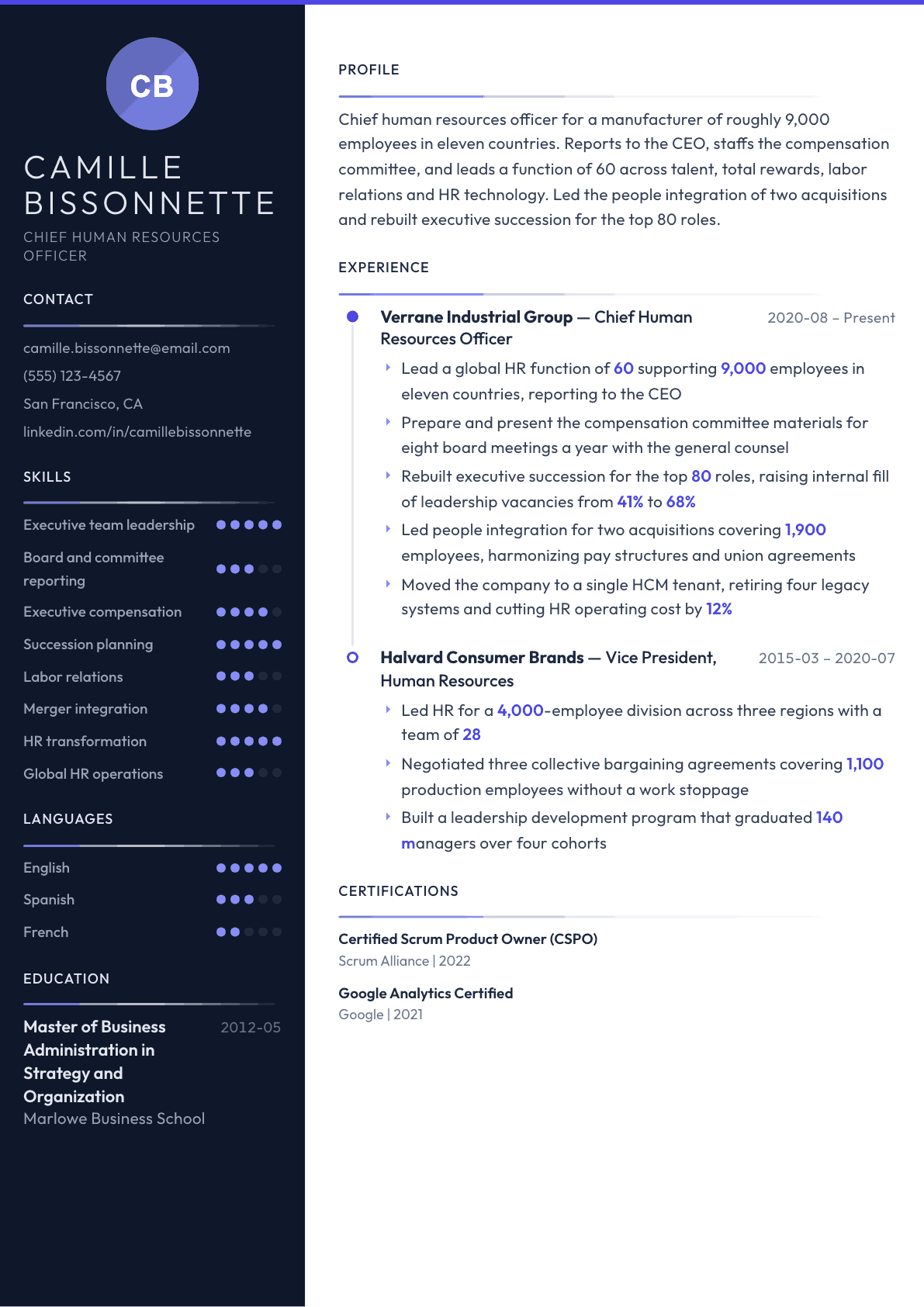
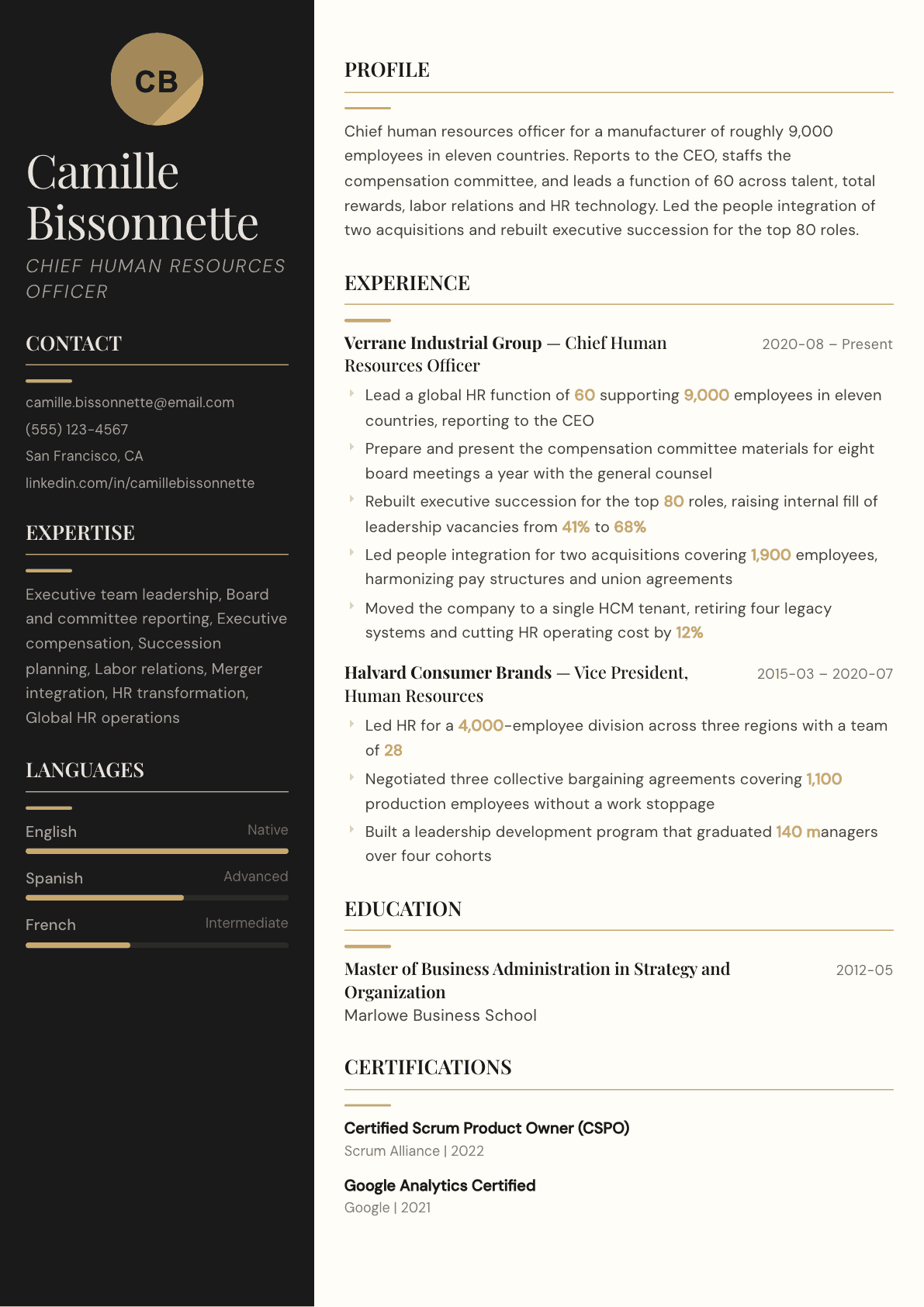
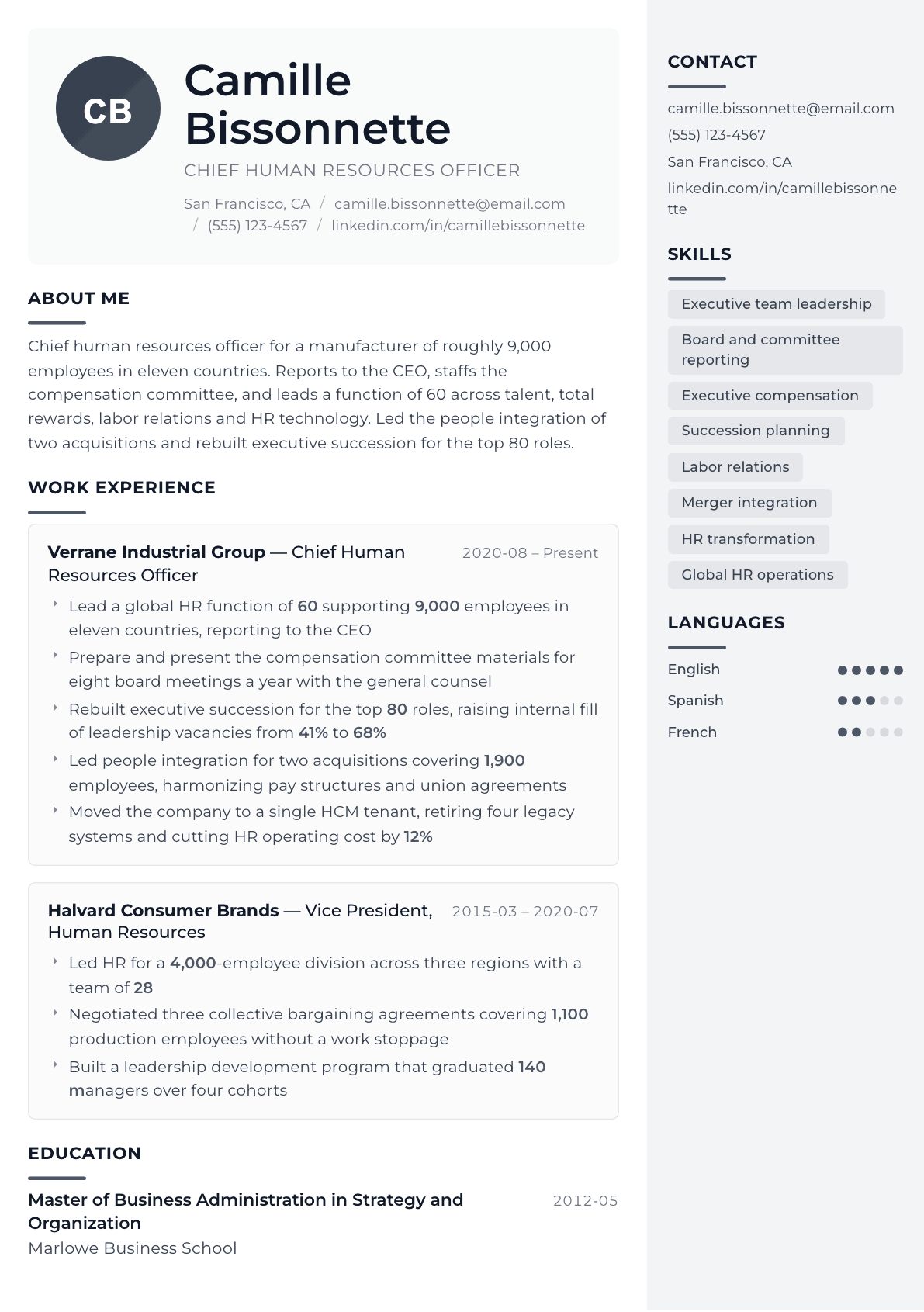
Example Chief Human Resources Officer summary
Chief human resources officer with more than fifteen years leading people functions in industrial and consumer businesses, currently 9,000 employees across eleven countries. Staffs the compensation committee, leads a global team of 60, and has integrated two acquisitions covering 1,900 employees. Rebuilt executive succession so internal fill of leadership roles rose from 41% to 68%, and consolidated four HR systems into one tenant.
Skills to list on a Chief Human Resources Officer resume
- Executive leadership
- Board and compensation committee
- Executive compensation design
- Succession planning
- Organizational design
- Labor relations and bargaining
- Merger and acquisition integration
- HR transformation
- Global mobility
- Talent strategy
- Culture and engagement
- Workforce cost management
- HR technology strategy
- Employment risk oversight
- Executive coaching
What actually gets this resume read
- Open with scope in one line: employees, countries, revenue scale of the business, function size and who you report to.
- Write for a board and CEO audience, which means business outcomes first and HR process detail second.
- Name the committee work explicitly, because compensation committee experience is a screening criterion at this level.
- Show at least one enterprise event you led: an integration, a restructuring, a union negotiation or a system consolidation.
- Prove succession and leadership bench with internal fill rates rather than a description of the framework you used.
- Two pages is normal at this level, with board service, degrees and any executive credential in a short block at the end.
How to write a chief human resources officer resume
A chief human resources officer resume is not read by HR. It is read by a chief executive, a board chair, a private equity operating partner or the search consultant working for one of them. That reader spends less than a minute on the first pass and is looking for scope, enterprise events you have led, and whether you have sat in front of a compensation committee before.
The most common failure at this level is a resume written in HR language. Program names, framework names and function-internal vocabulary crowd out the business context, and the page reads as a senior practitioner rather than an executive. The fix is to lead every job with the business: what the company did, how large it was, what was happening to it, and what you were brought in to change.
This guide covers the scope line a board reader needs, how to show governance and committee work, which enterprise events carry the most weight, how to handle a two page format at this level, and the questions candidates face when moving from vice president to the top seat.
Format: two pages, business context before HR detail
Two pages is standard and expected. Use a short positioning statement rather than a long summary, then the roles, then a compact block for board service, education and credentials at the end.
Under each employer, write a company line before the bullets: what the business does, revenue scale or employee count, ownership structure, and geography. Then a role line: who you reported to, the size of your function, and the population you served. A reader deciding whether you can operate at their scale needs both lines before any achievement.
- Header: name, city and state, phone, email, and a professional profile link.
- Section order: positioning statement, experience, board and advisory roles, education, certifications.
- Divisional leaders stepping up should make the enterprise exposure they already have unmistakable.
Positioning statement: scope, reporting line, signature work
Four or five lines that answer three questions. What scale have you operated at, measured in employees, countries and function size. Who have you reported to and which governance bodies have you served. What are you known for: a turnaround, a merger integration, a labor relations record, a culture rebuild, a global operating model.
Cut adjectives entirely. Strategic, transformational and visionary appear on every executive resume in the pile and carry no information. The events you have led do the work those words are attempting.
Experience: enterprise events, not program lists
Weight each role toward the handful of things a board would recognize. Merger and acquisition integration with the population involved. Restructuring or workforce reduction handled without litigation or reputational damage. Collective bargaining rounds concluded. An executive compensation redesign taken through committee. A succession bench rebuilt. A global operating model or system consolidation delivered.
Attach outcomes a chief executive cares about: internal fill of leadership roles, unplanned executive turnover, cost of the function, time to productivity after an acquisition, absence of work stoppages. Function-internal metrics belong further down and in fewer words.
Do not enumerate the programs your team ran. Listing the talent, rewards, learning and diversity programs in your function reads as a job description rather than a record of decisions. Name the two or three that changed the business and let the rest be implied by scope.
- Say who you reported to in every role, because a dotted line to the chief executive is different from reporting through a chief operating officer.
- Give function size and structure, including whether shared services and HR technology sat under you.
- Name the ownership context: public, family owned, private equity backed, or cooperative, since each implies a different job.
Governance: the compensation committee is the screen
Committee experience is the most common differentiator between a vice president resume and a chief human resources officer resume. Say how many meetings a year you prepared for, what you owned in the materials, who you worked with on them, and which topics you presented yourself: executive pay design, say on pay outcomes, succession, human capital disclosure or culture reporting.
If you have not yet served a committee, show the nearest equivalent honestly: preparing materials for the committee chair, presenting once on a specific topic, or leading executive compensation work reviewed by an external consultant. Search consultants ask this question directly and an accurate answer is better than an inflated one.
The closing block: boards, education, credentials
A short block at the end covering nonprofit or corporate board service, executive education, degrees and any senior HR credential. Keep it to a few lines. At this level the reader is checking rather than evaluating, and a long education section pushes the enterprise work off the first page.
Chief Human Resources Officer resume summary examples
Stepping up to the seat
Human resources leader for a 4,000-employee division across three regions with a team of 28, reporting to the division president. Concluded three collective bargaining agreements without a work stoppage and built a leadership program that graduated 140 managers. Ready for enterprise ownership of the people function.
First chief human resources officer role
Chief human resources officer for a manufacturer of 9,000 employees in eleven countries, reporting to the chief executive and staffing the compensation committee. Led people integration for two acquisitions covering 1,900 employees and raised internal fill of leadership vacancies from 41% to 68% by rebuilding succession for the top 80 roles.
Second time in the seat
Twice a chief human resources officer, most recently for a listed services group of 26K employees across four continents with a function of 180. Took executive pay redesign through the committee, led a restructuring of two business units, and consolidated the people technology landscape into a single platform.
Work experience bullets: before and after
Before: Led the global HR function and reported to the CEO.
After: Led a global people function of 60 covering talent, total rewards, labor relations and HR technology for 9,000 employees in eleven countries, reporting to the chief executive.
Function size, the domains inside it and the population turn a title statement into a scope a board can measure.
Before: Presented to the board on people topics.
After: Prepared and presented compensation committee materials for eight board meetings a year with the general counsel, owning executive pay design, succession and human capital reporting sections.
Meeting cadence, co-owner and named agenda items are the evidence a search consultant is actually looking for.
Before: Improved leadership succession planning.
After: Rebuilt succession for the top 80 roles with named ready-now and ready-later candidates reviewed twice a year, raising internal fill of leadership vacancies from 41% to 68% over three cycles.
A defined population, a review rhythm and an internal fill movement make succession something a chief executive can verify.
Before: Managed HR through two acquisitions.
After: Led people integration for two acquisitions covering 1,900 employees, harmonizing pay structures, benefit plans and two union agreements while holding voluntary attrition at the acquired sites below the group average.
The workstreams and the retention outcome show integration was managed rather than merely survived.
Before: Reduced HR costs through system changes.
After: Consolidated four legacy people systems into a single platform across eleven countries, retiring duplicate vendor contracts and lowering HR operating cost by 12% while shortening payroll close by two days.
Naming the scope, the vendor effect and a second operational benefit makes the cost claim credible.
Hard skills
- Executive compensation design
- Compensation committee governance
- Succession and leadership bench planning
- Organizational design and restructuring
- Labor relations and collective bargaining
- Merger and acquisition people integration
- Global HR operating models
- Workforce cost and productivity management
- HR technology strategy
- Human capital reporting
- Employment risk oversight
- Talent strategy and workforce planning
Soft skills
- Counsel to a chief executive
- Composure in a contested board discussion
- Judgment on sensitive executive matters
- Building trust with operating leaders
- Deciding with incomplete information
Certifications worth listing
- Senior Professional in Human Resources (SPHR) (HR Certification Institute)
- SHRM Senior Certified Professional (SHRM-SCP) (Society for Human Resource Management)
- Certified Compensation Professional (CCP) (WorldatWork)
- NACD Directorship Certification (National Association of Corporate Directors)
Mistakes that cost chief human resources officer candidates the interview
- Writing in HR vocabulary for an audience of chief executives and directors.
- Listing every program the function ran instead of the decisions you owned.
- Leaving out ownership structure and reporting line, which set the character of the role.
- Omitting committee work, which is the first thing a search consultant probes.
- Compressing an executive career onto one page and losing the enterprise events.
- Claiming credit for an integration or restructuring you supported rather than led.
- Ending with a long education section that pushes scope off the opening page.
Chief Human Resources Officer resume questions
How long should a chief human resources officer resume be?
Two pages. One page forces out the enterprise events that justify the role, and three pages signals an inability to prioritize. Give the last two roles most of the space and compress earlier positions into short entries with title, company and one line.
What do search consultants look for first?
Scope and governance. They check employee count, geography, function size and reporting line, then whether you have served a compensation committee and led an enterprise event such as an integration, a restructuring or a bargaining round.
How do I move from vice president to the top seat?
Show enterprise exposure rather than divisional depth. Highlight work that crossed the whole company, any committee material you contributed to, and a business event where you were the people leader in the room with the executive team.
Should I include the financial performance of the business?
Include revenue scale for context so a reader can size the company, and outcomes you influenced such as workforce cost or productivity. Avoid claiming company results you did not drive, because a board reader will discount the whole page.
Do I still need HR certifications at this level?
They are not decisive, but a senior credential does no harm and a compensation credential is useful if executive pay is central to the role. Keep them in a short closing block rather than near the top where scope belongs.
Related resume examples
- Chief People Officer Resume example
- HR Manager Resume example
- VP of Human Resources Resume example
- Head of People Resume example
- HR Director Resume example
- HR Business Partner Resume example