Childcare Worker Resume Examples: the lines they read
Child Care Worker Resume Samples and a Childcare Resume Template
By Mustafa Tarabya, founder of CVBooster · Published · Updated
Resume for a daycare or childcare job: child care worker samples for centers, school age programs and family homes, with ratios, clearances and keywords.
Sample resumes for a childcare worker
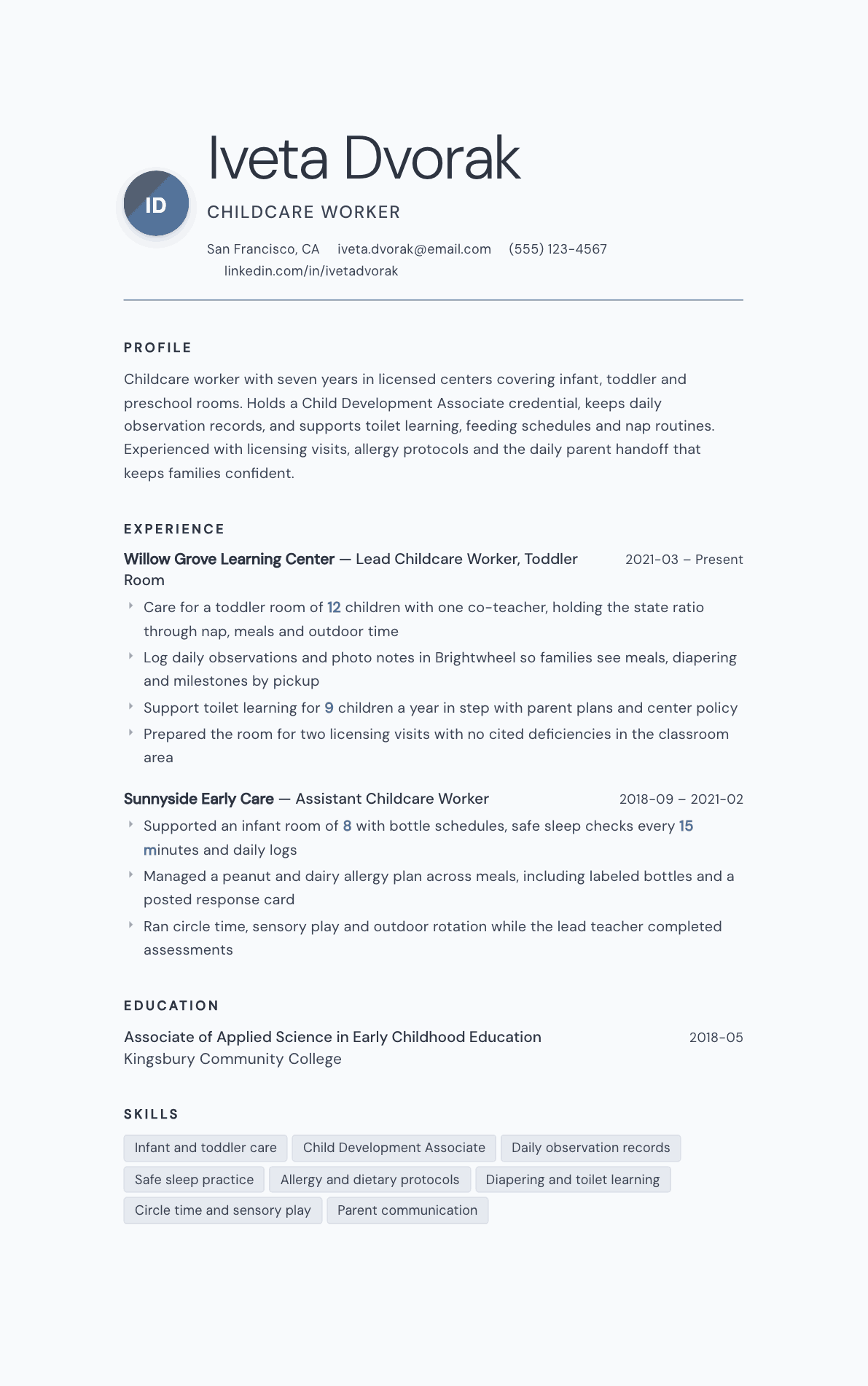
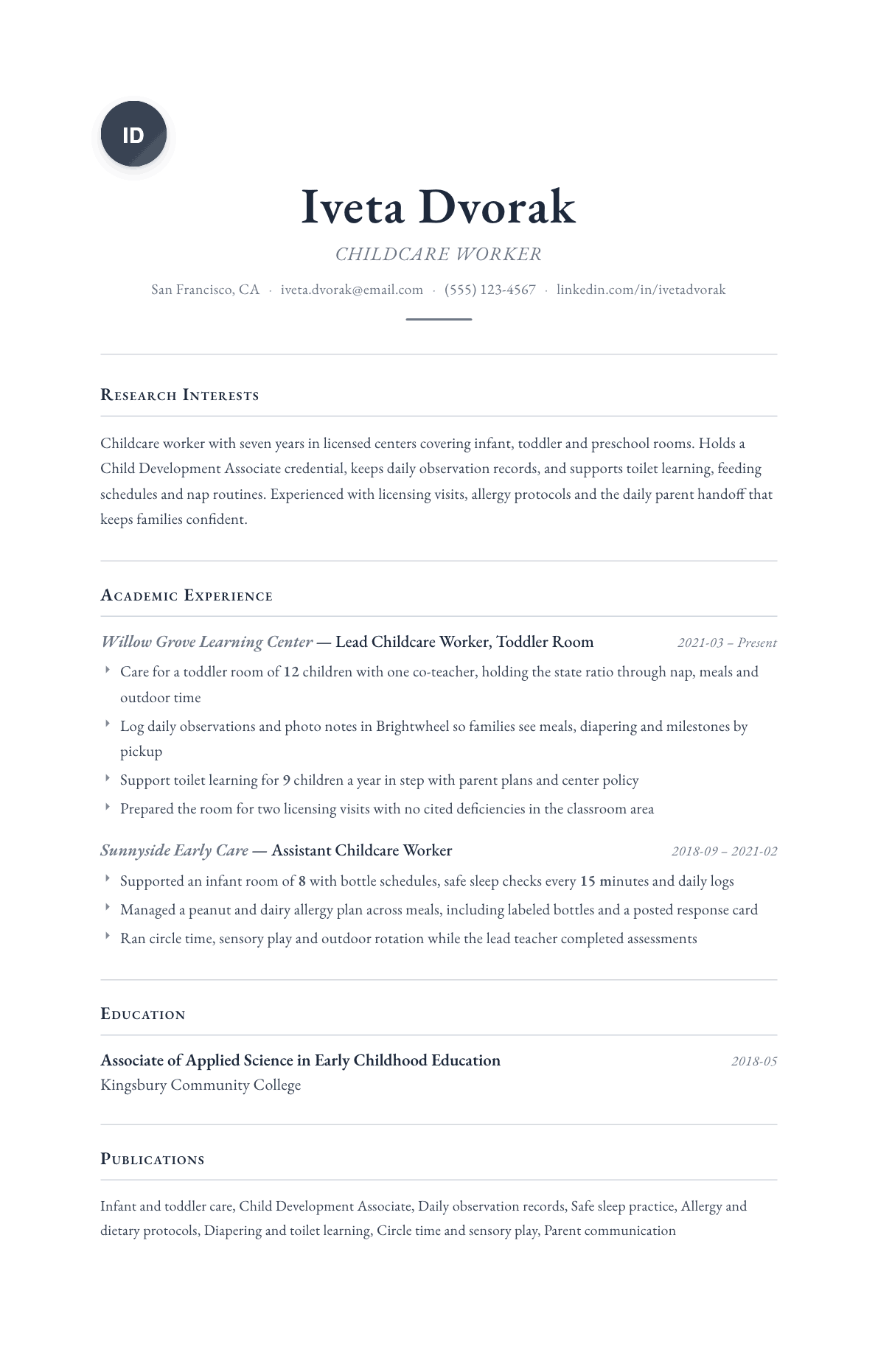
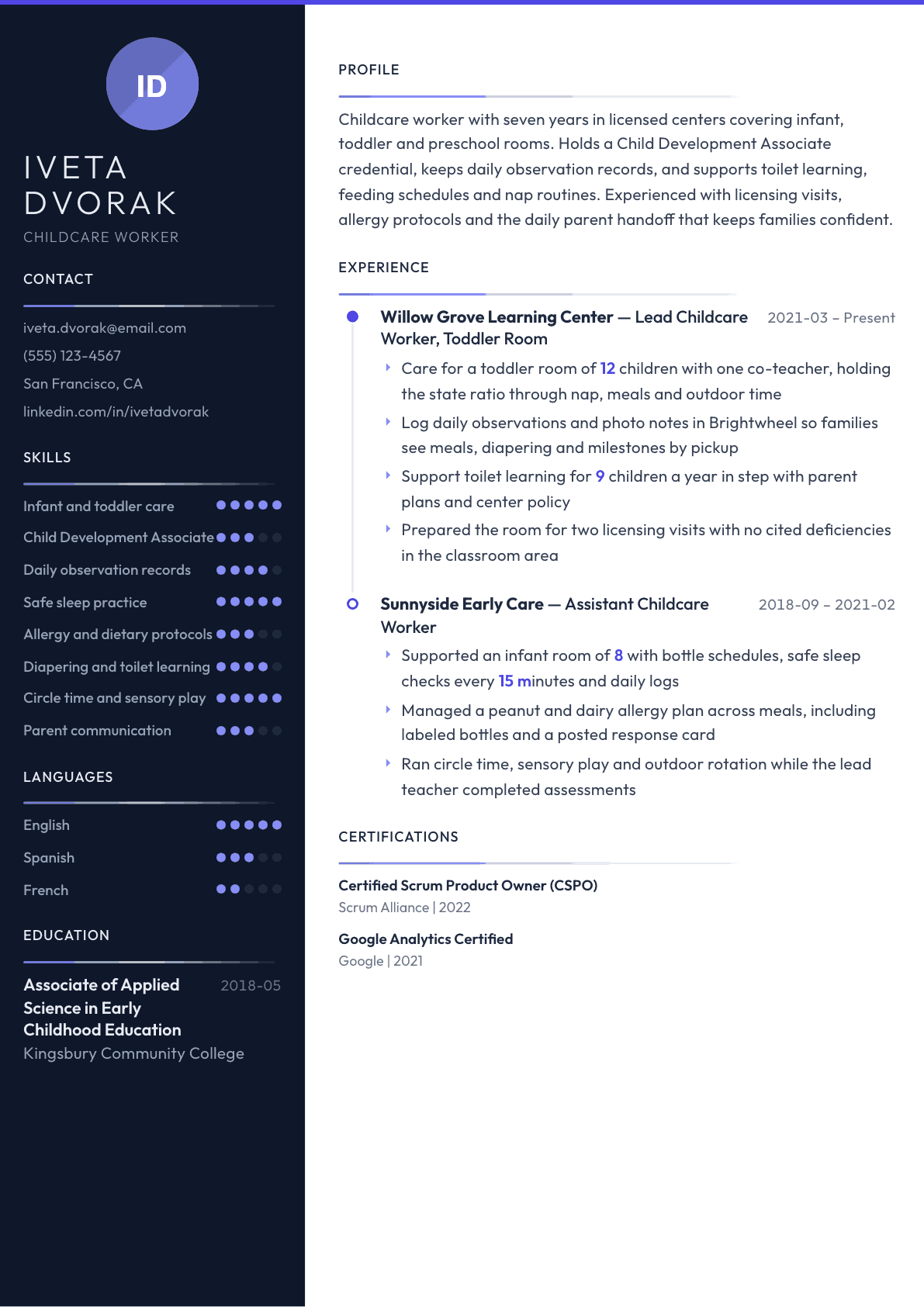
The same childcare worker content laid out in three CVBooster templates, so you can see what the finished document looks like before you write a word.
Example Childcare Worker summary
Childcare worker with seven years in licensed centers across infant, toddler and preschool rooms, currently leading a toddler group of twelve. Holds a Child Development Associate credential, records daily observations in Brightwheel, and manages allergy plans, toilet learning and safe sleep checks. Comfortable preparing a room for licensing and handling the pickup conversation when a day has gone badly.
Skills to list on a Childcare Worker resume
- Infant care and safe sleep
- Toddler room supervision
- Preschool activity planning
- Adult to child ratio compliance
- Diapering and toilet learning
- Feeding and bottle schedules
- Allergy and medication protocols
- Daily observation and reporting
- Developmental milestone tracking
- Circle time and sensory play
- Positive guidance techniques
- Licensing and health inspections
- Family communication
- Classroom sanitation routines
What actually gets this resume read
- Name the age rooms you have worked in, because infant, toddler and preschool care are staffed as separate jobs.
- State the group size and the adult to child ratio you held, since directors match that against their own rooms.
- List your credential, background clearance and health training together so a licensing manager can verify fast.
- Show the daily reporting app you use, whether Brightwheel, Procare or paper logs, as centers hire around theirs.
- Include experience with licensing visits, allergy plans or behavior support, because those tasks worry directors most.
- Describe parent communication concretely: handoffs, incident notes, conferences, not just a claim of being friendly.
How to write a childcare worker resume
A center director hiring a childcare worker is filling a specific room. Infant, toddler, preschool and pre-kindergarten are staffed separately, run on different ratios and demand different skills, and the first thing a director looks for on your resume is which of those rooms you can walk into on Monday. A resume that says child care experience without naming the age group makes her guess, and she will not.
The second thing she checks is compliance. State licensing sets the ratio, the training hours, the background clearance, the health requirements and the record keeping. A childcare worker who already understands ratio, safe sleep checks, allergy protocol and daily documentation costs the center far less to onboard than one who has only babysat.
Whether the posting says childcare worker, child care worker or daycare teacher, the job and the resume are the same, and a resume for a daycare follows the same order. This guide runs through the sections in the order a director reads them, with summaries for an assistant, a lead and a room lead with credential, before and after bullets that replace soft claims with what a licensing inspector would recognize, and answers to the questions people ask when they move from informal childcare into a licensed center.
Format: one page, age rooms named, clearances grouped
One page in reverse chronological order. Directors read fast and hire fast, because an unfilled classroom position means a room over ratio and a waitlist that cannot move. Put your age room specialization in the first line of the summary and again in each job title where the center allowed it.
Group credentials and clearances into one block: the Child Development Associate credential or coursework, background clearance, fingerprinting, pediatric first aid and CPR, health screening, and your annual training hours. A licensing manager can verify that block in a minute, which is exactly the point.
- Header: name, city, phone, email, and your availability for opening or closing shifts.
- Sections: summary, credentials and clearances, classroom experience, education, skills.
- Job titles that name the room: Lead Teacher, Toddler Room, rather than Child Care Staff.
Summary: ages, room size, ratio, credential
Three lines. The age rooms you have worked in, the group size you have held and the ratio you carried, your credential, and one strength the center is short of. Ratio is the number that matters, because it is the number the state checks and the number a director counts every hour.
Choose a strength that solves a problem. Toilet learning, feeding and bottle schedules, allergy plans, behavior support for a child with a plan in place, opening or closing coverage, and calm parent handoffs are all real gaps. Being caring and reliable is assumed of every applicant and proves nothing.
Experience: the room, the ratio, the routine, the record
Open each entry with the room and the numbers: a toddler room of twelve with one co-teacher, an infant room of eight, a preschool group of twenty with two adults. Then bullets on the daily work that is specific to that age.
For infants, that is bottle and feeding schedules, safe sleep checks on a timed interval, diapering, tummy time and milestone notes. For toddlers, it is toilet learning in step with parent plans, biting and sharing conflicts, transitions, and simple choice-based guidance. For preschool, it is circle time, small group activities, early literacy and numeracy routines, and kindergarten readiness notes.
Documentation runs through all of it. Name the app or the paper system: daily sheets, photo notes, observation records, incident forms and developmental checklists. Centers hire around the system they already use, and a candidate who has logged a full day in one of them starts producing immediately.
End with the compliance record where you have one. Licensing visits prepared for, deficiencies corrected, health inspections passed, or a room that held ratio through staffing gaps. Those are the outcomes a director can defend to her own supervisor.
Credentials, training hours and clearances
The Child Development Associate credential is the recognized entry credential in most states, and centers list it as preferred even when it is not required. If you hold it, put it in the header line after your name. If you are working toward it, say how many hours you have completed and when you expect to finish.
Annual training hours are a licensing requirement in most states, so state that you meet or exceed yours and name the topics: safe sleep, shaken baby prevention, medication administration, allergy response, mandated reporting and emergency procedures. A center that has to chase a new hire for training compliance loses days it cannot spare.
- Child Development Associate credential or the coursework hours completed to date.
- Pediatric first aid and CPR, with the issuing body and expiry.
- Background clearance, fingerprinting and any state registry number.
- Mandated reporter training and current annual training hours.
Skills and the vocabulary licensing uses
Postings for childcare workers recycle a narrow vocabulary: adult to child ratio, developmentally appropriate practice, positive guidance, safe sleep, diapering and sanitation, daily observation, family communication and licensing compliance. Mirror the terms you can defend, once in the skills list and once inside an experience bullet.
Add the software. Brightwheel, Procare, Tadpoles and HiMama each handle attendance, daily reports and billing differently, and a posting will often name one. If yours differs, say you have used a daily reporting app and name it, because the transferable part is obvious to a director.
Resume for a daycare or childcare job: a template and three settings
A resume for childcare work changes with the setting more than with the title. A licensed center wants rooms, ratios and training hours; a before and after school program wants group size and activities; a family wants reliability, routines and references. The sample resume for childcare below starts with a childcare resume template, the order of lines a director expects, then gives a summary and two bullets for each setting.
Swap in your own age groups, numbers and clearances. A director will check the training hours and the background check dates, so write the ones on your record.
If you are writing a resume for a daycare, use the posting's own word in your header, whether that is daycare teacher, daycare assistant or infant caregiver, and keep the room and ratio detail below. A skills line for a daycare job reads well as plain items: infant and toddler care, ratio supervision, safe sleep checks, diapering and feeding logs, allergy and medication records, parent communication at pickup, and age appropriate activity planning. Someone running a home daycare writes it as a business instead: the license type, the licensed capacity, the ages enrolled and the years open, then the curriculum, meals and parent communication.
- Resume template for childcare, in this order: name, the job title from the posting, phone, email and city; a three line summary naming age groups, ratio and credential; a clearances line with background check, CPR and pediatric first aid and their dates; experience with the room, ages, group size and ratio under each job; training hours and education; a short skills line.
- Sample one, licensed center, infant room: Childcare worker with two years in an infant room of eight children under eighteen months, working to a one to four ratio. Holds a CPR and pediatric first aid certificate and a current background check.
- Sample one, second bullet: Kept the daily sheets for feeding, sleep and diapering for every child and shared them with parents at pickup, with no missed entries on the last two licensing visits.
- Sample two, before and after school program: Group leader for twenty children aged five to ten in a school age program, planning homework time, outdoor play and one craft or science activity a day.
- Sample two, second bullet: Ran the sign in and sign out log at dismissal and released children only to authorized adults, checking photo ID for every new pickup.
- Sample three, nanny or family childcare: Nanny for two children aged two and five for three years, managing school and nursery pickup, meals, naps and activities, plus a weekly note to the parents.
- Sample three, second bullet: Potty trained the younger child and built a bedtime routine with the parents that held through a house move.
Childcare Worker resume summary examples
New to a licensed center
Early childhood assistant with 1 year in a licensed preschool room of 18 and 3 years of regular family childcare for children aged 1 to 7. Completed 60 hours toward the Child Development Associate credential, current in pediatric first aid and CPR, and cleared through state background check.
Lead in a toddler room
Childcare worker with 7 years in licensed centers across infant, toddler and preschool rooms, currently leading a toddler group of 12 with one co-teacher. Holds a Child Development Associate credential, logs daily observations in Brightwheel, and manages allergy plans and toilet learning with families.
Room lead and mentor
Senior childcare worker with 12 years in licensed care, leading an infant room and mentoring 5 assistants through onboarding and annual training. Prepared classrooms for 4 licensing visits with no cited classroom deficiencies, and coordinates allergy, medication and safe sleep protocols center wide.
Work experience bullets: before and after
Before: Cared for children in a daycare center.
After: Cared for a toddler room of 12 children with one co-teacher, holding the state ratio through nap, meals, diapering and outdoor rotation every day.
The room, the group size and the ratio tell a director whether you can slot into her classroom on Monday.
Before: Kept parents updated about their child's day.
After: Logged meals, diapering, naps and milestone notes in Brightwheel with photos, so every family had the full day on their phone before pickup.
The named system and the specific fields show a documentation habit a licensing visit would confirm.
Before: Helped children with potty training.
After: Supported toilet learning for 9 children a year in step with written parent plans and center policy, tracking accidents and successes on the daily sheet.
Coordination with parents and center policy shows a professional routine rather than an improvised one.
Before: Followed safety rules in the classroom.
After: Ran safe sleep checks every 15 minutes in an infant room of 8, with labeled bottles, a posted allergy response card and daily sanitation of cribs and toys.
These are the exact items an inspector checks, so naming them proves compliance knowledge.
Before: Planned activities for the kids.
After: Planned daily circle time, sensory play and small group activities against a developmental checklist, and wrote termly observation summaries for family conferences.
Tying activities to assessment shows developmentally appropriate practice instead of filling time.
Hard skills
- Infant care and safe sleep practice
- Toddler room supervision
- Preschool activity planning
- Adult to child ratio compliance
- Diapering and toilet learning
- Feeding and bottle schedules
- Allergy and medication protocols
- Daily observation and reporting apps
- Developmental milestone tracking
- Positive guidance techniques
- Licensing and health inspection readiness
- Classroom sanitation routines
- Mandated reporting procedures
- Emergency drills and evacuation
Soft skills
- Patience through repetition
- Steady voice during meltdowns
- Family handoff communication
- Teamwork with a co-teacher
- Observation without interrupting play
- Discretion with family information
Certifications worth listing
- Child Development Associate (CDA) Credential (Council for Professional Recognition)
- Pediatric First Aid and CPR (American Red Cross)
- ServSafe Food Handler (National Restaurant Association)
- Youth Mental Health First Aid (National Council for Mental Wellbeing)
Mistakes that cost childcare worker candidates the interview
- Writing child care experience without naming the age room, which leaves a director unable to place you.
- Omitting group size and ratio, the two numbers that decide whether your experience matches her classroom.
- Hiding the Child Development Associate credential or coursework hours in an education section at the bottom.
- Skipping the daily reporting system you used, when centers hire around the platform they already run.
- Listing babysitting without translating it into ages, number of children and the routines you managed.
- Leaving out background clearance and first aid status, which a director has to confirm before your first shift.
Childcare Worker resume questions
Do I need a Child Development Associate credential to work in childcare?
Requirements vary by state and by role. Many assistant positions need only a clearance, a health check and training hours, while lead teacher roles usually require the credential or equivalent coursework. Listing hours completed helps when you are still working toward it.
How do I turn babysitting into childcare work experience?
Describe it the way a center would: the number of children, their ages, how many hours a week, and the routines you ran such as meals, naps, school runs and activity planning. Consistency over time matters more than the informal setting.
What should a childcare worker resume say about ratios?
State the group size and the adult to child ratio you held in each room. A director compares it directly against her own classroom, and it also shows you understand that ratio is a licensing requirement rather than a preference.
Should I mention difficult behavior experience?
Yes, in professional terms. Say you have supported children with behavior plans, worked with a coach or specialist, and used positive guidance and redirection. Never include a child's name or identifying details, since discretion is part of what you are demonstrating.
What should a resume for a daycare or childcare job include?
Your contact details, a short summary with the ages you work with and your credential, then experience with the room or group size, ratios, routines and records you kept. Add CPR and first aid, training hours and background checks in their own section. Keep it to one page; the sample resume for childcare lines above show three settings.