Early Childhood Educator Resume Examples: free ATS score
Nurture an Early Childhood Educator Resume That Grows Your Career
By Mustafa Tarabya, founder of CVBooster · Published · Updated
Build an early childhood educator resume highlighting developmentally appropriate practices, family engagement, and assessment skills for preschool and pre-K settings.
Sample resumes for a early childhood educator
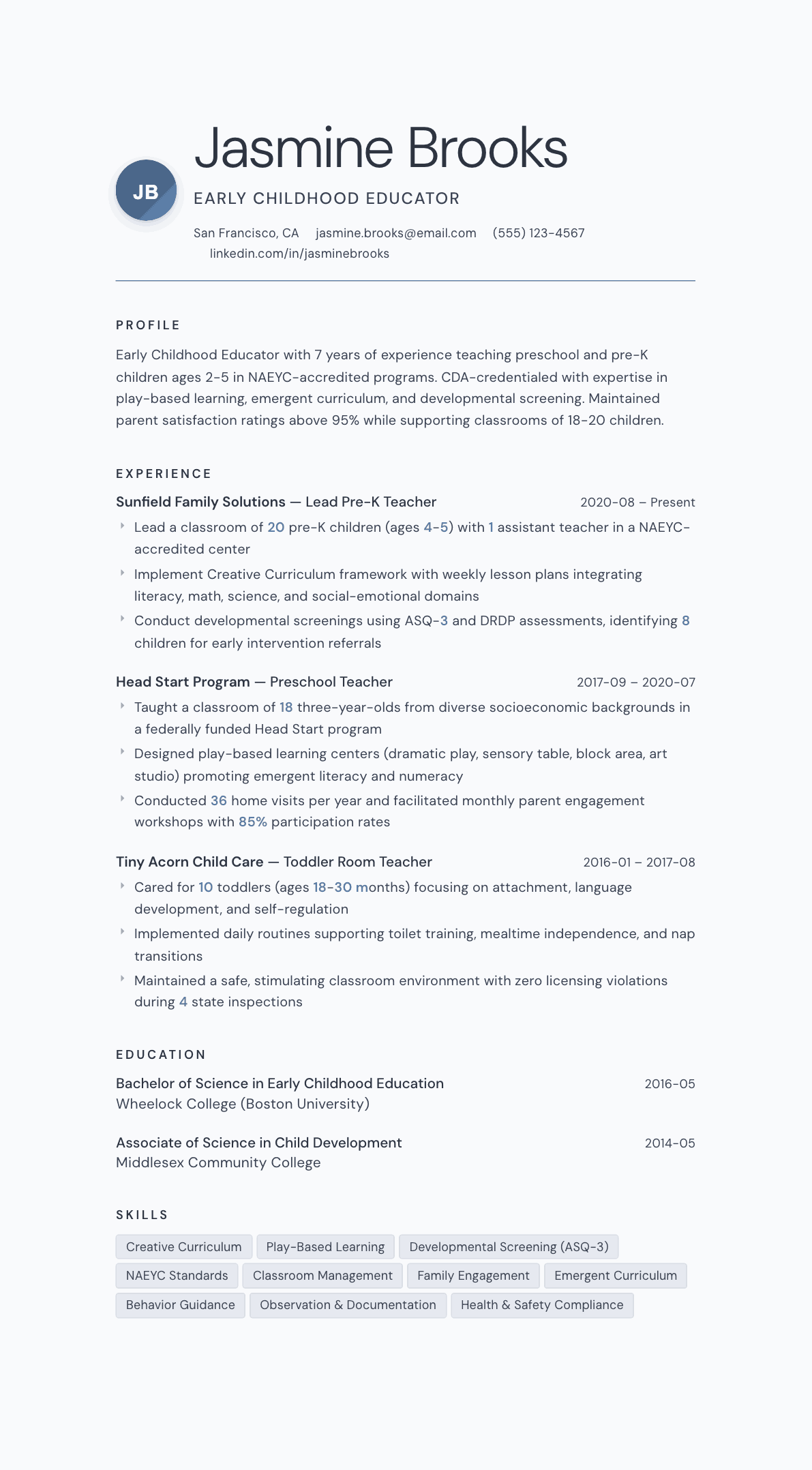
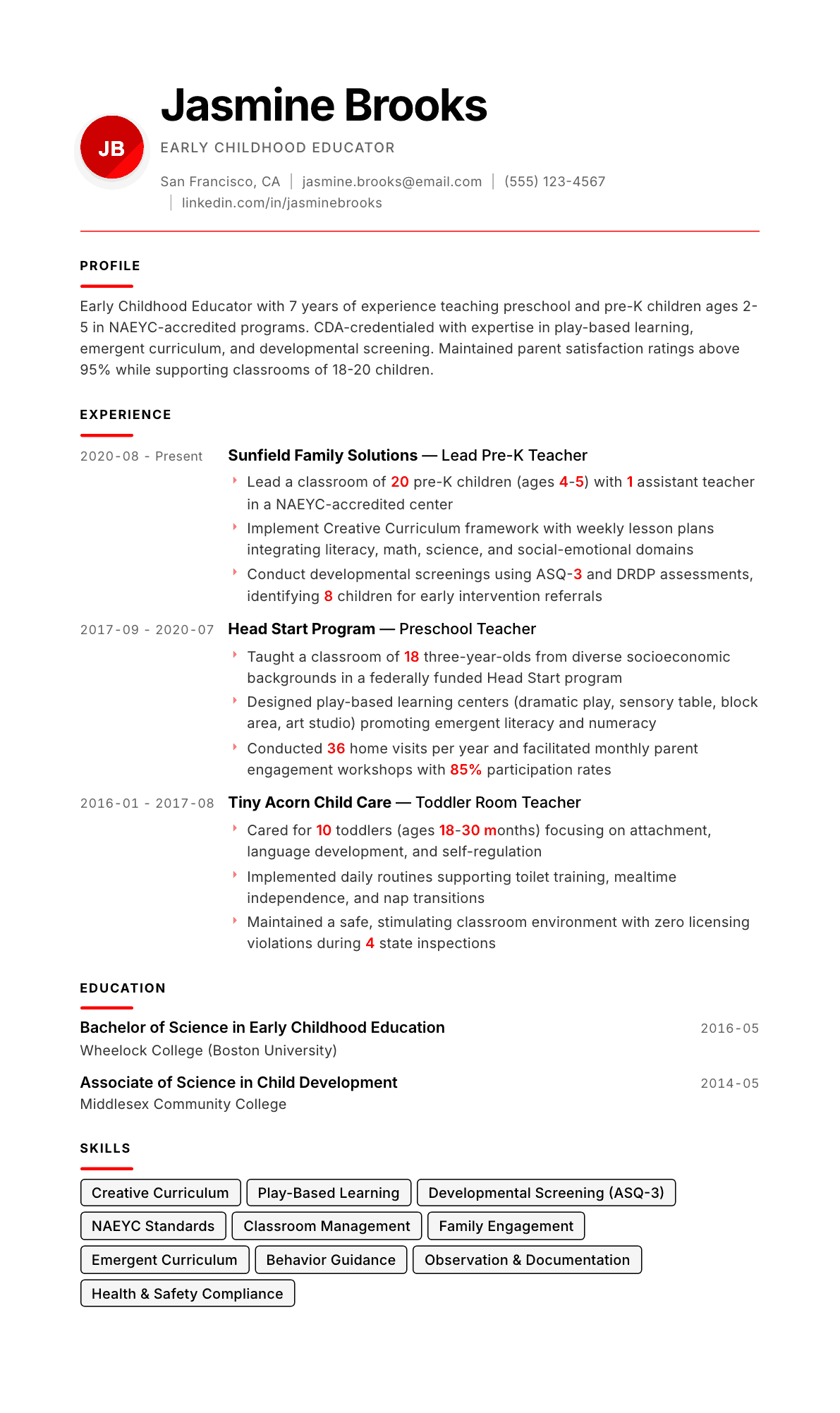
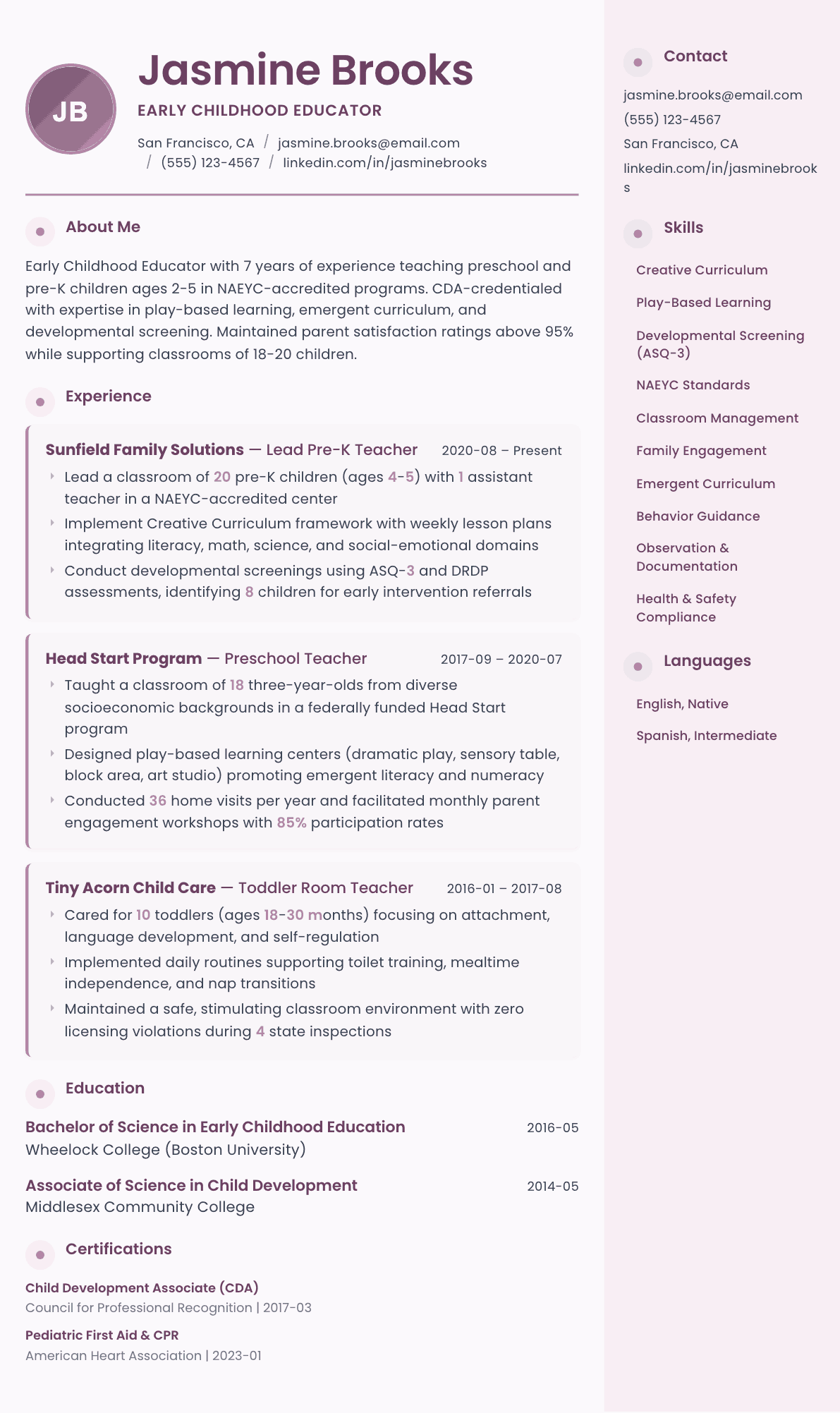
The same early childhood educator content laid out in three CVBooster templates, so you can see what the finished document looks like before you write a word.
Example Early Childhood Educator summary
CDA-credentialed Early Childhood Educator with 7 years of experience in NAEYC-accredited preschool and pre-K programs. Expert in Creative Curriculum, developmental screening, and family engagement. Committed to play-based, developmentally appropriate practices that support the whole child.
Skills to list on a Early Childhood Educator resume
- Creative Curriculum
- HighScope
- Play-Based Learning
- Emergent Curriculum
- Developmental Screening
- ASQ-3 / DRDP
- Teaching Strategies GOLD
- NAEYC Standards
- Classroom Management
- Family Engagement
- Behavior Guidance
- Observation & Documentation
- Health & Safety
- Inclusive Practices
What actually gets this resume read
- Highlight curriculum frameworks: Creative Curriculum, HighScope, Reggio Emilia, Montessori.
- Include credentials: CDA, state ECE license, NAEYC accreditation experience.
- Describe age groups specifically: infants (0-1), toddlers (1-3), preschool (3-4), pre-K (4-5).
- Quantify classroom metrics: class size, ratios, parent satisfaction, assessment completion rates.
- Mention developmental screening tools: ASQ-3, DRDP, Teaching Strategies GOLD.
- Reference family engagement practices: conferences, home visits, workshops, newsletters.
How to write a early childhood educator resume
An early childhood educator resume is screened by a center director who is thinking about the state license before anything else. Ratios have to hold, background checks have to clear, health and safety training has to be current, and every teacher of record has to meet the qualification the state child care rule specifies for that age group. A candidate who makes those items easy to find gets a call the same week, because directors are usually hiring against an empty classroom.
The second thing a director reads for is age group. Infants, toddlers, preschool and pre-kindergarten are four different jobs with different ratios, different daily rhythms and different training requirements. A resume that says early childhood without naming the ages leaves the director unable to place you, and placement is the whole point of the hire.
This guide covers the credential block, how to write the classroom in a way a director focused on state rules recognizes, the assessment and family engagement work that separates a professional from a caregiver, and the questions educators ask when moving between Head Start, private centers, public pre-kindergarten and Montessori settings.
Format: one page, credentials and clearances at the top
Keep it to one page early in a career and two once you have led a classroom for years or supervised staff. Directly under the header, put a credential block: your Child Development Associate credential or degree, the state early childhood license or registry level if your state maintains one, and the current status of your background clearance, pediatric first aid and cardiopulmonary resuscitation certification, and mandated reporter training.
That block exists because it answers a regulatory question. A director who can see that your health and safety training is current knows you can be counted in ratio quickly rather than after weeks of paperwork.
- Header: name, city and state, phone, email, and the age groups you are qualified and willing to work with.
- Section order: credentials and clearances, summary, classroom experience, curriculum and assessment, education.
- Include immunization and health screening status only if the state or program requires it in the application.
Summary: ages, setting, curriculum, and one thing you built
Name the exact age band, the setting type and the curriculum approach in the first line. A toddler teacher in a nationally accredited center running an emergent curriculum is a specific person, where a caring early childhood professional is nobody in particular.
Then add one thing you built or improved: a family conference routine, a transition plan for children moving up a room, a documentation system, an outdoor learning area, or the classroom portfolio process. Directors hire teachers who improve rooms rather than only staff them.
Classroom experience: ratio, group size, and the daily structure
Open every role with the room: the age band, the group size, the adult to child ratio, whether you were lead or associate teacher, and any co-teaching structure. A line reading lead teacher, preschool room, 18 children, ratio of one adult to nine with an associate and a floater describes a working day that any director recognizes.
Then show the daily structure: arrival and separation routines, small group and choice time, outdoor play in all weather, meal and family style dining, rest period supervision, toileting and diapering routines, and transitions. Transitions are where early childhood classrooms succeed or fall apart, and naming how you run them signals experience.
Include the regulatory side plainly: attendance and ratio tracking, incident reports, allergy and medication administration procedures, sanitizing routines, safe sleep practice for infants, playground safety checks, and participation in state inspection visits or an accreditation self-study. Directors screen hard for this.
Curriculum, screening and documentation
Name the curriculum framework by name: The Creative Curriculum, HighScope, Reggio-inspired practice, Montessori, a Head Start framework, or the state early learning standards you plan against. Then show how you planned, whether from a weekly plan template, an emergent web from children's interests, or an individualized plan for a child.
Assessment in early childhood is observation based, so describe the tools and the cycle: developmental screening with an instrument such as the Ages and Stages Questionnaire, ongoing observation with Teaching Strategies GOLD or your state desired results system, work sampling, photo and anecdotal documentation, portfolio building, and how the data changed your planning.
Add inclusion work explicitly. Supporting a child with an individualized family service plan or individualized education program, collaborating with early intervention therapists in the room, using visual schedules and supports, and behavior guidance based on positive strategies rather than compliance.
Family engagement and the professional side
Family partnership is a core competency in early childhood, so give it real lines: daily communication at drop-off and pick-up, digital family updates, twice yearly conferences with documentation, home language support, home visits where the program includes them, and the difficult conversations about a screening result or a behavior concern.
Then the professional record: annual training clock hours completed, a state registry level, accreditation work with the National Association for the Education of Young Children, mentoring of practicum students or new associates, and any leadership such as room lead, curriculum coordinator or acting director coverage.
Early Childhood Educator resume summary examples
Newly credentialed
Child Development Associate credential holder with 480 practicum hours across infant and preschool rooms, current in pediatric first aid, cardiopulmonary resuscitation and mandated reporter training. Trained in The Creative Curriculum and Ages and Stages screening, and seeking an associate teacher role in a preschool classroom.
Lead teacher, six years in
Lead preschool teacher with six years in a nationally accredited center, running a room of 18 children at a one to nine ratio with an associate. Uses Teaching Strategies GOLD for ongoing observation, completed screening for every child within 45 days of enrollment, and holds an associate degree in early childhood education.
Education coordinator
Early childhood education coordinator with twelve years across infant through pre-kindergarten rooms, supervising 14 teachers in six classrooms. Led a successful accreditation self-study, built the center coaching and observation cycle, and raised classroom assessment scores across all six rooms in two years.
Work experience bullets: before and after
Before: Cared for a class of preschool children each day.
After: Led a preschool room of 18 children aged three to four at a one to nine ratio with an associate teacher, covering arrival, small group, outdoor play, family style meals and rest period.
Age band, group size, ratio and the daily structure tell a director exactly which room you can be placed in.
Before: Planned fun learning activities for the children.
After: Planned weekly from The Creative Curriculum study topics and children's documented interests, adding a three-week investigation of the construction site next door that ran through blocks, drawing, writing and a site visit.
Naming the framework and one real investigation shows planning practice rather than an activity list.
Before: Kept track of how the children were developing.
After: Collected weekly observation notes and photographs in Teaching Strategies GOLD, completed checkpoints three times a year for every child, and used the data to add a small group focused on early letter recognition.
The tool, the checkpoint cycle and a planning change made from the data show real assessment use.
Before: Communicated with parents regularly.
After: Held twice yearly conferences with a portfolio of work samples and screening results for each family, sent daily updates in the family app, and provided interpretation for two Spanish-speaking families through a bilingual colleague.
Conferences with evidence and a named language access step turn communication into partnership.
Before: Followed all health and safety rules.
After: Maintained ratio and attendance counts at every transition, completed daily playground safety checks, administered medication under written parent authorization, and passed two unannounced state inspection visits with no citations.
Concrete compliance routines and a clean inspection outcome are the strongest reassurance a director can receive.
Hard skills
- Infant, toddler and preschool classroom practice
- The Creative Curriculum and HighScope
- Emergent and play-based curriculum planning
- Ages and Stages developmental screening
- Teaching Strategies GOLD observation
- Portfolio and anecdotal documentation
- Ratio and attendance compliance
- Safe sleep and diapering procedures
- Allergy and medication administration
- Individualized education program support
- Positive behavior guidance
- Family conference facilitation
- State inspection and accreditation preparation
- Classroom environment design
Soft skills
- Patience through long transitions
- Co-teaching and shift handover
- Calm response to injury and illness
- Sensitive conversations with families
- Observation without interrupting play
- Physical stamina on the floor all day
Certifications worth listing
- Child Development Associate (CDA) Credential (Council for Professional Recognition)
- Pediatric First Aid and CPR (American Red Cross)
- Certified Childcare Professional (National Early Childhood Program Accreditation)
- Montessori Early Childhood Credential (American Montessori Society)
Mistakes that cost early childhood educator candidates the interview
- Writing early childhood without the age band, leaving a director unable to place you in a specific room.
- Omitting ratio and group size, the two figures that describe an early childhood classroom more than anything else.
- Leaving background clearance, pediatric first aid and mandated reporter status off the page when they determine how fast you can start.
- Describing the work as caring for children rather than teaching, which undersells planning, assessment and documentation.
- Skipping the curriculum framework and the observation tool, both of which appear in most job postings by name.
- Ignoring family engagement, which is a core competency in every early childhood framework and a daily part of the job.
Early Childhood Educator resume questions
Do I need a Child Development Associate credential to work in early childhood?
Requirements are set by state child care rules and by the program type. Many assistant roles require only a high school diploma with health and safety training, while lead teacher and publicly funded pre-kindergarten positions commonly require the credential or a degree, so check the rule for your state and age group.
How do I list ratios and group size on my resume?
Put them in the first line of each role beside the age band, written the way state rules write them, such as a toddler room of 12 children at one adult to four. That is the format directors read all day and it removes any guesswork about the load you have carried.
What is the difference between a Head Start and a private center resume?
Head Start applications weigh the performance standards, family services, school readiness goals, degree requirements and documented outcomes more heavily. Private center applications weigh curriculum approach, enrollment retention and family relationships. Reorder your bullets to lead with whichever set the posting names.
How do I show results when young children are not tested?
Use the evidence early childhood actually produces: screening completed within the enrollment window, assessment checkpoints finished for every child, portfolios completed, conference attendance rates, classroom assessment scores, state inspection visits without citations, and children transitioned successfully to the next room or to kindergarten.
Can I move from a home daycare to a center classroom?
Yes, and family child care experience counts. Translate it into the language a center uses: the age range and mixed-age group size, the daily schedule, the curriculum you planned, the screening and documentation you kept, your inspection record, and the family communication routine you ran on your own.