Nanny Resume Examples: what a hiring manager reads first
Nanny Resume: Sample Resumes for Nannies at Every Stage
By Mustafa Tarabya, founder of CVBooster · Published · Updated
Nanny resume examples and sample resumes for nannies: three nannying placements written out, age ranges, driving and safety credentials, and summaries by stage.
Sample resumes for a nanny
The same nanny content laid out in three CVBooster templates, so you can see what the finished document looks like before you write a word.
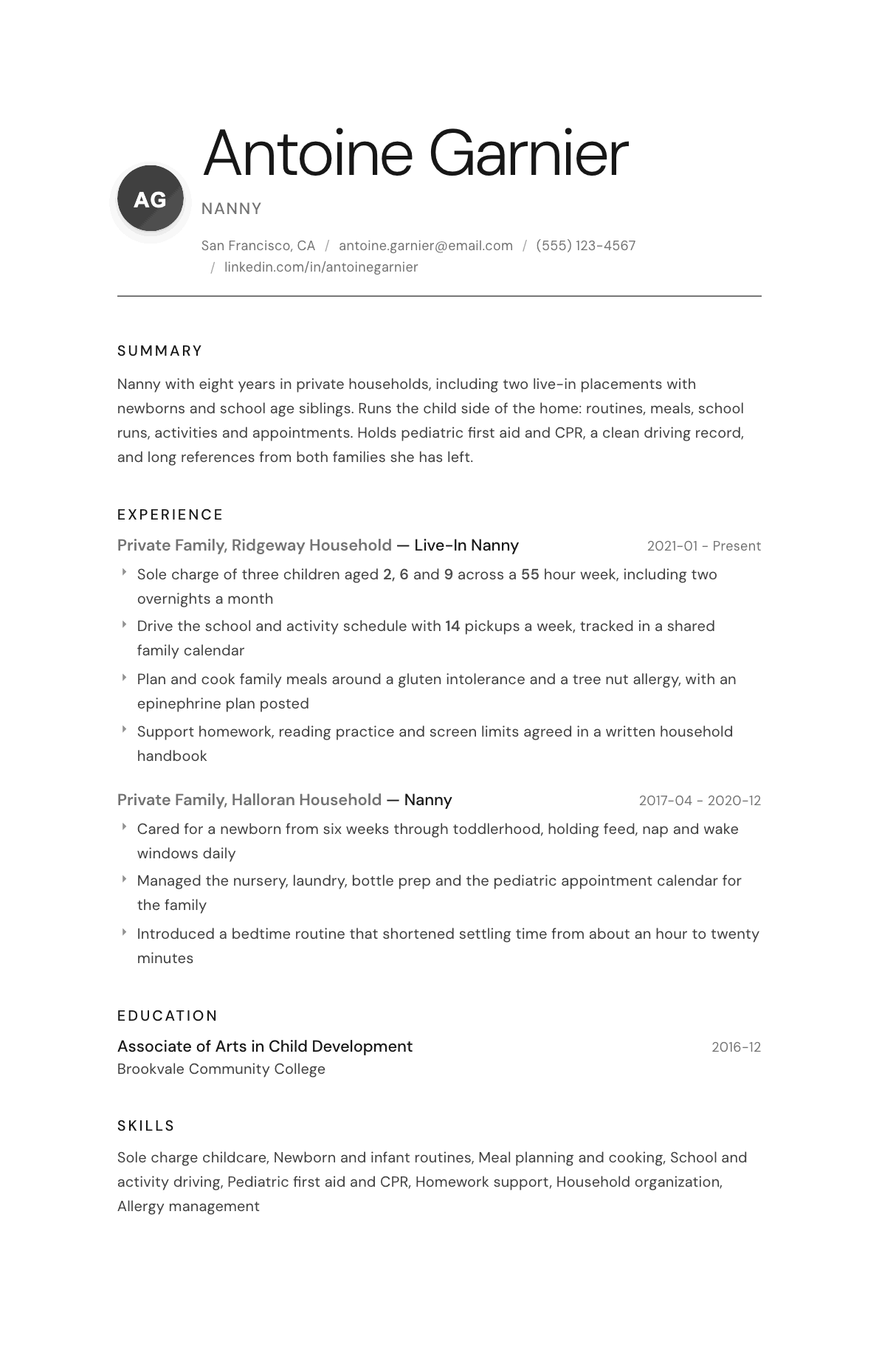
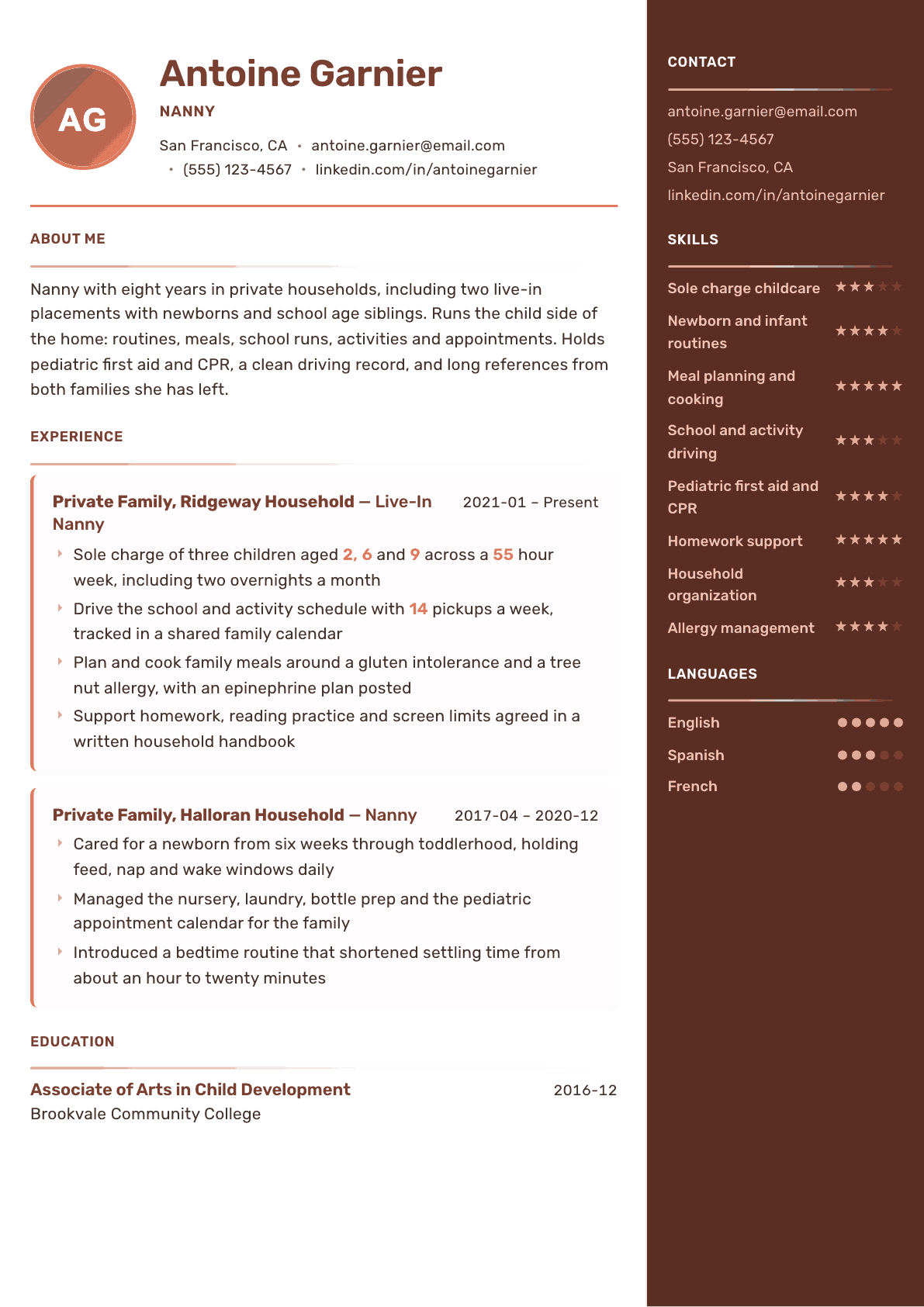
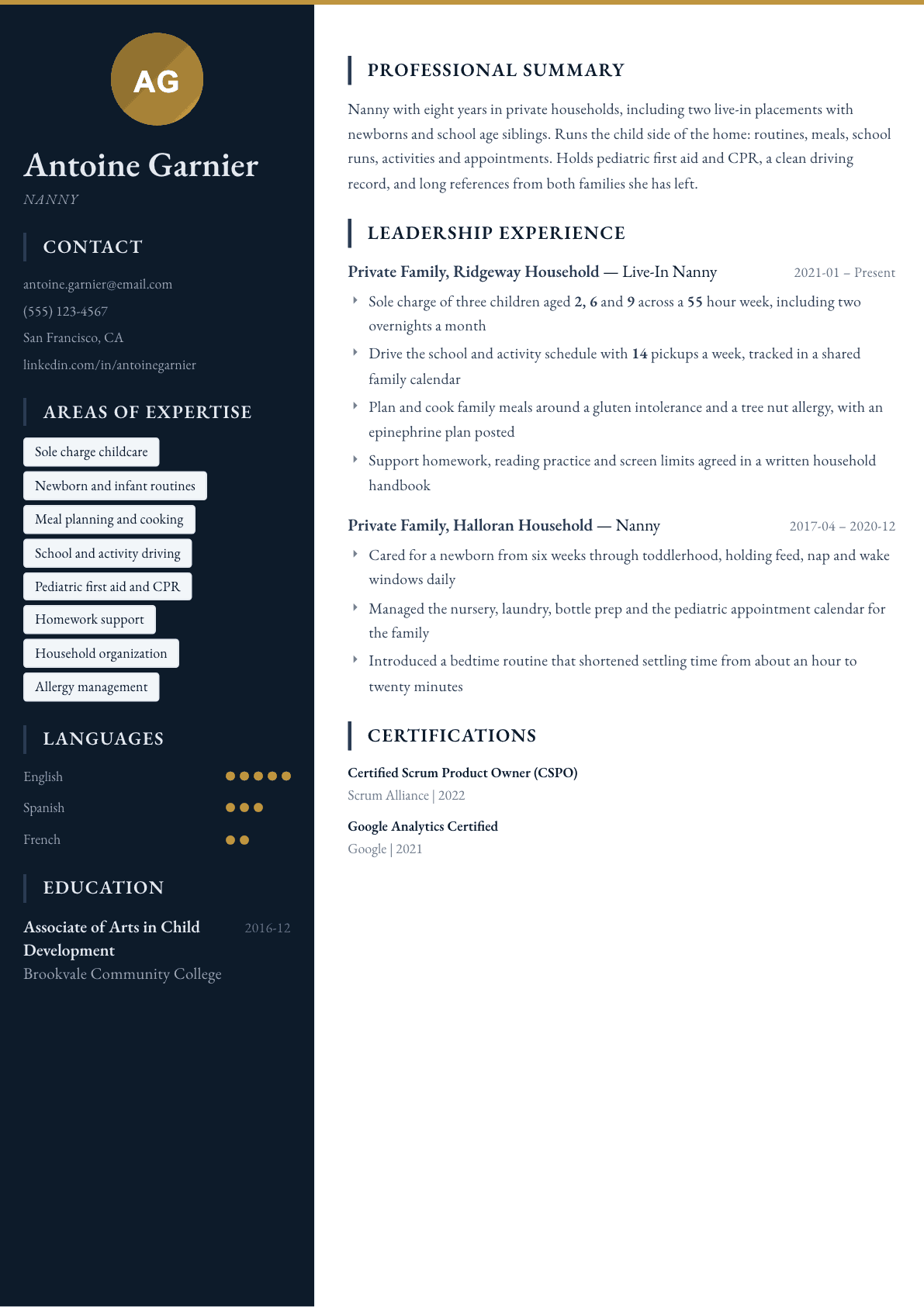
Example Nanny summary
Nanny with eight years in private households, currently in sole charge of three children aged two, six and nine on a live-in placement. Runs routines, meals, school runs and activities, cooks around allergies, and supports homework and reading. Certified in pediatric first aid and CPR, insured to drive the family car, and able to provide written references from both previous families.
Skills to list on a Nanny resume
- Sole charge childcare
- Newborn and infant care
- Nap and feeding routines
- Toddler behavior guidance
- School age homework support
- Meal planning and cooking
- Safe driving and school runs
- Pediatric first aid and CPR
- Allergy and medication management
- Nursery and playroom organization
- Activity and outing planning
- Family calendar coordination
- Bilingual household support
- Household handbook adherence
What actually gets this resume read
- Lead with the ages you have cared for and whether the role was sole charge, shared care, live-in or live-out.
- Give the weekly hours and the household size, because families compare that against the job they are filling.
- List driving, swimming, cooking and languages, since those four decide many placements before an interview.
- Name your first aid and CPR credential with the issuing body, and say that a background check is available.
- Explain long placements plainly and account for gaps, because families read tenure as the trust signal.
- Offer references by number rather than detail on the resume, then bring written letters to the trial day.
How to write a nanny resume
A nanny resume is read by a parent or by an agency placement consultant working on that parent's behalf, and both are screening for trust before anything else. Unlike a center, a family cannot fall back on a supervisor down the hall. They are handing over their children, their house keys and often their car, so tenure and references carry more weight than any single qualification.
The practical filters come next, and they are narrower than most candidates expect. Ages you have cared for, whether the role was sole charge, hours per week, driving, swimming, cooking, languages and whether you will live in. An agency runs its database on those fields, and a resume that leaves them out simply does not surface for the right jobs.
This guide reads like sample resumes for nannies taken apart: the section order agencies expect, three summaries at different stages of a nanny career, before and after bullets that turn generic household duties into the specifics a family can picture, and the questions that come up around gaps, references and the trial period.
How to write a nanny resume: one page, placements as households, dates precise
How to write a nanny resume in five steps: list each placement as a household with months, not just years; open each one with the shape of the job (ages, sole charge or shared, hours, live-in or live-out); add three bullets on what you ran; put clearances, first aid and driving in their own block; and write the summary last, once you can see what the page proves.
One page, reverse chronological. List each placement as a private family with a location and a household descriptor rather than a company name, for example Private Family, Ridgeway Household, Denver. This keeps confidentiality while giving an agency something to record.
Be exact with dates by month. Agencies read gaps as a question, and an unexplained six month break invites more doubt than a short line explaining a move, a study period or a family relocation would have. Long placements are your strongest asset, so make their length obvious.
Sample resumes for nannies look different at each stage, but the top third never changes: ages cared for, sole charge or shared, hours, driving and clearances. A first formal placement sample leans on babysitting, camp or classroom work with the ages named. An experienced sample lists two or three households with the routines run. A career nanny sample adds household management, travel with the family and newborn care.
- Header: name, city, phone, email, driving status, and whether you are seeking live-in or live-out.
- Sections: summary, certifications and clearances, placements, education and training, skills, references available.
- Each placement: ages of children, sole charge or shared, weekly hours, live-in or live-out, reason for ending.
Summary: ages, charge type, hours, and the three practical filters
Open with the ages you have cared for and whether you worked sole charge. Sole charge means you ran the day without a parent present, and it is the line that separates an experienced nanny from a mother's helper. Then the household size and the weekly hours you have carried.
Then get the practical filters in early: driving with a clean record and insurance history, swimming ability, cooking for children including allergy and dietary work, and any second language spoken with children. Families search on exactly these, and burying them at the bottom costs you interviews.
Placements: what you actually ran in that house
Each placement opens with the shape of the job: three children aged two, six and nine, sole charge, fifty five hours a week, live-in, with two overnights a month. A family reading that can immediately tell whether you have done their job before.
Then bullets on the areas you owned. Routines and sleep, meals and cooking with any dietary constraint, the school and activity schedule with driving, homework and reading support, laundry and children's spaces, appointments and the family calendar, and screen or behavior boundaries set in the household handbook.
Newborn and infant work deserves its own detail when you have it: feed, nap and wake windows, bottle preparation and sterilizing, nursery setup, and support during the early weeks. Families hiring for a newborn are anxious and read that section closely.
Say why each placement ended in one clause. The children started full time school, the family relocated, the contract was for a fixed term. Endings you explain yourself never become the awkward question in the interview.
Credentials, clearances and the car
Pediatric first aid and CPR are the baseline, and should be current with the issuing body named. Add any early years qualification, newborn care training, water safety or a specialist credential you hold. Certification is not required to be a good nanny, but it removes an objection.
Give the driving detail properly: license class, years held, clean record, comfort driving the family car or your own, and experience with car seat installation. Then state that a background check, driving record and written references are available. Families want to know the checks exist without having to ask.
- Pediatric first aid and CPR with issuer and expiry.
- Driving license, years held, record status and car seat experience.
- Background check, criminal record clearance and reference letters available.
- Languages spoken with children, and level of fluency.
Skills, keywords and what agencies filter on
Agency listings use a stable vocabulary: sole charge, live-in, live-out, newborn care, school age, multiples, travel with the family, household management, meal preparation, nursery duties and light housekeeping related to the children. Use the terms that are true of you, and be clear about what you do not do, because a mismatch found in week two ends a placement badly.
One line on flexibility carries weight: overnights, travel with the family, occasional weekends, or holiday cover. These are the requests families struggle to fill, and a nanny who names her limits honestly at the start is easier to place than one who agrees to everything.
Nannying resume examples: three placements written out
The examples below show how one placement line and three bullets read at three stages: a first formal nannying job after babysitting, a nanny share, and a long live-in placement with newborn care. The families, names and towns are invented. Copy the shape, never the details.
Each one starts with the shape of the job before any duty, because a parent reading a nannying resume decides in that first line whether you have done their job before.
- First placement: Nanny, Private Family, Hollis Household, Columbus, 18 months. Two children aged one and four, sole charge three days a week, 30 hours, live-out. Ran nap and meal routines, preschool drop-off and pick-up in the family car, and a daily note to the parents. Ended when the older child started kindergarten.
- Nanny share: Nanny, two families, Avery and Moss Households, Portland, two years. Three children aged 10 months to three years across two homes, 45 hours, live-out. Planned outdoor and reading activities for mixed ages, kept one shared log for both families and managed two allergy plans. Ended when one family moved.
- Career nanny: Live-in Nanny, Private Family, Ridgeway Household, Denver, four years. Newborn twins from week two, then a third child, sole charge with two overnights a month. Set up feed and sleep routines with the pediatrician's plan, traveled with the family twice a year and ran the children's calendar, laundry and meal planning.
Nanny resume summary examples
First formal placement
Child development graduate seeking a first nanny placement, with 3 years of regular after school care for 2 siblings aged 5 and 8 and a preschool room practicum. Certified in pediatric first aid and CPR, confident driver with a clean record, and a strong swimmer.
Experienced sole charge nanny
Nanny with 8 years in private households including 2 live-in placements, currently sole charge of 3 children aged 2, 6 and 9 across a 55 hour week. Runs routines, meals around a nut allergy, 14 school and activity pickups weekly, and homework support.
Career nanny and household lead
Career nanny with 16 years across 4 long placements, including newborn twins and school age siblings. Coordinates household staff schedules, travels with the family for extended stays, manages the children's calendar and appointments, and holds written references from every previous family.
Work experience bullets: before and after
Before: Looked after three children for a family.
After: Held sole charge of 3 children aged 2, 6 and 9 across a 55 hour week in a live-in placement, including 2 overnights a month while the parents traveled.
Charge type, ages, hours and overnight cover let a family match the role to their own household in one line.
Before: Cooked meals for the children.
After: Planned and cooked family meals around a gluten intolerance and a tree nut allergy, with labeled storage and an epinephrine response card posted in the kitchen.
Dietary constraints and the allergy plan show a nanny who has handled the risk, not just the cooking.
Before: Drove the kids to school and activities.
After: Ran 14 school and activity pickups a week in the family car, tracked in a shared calendar, and installed and checked both car seats after each seasonal change.
Volume, the shared calendar and car seat care turn driving into a demonstrated logistics responsibility.
Before: Took care of a newborn baby.
After: Cared for a newborn from 6 weeks through toddlerhood, holding feed, nap and wake windows daily, sterilizing bottles, and keeping the pediatric appointment calendar for the family.
Naming the newborn routines and the appointment work is what an anxious first-time parent is actually reading for.
Before: Helped the children with bedtime.
After: Introduced a consistent bedtime routine with bath, two books and lights out at a fixed time, shortening settling from about an hour to 20 minutes within 3 weeks.
The routine and the measurable change give a family evidence rather than a promise.
Hard skills
- Sole charge childcare
- Newborn and infant routines
- Nap and feeding schedules
- Toddler behavior guidance
- Homework and reading support
- Meal planning and cooking for children
- Allergy and medication management
- Safe driving and car seat installation
- Pediatric first aid and CPR
- Activity and outing planning
- Family calendar coordination
- Nursery and playroom organization
- Travel with the family
Soft skills
- Discretion about family life
- Boundary setting with children
- Communication with both parents
- Adapting to a household's rules
- Initiative without being asked
- Steadiness during illness and disruption
Certifications worth listing
- Pediatric First Aid and CPR (American Red Cross)
- INA Credentialed Nanny Examination (International Nanny Association)
- Child Development Associate (CDA) Credential (Council for Professional Recognition)
- Newborn Care Specialist Training (Newborn Care Specialist Association)
Mistakes that cost nanny candidates the interview
- Hiding whether a placement was sole charge, which is the detail that defines the level of the role.
- Leaving out driving, swimming, cooking and languages, the four filters that decide most placements.
- Giving years only instead of months, so a family cannot see how long each placement actually ran.
- Ignoring gaps rather than explaining them in a clause, which turns a small thing into an interview problem.
- Naming children or families in full, since discretion is part of what a household is hiring.
- Listing housekeeping as a main duty when the role is childcare, which confuses the job you are applying for.
- Writing that you love children instead of describing the routine you ran and what changed because of you.
Nanny resume questions
Should a nanny resume name the families I worked for?
No. Use a neutral label such as private family with a city and a household name, and keep full names out. Discretion signals professionalism, and the agency or family will get full reference details separately when the process reaches that stage.
How do I explain a gap between nanny placements?
Give the reason in a short clause on the resume: study, relocation, family care, travel or a temporary role. A one line explanation closes the question, while an unexplained gap invites the interviewer to imagine something worse than the truth.
How do I describe nannying on a resume?
Write each nannying job as a placement: Nanny, Private Family, a household name and a city, then one line with the children's ages, sole charge or shared, weekly hours and live-in or live-out. Follow with three bullets on the routines, meals, driving and school schedule you ran, and one clause on why the placement ended.
How should I present references on a nanny resume?
Write that written references from previous families are available, and give the number you hold. Bring the letters and contact details to the interview or trial day rather than printing personal phone numbers on a document that circulates.
What should sample resumes for nannies show first?
The practical filters a family searches on: the ages you have cared for, whether you worked sole charge, weekly hours, driving status and live-in or live-out. Then current first aid and CPR, your background check, and each placement written as a household. Occasional babysitting belongs in a separate short section.