Montessori Teacher Resume Examples: the lines they read
Guide Young Minds with a Montessori Teacher Resume
By Mustafa Tarabya, founder of CVBooster · Published · Updated
Build a Montessori teacher resume showcasing your AMS/AMI certification, prepared environment expertise, and child-centered approach to individualized learning.
Sample resumes for a montessori teacher
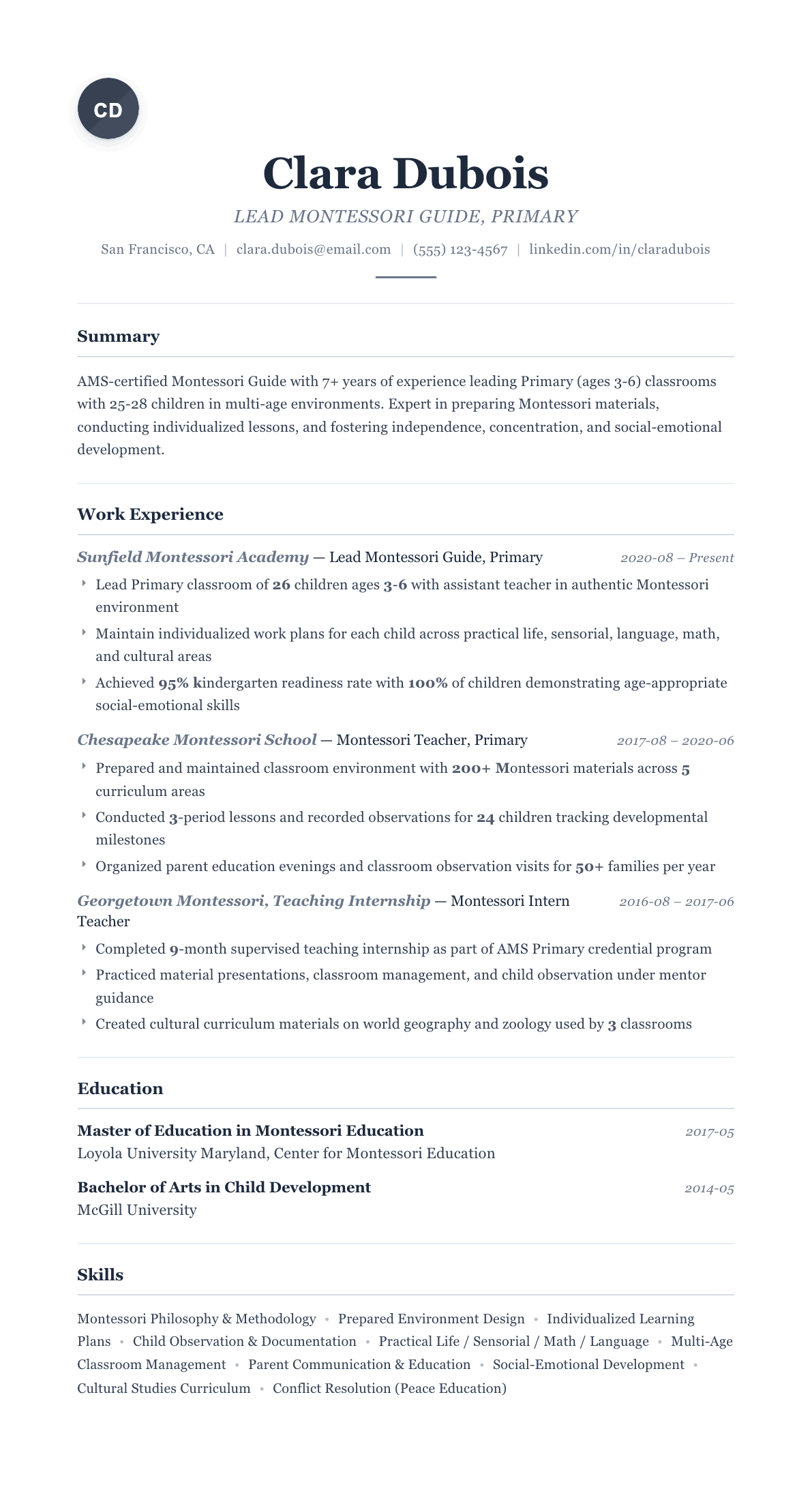
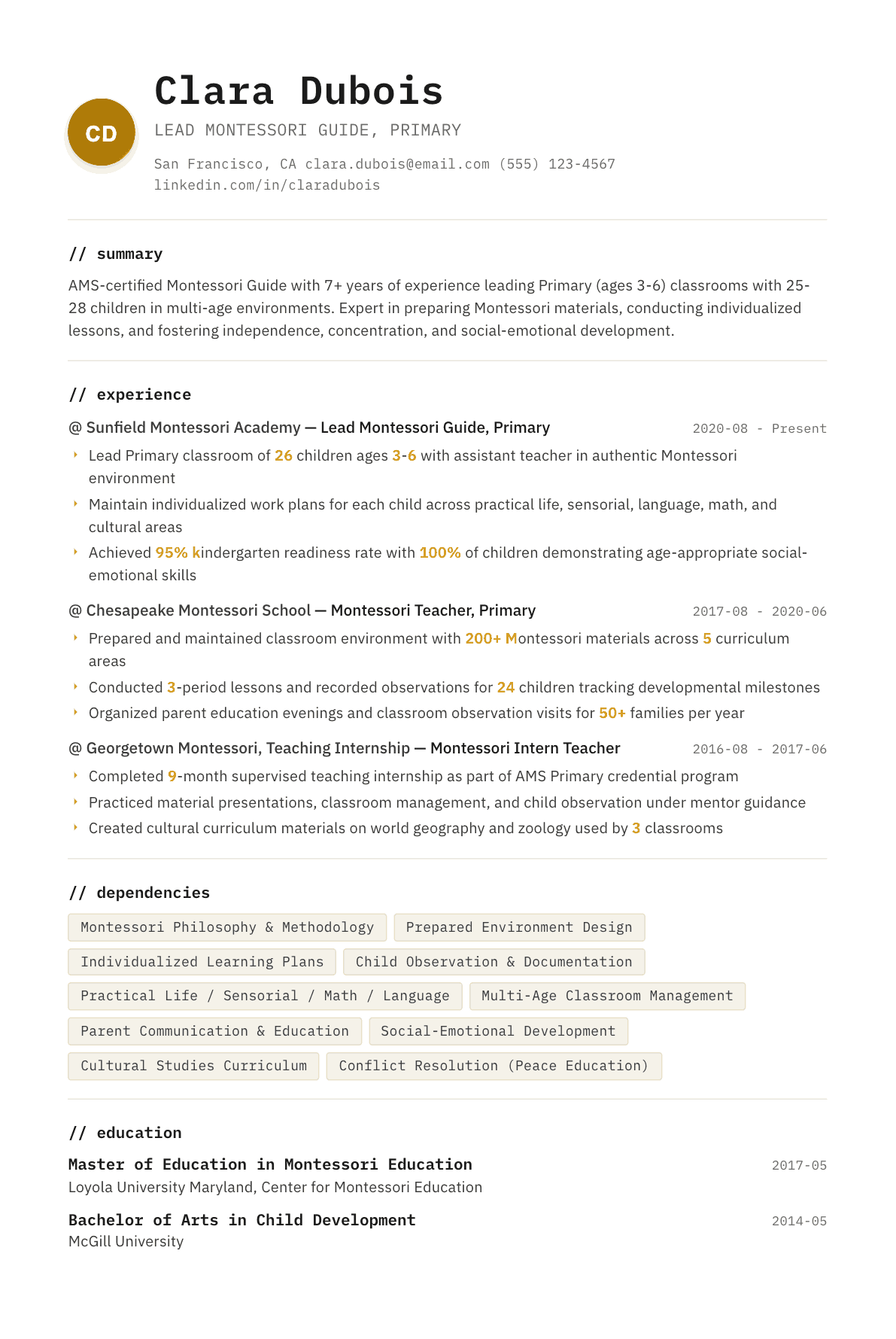
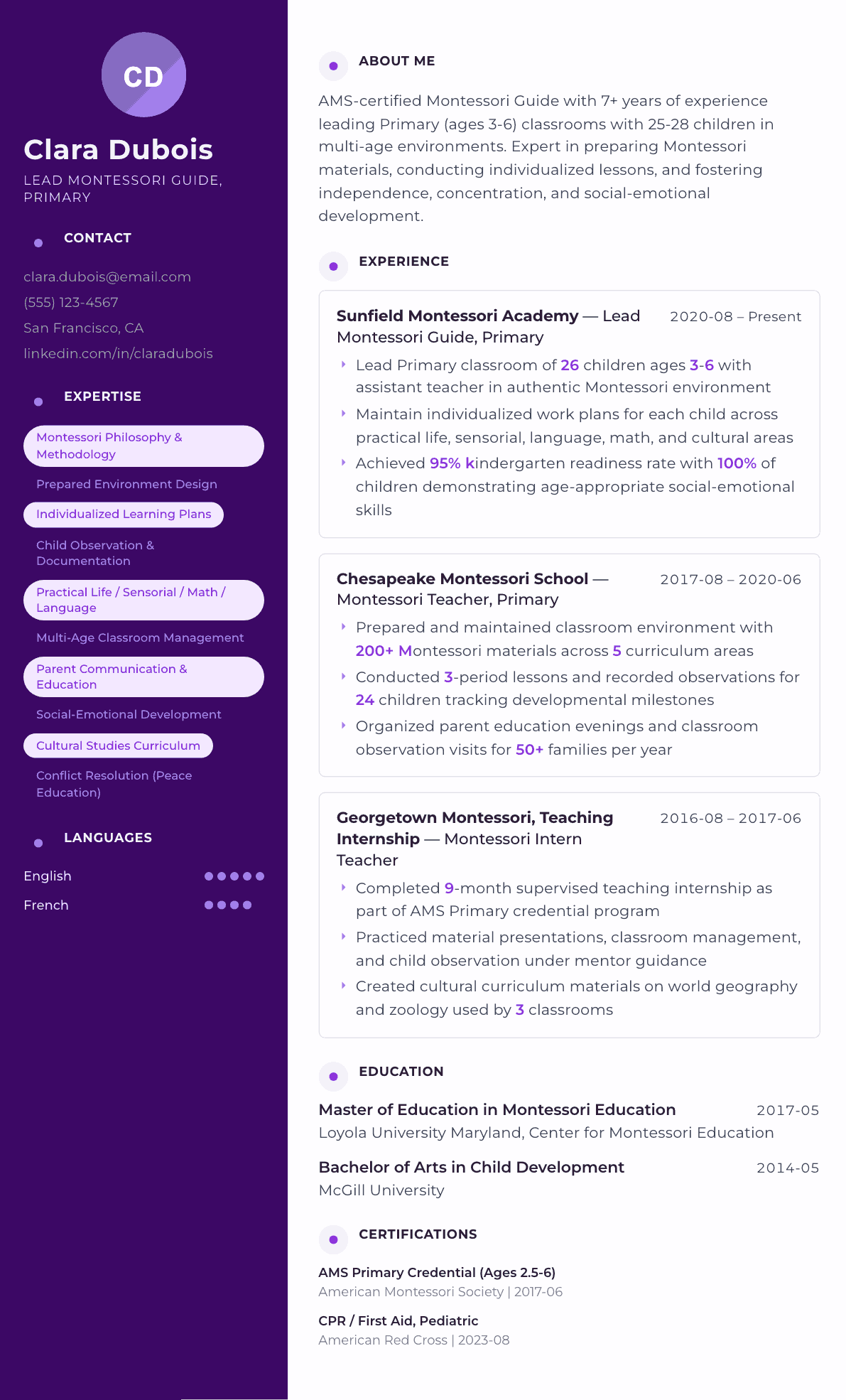
The same montessori teacher content laid out in three CVBooster templates, so you can see what the finished document looks like before you write a word.
Example Montessori Teacher summary
AMS-certified Montessori Guide with 7 years of Primary classroom experience fostering independence and academic growth for 25+ children ages 3-6. Achieved 95% kindergarten readiness with expertise across all Montessori curriculum areas.
Skills to list on a Montessori Teacher resume
- Montessori Philosophy
- Prepared Environment
- Individualized Instruction
- Child Observation
- Practical Life Activities
- Sensorial Materials
- Montessori Math
- Language Development
- Cultural Studies
- Parent Education
- Peace Education
- Multi-Age Classroom
What actually gets this resume read
- Include your Montessori credential (AMS, AMI, or MACTE-accredited) with age level prominently.
- Specify the age group and classroom size to demonstrate your multi-age management experience.
- Highlight all 5 curriculum areas: practical life, sensorial, language, math, and cultural studies.
- Mention parent education and communication as Montessori schools value strong family partnerships.
- Use Montessori terminology: guide, prepared environment, work cycle, normalization, sensitive periods.
How to write a montessori teacher resume
Montessori hiring turns on one question before any other: which credential do you hold, from which training body, for which age level. A head of school reads the top of your resume for the letters AMI or AMS, or the name of a MACTE-accredited training center, and for the level, whether that is Infant and Toddler, Primary for ages three to six, Lower Elementary, Upper Elementary or Adolescent. A resume that says only "Montessori trained" leaves the most important question open.
The second thing a head of school reads for is whether you have led a classroom or supported one. A lead guide holds the environment, gives the presentations, keeps the records and meets the parents. An assistant supports it. Both are real jobs, and confusing them on a resume costs you credibility with a reader who has run a classroom herself.
This guide covers how to present the credential, how to write about the prepared environment, observation and record keeping so a Montessori school recognizes its own practice in your words, summaries from a newly credentialed guide to a pedagogical lead, and the questions candidates ask when moving between Montessori and conventional schools.
Format: credential first, then classrooms, then training
Keep it to two pages, reverse-chronological. Montessori schools are usually small and independent, so your resume is often read by the head of school directly rather than by an applicant tracking system, but write it plainly anyway, because larger networks and public Montessori charter schools do screen electronically.
Give the credential its own line under the header: the awarding association, the level, the training center and the year of award. Add your state teaching license separately if you hold one, since public Montessori programs require it alongside the Montessori credential.
- Header: name, city and state, phone, email, and the Montessori credential with level and awarding body.
- Order: summary, credential and licensure, classroom experience, Montessori training, other education, professional development.
- A guide in training lists the credential as in progress with the training center and the expected completion term.
Summary: level, classroom composition, and years leading
Name the age level, the classroom size, whether the group was a full three-year cycle, and how many years you have led rather than assisted. "Primary guide, ages three to six, 26 children in a full three-year mixed-age community, five years as lead" tells a head of school more than a paragraph about respecting the child.
Add the school context if it is distinctive: a public Montessori charter with state assessment obligations, an infant and toddler program with licensing ratios, a school pursuing association accreditation, or a bilingual environment. Those contexts change the job enough that heads of school hire for them.
Experience: the prepared environment and the work of the guide
Write the classroom first: the ages, the number of children, the number of adults in the room, and the length of the uninterrupted work period. Then describe the environment you were responsible for preparing and maintaining across the curriculum areas, which for Primary means practical life, sensorial, language, mathematics and cultural, and for Elementary means the great lessons and the follow-up work that flows from them.
Presentations and observation are the daily craft. Say how you gave individual and small-group presentations, how you tracked which materials each child had received, and what your observation practice looked like in writing. Record keeping is a real differentiator, because heads of school know how many classrooms drift when nobody writes anything down.
Then the family and community work: parent conferences grounded in observation notes, classroom observations for prospective families, parent education evenings, and the transition conversations at the end of a cycle. Add any work on materials, since guides who make and repair materials keep a classroom running on a small budget.
Outcomes without turning the classroom into a test score
Montessori schools are wary of resumes that borrow conventional achievement language, but they still want evidence. Use what the method itself values: length and quality of concentration during the work period, the proportion of children who completed the third year of the cycle, kindergarten or next-level readiness as the receiving school judged it, retention of families year over year, and the independence markers you observed and recorded.
If you worked in a public Montessori program with required state assessments, report those results plainly and say how you kept the assessment obligation from disrupting the work period. That balancing act is one of the hardest parts of the job and a head of school will want to hear about it.
Training and continuing education
Give the training its own section with the center, the association, the level, the practicum length and the supervising school. Montessori training is a substantial commitment and readers know the difference between a full academic year with a supervised practicum and a short orientation course, so state the format.
Then list continuing education that a Montessori school recognizes: association conference attendance, a second level credential in progress, coursework in child development, training in positive discipline or conflict resolution, and any work toward an administrator credential if you are aiming for a pedagogical leadership role.
Montessori Teacher resume summary examples
Newly credentialed guide
Montessori guide with an association credential for ages three to six and a nine-month supervised practicum in a classroom of 24 children. Prepared and maintained materials across all five curriculum areas, gave daily individual presentations, and kept written observation records reviewed weekly with the mentor guide.
Five years leading a classroom
Primary Montessori teacher with five years as lead guide in a community of 26 children ages three to six, working with one trained assistant. Protects a three-hour uninterrupted work period, maintains individual work plans, and leads parent conferences and classroom observations for prospective families.
Pedagogical lead
Lower Elementary Montessori guide and pedagogical lead supporting six classrooms across two campuses. Mentors newly credentialed guides through their first cycle, runs environment audits each term, and led the school through its association accreditation review while continuing to lead a class of 28.
Work experience bullets: before and after
Before: Taught in a Montessori classroom with young children.
After: Led a Primary community of 26 children ages three to six with one trained assistant, protecting a three-hour uninterrupted work period each morning across a full three-year cycle.
Level, group size, adult support and the work period tell a head of school exactly what you have carried.
Before: Prepared the classroom environment.
After: Maintained and rotated materials across practical life, sensorial, language, mathematics and cultural areas, hand-making 40 language and geography materials to fill gaps the budget could not cover.
Naming the curriculum areas and the materials you built shows real stewardship of the prepared environment.
Before: Observed and assessed children's progress.
After: Kept written observation notes and an individual record of presentations given for each of 26 children, reviewing the records weekly to plan the following week's lessons and identify children who had not been reached.
The record system and the weekly review turn observation from a value statement into a practice.
Before: Communicated with parents regularly.
After: Held two conferences a year per family grounded in observation records, ran three parent education evenings on the work period and normalization, and hosted classroom observations for 30 prospective families.
Counting the conferences, evenings and observations shows the family-facing half of a guide's job.
Before: Helped children develop independence.
After: Introduced a practical life sequence for the youngest children that moved snack preparation, table washing and shoe tying to child-managed routines within the first term.
A concrete sequence and a timeframe replace a phrase every Montessori resume already contains.
Hard skills
- Prepared environment design and maintenance
- Three-period lesson presentation
- Practical life curriculum
- Sensorial curriculum
- Montessori language and reading sequence
- Montessori mathematics materials
- Cultural and cosmic education
- Written child observation and record keeping
- Individual work plan management
- Mixed-age three-year cycle planning
- Materials making and repair
- Parent conferences and family education
- Classroom licensing and ratio compliance
Soft skills
- Grace and courtesy modeling
- Patience with the pace of the child
- Observation without interruption
- Conflict resolution between children
- Mentoring assistants
- Calm classroom presence
Certifications worth listing
- AMI Diploma, Primary or Elementary level (Association Montessori Internationale)
- AMS Credential, Early Childhood or Elementary (American Montessori Society)
- MACTE-accredited teacher preparation completion (Montessori Accreditation Council for Teacher Education)
- CPR, AED and Pediatric First Aid (American Red Cross)
Mistakes that cost montessori teacher candidates the interview
- Writing "Montessori trained" without the awarding association, the level or the training center, the three facts a head of school checks first.
- Blurring assistant work into lead guide language, which reference calls expose immediately.
- Describing the classroom in conventional teaching terms such as lesson plans and grading, which reads as a candidate who has not internalized the method.
- Omitting the number of children and adults in the room, so nobody can judge the load you have handled.
- Skipping the observation and record keeping practice, the part of the job most likely to be probed in a working interview.
- Leaving the state teaching license off when applying to a public Montessori program that requires it alongside the credential.
Montessori Teacher resume questions
Which Montessori credential should I list first?
List the credential that matches the level you are applying to teach, with the awarding association named in full and the training center identified. If you hold credentials at two levels, list both, because schools with an unexpected opening will move a guide between levels when the credential allows it.
Do I need a state teaching license as well?
It depends on the school. Independent Montessori schools generally require only the Montessori credential. Public Montessori charter and district programs require the state teaching license for the corresponding grade band as well, and often ask for both to be current at the time of hire.
How do I write my resume while my training is still in progress?
Name the training center, the association, the level and the expected completion term, then describe the practicum classroom in detail: the ages, the number of children, and the presentations you have given under supervision. Many schools hire guides in training as assistants with a path to lead.
How do I move from a conventional classroom into Montessori?
Lead with the credential or the training you have started, since without it most schools cannot consider you for a lead role. Then translate your classroom experience toward the method: individualized planning, mixed-age grouping, observation-based assessment, and any time you have worked without whole-group instruction.
What evidence of results do Montessori schools want to see?
Evidence drawn from the method rather than borrowed from testing culture. Length and depth of concentration in the work period, how many children stayed for the full three-year cycle, readiness as judged by the receiving level, and family retention all carry weight with a head of school.