Medical Lab Technician Resume Examples: read this first
Medical Lab Technician Resume: Technician and Laboratory Assistant Samples
By Mustafa Tarabya, founder of CVBooster · Published · Updated
Medical lab technician resume examples with a medical technician sample and two medical laboratory assistant resume samples: certification, analyzers, QC.
Sample resumes for a medical lab technician
The same medical lab technician content laid out in three CVBooster templates, so you can see what the finished document looks like before you write a word.
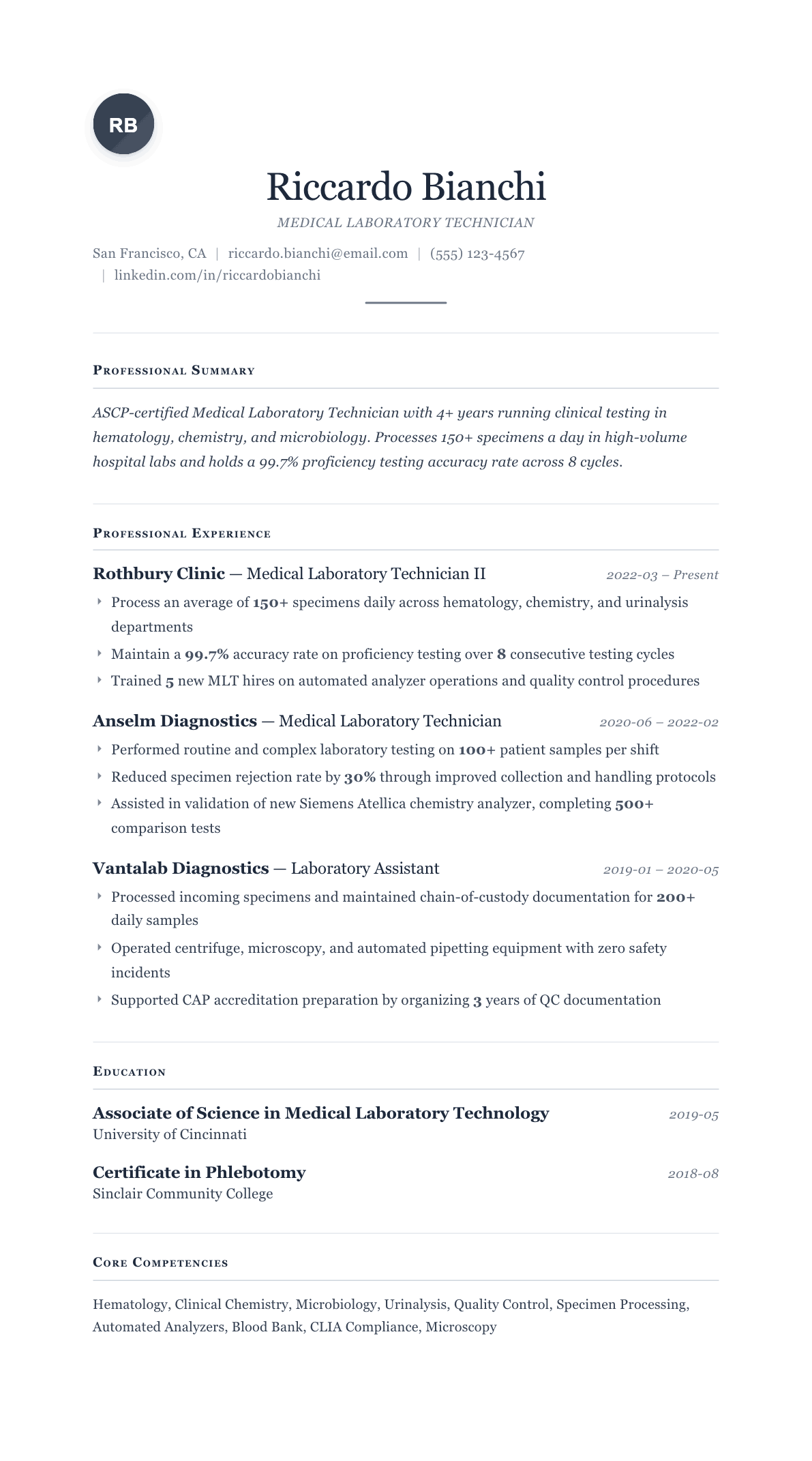
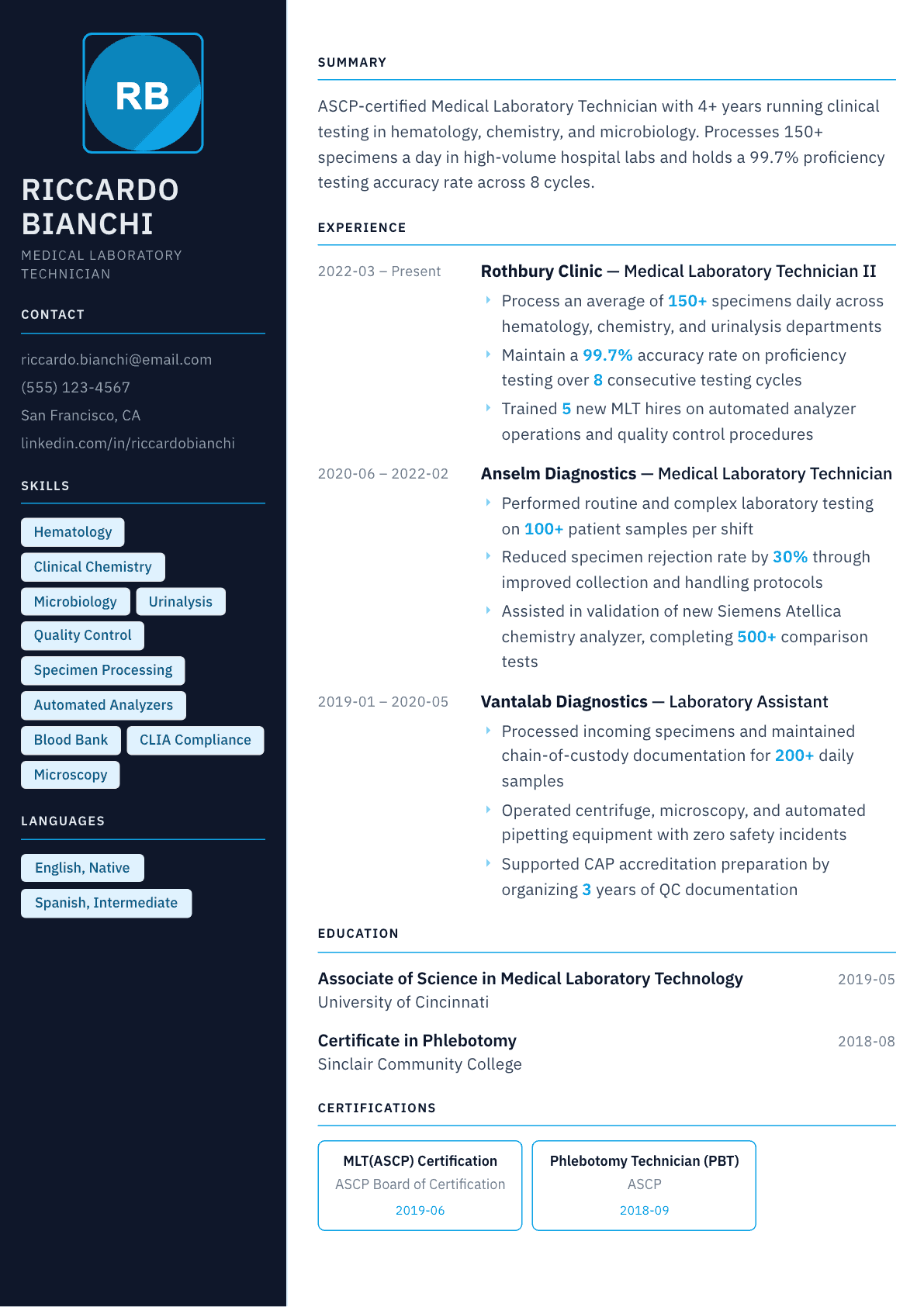
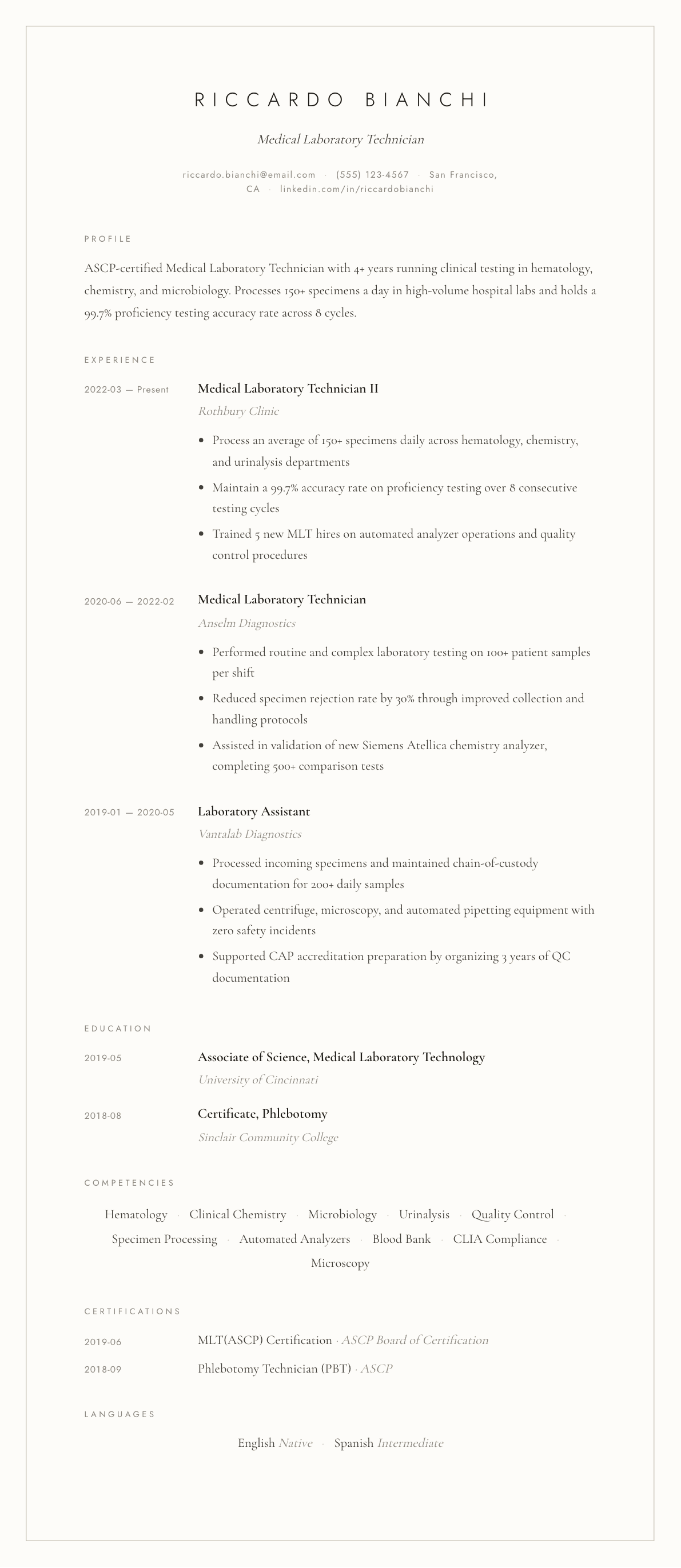
Example Medical Lab Technician summary
MLT(ASCP) with 4 years in hospital laboratories covering hematology, chemistry, urinalysis and microbiology. Holds 99.5%+ proficiency testing accuracy at 150+ specimens per day and cut specimen rejections by 30%. Looking for a bench role in a CAP-accredited laboratory.
Skills to list on a Medical Lab Technician resume
- Hematology
- Clinical Chemistry
- Microbiology
- Urinalysis
- Blood Bank
- Specimen Processing
- Quality Control
- Automated Analyzers
- Microscopy
- Phlebotomy
- CLIA Compliance
- CAP Standards
- LIS Systems
- Immunology
What actually gets this resume read
- Place your ASCP certification directly under your name or in a credentials section.
- Quantify daily specimen volumes and accuracy rates to demonstrate throughput capability.
- List specific analyzers and laboratory information systems you have used.
- Mention CAP, CLIA, or AABB compliance experience to show regulatory knowledge.
- Include proficiency testing results and QC achievements as measurable accomplishments.
- Tailor your resume to the specific lab department if the posting is specialty-focused.
How to write a medical lab technician resume
A medical lab technician resume is screened by a laboratory manager or a lead technologist who is trying to answer three questions in under a minute: is the certification current, which benches can this person run unsupervised, and which analyzers have they actually touched. Nothing on the resume matters as much as the answers to those three.
Laboratory hiring is unusual because the instruments are named brands and the reader knows every one of them. A technician who writes "operated laboratory equipment" gets skipped, while one who writes the analyzer platform, the department and the daily specimen volume gets called. The lab manager is mentally checking whether you can be signed off on her bench without six weeks of retraining.
This guide covers the section order labs expect, a complete medical technician resume sample and a medical lab assistant resume sample, how to present the certification and any state license, how to write bench experience in a way that survives both the applicant tracking system and the technologist reading it, and the questions technicians ask when they move between hospital, reference and clinic settings.
Format: one page, credentials in the header, benches in plain sight
Keep it to a single page unless you have more than a decade across several departments. Reverse chronological order, no columns, no icons, because hospital parsers routinely scramble two column layouts and drop the dates that a laboratory manager checks against your certification renewal.
Put the credential after your name exactly as the certifying body writes it. "Marcus Reyes, MLT(ASCP)" with the parentheses is the form a lab reader recognizes instantly, and the applicant tracking system is matching on that string.
- Header: name with the credential, city and state, phone, email, and any state laboratory personnel license.
- Sections in this order: summary, certification and licensure, laboratory experience, instrumentation, education and clinical training.
- New graduates put the accredited program and the clinical practicum rotations above work history, with hours per department.
Summary: departments, setting, volume, certification
Three lines. Name the certification, the years, the departments you are competent in, and the setting, because a high volume hospital core lab, a reference laboratory and a small physician office laboratory run on completely different rhythms. Hiring managers filter hard on setting.
If you are cross trained across hematology, chemistry, urinalysis, coagulation, blood bank and microbiology, say which ones you can run solo on an off shift. Being trusted alone on a night shift is a specific claim and a valuable one, and most candidates never make it.
Experience: the bench, the volume, the quality record
Open each role with the type of laboratory, the shift and the departments covered. Then write bullets around three things a laboratory manager cares about: throughput, quality control and turnaround time. Daily specimen counts, the number of instruments you maintain, proficiency testing results and corrective action work all belong here.
Quality is the differentiator. Write about running and evaluating daily quality control, investigating a shifted control, documenting corrective action, participating in an instrument correlation study, or preparing documentation for an inspection. Those bullets tell the reader you understand that the result leaving the laboratory is a clinical decision, not a number.
Do not spend bullets describing what the job title already implies. Everyone in the role performs testing and records results. What separates candidates is the validation work, the maintenance and troubleshooting, and the times you caught something before it reached a chart.
Instrumentation: a named list, not a category
Give the analyzers their own short block and name the platforms: Sysmex or Beckman Coulter hematology, Siemens Atellica or Roche cobas chemistry, Stago coagulation, BD or bioMerieux microbiology systems, and the middleware or laboratory information system you chart in, such as Sunquest, Cerner Millennium or Epic Beaker.
Add the level of engagement, because there is a large gap between loading a rack and calibrating a platform. Note where you perform daily and preventive maintenance, run calibration verification, or take the first call when the instrument flags an error.
Regulatory language every laboratory posting uses
Laboratory job descriptions repeat a small vocabulary: quality control, quality assurance, proficiency testing, calibration verification, delta checks, critical value reporting, specimen integrity, chain of custody, personal protective equipment, and inspection readiness under CLIA regulations with accreditation through the College of American Pathologists or the Joint Commission. Mirror the wording of the posting once in the skills block and once inside a bullet where it is demonstrated.
Critical value reporting is worth a sentence of its own. Naming the process by which you call a panic result to a nurse or provider and document the read back shows a reader you understand where the laboratory meets the patient.
Medical technician and medical laboratory assistant resume samples
Hospitals and clinics often post this job as medical technician, med tech or clinical laboratory technician, so a medical technician resume follows the same order as the MLT resume above. The first sample is a generalist MLT in a community hospital. Profile: Marcus Reyes, MLT(ASCP), Medical Laboratory Technician. Four years in a 180 bed community hospital laboratory on rotating evening and night shifts, competent to work hematology, chemistry, urinalysis and coagulation alone, cross trained in blood bank. Runs daily quality control, performs analyzer maintenance and calls critical values to nursing with read back.
Experience for that sample, written as three bullets: runs about 400 tests a shift across the core lab benches on Sysmex XN and Roche cobas platforms; reviews and documents daily QC, investigates shifts and records corrective action for inspection; trains new technicians and lab assistants on the evening shift. Education: associate degree in medical laboratory technology from an accredited program, with clinical rotations in each department.
Many people searching for a lab assistant resume are one step before the technician role: processing specimens, running the pre-analytical bench and supporting the techs. The complete lab assistant resume example below is a laboratory assistant in a hospital core lab. A research lab assistant can keep the same order and swap specimen processing for experiments, media prep and lab inventory.
Profile: Grace Liu, Laboratory Assistant. Two years in a 300 bed hospital core laboratory on the evening shift: specimen accessioning, centrifugation, aliquoting and send out testing. Phlebotomy certified, and studying for an MLT associate degree to move to the bench.
A medical laboratory assistant resume with no laboratory job yet follows the same order with the training doing the work. Profile: Daniel Ortiz, Medical Laboratory Assistant. Completed a medical laboratory assistant certificate with a 120 hour externship in an outpatient laboratory, phlebotomy certified, 90 successful venipunctures logged during the externship. Externship bullets: registered and labeled specimens for a family practice and a reference lab courier route, spun and aliquoted serum and plasma samples, ran urine dipsticks and other waived tests under supervision, and kept the refrigerator and freezer temperature logs. Previous job: two years as a pharmacy technician, which shows accuracy with labels and orders.
- Current role, Laboratory Assistant, St. Anne Regional Hospital, two years: receive and accession specimens from the emergency department, inpatient floors and outpatient draw stations.
- Process about 250 specimens a shift: label checks, centrifugation, aliquoting and loading to the automation line.
- Reject and document specimens that fail labeling or volume rules, and call the floor for recollection the same shift.
- Package send out tests for reference labs following their packing and temperature requirements.
- Draw blood at the outpatient station when the phlebotomy team is short.
- Previous role, Patient Service Representative, Valley Outpatient Lab, one year: registration, insurance checks and specimen labeling.
- Certifications and education: phlebotomy technician certification, BLS, OSHA bloodborne pathogens training; MLT associate degree in progress.
- Systems: Epic Beaker, a specimen tracking system, label printers and centrifuges.
Medical Lab Technician resume summary examples
New graduate technician
Recent graduate of an accredited associate program and newly certified MLT(ASCP) with 560 practicum hours across hematology, chemistry, urinalysis, blood bank and microbiology in a community hospital core laboratory. Trained on Sysmex and Roche platforms and seeking a rotating shift position.
Four years on the bench
MLT(ASCP) with four years in a high volume hospital core laboratory, processing roughly 150 specimens a shift across chemistry, hematology and coagulation. Signed off to run the night bench without a technologist on site and the trainer for three new hires on analyzer maintenance.
Lead technician
Lead medical laboratory technician with nine years across hospital and reference settings, currently coordinating second shift for a five person bench. Owns quality control review, proficiency testing submissions and instrument correlation studies, and prepared the department for its last two accreditation inspections.
Work experience bullets: before and after
Before: Performed laboratory tests on patient samples.
After: Ran roughly 150 specimens a shift across chemistry, hematology and urinalysis on Roche cobas and Sysmex XN platforms in a hospital core laboratory.
Volume, department and named analyzers tell a lab manager which bench you can be dropped onto.
Before: Followed quality control procedures.
After: Reviewed and released daily quality control across four analyzers, investigated shifted controls through calibration verification, and documented corrective action for the technical supervisor.
It shows the judgment inside quality work rather than the fact that quality control exists.
Before: Helped reduce sample problems.
After: Cut specimen rejections on the medical floors by rewriting the collection card and running four in-service sessions with nursing staff, which removed the most common hemolysis and label errors.
The reader sees the cause, the intervention and the audience, which is what makes the improvement believable.
Before: Assisted with new analyzer setup.
After: Supported validation of a new chemistry analyzer by completing more than 500 method comparison runs, recording precision and linearity data, and drafting the bench procedure that followed.
Validation work is senior work, and naming the deliverables proves you did it rather than watched it.
Before: Trained new employees.
After: Trained five new technicians on hematology analyzer operation, daily maintenance and quality control review, and wrote the checklist the department still uses for bench sign off.
A count plus a lasting artifact turns training into evidence of technical ownership.
Hard skills
- Hematology and differential review
- Clinical chemistry testing
- Urinalysis and body fluid analysis
- Coagulation testing
- Microbiology plating and setup
- Blood bank specimen processing
- Quality control and corrective action
- Calibration verification
- Proficiency testing
- Instrument maintenance and troubleshooting
- Phlebotomy and specimen collection
- Laboratory information systems
- Critical value reporting
Soft skills
- Attention to detail under volume
- Independent night shift judgment
- Clear handoff to nursing
- Documentation discipline
- Training newer staff
- Composure during instrument downtime
Certifications worth listing
- Medical Laboratory Technician, MLT(ASCP) (American Society for Clinical Pathology Board of Certification)
- Medical Laboratory Technician (MLT) (American Medical Technologists)
- Clinical Laboratory Technician (CLT) (American Association of Bioanalysts Board of Registry)
- Phlebotomy Technician, PBT(ASCP) (ASCP Board of Certification)
Mistakes that cost medical lab technician candidates the interview
- Writing the credential without the certifying body in parentheses, so neither the parser nor the technologist recognizes the standard form.
- Listing departments without saying which benches you can run unsupervised, which is the question the hiring manager actually has.
- Naming no analyzers at all, leaving the reader unable to guess how long your training period will be.
- Omitting the state laboratory personnel license in states that require one, which stops the file before it reaches the manager.
- Filling bullets with routine testing language when the differentiators are validation, maintenance, troubleshooting and quality investigations.
- Leaving off the practicum rotation hours as a new graduate, when those hours are the only bench evidence you have.
Medical Lab Technician resume questions
What goes on a medical technician resume compared to a medical laboratory assistant resume?
A medical technician resume leads with the MLT certification, the benches you run alone, the analyzers you operate and your quality control work, because technicians release results. A medical lab assistant resume leads with specimen processing, accessioning, phlebotomy and send outs. If you are moving up, show the bench training or MLT program you have started.
How do I list my ASCP certification on a resume?
Write it after your name in the standard form with the body in parentheses, then repeat it in a certification section with the certification number and the renewal date. Laboratory parsers and human readers both look for that exact string.
What is the difference between a medical lab technician and a technologist resume?
The technician resume proves bench competence, throughput and quality control discipline. A technologist resume adds result interpretation, method validation, complex troubleshooting and supervisory work. Do not claim technologist scope you have not been signed off to perform.
I am a new graduate with no paid laboratory job. What do I put in experience?
Your clinical practicum. List the hospital, each department rotation, the hours completed and the platforms you were trained on. Add phlebotomy or laboratory assistant work, and keep the section until you have a full year of paid bench time.
Do I need a state license as well as certification?
Several states license laboratory personnel separately from national certification, and a few of them will not let a hospital hire you without it. Put the license type, the state and the status on the resume whenever you apply into one of those states.