Epidemiologist Resume Examples: the lines they read
Create an Epidemiologist Resume That Tracks Results
By Mustafa Tarabya, founder of CVBooster · Published · Updated
Build a data-driven epidemiologist resume highlighting disease surveillance, biostatistics, and public health research with templates designed for government and academic hiring.
Sample resumes for a epidemiologist
The same epidemiologist content laid out in three CVBooster templates, so you can see what the finished document looks like before you write a word.
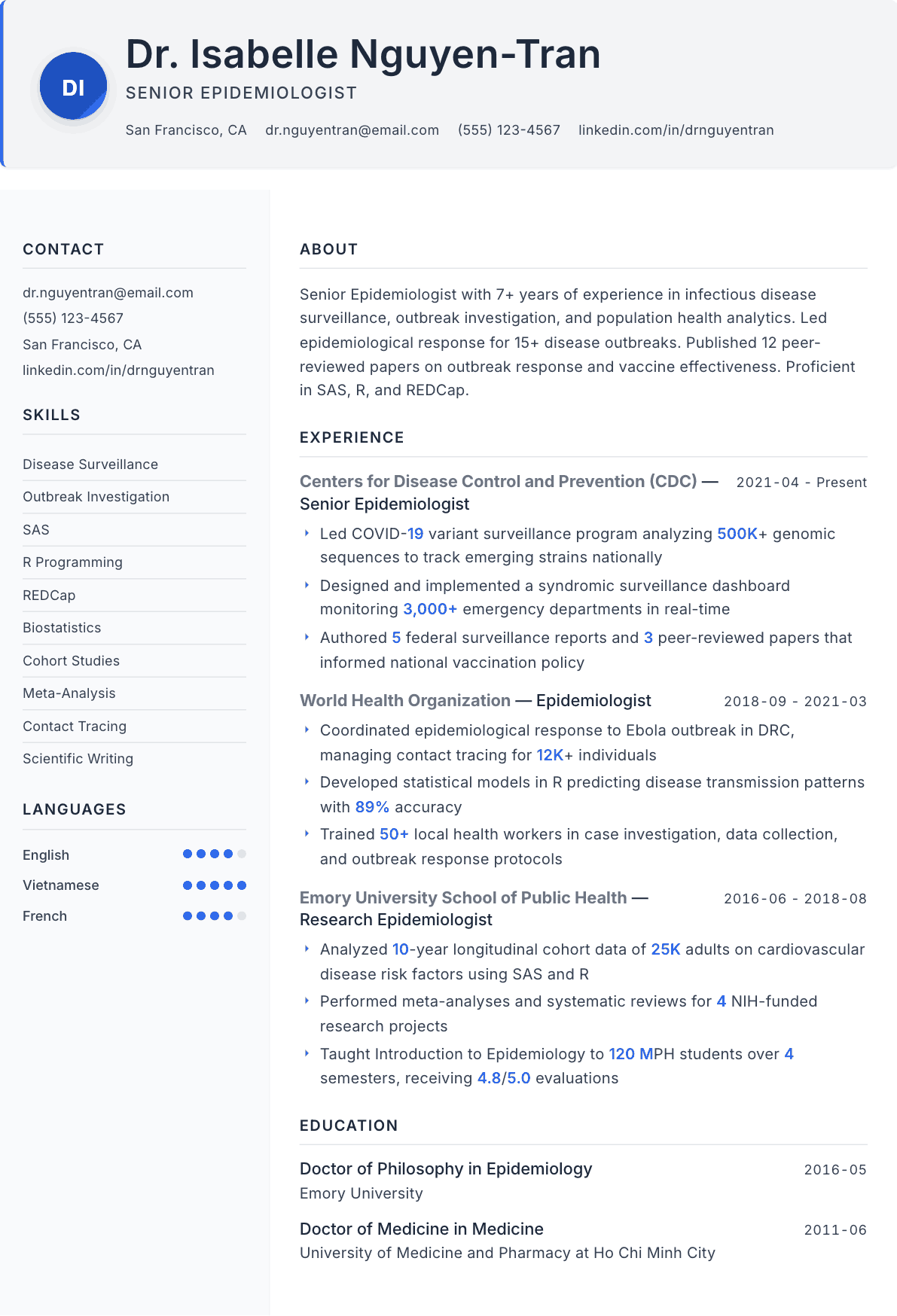
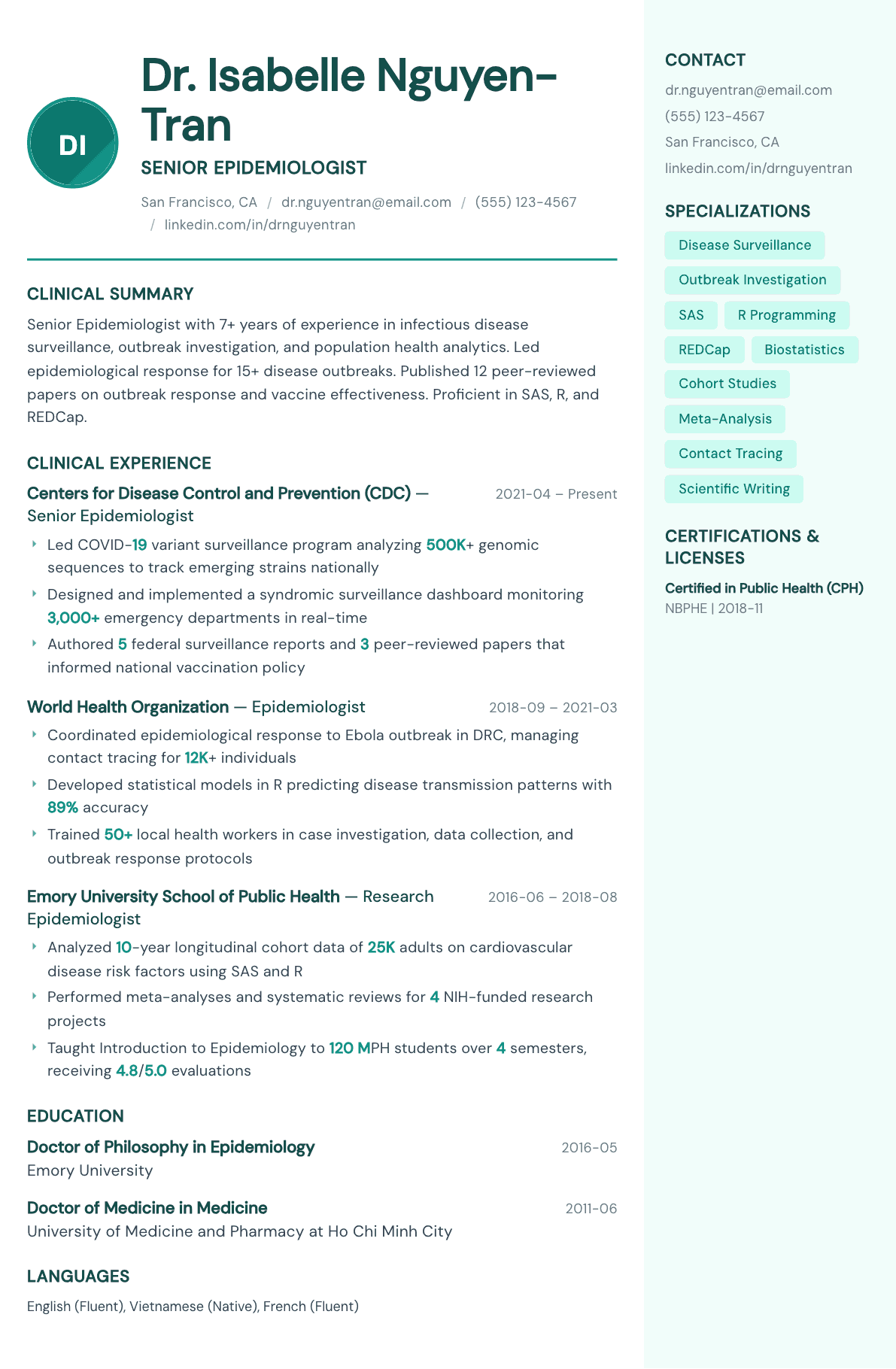
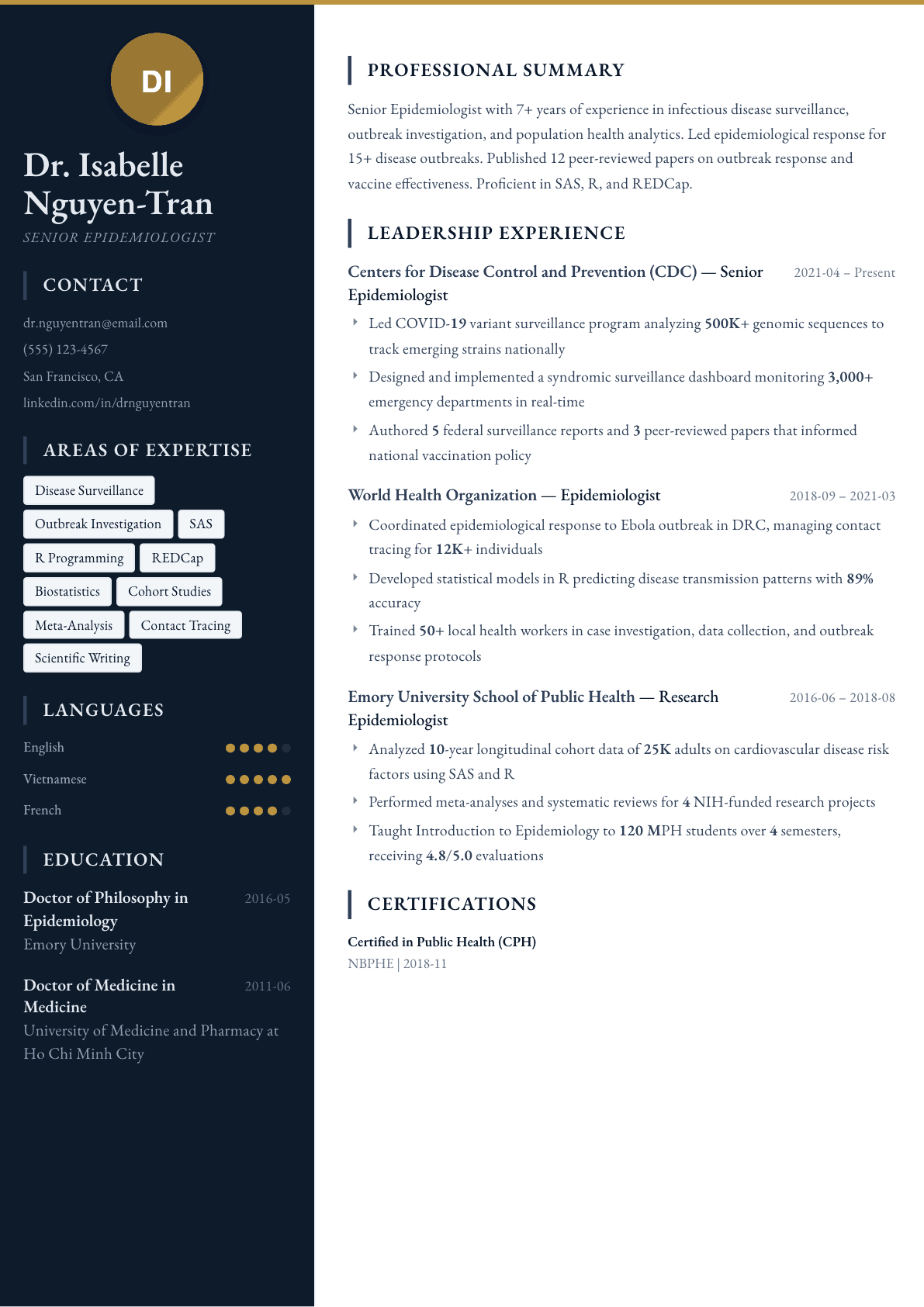
Example Epidemiologist summary
Senior Epidemiologist with 7+ years in infectious disease surveillance and outbreak response, including field work on 15+ outbreaks across 4 continents. Built a syndromic surveillance dashboard covering 3,000+ emergency departments and published 12 peer-reviewed papers. Works daily in SAS, R, and REDCap.
Skills to list on a Epidemiologist resume
- Disease Surveillance
- Outbreak Investigation
- Biostatistics
- SAS
- R Programming
- Stata
- REDCap
- Study Design
- Meta-Analysis
- Contact Tracing
- Scientific Writing
- Public Health Policy
What actually gets this resume read
- Lead with statistical software expertise: SAS, R, Stata, SPSS, Python, or EpiInfo.
- Quantify outbreak response: populations covered, cases investigated, contacts traced.
- Highlight publications in high-impact journals and agency surveillance reports prominently.
- Include study design expertise: cohort, case-control, cross-sectional, randomized trials.
- Mention data management platforms: REDCap, DHIS2, Epi Info, or custom surveillance systems.
How to write a epidemiologist resume
Epidemiologist resumes go to three very different readers. A health department is hiring someone who can take a call at nine at night, build a line list, interview cases and write a report that the state can act on. A pharmaceutical or device company is hiring someone who can design a real world evidence study in claims or registry data and defend it to a regulator. An academic center is hiring on methods, funding and publications.
The mistake that costs candidates the most is writing one resume for all three. Outbreak response and observational study design use overlapping vocabulary but are graded on different evidence, and a public health department reading a manuscript centered CV cannot tell whether you have ever run a field investigation.
This guide covers how to organize an epidemiologist resume around study designs and data sources, three summaries for an entry epidemiologist, an applied epidemiologist and a senior methodologist, before and after bullets built from surveillance and analysis work, and the questions that come up when moving between government, industry and academia.
Format: pick the setting, then decide resume or CV
Government and industry roles want a two page resume with analysis and surveillance work first and a short selected publications block at the end. Academic and research faculty positions want a full curriculum vitae with funding, teaching and complete publications. Sending the wrong one signals you do not know the sector.
Whichever you send, put your degree and any board style credential after your name, and state your software fluency in the top third. Analysis tools are a hard screen in this field, and a hiring analyst scanning for a specific statistical package should find it without scrolling.
- Header: name, degree, credentials, location, phone, email.
- Order for applied roles: summary, technical skills, epidemiology experience, selected analyses and reports, education, publications and presentations.
- For academic roles use a CV: education, appointments, funding, publications, teaching, service.
Summary: disease area, study design, and the data you work in
Three lines naming the domain and the method. Infectious disease surveillance, chronic disease and cancer registries, maternal and child health, injury, occupational and environmental exposures, or pharmacoepidemiology are the domains, and cohort, case control, cross sectional, time series and quasi experimental are the designs.
Then name the data. Notifiable disease surveillance systems, vital records, hospital discharge and claims databases, electronic health records, registries, survey data with complex sampling, and genomic sequence data all require different handling, and stating which ones you have analyzed tells a manager whether you can start without a year of ramp up.
Experience: surveillance, investigation, analysis, product
Applied epidemiology bullets should carry volume and consequence. Surveillance work: the systems you maintained, the conditions under surveillance, case volume reviewed, data quality checks you built, and the routine reporting you produced weekly or monthly. Investigation work: outbreaks investigated, cases and contacts interviewed, hypothesis generating questionnaires designed, analytic studies run during the response, and the control measure that followed.
Analysis work should name the design and the handling of bias. Confounding controlled by regression, matching or standardization, effect measure modification tested, missing data approach, sensitivity analyses, and the measure you reported, whether that is an incidence rate, a risk ratio, an odds ratio, a hazard ratio or an adjusted difference. Method specificity is the fastest way to prove competence here.
Every analysis has a product, so name it: a public dashboard, a report to a program area, a briefing for leadership, a manuscript, a regulatory submission section, or a recommendation adopted into policy. Analyses with no stated destination read as coursework.
Programming and data management, stated honestly
Name the tools individually and say what you do in each: data management in SAS, analysis and visualization in R, regression in Stata, pipeline and cleaning work in Python and SQL against a warehouse, and study data capture in REDCap. Add version control and reproducibility habits, because analytic teams increasingly screen for whether your work can be rerun by someone else.
Say something about data governance too. Data use agreements, institutional review board submissions and exempt determinations, limited data sets and identifiers, and secure environments for restricted data. Teams working with health data care as much about whether you handle it correctly as about whether you can model it.
Publications, presentations and gray literature
For applied roles, keep a compact block that mixes peer reviewed papers with the reports that actually shaped practice: surveillance summaries, outbreak reports, program evaluations and technical briefs. In public health the gray literature is the work, and leaving it out to look academic makes the resume thinner, not stronger.
For research roles, order publications the standard way and mark your first and senior author positions clearly. Add funding with the mechanism and your role, because in academia that block is read before the papers.
Epidemiologist resume summary examples
Entry epidemiologist
Epidemiologist with an MPH and 2 years in a local health department. Maintained notifiable disease surveillance for 14 conditions, reviewed 900 case reports for completeness, interviewed cases during 3 outbreak investigations, and produced weekly surveillance summaries in R.
Applied epidemiologist, six years
Applied epidemiologist with 6 years in state level infectious disease surveillance and response. Led 11 outbreak investigations including 2 multi jurisdiction clusters, designed case control studies during response, and analyzes surveillance and hospital discharge data in SAS and R for program leadership.
Senior epidemiologist and methods lead
Senior epidemiologist with 12 years across academic and industry research in pharmacoepidemiology. Designs cohort and self controlled studies in claims and electronic health record data, leads a 5 analyst team, and has authored 20 peer reviewed papers and 4 safety study reports submitted to regulators.
Work experience bullets: before and after
Before: Investigated disease outbreaks.
After: Led investigation of a 62 case gastrointestinal illness cluster: built the line list, designed and administered a hypothesis generating questionnaire, ran a matched case control analysis, and identified the implicated food item that drove the recall.
Case count, the investigative steps and the control action show a complete field investigation rather than participation.
Before: Analyzed public health data using SAS.
After: Analyzed 5 years of statewide hospital discharge records in SAS, covering every inpatient admission for 3 chronic conditions, and calculated age adjusted rates by county, and produced the trend report used to target a chronic disease prevention program.
Data source, coverage, the adjustment method and the program decision make the analysis concrete.
Before: Maintained the surveillance system.
After: Managed notifiable disease surveillance for 14 conditions, built automated completeness and duplicate checks that cut manual record review substantially, and cut the median time from report to case closure by 4 days.
Naming the automation and a timeliness measure turns maintenance into a documented improvement.
Before: Designed a study on medication safety.
After: Designed a new user active comparator cohort study in claims data with propensity score matching, prespecified sensitivity analyses for unmeasured confounding, and reported adjusted hazard ratios in a safety report to the regulator.
Naming the design, the confounding strategy and the deliverable proves methodological ownership.
Before: Presented findings to stakeholders.
After: Briefed program directors and county health officers weekly during a respiratory surge, translated modeling output into staffing and testing recommendations, and published a public dashboard updated daily from the surveillance feed.
The audience, the decision supported and the recurring product show communication that was actually used.
Hard skills
- Disease surveillance system management
- Outbreak investigation and contact tracing
- Cohort and case control study design
- Regression modeling and confounding control
- Survival and time to event analysis
- Age adjustment and standardization
- SAS programming
- R and tidyverse
- Stata
- SQL and relational data extraction
- REDCap study data capture
- Claims and electronic health record analysis
- Data visualization and dashboards
- Scientific and technical report writing
Soft skills
- Interviewing cases with sensitivity
- Briefing leadership under time pressure
- Working across jurisdictions and agencies
- Translating uncertainty for non specialists
- Managing analysts and reviewing their code
Certifications worth listing
- Certified in Public Health (CPH) (National Board of Public Health Examiners)
- Certification in Infection Prevention and Control (CIC) (Certification Board of Infection Control and Epidemiology)
- Certified Health Education Specialist (CHES) (National Commission for Health Education Credentialing)
- SAS Certified Specialist: Base Programming (SAS Institute)
Mistakes that cost epidemiologist candidates the interview
- Sending an academic curriculum vitae to a health department, where field investigation experience is what the hiring committee needs to see first.
- Naming a statistical package without naming a study design, which suggests you ran code someone else wrote.
- Describing outbreak work without case counts, jurisdictions or the control measure that resulted.
- Omitting the data sources you have analyzed, since the ramp up cost for a new data system is the manager's main hiring worry.
- Leaving reports, dashboards and surveillance summaries off the resume because they are not peer reviewed, which erases most applied work.
- Claiming a policy change as your own when your contribution was the analysis behind it, a distinction interviewers probe directly.
Epidemiologist resume questions
Should I send a resume or a curriculum vitae?
A two page resume for health departments, non profits and industry, and a full curriculum vitae for faculty and research scientist positions. If the posting names a preference, follow it exactly, and keep both versions maintained since applications often cross sectors.
How do I show outbreak response experience if I was one of many responders?
Describe your specific function inside the response: the interviews you conducted, the analysis you ran, the line list you maintained, the report section you wrote. Named contributions inside a large response read as credible, while claiming leadership of the whole response does not.
Do I need a doctorate to advance in epidemiology?
A masters supports a full applied career in surveillance, program evaluation and response, and many senior government positions are held by masters trained epidemiologists. A doctorate matters most for principal investigator roles, methods leadership and academic appointments.
How much statistical detail belongs on the resume?
Enough to prove you chose the method rather than inherited it. Name the design, the primary model, the confounding approach and the measure you reported. Leave the full specification for the interview, where a methods discussion is expected anyway.
How do I move from public health into industry epidemiology?
Lead with observational study design, large database analysis and regulatory or safety relevant work, and use industry vocabulary such as real world evidence, comparative safety and study protocols. Surveillance experience translates well once it is framed as longitudinal data management.