Environmental Scientist Resume Examples: free ATS score
Build an Environmental Scientist Resume That Makes an Impact
By Mustafa Tarabya, founder of CVBooster · Published · Updated
Create a compelling environmental scientist resume highlighting field research, regulatory compliance, and sustainability expertise with ATS-optimized templates.
Sample resumes for a environmental scientist
The same environmental scientist content laid out in three CVBooster templates, so you can see what the finished document looks like before you write a word.
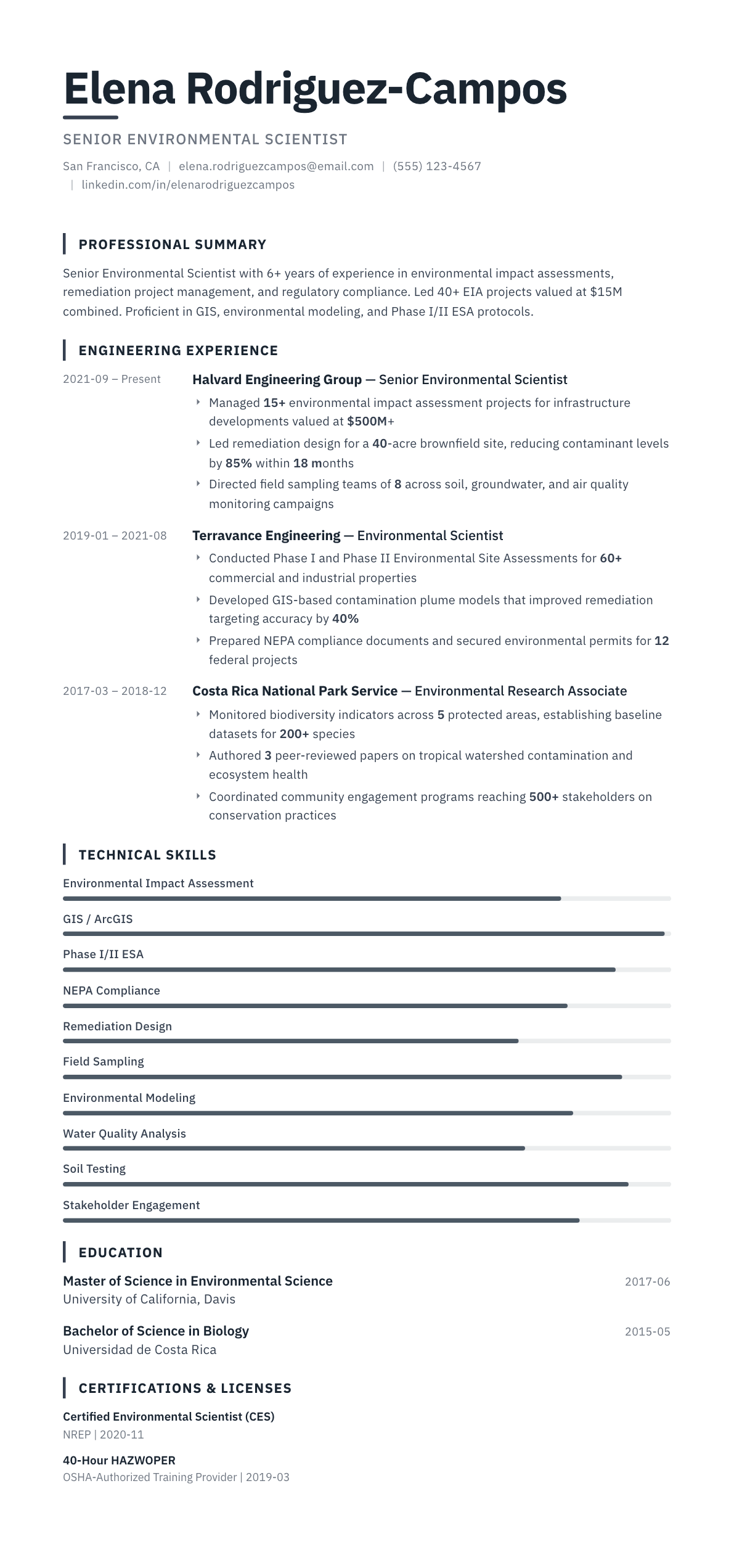
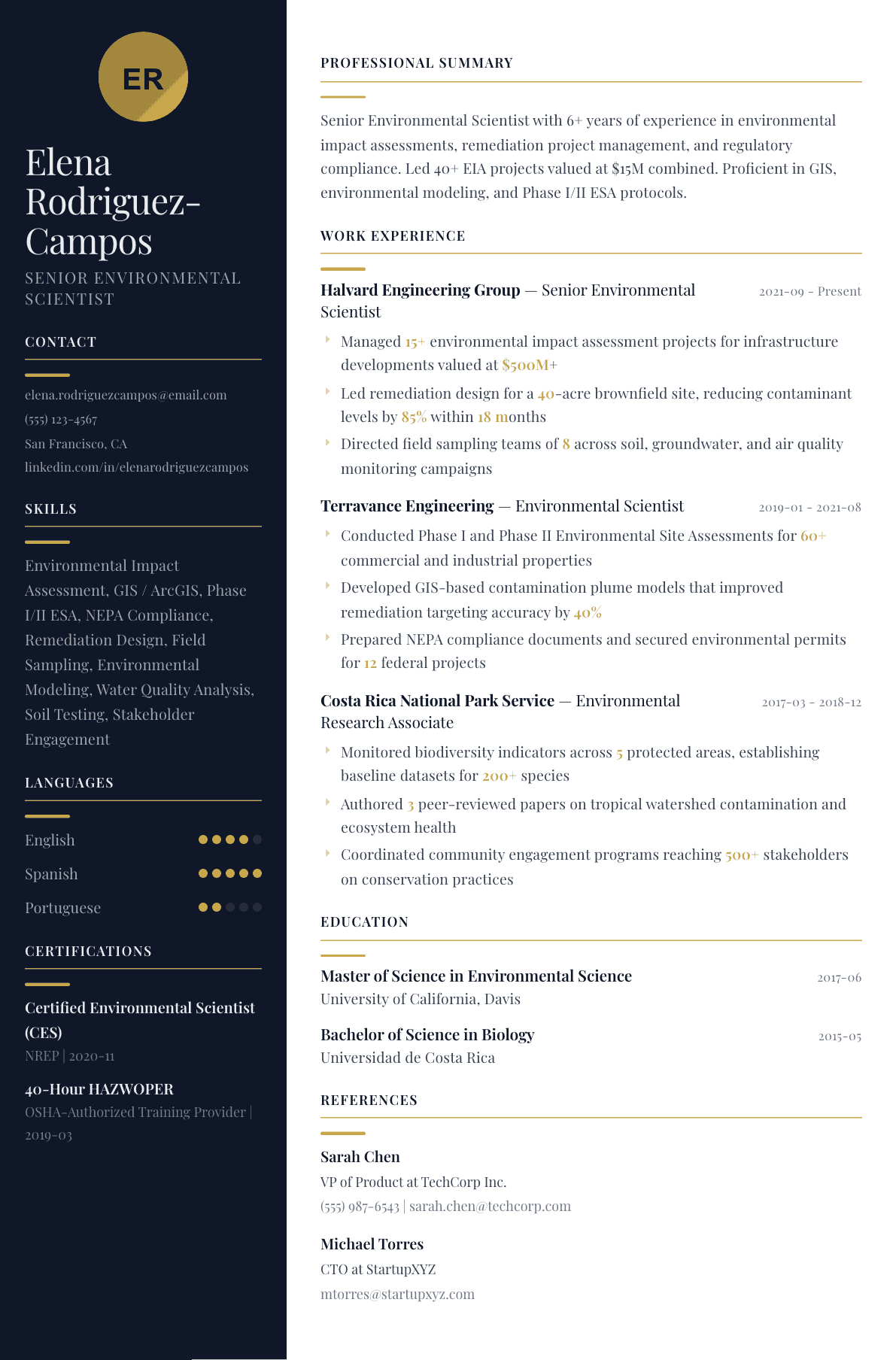
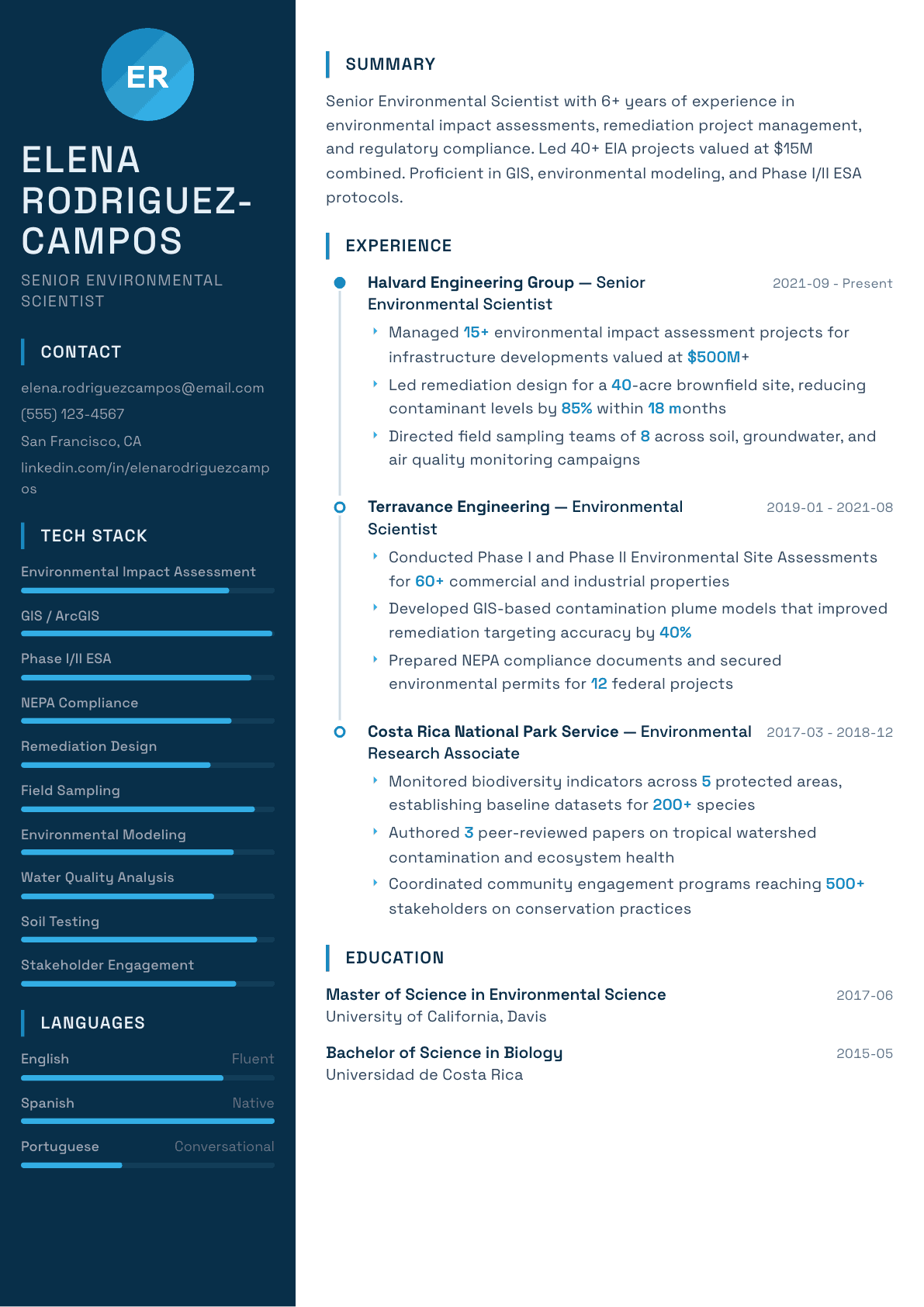
Example Environmental Scientist summary
Certified Environmental Scientist with 6+ years of experience managing EIAs, remediation projects, and regulatory permitting for infrastructure and industrial clients. Skilled in GIS, NEPA compliance, and Phase I/II ESAs with $15M+ in combined project value. HAZWOPER-certified with strong field sampling and stakeholder engagement capabilities.
Skills to list on a Environmental Scientist resume
- Environmental Impact Assessment
- GIS / ArcGIS
- Phase I/II ESA
- NEPA / CERCLA / RCRA
- Remediation Design
- Field Sampling
- Environmental Modeling
- Water Quality Analysis
- Air Quality Monitoring
- Stakeholder Engagement
- HAZWOPER
- Ecological Risk Assessment
What actually gets this resume read
- Highlight regulatory frameworks you work with: NEPA, CERCLA, RCRA, Clean Water Act, Clean Air Act.
- Quantify project scope: acreage, budget, contaminant reduction percentages, and number of assessments completed.
- Include GIS and modeling software proficiency: ArcGIS, MODFLOW, AERMOD, or similar tools.
- Mention field work experience including sampling, monitoring, and team leadership.
- Reference any professional certifications: CES, QEP, CHMM, or HAZWOPER training.
How to write a environmental scientist resume
Environmental scientist covers several distinct careers that share a job title: the person who writes impact documents for infrastructure projects, the person who delineates wetlands and surveys habitat, the person who runs monitoring networks and interprets the data, and the person who assesses property before a transaction. Employers post the same title and screen for one of them.
What every version has in common is defensibility. Your findings end up in a public document, a permit file or a transaction record, and somebody may challenge them. So hiring managers look for evidence that your field methods, your data handling and your reporting would survive that challenge: the protocol you followed, the agency that accepted it, and the document that came out the other end.
This guide covers how to organize an environmental scientist resume around documents and field programs, three summaries covering a field scientist through a senior project scientist, before and after bullets from assessment and monitoring work, and the questions that come up when scientists move between consulting, agency and industry roles.
Format: field days, documents, and the credentials that unlock sites
One page early, two once you are authoring documents and managing projects. Below your name, name the specialization: impact assessment, ecology and natural resources, contaminated site assessment, water quality, or air quality. Then list the credentials that let an employer send you somewhere: the 40 hour hazardous waste training, a wetland delineation certification, a boating or first aid card for remote work, and a valid driver record if field travel is constant.
Field science is bought by the day. Somewhere near the top, say how much field time you have: seasons worked, sites visited, or the survey types you can run unsupervised. Consulting firms staff on exactly that.
- Header: name, specialization, key field credentials, location, phone, email.
- Order: summary, credentials and training, professional experience, representative projects and documents, technical and field skills, education.
- Add a short list of the document types you have authored rather than only contributed to.
Summary: what you survey, what you write, who accepted it
Three lines that name the resource you work on and the deliverable you produce. Water quality monitoring and reporting, wetland delineation and permitting support, protected species surveys, air monitoring, or environmental site assessment before property transfer are all specific, and all searchable.
The strongest phrase available to you is regulatory acceptance. An assessment that supported an approved permit, an impact document that cleared agency review, a delineation concurred with by the reviewing authority: these say your work holds up. Say it plainly in the summary rather than leaving it buried.
Experience: field program, data, document, decision
Structure bullets in that order. Field program first: what you surveyed, the season and duration, the protocol you followed, the equipment you used and the crew you led. Multiparameter water quality sondes, flow measurement, benthic and vegetation sampling, small mammal or avian point counts, soil pits and hydric soil indicators, and passive or continuous air samplers all belong here by name.
Data next. Chain of custody handling, laboratory coordination and data validation, database management, statistical analysis in R or a comparable tool, and spatial analysis and figure production in ArcGIS Pro or QGIS. Environmental scientists are frequently hired for data credibility as much as for field skill, and this section is where you show it.
Then the document and the decision. Environmental assessments and impact statements, constraints analyses, wetland delineation reports, biological evaluations, monitoring reports, and property assessment reports written to the recognized standard practice. Say what the document supported: a permit issued, a project approved with conditions, a transaction closed, a mitigation plan adopted.
Regulatory literacy without the alphabet soup
Name the frameworks you have actually worked inside and pair each with a deliverable. Federal environmental review documents, wetland and waterway permitting, protected species consultation, clean water permitting and monitoring, cleanup and hazardous waste programs, and state level environmental quality review. Listing acronyms with nothing attached is transparent to anyone who does this work.
Add the agencies you have corresponded with. Scientists who have sat in an agency meeting, answered comments and revised a document accordingly are worth more than scientists who only wrote drafts, and the distinction is invisible unless you state it.
Skills, software and the safety record
Keep three groups: field methods and equipment, data and spatial tools, and reporting. Under spatial, be specific about what you produce: georeferenced field maps, habitat classification, change detection from imagery, and figure sets that accompany a permit application.
Field safety belongs on this resume. Days worked without a recordable incident, tailgate safety briefings led, hazard assessments written, and remote work protocols followed all matter to a firm whose insurance depends on them.
Environmental Scientist resume summary examples
Field scientist, first two years
Environmental scientist with 2 field seasons in water quality and habitat monitoring. Collected 600 surface water and benthic samples under strict chain of custody, ran multiparameter sondes at 24 stations, and produced ArcGIS figures and data summaries for 5 monitoring reports.
Project scientist, six years
Environmental scientist with 6 years in impact assessment and permitting for transportation and energy projects. Authored 9 environmental assessments, led wetland delineations across 1,200 acres, and carried 4 protected species consultations through agency review to project approval.
Senior project scientist
Senior environmental scientist with 13 years leading assessment and monitoring programs across the western states. Manages a field team of 8, has authored or reviewed 40 impact and monitoring documents, and serves as the technical lead in agency negotiations on mitigation and long term monitoring commitments.
Work experience bullets: before and after
Before: Conducted field sampling for environmental projects.
After: Ran a 3 season surface water monitoring program at 24 stations: sonde deployment and calibration, grab and composite sampling, chain of custody to a certified laboratory, and quarterly data validation before reporting.
Duration, station count and the full sample path show a monitoring program rather than occasional field days.
Before: Wrote environmental reports.
After: Authored 4 environmental assessments for highway projects, integrating noise, water quality, wetland and cultural resource findings, and responded to 2 rounds of agency comments before each document was accepted.
Document type, the disciplines you integrated and the comment cycles prove authorship that survived review.
Before: Did wetland work in the field.
After: Delineated wetlands across 640 acres using the routine determination method, documented hydrophytic vegetation, hydric soils and hydrology indicators at 80 sample points, and prepared the delineation report the reviewing agency concurred with.
Method, acreage, indicator documentation and agency concurrence make the delineation defensible on paper.
Before: Used GIS to make maps.
After: Built an ArcGIS Pro project for a 9 mile corridor combining survey points, habitat polygons and jurisdictional features, and produced the constraints figure set used to reroute the alignment away from 2 sensitive habitats.
A spatial product that changed a project decision demonstrates analysis rather than cartography.
Before: Performed Phase I site assessments.
After: Completed 22 Phase I environmental site assessments to the recognized standard practice, including records review, site reconnaissance and interviews, and identified recognized environmental conditions that triggered subsurface investigation at 5 properties.
Volume, the standard followed and the findings that led to further work show real assessment judgment.
Hard skills
- Environmental impact assessment
- Wetland delineation
- Protected species surveys
- Phase I environmental site assessment
- Surface water and groundwater sampling
- Water quality monitoring instrumentation
- Air quality monitoring
- Ecological risk assessment
- Chain of custody and data validation
- ArcGIS Pro and QGIS
- Statistical analysis in R
- Permit application preparation
- Monitoring and mitigation plan development
Soft skills
- Agency and stakeholder meetings
- Field crew leadership
- Public comment response writing
- Working alone in remote conditions
- Coordinating with engineers and planners
Certifications worth listing
- Certified Hazardous Materials Manager (CHMM) (Institute of Hazardous Materials Management)
- Qualified Environmental Professional (QEP) (Institute of Professional Environmental Practice)
- Professional Wetland Scientist (PWS) (Society of Wetland Scientists Professional Certification Program)
- Certified Environmental Scientist (CES) (National Registry of Environmental Professionals)
- GIS Professional (GISP) (GIS Certification Institute)
- HAZWOPER 40-Hour Training (OSHA compliant training provider)
Mistakes that cost environmental scientist candidates the interview
- Listing regulatory acronyms with no deliverable attached, which signals coursework rather than practice to anyone in the field.
- Hiding field experience behind office duties when consulting firms staff projects on available field days.
- Saying you contributed to a document without ever stating which sections you wrote and whether it was accepted.
- Leaving out the survey protocol or standard practice followed, the detail that makes a finding defensible.
- Treating GIS as a graphics skill instead of showing an analysis that changed a project decision.
- Omitting training cards and safety records, which decide whether a firm can put you on a site next week.
Environmental Scientist resume questions
How much field experience should I highlight?
All of it, expressed in seasons, sites or survey types you can run without supervision. Consulting firms plan staffing around who can be sent out, and a candidate who states clearly what they can survey alone is easier to hire than one who lists coursework.
Do I need a masters degree to advance?
A bachelors is enough to enter and to build a long field career. A masters helps most for technical specialties such as ecology, hydrology or risk assessment, and for agency roles where the degree sits in the hiring classification, so weigh it against the specialization you want.
How do I present seasonal and contract work without looking unstable?
Group seasonal positions under one heading such as field seasons, list each with the employer, the survey type and the duration, and let the pattern read as accumulating range. Continuous seasonal work is normal in this field and does not need an apology.
Which certification is worth pursuing first?
Choose the one that matches your specialization rather than the most general. Wetland and ecology practitioners benefit from the wetland scientist credential, site assessment staff from hazardous materials certification, and anyone doing heavy spatial work from the professional geographic information systems credential.
How do I move from consulting to a government or agency role?
Reframe around review rather than production: documents you prepared that met agency standards, comments you resolved, monitoring commitments you tracked and compliance you verified. Agencies also weigh formal position requirements closely, so mirror the wording of the posting exactly.