Statistician Resume Examples: free ATS score and gap list
Build a Statistician Resume That Adds Up
By Mustafa Tarabya, founder of CVBooster · Published · Updated
Create a data-driven statistician resume showcasing statistical modeling, experimental design, and analytical expertise with ATS-optimized templates for government, pharma, and tech roles.
Sample resumes for a statistician
The same statistician content laid out in three CVBooster templates, so you can see what the finished document looks like before you write a word.
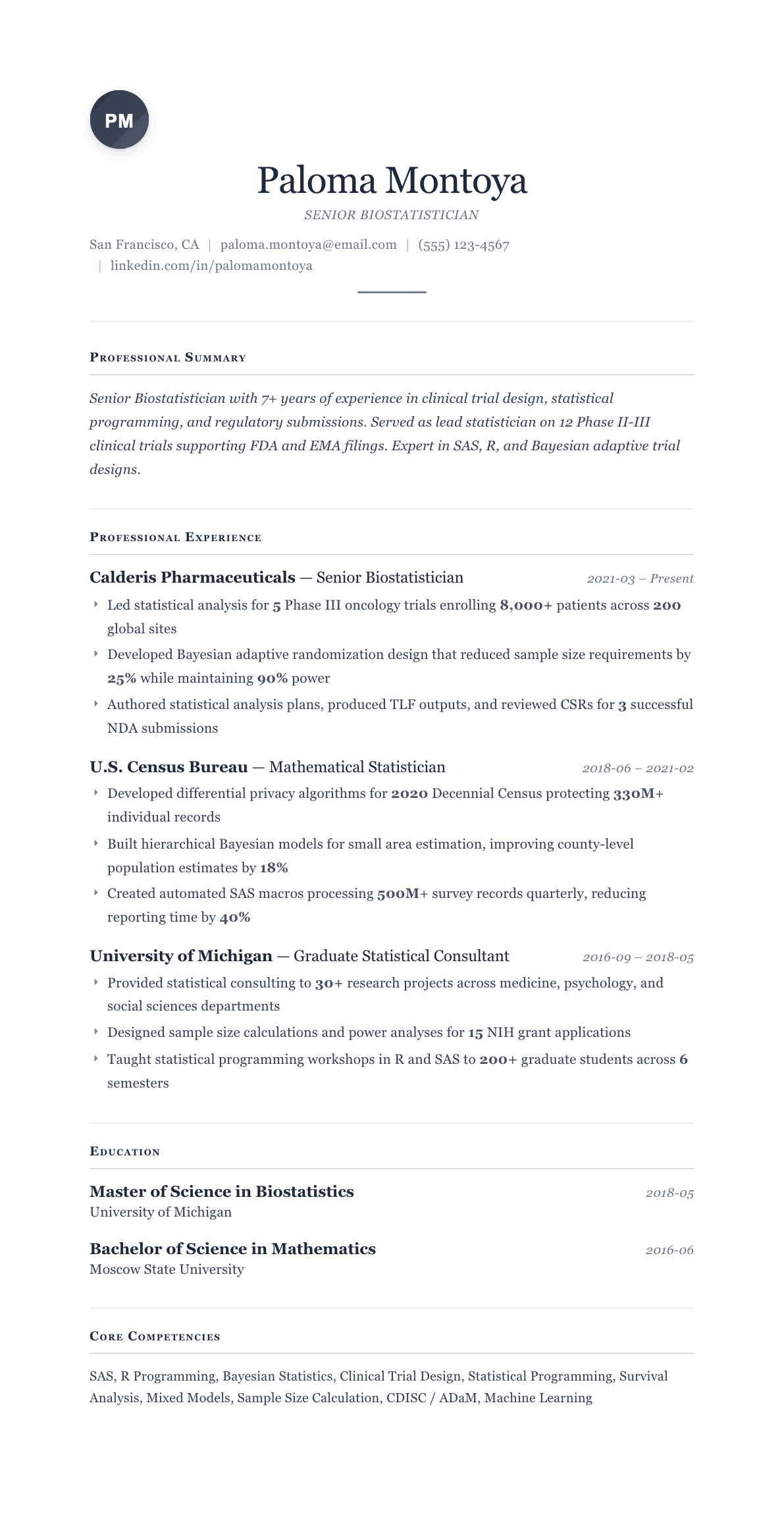
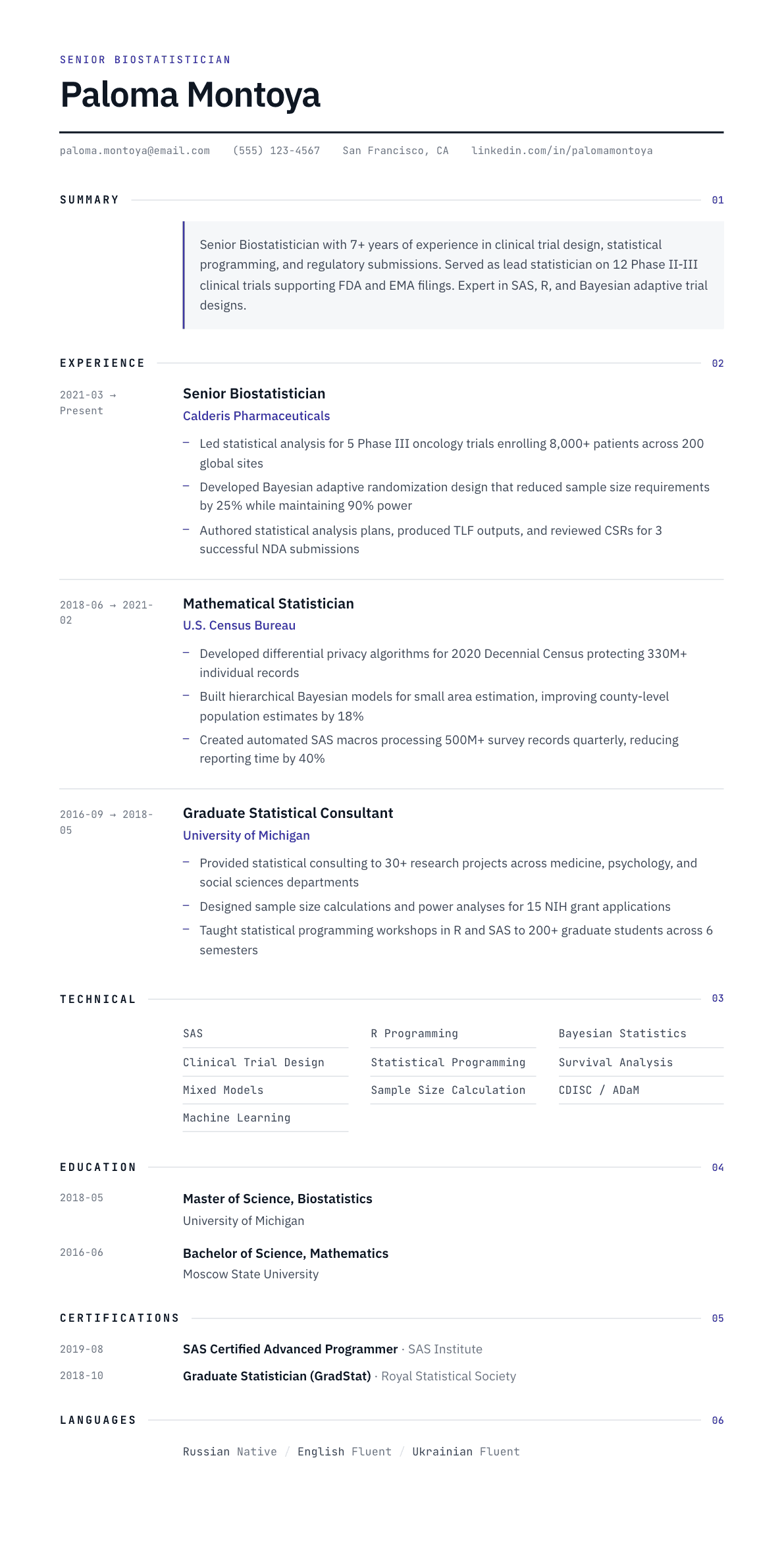
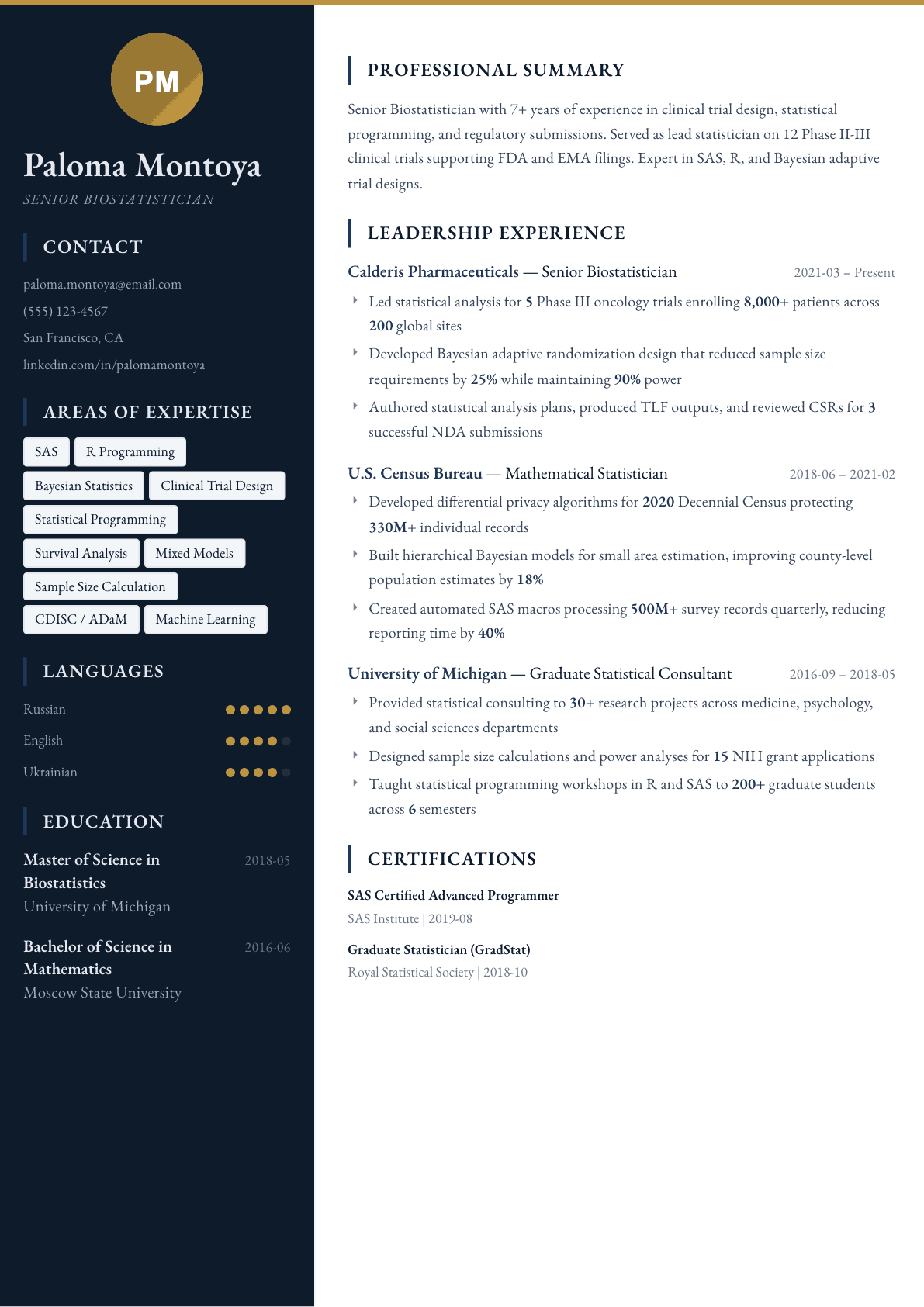
Example Statistician summary
SAS-certified Senior Biostatistician with 7+ years in clinical trial design and regulatory submissions. Led statistical analysis for 12 Phase II-III trials enrolling 15K+ patients. Expert in Bayesian adaptive designs, survival analysis, and CDISC standards. Supported 3 successful NDA filings at FDA.
Skills to list on a Statistician resume
- SAS Programming
- R Programming
- Bayesian Statistics
- Clinical Trial Design
- Survival Analysis
- Mixed Models
- Regression Analysis
- Sample Size Calculation
- CDISC / SDTM / ADaM
- Machine Learning
- Data Visualization
- Causal Inference
What actually gets this resume read
- List statistical software and languages prominently: SAS, R, Python, Stata, SPSS, JMP.
- Quantify clinical trial work: number of trials, patients enrolled, sites, and regulatory submissions supported.
- Highlight methodology expertise: Bayesian methods, survival analysis, mixed models, causal inference.
- Include CDISC standards experience (SDTM, ADaM) for pharmaceutical biostatistics roles.
- Mention teaching, consulting, or mentoring experience to demonstrate communication skills.
How to write a statistician resume
Statistician means something different in each of the sectors that hire one. In pharmaceuticals it means designing trials, writing the analysis plan and defending it to a regulator. In government it means survey methodology, weighting and disclosure control. In technology it means experimentation and causal inference. In insurance and finance it means risk modeling. The methods overlap; the deliverables and the review process do not.
The reviewer, usually a lead statistician, is checking whether you have owned an analysis that somebody depended on. That means a protocol or a plan you wrote, a model whose assumptions you can defend, code that reproduces, and a result you presented to people who challenged it. Listing methods you studied is not the same as owning an analysis that shipped to a decision.
This guide covers how to declare sector and deliverable, how to describe methods so both a recruiter and a statistician can read them, how to present code and reproducibility, summaries at three career stages, and the credentials and mistakes that decide these applications.
Declare sector, deliverable and study type
Start with the domain and the artifact you produce. A clinical statistician writes protocols, statistical analysis plans, and the tables, listings and figures that support a submission. A survey statistician produces sample designs, weights and variance estimates. An experimentation statistician produces test designs, readouts and decision rules. Naming the artifact tells the reader what you have actually been accountable for.
Add the study designs you have worked on: randomized parallel group, crossover, adaptive, group sequential, cluster randomized, observational cohort, case control, complex survey, or online controlled experiment. Design vocabulary is the fastest way for a senior statistician to gauge depth.
- Header: name, degree, city and state, phone, email.
- Order: summary, methods and software, experience, education, publications, certifications.
- State the regulatory or governance environment: submission support, data monitoring committee work, or internal review boards.
Methods: name them at the right level of precision
Write methods so a recruiter can match keywords and a statistician can judge substance. Mixed effects models, generalized linear models, survival analysis with time-varying covariates, Bayesian hierarchical models, multiple imputation for missing data, propensity score methods, sample size and power calculation, multiplicity control, and sequential monitoring boundaries are all specific enough to be checked.
Avoid the two failure modes. Listing machine learning as a single word says nothing, and listing thirty method names says you have read a textbook. Pick the methods you would defend under questioning and attach each to a piece of work you did.
Say what you did about assumptions. Sensitivity analyses, model diagnostics, handling of missing data under stated assumptions, and pre-specification versus post hoc analysis are the details that separate a statistician from someone who runs procedures.
Software, code and reproducibility
Name the languages and the environment: R with the packages you rely on, SAS with the procedures and macro work, Python, Stata, and SQL for data extraction. In regulated work, say whether you produced validated outputs, worked to a data standard, or performed independent double programming.
Reproducibility is now part of the job description. Version control, parameterized reporting, a project structure someone else can run, and documented data lineage all belong on the page. A statistician whose analysis can be rerun by a colleague six months later is more valuable than one whose results live in a single spreadsheet.
Communication and the defense of a result
Statisticians are hired to say what the data will and will not support, often to people who want a different answer. Show that on the resume: presenting to a review board, a data monitoring committee, a regulator, a product team or an editorial reviewer, and the outcome of the discussion.
Written output counts too. Analysis plans, study reports, methodology sections, technical documentation for a published dataset and internal standards you authored are all deliverables that prove you can write for scrutiny rather than for yourself.
- Say how many studies or analyses you have led, not just supported.
- Name the collaborators: clinicians, product managers, epidemiologists, engineers, policy staff.
- Include any teaching or internal training on statistical methods.
Education, publications and credentials
A master's degree is the working minimum in most sectors and a doctorate is common in pharmaceutical and research settings, so put the degree, the field and the thesis area when it is relevant. Coursework listings belong only on a first resume, and then only for advanced courses that match the posting.
List publications selectively unless the role is academic, ordering by relevance and marking your authorship position. Professional accreditation exists in this field and is worth listing with the awarding society, as are software certifications when the employer works in that environment.
Statistician resume summary examples
New master's graduate
Statistician with a master's degree in biostatistics and a year of applied work on observational health data, covering survival analysis, multiple imputation and propensity score matching in R. Wrote the analysis section of 2 manuscripts and maintains reproducible project code under version control.
Six years in
Biostatistician with 6 years supporting clinical development, serving as lead statistician on 4 studies including a group sequential design. Authors analysis plans, specifies tables and figures, and reviews independent programming output ahead of study reporting and regulatory response.
Principal statistician
Principal statistician with 13 years across clinical trials and real-world evidence, accountable for statistical strategy on a therapeutic program and for interactions with health authorities. Chairs internal methods review, supervises 5 statisticians, and led the design of two adaptive studies.
Work experience bullets: before and after
Before: Performed statistical analysis for clinical studies.
After: Served as lead statistician on 4 randomized studies, authoring the analysis plans, specifying the estimand and multiplicity strategy, and defending the primary analysis at internal review.
Leading, authoring and defending are different from performing, and the estimand detail proves current practice.
Before: Used R and SAS for data analysis.
After: Built the analysis pipeline in R for a cohort of roughly 12 thousand patients, with parameterized reporting under version control so the full set of tables regenerates from raw extracts in one run.
Scale plus reproducible infrastructure shows engineering discipline that most statistical resumes never mention.
Before: Calculated sample sizes for studies.
After: Ran sample size and power calculations for 9 study designs, including simulation-based sizing for a group sequential trial where a closed-form solution did not apply.
The simulation case shows you can size a design that a standard formula cannot handle.
Before: Presented findings to stakeholders.
After: Presented interim safety summaries to an independent data monitoring committee across 3 meetings, including the rationale for the stopping boundary and the handling of incomplete follow-up.
A named governance audience and the technical points defended show the result survived expert challenge.
Before: Worked with missing data in the dataset.
After: Implemented multiple imputation under a stated missing-at-random assumption and ran a tipping point sensitivity analysis that showed the primary conclusion held under plausible departures.
Naming the assumption and the sensitivity analysis is the difference between handling missing data and hiding it.
Hard skills
- Study and experimental design
- Sample size and power analysis
- Mixed effects and generalized linear models
- Survival analysis
- Bayesian methods
- Causal inference and propensity score methods
- Missing data methods and multiple imputation
- Multiplicity and interim analysis strategy
- Survey sampling and weighting
- R and the tidyverse
- SAS programming and macros
- Python
- SQL
- Statistical analysis plan authoring
Soft skills
- Defending an analysis under challenge
- Explaining uncertainty to non-statisticians
- Collaboration with clinicians and product teams
- Pre-specification discipline
- Reviewing and mentoring other analysts
Certifications worth listing
- Accredited Professional Statistician (PStat) (American Statistical Association)
- Graduate Statistician (GStat) (American Statistical Association)
- Chartered Statistician (CStat) (Royal Statistical Society)
- SAS Certified Statistical Business Analyst (SAS Institute)
- SAS Certified Advanced Programmer (SAS Institute)
Mistakes that cost statistician candidates the interview
- Never naming the sector, so a clinical hiring manager cannot tell whether your experience involved a submission or a dashboard.
- Listing methods as a keyword wall with no analysis attached to any of them.
- Omitting the deliverable, when the analysis plan, the report and the tables are what the job is actually judged on.
- Saying nothing about assumptions or sensitivity analyses, which is the first thing a senior statistician probes.
- Skipping reproducibility and version control, which employers now treat as a baseline expectation.
- Confusing supporting an analysis with leading one, since the reviewer will ask precisely that in the interview.
Statistician resume questions
What is the difference between a statistician and a data scientist resume?
A statistician resume centers on design, inference and defensible conclusions: study design, assumptions, uncertainty and the written analysis plan. A data science resume leans toward prediction, pipelines and product metrics. If you are applying to both, write two versions rather than blending them.
Should a statistician list every statistical method learned?
No. List the methods you would defend under questioning and tie each to work you performed. A long unattached list dilutes the strong entries and invites interview questions on techniques you have only read about, which is a bad trade.
How do I show clinical trial experience without breaking confidentiality?
Describe the phase, the design type, the therapeutic area in general terms, the number of studies and your role. Leave out compound names, sponsor identifiers and unpublished results. The reviewer wants your role and the methods, not the confidential detail.
Do I need a doctorate to work as a statistician?
Not for most positions. A master's degree is the working standard across government, industry and clinical programming roles. A doctorate is expected for principal and methods-development positions, especially where you would set statistical strategy for a program.
Should I link to code or a portfolio?
One link is useful if the repository shows a documented, reproducible analysis rather than assorted scripts. Include the analysis question, the data source and a readable summary of results. Never link to work containing confidential or individual-level data.