Infrastructure Engineer Resume Examples: free ATS score
Build a Rock-Solid Infrastructure Engineer Resume
By Mustafa Tarabya, founder of CVBooster · Published · Updated
Create a compelling infrastructure engineer resume highlighting your expertise in cloud infrastructure, networking, automation, and high-availability systems.
Sample resumes for a infrastructure engineer
The same infrastructure engineer content laid out in three CVBooster templates, so you can see what the finished document looks like before you write a word.
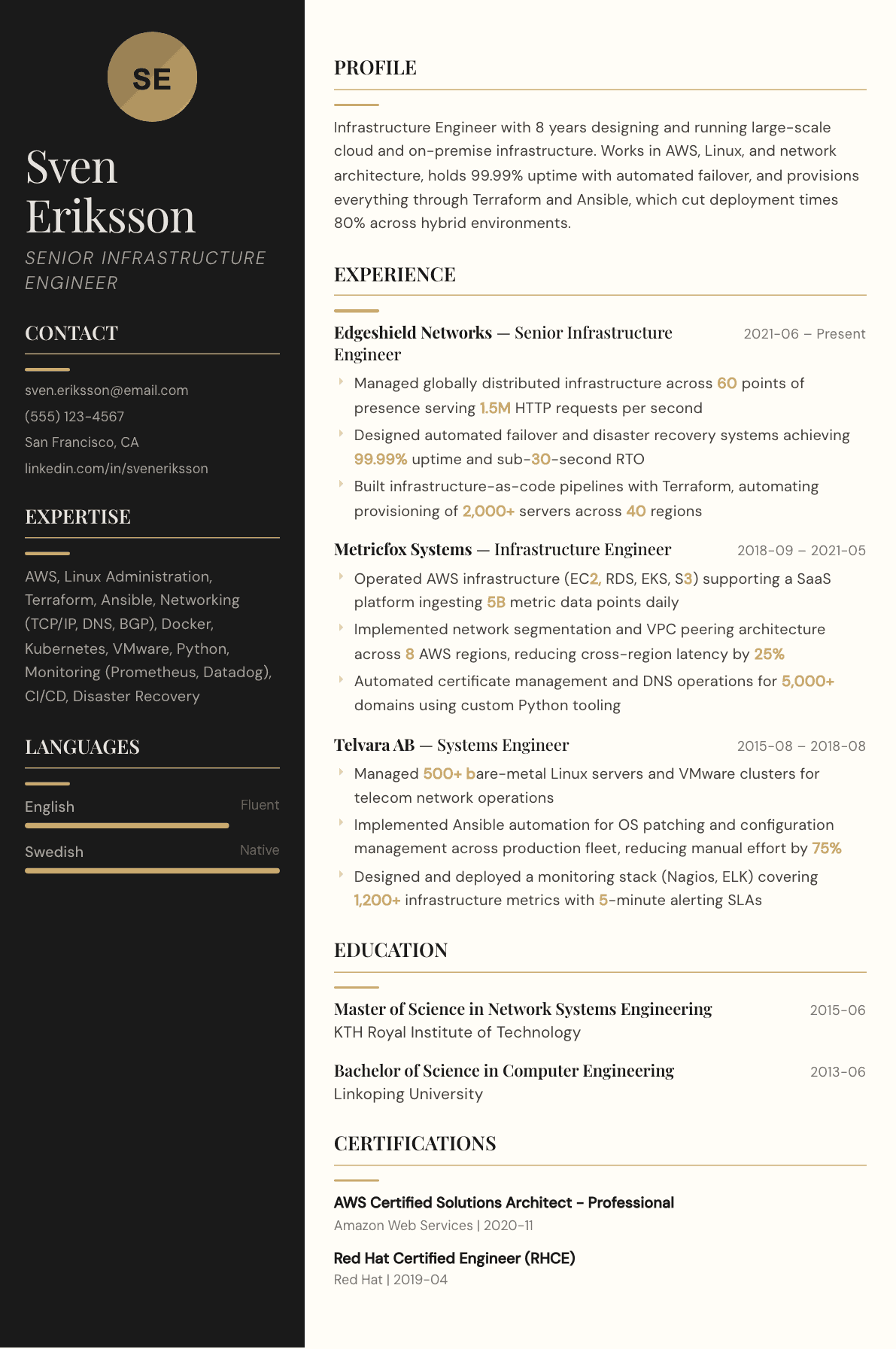
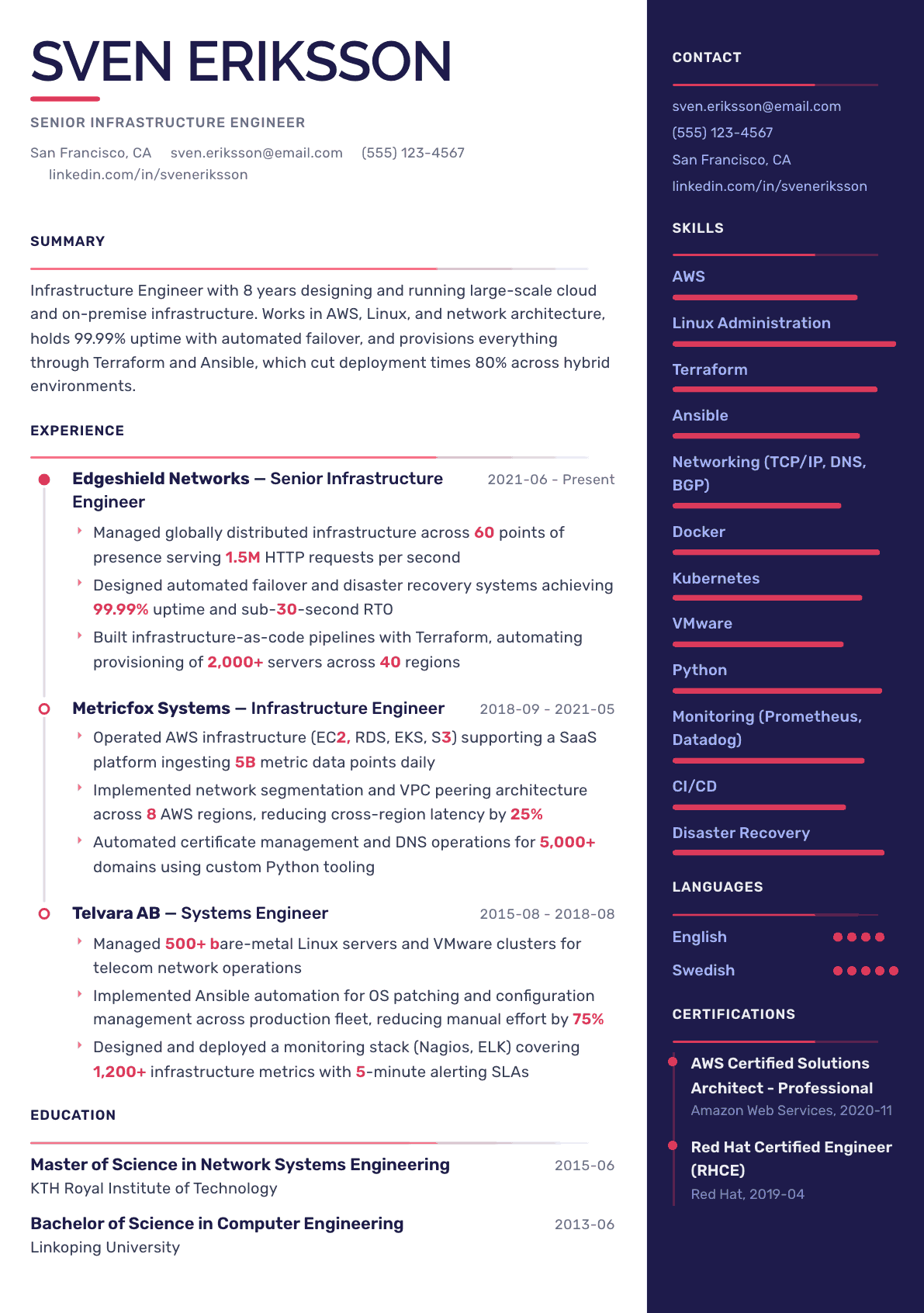
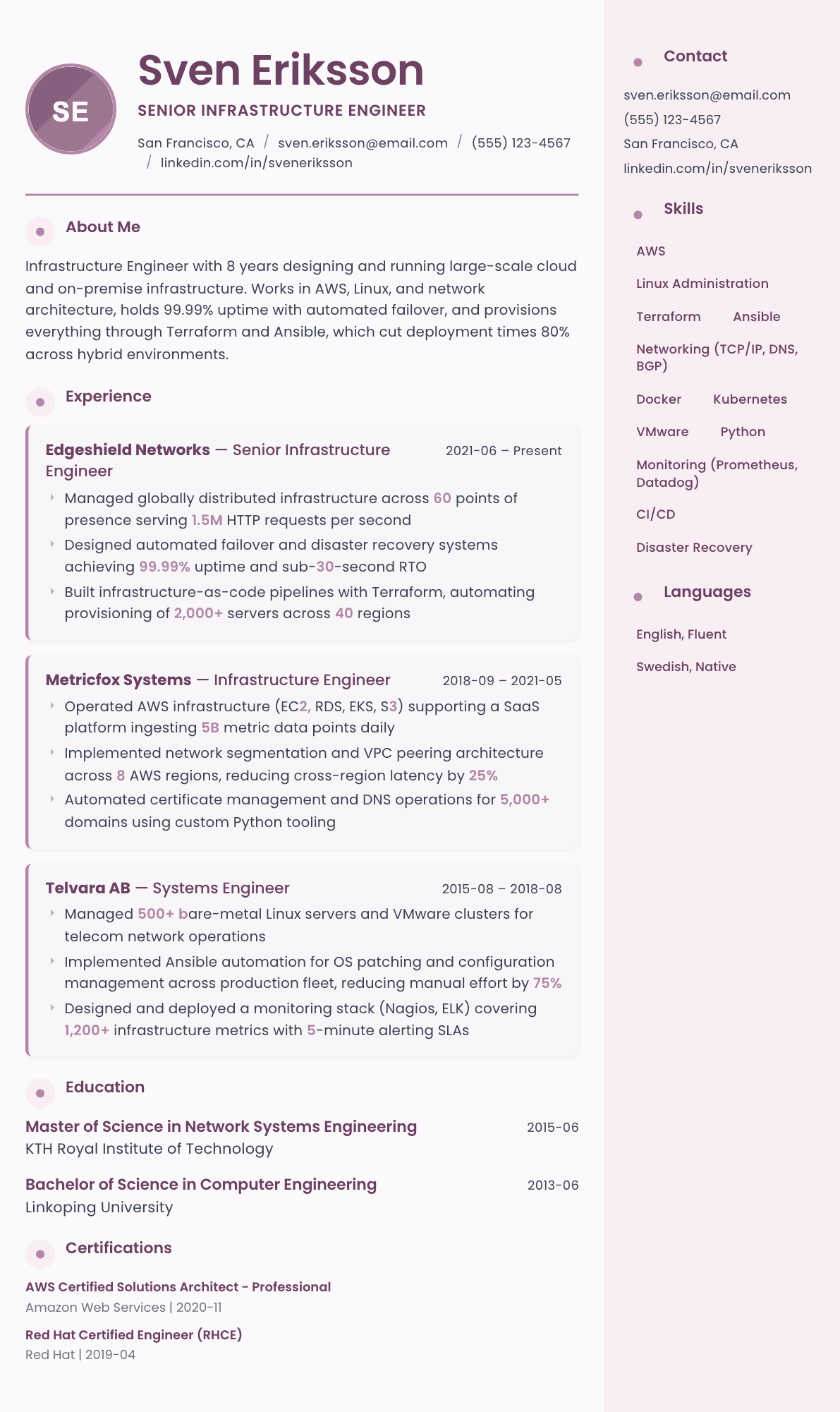
Example Infrastructure Engineer summary
Infrastructure Engineer, 8 years across globally distributed cloud and on-premise estates. Holds 99.99% uptime with sub-30-second failover and provisions 2,000 servers across 40 regions from Terraform and Ansible. Strong on AWS, Linux, networking, and disaster recovery.
Skills to list on a Infrastructure Engineer resume
- AWS/GCP/Azure
- Linux Administration
- Terraform
- Ansible
- Networking (TCP/IP, DNS, BGP)
- Docker
- Kubernetes
- VMware/KVM
- Python/Bash
- Monitoring & Observability
- CI/CD Pipelines
- Disaster Recovery
What actually gets this resume read
- Quantify infrastructure scale: servers managed, requests per second, or data centers operated.
- Highlight uptime achievements and disaster recovery capabilities: RTO, RPO, and SLA metrics.
- List infrastructure automation tools: Terraform, Ansible, Puppet, Chef, or CloudFormation.
- Include networking expertise: TCP/IP, DNS, BGP, VPN, load balancing, and firewall configuration.
- Show cost optimization wins: cloud spend reduction, resource right-sizing, or reserved instance savings.
How to write a infrastructure engineer resume
An infrastructure engineer resume is read by someone who carries a pager. Her first question is whether you have been responsible for a system while it was broken, at night, with users affected. Everything that follows on the page is judged against that, because the difference between an engineer who has built infrastructure and one who has only configured it shows up during an incident and nowhere else.
The second question is scale and shape. Managing a handful of virtual machines for one application, running a multi-account cloud estate for a company, and operating physical hardware in colocation are three different jobs sharing one title. Say which one you did, with numbers: accounts, clusters, nodes, environments, regions, or racks.
This guide covers the section order that works for platform and operations hiring, how to write about automation and reliability so the numbers mean something, three summaries at different levels, rewritten bullets, and the certification question that infrastructure candidates ask most.
Format: one page early, two once you have run production
Reverse chronological, single column, no graphics. Cloud and platform teams filter heavily on tool names, and a column layout scrambles them in the parser. Two pages become normal once you have several years of production ownership and a real estate to describe.
Add a short environment block under the header for each recent role rather than one giant skills wall: cloud provider, orchestration, infrastructure as code tool, and the operating system. A hiring manager reads that block and knows whether your experience transfers to her stack before she reads a single bullet.
- Header: name, city, email, and a repository link if you have public modules or configuration.
- Order: summary, experience with an environment line each, skills by category, certifications, education.
- Candidates moving from system administration or support keep those roles in full and rewrite the bullets around automation rather than tickets.
Say what you were responsible for, and how big it was
Numbers are the whole game in infrastructure. Instances or nodes under management, Kubernetes clusters and their size, accounts or subscriptions, environments, regions, requests per second at the edge, terabytes stored, and the size of the team that depended on you. Without them a reader cannot tell a single-cluster startup from a regulated enterprise estate.
State the reliability targets you worked to and whether you met them. Service level objectives, error budgets, recovery time and recovery point objectives, and maintenance windows are the vocabulary of the job. If you owned a disaster recovery plan, say whether it was ever tested and what the test found, because tested plans are rare and reviewers know it.
Automation: name the tool and the thing it replaced
Infrastructure as code is the expected baseline, so the differentiator is what you built with it. Say whether you wrote reusable Terraform modules other teams consumed, managed state and workspaces across accounts, wrote Ansible roles that replaced a runbook, or built the pipeline that applies changes with a plan review and an approval gate.
Always name the manual process the automation removed and roughly what it cost. Provisioning that took a week and now takes an hour, patching that was a weekend and is now a scheduled job, or an onboarding that required three tickets and now requires none. That framing is what turns a tool list into evidence of judgment.
Networking, security and cost, the three things managers worry about
Networking is where infrastructure candidates most often go thin. Say what you have actually configured: virtual networks and subnets, routing, load balancers, DNS, VPN or private connectivity, firewall and security group design, TLS certificate management, and where relevant, BGP. Being the person who can debug why traffic is not arriving is a hiring reason on its own.
Security and cost belong in the same conversation. Identity and access design with least privilege, secret management, patching cadence, image hardening and audit evidence on one side; right-sizing, committed use discounts, storage tiering, and turning off what nobody owns on the other. Cost work is unusually persuasive because it is easy to state as a result and hard to fake.
- Give incident work its own bullet: what broke, how you found it, how long recovery took, and what you changed so it stopped repeating.
- Name the monitoring stack and say what you instrumented, not just that it existed.
- Mention migrations plainly, including what moved, over what period, and whether users noticed.
Keywords in infrastructure postings
These postings recycle a stable vocabulary: AWS, Azure or Google Cloud, Linux administration, Terraform, Ansible, Kubernetes, Docker, CI/CD, networking, monitoring and observability, high availability, disaster recovery, scripting in Python or Bash, and security hardening. Mirror the wording once in the skills block and once inside a bullet attached to real work. Spell out both the acronym and the full term the first time, since parsers and humans search differently.
Infrastructure Engineer resume summary examples
Junior infrastructure engineer
Infrastructure engineer with two years supporting a Linux estate of about 90 instances, automating patching and user provisioning with Ansible and Bash. Comfortable with Terraform for small changes, on the secondary on-call rotation, and studying for the associate cloud architect exam.
Five years in
Infrastructure engineer with five years running an AWS estate across nine accounts and three regions, with two Kubernetes clusters serving 40 services. Owns the Terraform modules four teams build on, carries the primary pager, and cut monthly cloud spend by 23% through right-sizing and storage tiering.
Senior or platform lead
Senior infrastructure engineer with eleven years across colocation hardware and public cloud, leading a platform team of five. Designed the multi-account landing zone, ran a data center exit covering 400 workloads, and holds the reliability targets the business signs off on each quarter.
Work experience bullets: before and after
Before: Managed cloud infrastructure using Terraform.
After: Wrote and versioned the Terraform modules for networking, identity and cluster provisioning across nine AWS accounts, so a new environment now stands up from a pull request in about an hour instead of a week of manual setup.
The estate size and the before and after provisioning time convert a tool mention into a measurable capability.
Before: Improved system uptime.
After: Moved the order service to a multi-zone deployment with health-checked failover and tested the failover monthly, ending the recurring single-zone outages that had caused four incidents in the prior year.
The architectural change and the incidents it removed prove reliability work rather than quoting an uptime figure with no context.
Before: Reduced cloud costs.
After: Cut monthly cloud spend by roughly a third by right-sizing 120 over-provisioned instances, moving cold logs to archival storage and deleting unclaimed volumes and snapshots found in a tagging audit.
Naming the three levers makes the saving credible and shows a repeatable method rather than a one-time cleanup.
Before: Responsible for monitoring and alerts.
After: Rebuilt alerting around service level objectives with Prometheus and Alertmanager, retiring 60 noisy threshold alerts and cutting overnight pages to about two a month without missing an incident.
Alert fatigue is a real operational problem, so removing noise while keeping coverage is a stronger claim than having monitoring at all.
Before: Handled incidents and outages.
After: Led recovery of a two-hour outage caused by an expired internal certificate, restored service in 40 minutes once identified, then automated renewal and added an expiry alert that has prevented any repeat.
A named cause, a recovery time and the permanent fix show the full incident cycle instead of just presence during one.
Hard skills
- Linux system administration
- AWS, Azure or Google Cloud
- Terraform and infrastructure as code
- Ansible configuration management
- Kubernetes and container orchestration
- Docker and image hardening
- Networking, DNS and load balancing
- Identity and access management
- Prometheus and Grafana monitoring
- Logging and log aggregation
- Bash and Python scripting
- CI/CD pipelines
- Backup and disaster recovery
- Cloud cost management
Soft skills
- Incident command
- Writing runbooks
- Change control discipline
- Working with developers as customers
- Calm under outage pressure
- Capacity planning judgment
Certifications worth listing
- AWS Certified Solutions Architect, Associate (Amazon Web Services)
- AWS Certified SysOps Administrator, Associate (Amazon Web Services)
- Microsoft Certified: Azure Administrator Associate (Microsoft)
- Google Cloud Professional Cloud Architect (Google Cloud)
- Certified Kubernetes Administrator (Cloud Native Computing Foundation)
- Red Hat Certified System Administrator (Red Hat)
- HashiCorp Certified: Terraform Associate (HashiCorp)
- CompTIA Linux+ (CompTIA)
Mistakes that cost infrastructure engineer candidates the interview
- Listing tools with no estate behind them, so the reader cannot tell whether you ran two servers or two hundred.
- Quoting an availability figure without saying what the target was, who set it, or how it was measured.
- Leaving networking off the resume, when the ability to diagnose routing, DNS and load balancer problems is a common reason to hire.
- Describing infrastructure work only as ticket resolution, which reads as support rather than engineering even when the work was engineering.
- Never mentioning on-call. Being trusted with the pager is a strong signal and candidates routinely leave it out.
- Putting expired certifications on the page without dates, which invites a question you would rather not answer in the first call.
Infrastructure Engineer resume questions
Which cloud certification helps an infrastructure engineer most?
The one matching the platform in the job description, at associate or professional level. Certifications get you past recruiter screening, but the interview is decided by the estate you have run, so keep them below your experience on the page.
Is infrastructure engineer the same as a DevOps or site reliability role?
The titles overlap heavily and vary by company. Infrastructure leans toward the platform and its foundations, reliability leans toward service level objectives and incident work, and the safest move is to mirror the title used in the posting you are answering.
How do I show infrastructure work with no public artifacts?
Describe scale, architecture decisions and outcomes without naming customers or exposing configuration. A sanitized description of a landing zone design or a migration is fine, and most reviewers expect infrastructure work to be private.
Should I include on-call experience on my resume?
Yes. Say the rotation size, roughly how many pages a week you carried, and one incident you led from detection through the permanent fix. Operational trust is the hardest thing to prove on paper and this is how you prove it.
How do I move from system administration into infrastructure engineering?
Rewrite existing work around automation and repeatability instead of tickets closed, then add one project where you replaced a manual process with code. A single tested Terraform or Ansible artifact changes how the whole resume reads.
Related resume examples
- Platform Engineer Resume example
- DevOps Engineer Resume example
- Cloud Security Engineer Resume example
- Cloud Engineer Resume example
- AWS Engineer Resume example
- Network Engineer Resume example