Cloud Architect Resume Examples: the lines they read
Design a Cloud Architect Resume That Reaches New Heights
By Mustafa Tarabya, founder of CVBooster · Published · Updated
Build a compelling cloud architect resume with ATS-optimized templates showcasing your cloud infrastructure and design expertise.
Sample resumes for a cloud architect
The same cloud architect content laid out in three CVBooster templates, so you can see what the finished document looks like before you write a word.
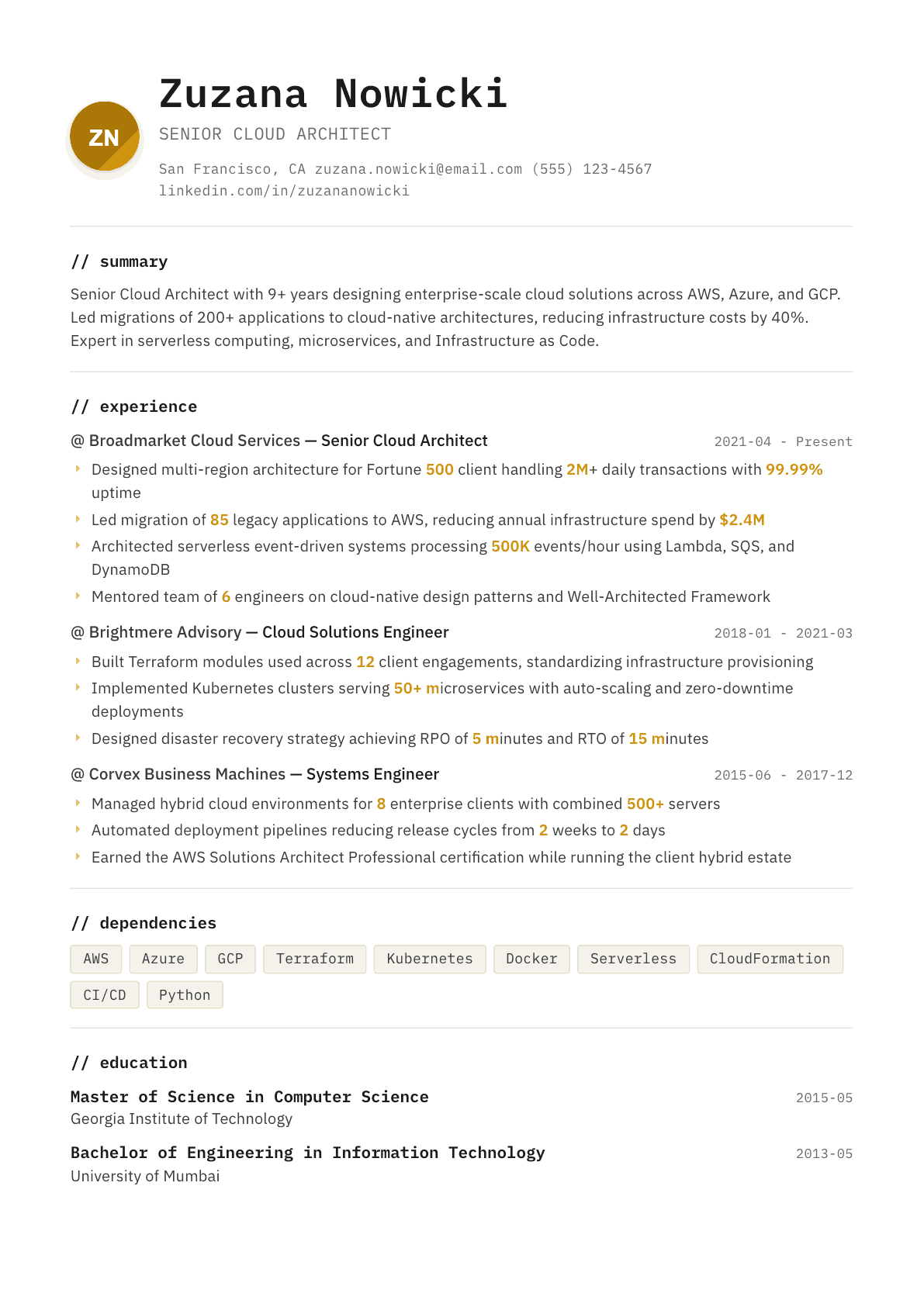
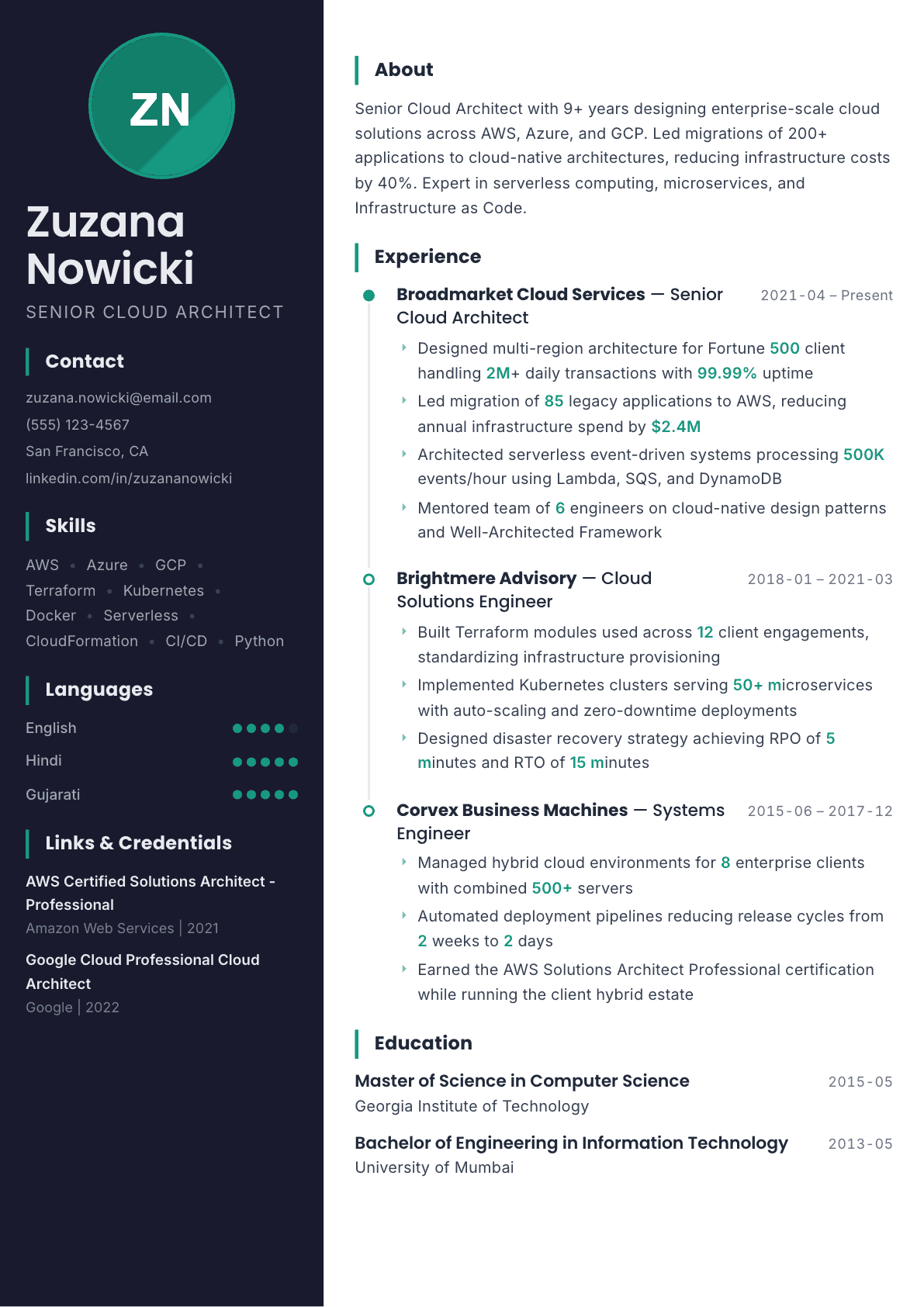
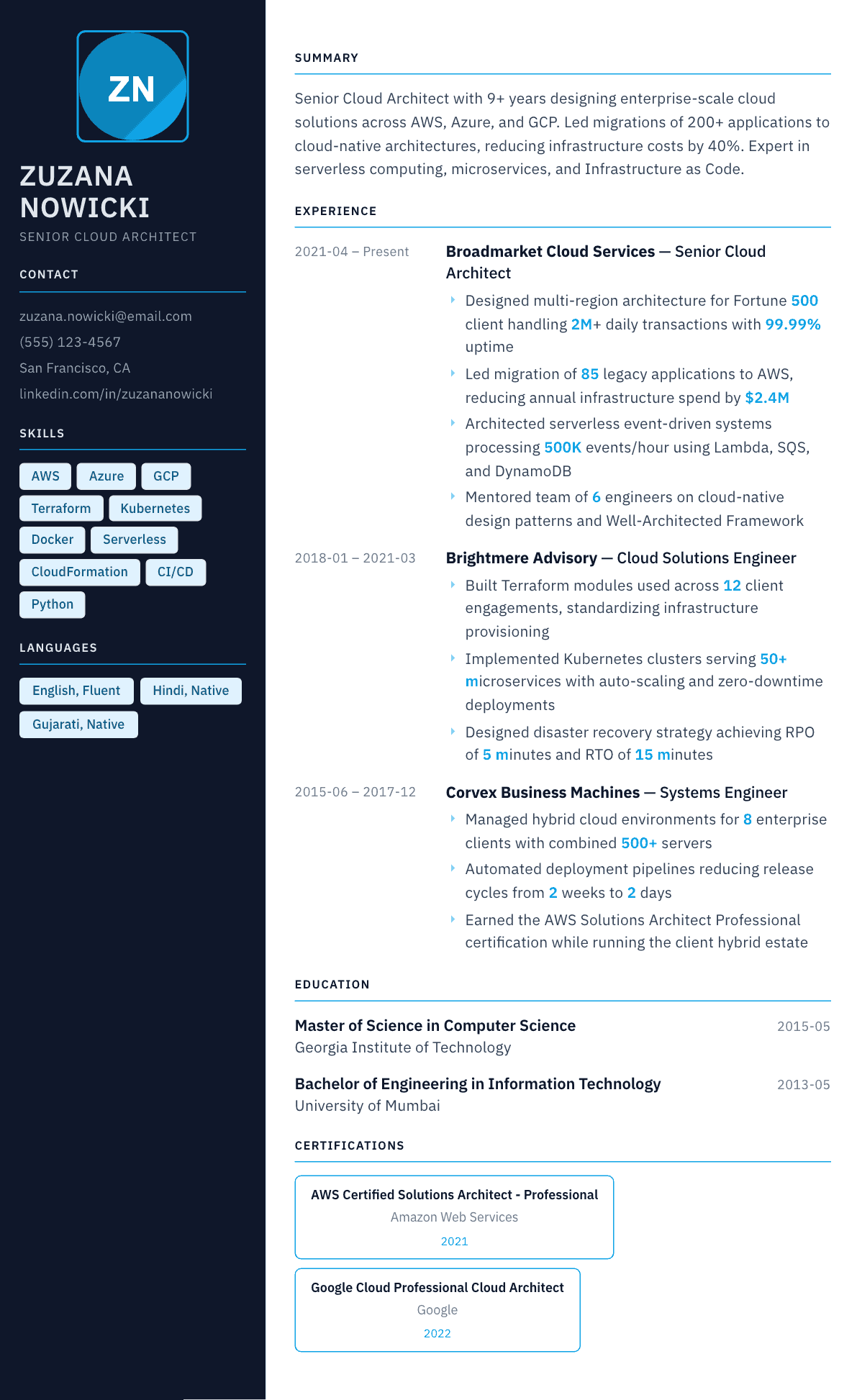
Example Cloud Architect summary
Cloud architect, 9 years, AWS Solutions Architect Professional and Google Cloud Professional Architect. Moved 85 legacy applications into AWS for one client and took $2.4M a year out of the run rate, and now owns the landing zone, Terraform modules and disaster recovery design behind a multi-region platform at 99.99% availability.
Skills to list on a Cloud Architect resume
- AWS
- Azure
- GCP
- Terraform
- Kubernetes
- Docker
- Serverless
- Microservices
- CloudFormation
- Infrastructure as Code
- CI/CD
- Python
- Security
- Networking
- Cost Optimization
What actually gets this resume read
- Name the platform, the certification level and the date, because an expired associate certificate reads very differently from a current professional one.
- Give each migration a before and after: number of applications, the pattern used for each (rehost, replatform, refactor), downtime taken and the change in monthly spend.
- Show the design artifacts you own, whether reference architectures, Well-Architected reviews, landing zone standards or architecture decision records.
- Be honest about depth per cloud. State which platform you design in daily and which you have only reviewed, since interviewers test the second one.
- Cover the guardrails as well as the build: identity model, network segmentation, key management, and how you stopped cost from drifting after handover.
How to write a cloud architect resume
A cloud architect resume is read as a design document about you. The hiring panel is usually a director of engineering plus a principal architect, and they are trying to work out one thing: have you owned a landing zone, a migration or a platform end to end, or have you assembled services under someone else design. Those two profiles look identical on a skills list and completely different in the experience section.
The difference shows in scope words. Accounts and subscriptions governed, workloads migrated, regions and availability zones, network topology, identity model, cost baseline. An architect who names the landing zone structure, the connectivity pattern and the guardrails is describing decisions. An architect who lists twelve managed services is describing a menu.
This guide covers what to put in each section, three summaries at the levels panels recognize, before-and-after bullets, and the questions engineers ask when they move from building infrastructure to designing it.
Format: two pages, with certifications visible above the fold
Two pages is normal and expected for a cloud architect, because the role only exists after several years of infrastructure work. Reverse chronological, one column, and no diagrams inside the document. Save the architecture diagrams for the portfolio you bring to the panel.
Cloud certifications carry real weight in this hire, partly because partner status at consultancies depends on them. Put a certifications line in the header area or immediately under the summary rather than at the end of page two.
- Header: name, title, location, email, LinkedIn, and the certifications in short form.
- Order: summary, certifications, core platforms, experience, selected architectures, education.
- A selected architectures block of three engagements is worth more than a longer skills list.
Summary: the platform, the estate size, and the kind of problem you solve
Three lines. Name the primary cloud and the secondary, the size of the estate you have governed in accounts or subscriptions, the workload type, and the outcome you are known for: a data center exit, a regulated landing zone, a multi-region resilience design, a cost reset.
Avoid the words scalable, secure and robust unless the next clause proves them. Every architect claims all three. Naming the recovery objective you designed to, or the compliance regime the design had to satisfy, proves them in the same number of words.
Experience: decisions, constraints, and what the design had to survive
Under each job title, give the environment in one line: the cloud, the number of accounts or subscriptions, the workload profile, and the regulatory context if there is one. Then bullets that each contain a decision and its constraint. A hub-and-spoke network with a transit gateway because the estate had to reach on-premises over a private circuit. A multi-account structure because the security team required blast-radius isolation per environment.
Include the migration mechanics where you have them: the wave plan, the discovery tooling, the rehost versus replatform split, the cutover and the rollback. Migrations are the bulk of cloud architecture work and panels probe them hard.
Add cost. An architect who has never had to defend a bill has not finished the job. Say what you changed: reserved capacity or savings plans, right-sizing, storage tiering, moving a chatty workload into the same availability zone, killing an over-provisioned cluster.
Governance and security: the part junior architects leave out
Panels test this section hardest because it is where a good design becomes an operable one. Name the identity model you designed: federated single sign-on, role assumption boundaries, permission boundaries or management group policy. Name the guardrails: service control policies, Azure Policy, organization policy constraints, and how drift was detected.
Then name the delivery method. Infrastructure as code in Terraform or Bicep or CloudFormation, module ownership, environment promotion, and the pipeline that applies it. An architect who hands over a design without a pipeline has handed over a slide.
Skills and keywords: platform first, patterns second
Group by platform rather than throwing every service into one line. Under AWS, Azure and GCP, list the services you have actually designed with. Then a second group for the cross-cutting practice: infrastructure as code, container orchestration, event-driven architecture, disaster recovery, network design, FinOps.
The words a screener searches for in this field are the ones in the posting: landing zone, well-architected review, migration, hybrid connectivity, disaster recovery, cost optimization, zero trust. Use each once in prose where you did the work, and once in the skills block.
Cloud Architect resume summary examples
Moving up from infrastructure engineering
Infrastructure engineer with 5 years on AWS moving into architecture. Designed and coded the Terraform landing zone for a 12-account organization, set the network and identity baseline, and led the replatform of 30 workloads out of a colocation facility ahead of the lease end.
Five years architecting
Cloud architect with 5 years designing AWS and Azure estates for regulated financial services. Owns a 60-subscription landing zone, a hub-and-spoke network over ExpressRoute, and the disaster recovery design meeting a 4-hour recovery time objective across two regions.
Principal or lead architect
Principal cloud architect with 12 years, currently accountable for the target architecture of a multi-cloud estate spanning 200 accounts and 3 business units. Led a data center exit of 400 workloads, cut the annual run rate 34%, and chairs the architecture review board.
Work experience bullets: before and after
Before: Designed scalable and secure cloud architecture on AWS.
After: Designed the multi-account landing zone for 42 accounts: organizational units by environment, service control policies blocking unapproved regions, centralized logging into a security account, and a transit gateway hub for on-premises connectivity.
Four concrete design elements replace three adjectives that every architect resume already claims.
Before: Led cloud migration for the company.
After: Led the migration of 180 workloads from two data centers to Azure in 9 waves, running discovery with Azure Migrate, replatforming 40 databases to managed instances and rehosting the rest, with a tested rollback at every cutover.
Wave count, tooling and the rehost versus replatform split show a real migration rather than a slogan.
Before: Reduced cloud costs significantly.
After: Cut the monthly compute bill 29% by right-sizing 300 instances against 90 days of utilization data, moving batch work to spot capacity, and committing steady-state usage to a savings plan reviewed quarterly.
The method makes the saving credible and shows it was engineered, not a one-off discount.
Before: Implemented infrastructure as code.
After: Replaced click-built environments with 24 reusable Terraform modules, a two-stage plan and apply pipeline with policy checks, and drift detection that raised a ticket within an hour of a manual change.
Module count, pipeline gates and drift detection describe a platform other teams can use, not a personal script.
Before: Responsible for cloud security and compliance.
After: Designed the identity model for 3 business units: federated single sign-on, permission boundaries on all delegated admin roles, and quarterly access reviews that closed the audit finding raised against the previous estate.
A named audit outcome turns a general responsibility into evidence the design held up under review.
Hard skills
- AWS solution design
- Microsoft Azure solution design
- Google Cloud solution design
- Landing zone and account structure
- Terraform and Bicep
- Hybrid and multi-region networking
- Identity and access design
- Kubernetes platform design
- Event-driven and serverless patterns
- Disaster recovery and business continuity
- Cloud cost management
- Well-architected reviews
- Container and virtual machine migration
- Policy as code
Soft skills
- Written design documentation
- Facilitating architecture review
- Stakeholder negotiation
- Mentoring platform engineers
- Explaining trade-offs to non-technical leaders
- Vendor management
Certifications worth listing
- AWS Certified Solutions Architect Professional (Amazon Web Services)
- Microsoft Certified: Azure Solutions Architect Expert (Microsoft)
- Professional Cloud Architect (Google Cloud)
- Certified Kubernetes Administrator (Cloud Native Computing Foundation)
- HashiCorp Certified: Terraform Associate (HashiCorp)
- TOGAF Enterprise Architecture Certification (The Open Group)
Mistakes that cost cloud architect candidates the interview
- Listing every managed service in the catalog. A panel reads a long service list as exposure, not ownership.
- Writing the resume as a builder when applying as an architect. If every bullet is a task you executed, nothing shows you set direction.
- Leaving out estate size. Governing 4 accounts and governing 200 are different jobs and the reader cannot tell them apart without the number.
- Claiming multi-cloud on the strength of one platform plus a training course. Panels ask a design question on the second cloud immediately.
- Skipping cost entirely, which signals you have never owned the bill or defended it to a finance partner.
- Burying the certifications on page two when partner-status recruiters filter on them first.
- Embedding an architecture diagram in the document, which parsers turn into nothing and reviewers cannot read at resume scale.
Cloud Architect resume questions
How many pages should a cloud architect resume be?
Two pages. The role requires enough history that one page forces you to cut the estate details a panel needs, and a third page never gets read. Keep page one to the summary, certifications and the current two roles.
Which cloud certifications matter most for an architect role?
The professional or expert tier architect certification for your primary platform is the one screeners filter on. Add a Terraform or Kubernetes credential if your work is platform heavy. Associate-level certifications add little once you have architect experience.
How do I move from DevOps engineer to cloud architect on paper?
Rewrite your bullets around decisions rather than tasks. Instead of the pipeline you built, describe the environment topology and promotion model you chose and why, then add any landing zone, network or identity design you contributed to.
Should I list every project I have worked on?
No. Pick three engagements for a selected architectures section and give each two lines: the constraint, the design, the outcome. A short list of well-described designs reads as senior; a long list of project names reads as a timesheet.
Is multi-cloud experience worth claiming if one platform is much stronger?
Yes, if you state the split honestly. Write the primary platform first with depth, then a shorter line saying what you have actually delivered on the second. Overstating it is caught in the first design question of the interview.
Related resume examples
- DevOps Engineer Resume example
- Solutions Architect Resume example
- Infrastructure Engineer Resume example
- Cloud Engineer Resume example
- Platform Engineer Resume example
- AWS Engineer Resume example