Platform Engineer Resume Examples: the lines they read
Engineer a Platform Engineer Resume That Scales
By Mustafa Tarabya, founder of CVBooster · Published · Updated
Create a compelling platform engineer resume highlighting your expertise in internal developer platforms, Kubernetes, CI/CD, and infrastructure automation.
Sample resumes for a platform engineer
The same platform engineer content laid out in three CVBooster templates, so you can see what the finished document looks like before you write a word.
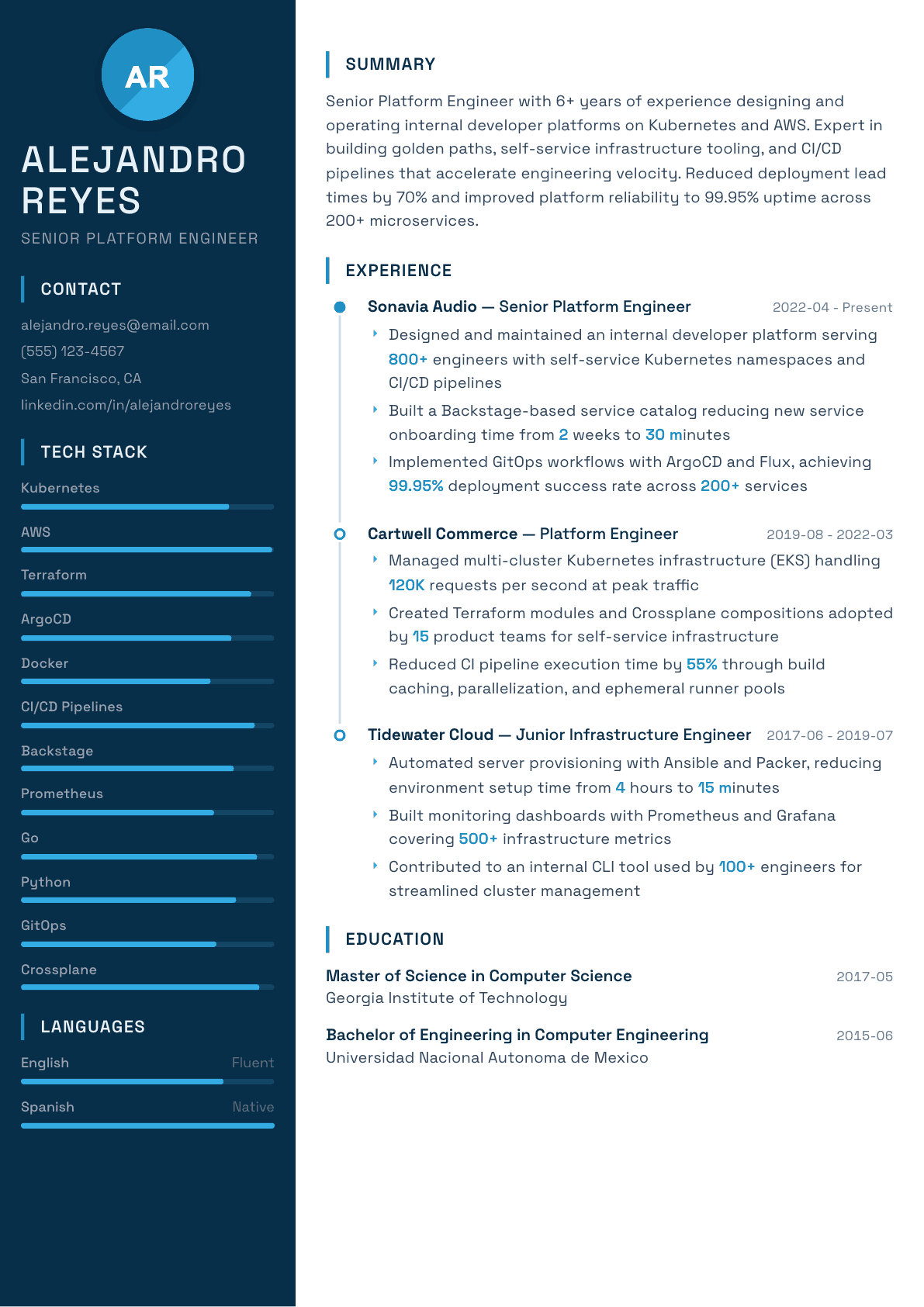
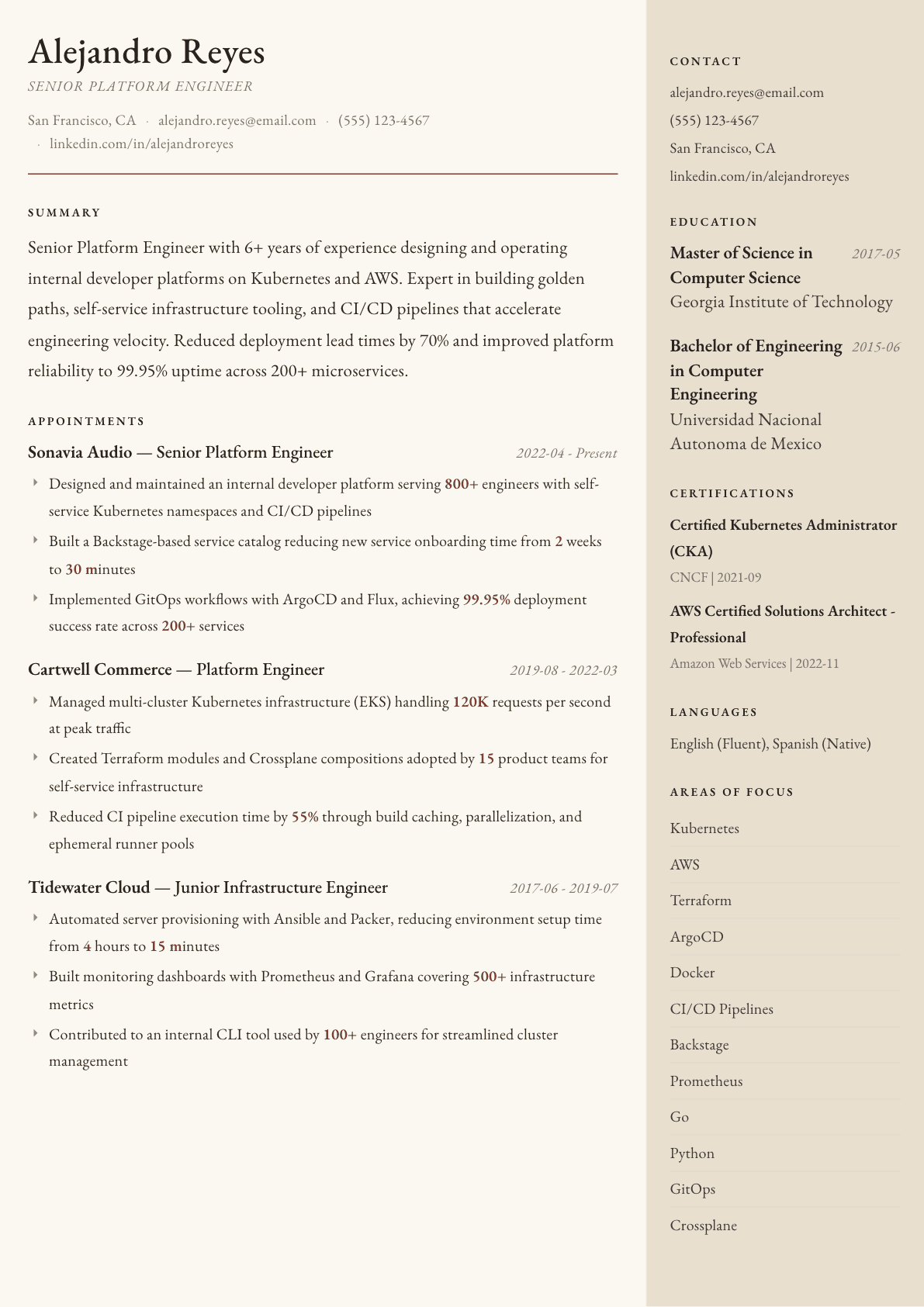
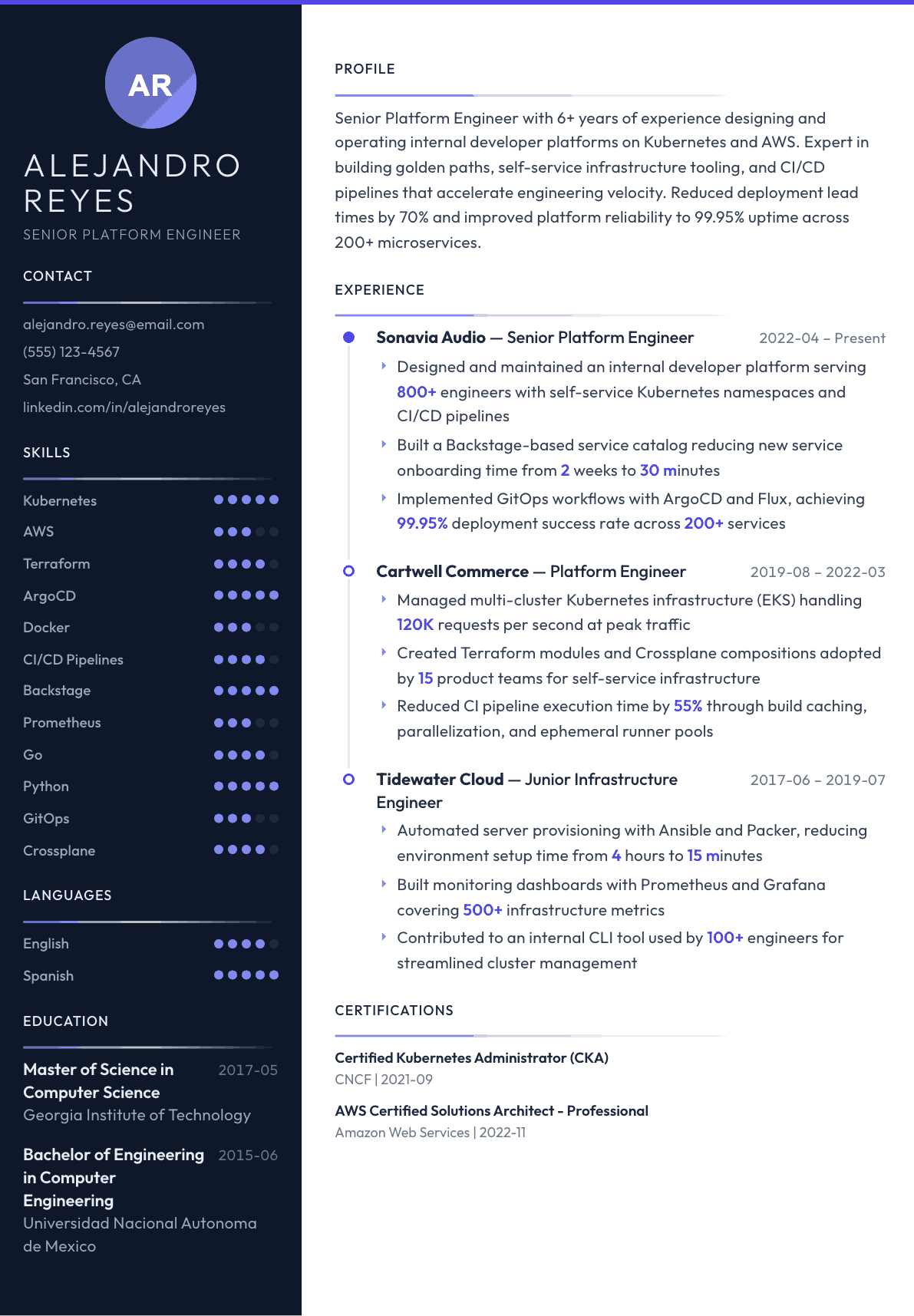
Example Platform Engineer summary
Senior Platform Engineer with 6 years of experience building internal developer platforms on Kubernetes and AWS. Designed self-service tooling and golden paths adopted by 800+ engineers, reducing service onboarding from 2 weeks to 30 minutes. Expert in GitOps, Terraform, and Backstage with a track record of 99.95% platform uptime.
Skills to list on a Platform Engineer resume
- Kubernetes
- AWS/GCP/Azure
- Terraform
- ArgoCD/Flux
- Docker
- CI/CD Pipelines
- Backstage
- Prometheus & Grafana
- Go
- Python
- GitOps
- Crossplane
What actually gets this resume read
- Emphasize developer experience improvements: onboarding time, deployment frequency, and self-service adoption rates.
- List specific CNCF tools and platforms: Kubernetes, ArgoCD, Crossplane, Backstage, Prometheus.
- Quantify scale: number of engineers served, services managed, or requests handled per second.
- Highlight IaC expertise with Terraform, Pulumi, or CDK and mention module reuse across teams.
- Show how you reduced toil and improved engineering velocity with golden paths and paved roads.
How to write a platform engineer resume
Platform engineering is judged by a customer who is unusual: other engineers inside the same company. That changes what a resume has to prove. A hiring manager is not asking whether you can run Kubernetes, because dozens of candidates can. She is asking whether the engineers who used what you built chose to use it, or worked around it. Adoption is the metric that distinguishes a platform engineer from an infrastructure engineer with a Kubernetes cluster.
The second question is scope. Platform work spans the container runtime, the delivery pipeline, the developer portal, the environment provisioning path, secrets, observability defaults and the on-call experience. Very few people own all of it. Say which parts you owned, which you operated but did not design, and how many engineers depended on the result.
This guide covers how to write about a paved road, which numbers a platform manager trusts, how to describe reliability work honestly, and how to avoid the most common failure on these resumes: a list of cloud native tools with no evidence that anyone benefited from them.
Format: platform profile before the tool list
Reverse-chronological, one page under six years, two beyond it. Under the summary put a platform profile block: engineers served, services running on the platform, clusters and environments, cloud provider, and the delivery model such as GitOps with pull based reconciliation. Those five facts frame everything a reader will interpret afterwards.
Resist the temptation to open with a wall of logos. A list of thirty tools reads as a person who has installed things. The reader wants to know which of those you operated at a size where the failure modes appear, and that only shows through the profile block and the bullets.
- Header: name, title, city, email, and a repository profile if you have public infrastructure code or operators.
- Order: summary, platform profile, experience, skills grouped by layer, certifications, education.
- State whether the platform was internal-facing, customer-facing or both, since the constraints are different.
- Say whether you carried the pager for the platform, because that changes how a manager reads every reliability claim.
Summary: who you served, what you built, what it replaced
Name the population of engineers you served and the size of the estate. Then the single most valuable thing you built: a self-service provisioning path, a service catalog and templates, a deployment pipeline anyone can use without asking you, or a migration that took teams off snowflake infrastructure.
Close with what it replaced, because platform value is always measured against the previous manual path. A ticket queue you eliminated, a two week onboarding that became an afternoon, or a set of hand-maintained environments that became reproducible.
Experience: golden paths, not tool installations
Write each major piece of platform work as a path a developer walks. What a team had to do before, what they do now, and what the platform does on their behalf. A new service that starts from a template, gets a repository, a pipeline, a namespace, a database, an alerting default and a dashboard without a human ticket is a story every platform manager recognizes and wants.
Then the infrastructure underneath: cluster topology, node pools and autoscaling, multi-tenancy and namespace isolation, network policy, admission control with policy engines such as OPA Gatekeeper or Kyverno, secret delivery through an external secrets operator, and the ingress and service mesh choices. Say which of these you designed rather than inherited.
Cover the delivery layer explicitly. Continuous integration runners and caching, build times, artifact management, progressive delivery with canary or blue green, rollback behavior and how a failed release is detected. Deployment frequency and change failure rate are the language platform teams speak, so use them where they are true.
Adoption and reliability: the two numbers that matter
Adoption first. Percentage of services on the platform, number of teams onboarded, how many services were created from the template in a quarter, and how many teams still run their own bespoke pipeline. A platform with low adoption is a strong signal, and being honest about a migration still in progress reads better than implying completeness.
Then reliability, described the way a platform team measures it. Availability of the platform control plane rather than of the applications, error budget policy, mean time to restore, and how many production incidents traced back to the platform itself. Include the toil you removed, measured in engineer hours or in tickets that stopped arriving.
- Engineers served and services onboarded, with the fraction of the estate that is not yet migrated.
- Time from a new service idea to a running deployment in production.
- Deployment frequency and change failure rate, before and after.
- Toil removed: recurring tickets, manual approvals or provisioning steps that no longer exist.
Skills: infrastructure, delivery, developer experience, observability
Group into four buckets rather than one list. Infrastructure covers Kubernetes, the cloud provider, Terraform or Pulumi, Crossplane and cluster add-ons. Delivery covers the continuous integration system, ArgoCD or Flux, Helm and Kustomize, artifact registries and progressive delivery tools. Developer experience covers Backstage or a custom portal, service templates, command line tooling and documentation. Observability covers Prometheus, Grafana, OpenTelemetry, log pipelines and alert routing.
Name the language you write real tooling in. Go and Python dominate this field, and a platform engineer who has written a Kubernetes controller, an operator or a well used internal command line tool should say so plainly, because it separates builders from configurers.
Platform Engineer resume summary examples
Moving into platform work
Infrastructure engineer with two years automating provisioning with Ansible and Terraform, now running a three cluster Kubernetes estate for 40 engineers. Built Helm chart templates and a Prometheus alerting baseline, and looking for a dedicated platform team role.
Five years in
Platform engineer serving 200 engineers across 90 services on EKS. Built a Backstage catalog and service templates that take a new service from repository to production deployment in under an hour, and moved delivery to ArgoCD with automated rollback on failed health checks.
Staff platform engineer
Staff platform engineer with nine years, owning an internal developer platform used by 800 engineers and 400 services. Set the multi-tenant cluster and policy architecture, drove adoption from 30% to 92% of the estate over two years, and leads a team of five with a defined error budget policy.
Work experience bullets: before and after
Before: Managed Kubernetes clusters for the engineering team.
After: Operated eight multi-tenant EKS clusters across three environments for 200 engineers, with namespace isolation, Kyverno admission policy, cluster autoscaling and a documented upgrade path run quarterly with no application downtime.
Tenancy model, policy enforcement and a repeatable upgrade cadence are the parts that show real operational ownership.
Before: Built internal developer tools.
After: Built a service scaffolding path in Backstage that provisions the repository, pipeline, namespace, database, dashboard and alert defaults from one form, cutting new service setup from two weeks of tickets to 30 minutes.
It describes the whole developer journey and the manual process it replaced, which is what platform value actually looks like.
Before: Implemented CI/CD pipelines.
After: Moved 90 services to GitOps delivery with ArgoCD and Kustomize overlays, adding automated rollback on failed health checks, which took deployment frequency from weekly to 40 releases a day with a 3% change failure rate.
Delivery metrics before and after are the language a platform manager already uses to run her team.
Before: Wrote Terraform modules for infrastructure.
After: Wrote versioned Terraform modules for networking, databases and queues, adopted by 15 product teams, replacing copied configuration with reviewed defaults and removing 60 provisioning tickets a quarter from the platform queue.
Module adoption and the ticket volume that disappeared prove the modules were used, not just written.
Before: Improved platform reliability.
After: Introduced an error budget policy with control plane availability targets, cut mean time to restore from 90 minutes to 18 through runbooks and alert routing, and traced every platform-caused incident in a monthly review.
Naming the reliability practice and the restore time gives a manager something to compare against her own numbers.
Hard skills
- Kubernetes and cluster operations
- AWS, GCP or Azure
- Terraform and Pulumi
- Crossplane
- ArgoCD and Flux (GitOps)
- Helm and Kustomize
- Backstage and developer portals
- Policy as code (OPA Gatekeeper, Kyverno)
- Prometheus, Grafana and OpenTelemetry
- CI systems (GitHub Actions, GitLab CI, Buildkite)
- Go
- Python
- Container image build and supply chain security
- Secrets management (Vault, external secrets)
Soft skills
- Treating internal engineers as customers
- Driving adoption without mandate
- Writing documentation people actually read
- Prioritizing between platform features and toil
- Incident review facilitation
Certifications worth listing
- Certified Kubernetes Administrator (CKA) (Cloud Native Computing Foundation)
- Certified Kubernetes Application Developer (CKAD) (Cloud Native Computing Foundation)
- Certified Kubernetes Security Specialist (CKS) (Cloud Native Computing Foundation)
- HashiCorp Certified: Terraform Associate (HashiCorp)
- AWS Certified Solutions Architect - Professional (Amazon Web Services)
Mistakes that cost platform engineer candidates the interview
- Listing cloud native tools with no adoption evidence, which reads as a person who installed software rather than ran a platform.
- Claiming a platform serves the whole company when several teams still run their own pipelines, a claim that collapses in the first interview question.
- Writing only about infrastructure and never about the developer experience, which makes you an infrastructure engineer applying to a platform team.
- Omitting whether you carried the pager, since every reliability claim is read differently once that is known.
- Presenting a tool migration as an outcome, when the outcome is what changed for the engineers using it.
- Leaving out the language you build in, so the reader cannot tell whether you write controllers and tooling or only configure charts.
Platform Engineer resume questions
What is the difference between a platform engineer and a DevOps engineer on a resume?
A DevOps resume is usually organized around pipelines and infrastructure for specific applications. A platform resume is organized around a product used by internal engineers, with adoption, self-service and paved roads as the outcomes. Same tools, different framing, and the framing is what gets you the platform interview.
How do I show platform adoption when the migration is unfinished?
State the fraction migrated and the trend, then explain the blockers you tackled and the ones you did not reach. Honest partial adoption with a plan reads as a real practitioner, while implied completeness reads as a claim someone will check with two follow-up questions.
Do I need Kubernetes experience to be a platform engineer?
Nearly every posting expects it, though the substance is what matters: multi-tenancy, upgrades, resource governance, admission policy and debugging a failing workload. A candidate who has operated serverless or virtual machine based platforms can compete by describing the same responsibilities in that context.
Should I list every CNCF tool I have used?
No. Pick the ones you ran in production long enough to hit their failure modes, and let the bullets show depth. A short list you can defend beats a long list where two questions expose that half of it came from a weekend proof of concept.
How do I move from systems administration into platform engineering?
Rewrite your work as a product for engineers: the self-service you enabled, the tickets you removed, the templates others reused. Add infrastructure as code and a version controlled delivery path, and put any internal tooling you wrote near the top, since building is the main gap hiring managers look for.
Related resume examples
- DevOps Engineer Resume example
- Infrastructure Engineer Resume example
- Cloud Security Engineer Resume example
- Cloud Architect Resume example
- Site Reliability Engineer Resume example
- Cloud Engineer Resume example