Complaints Resolution Officer Resume Examples: free score
Turn Complaints into Loyalty with a Complaints Resolution Officer Resume
By Mustafa Tarabya, founder of CVBooster · Published · Updated
Build a complaints resolution officer resume showcasing your de-escalation expertise, regulatory compliance, and ability to transform dissatisfied customers into advocates.
Sample resumes for a complaints resolution officer
The same complaints resolution officer content laid out in three CVBooster templates, so you can see what the finished document looks like before you write a word.
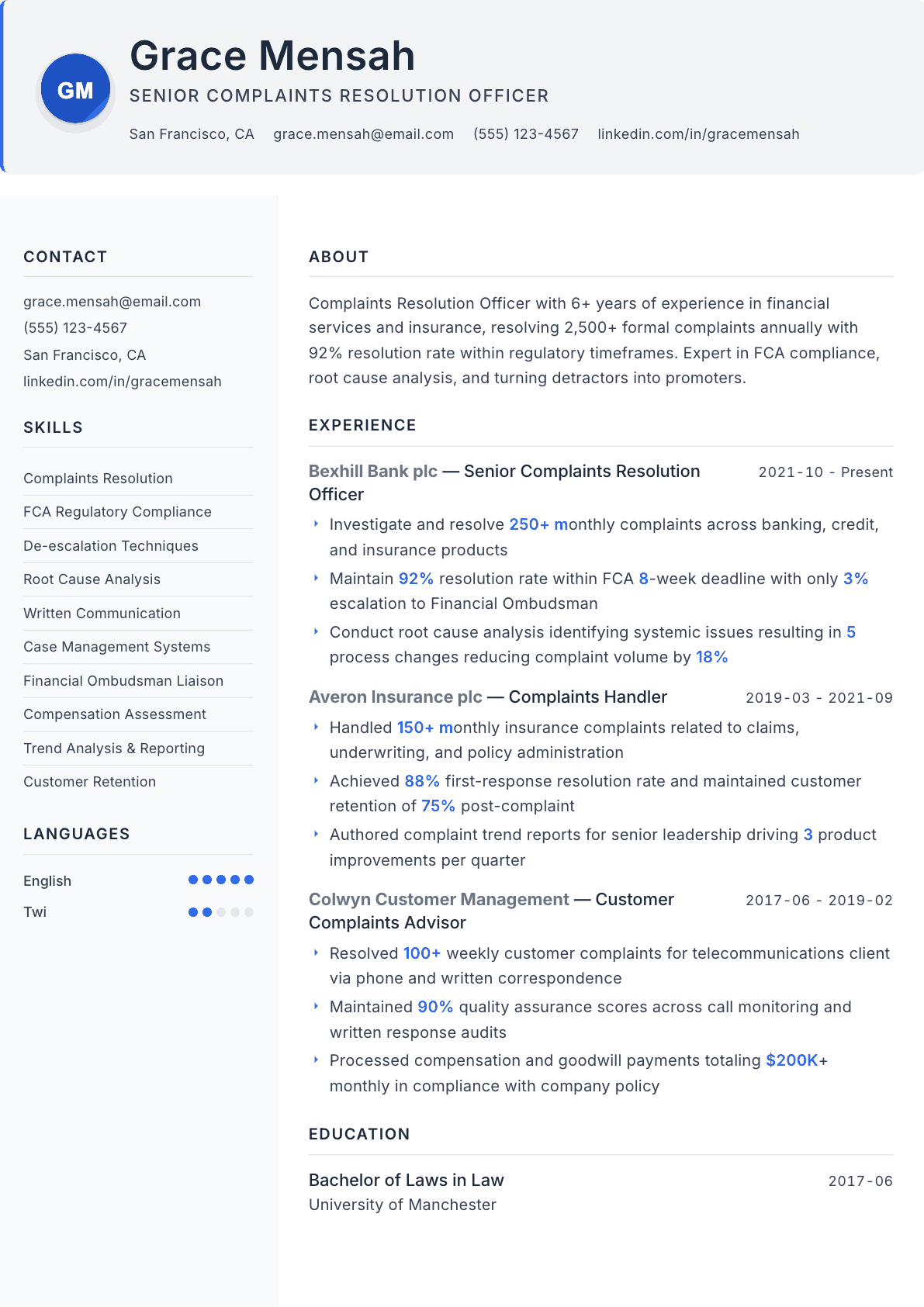
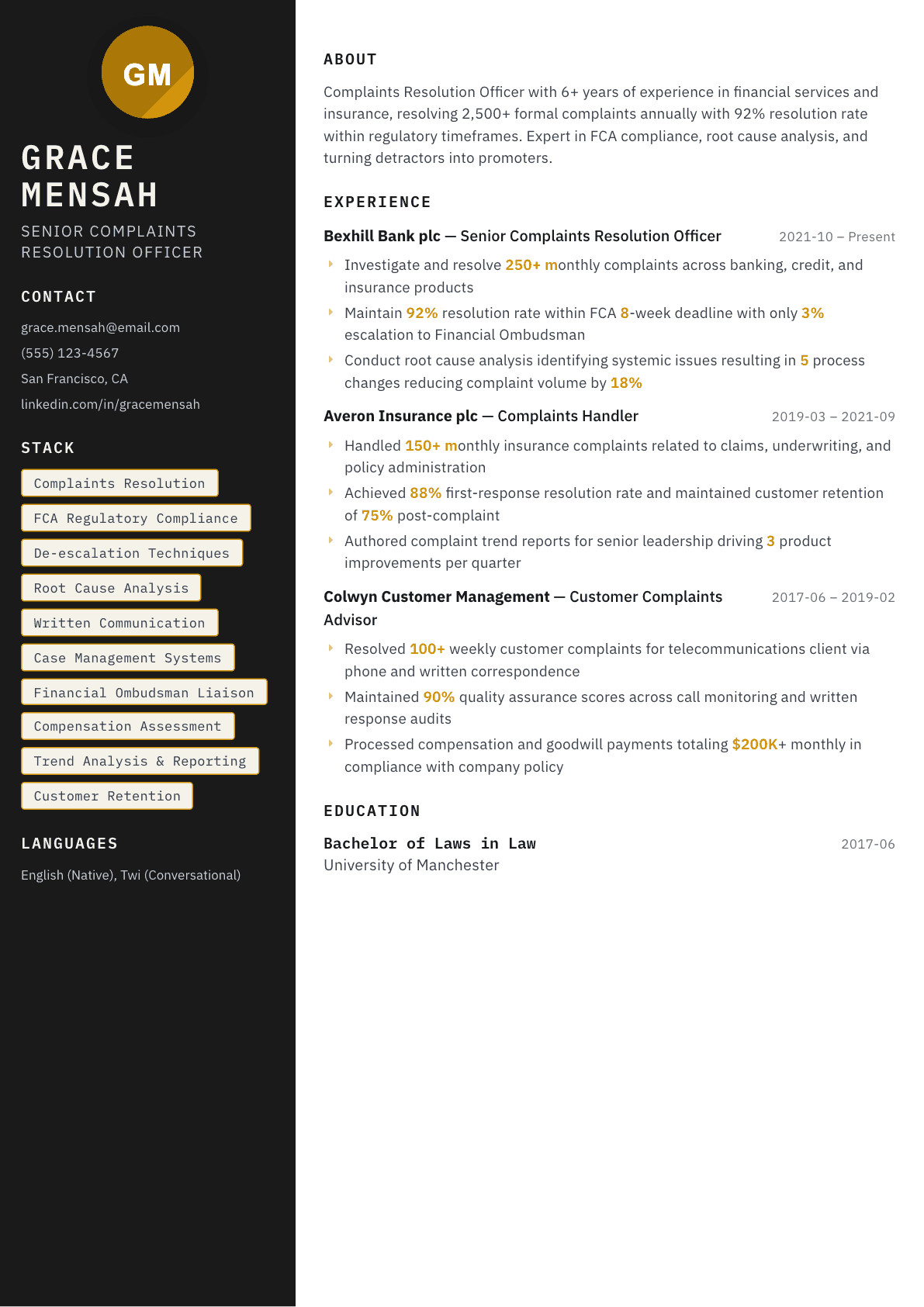
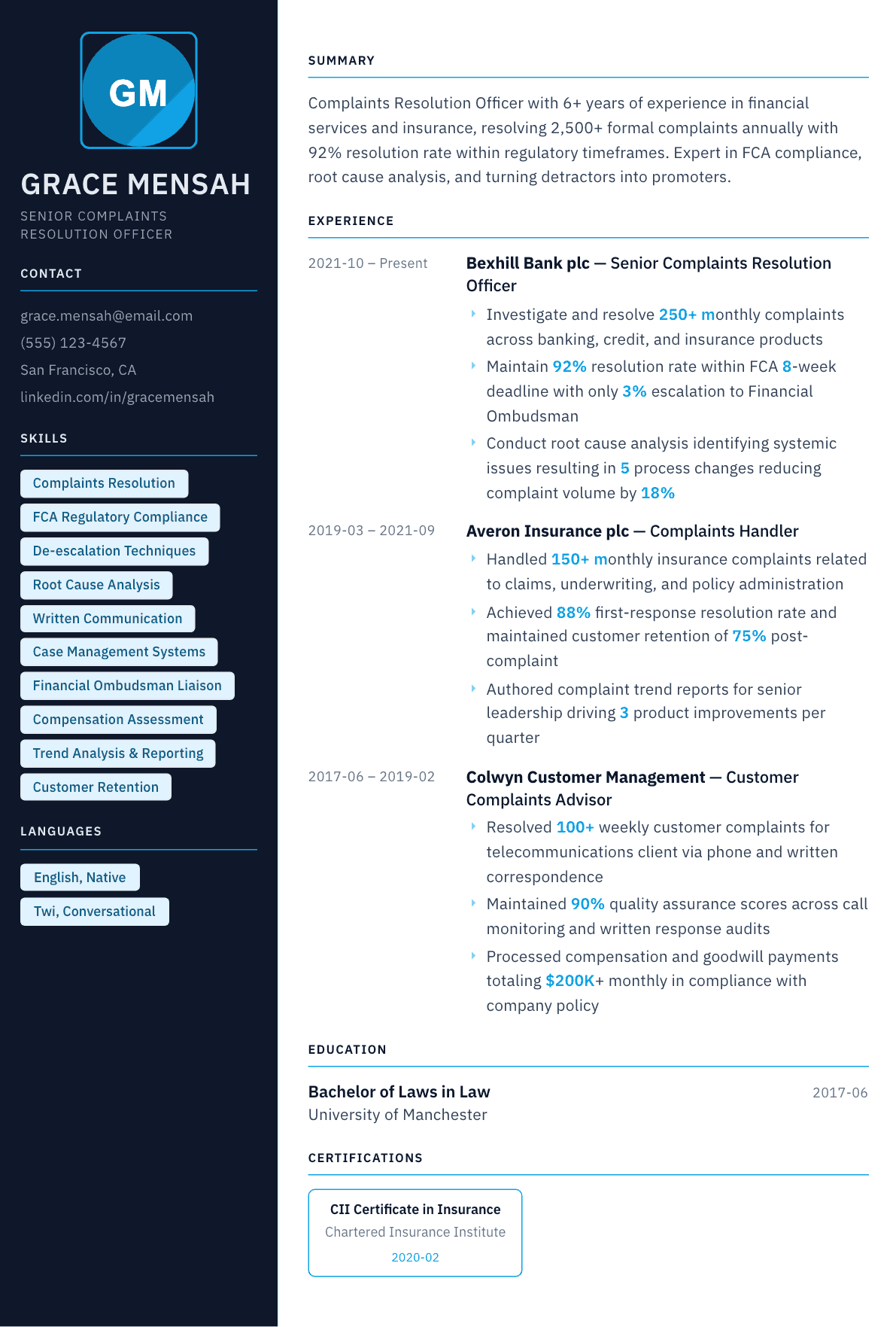
Example Complaints Resolution Officer summary
Complaints Resolution Officer, 6 years in banking and insurance, 2,500 formal complaints a year at 92% resolution inside the FCA 8-week deadline and 3% ombudsman escalation. Retains 75% of customers after a complaint and turns root cause findings into process changes.
Skills to list on a Complaints Resolution Officer resume
- Complaints Resolution
- Regulatory Compliance (FCA/CFPB)
- De-escalation & Mediation
- Root Cause Analysis
- Written Correspondence
- Case Management Systems
- Ombudsman/Regulator Liaison
- Compensation Assessment
- Trend Analysis & Reporting
- Customer Retention
- Quality Assurance
- Conflict Resolution
What actually gets this resume read
- Quantify complaint volumes and resolution rates to demonstrate your capacity and effectiveness.
- Highlight regulatory compliance. FCA, CFPB, or industry-specific regulations are critical.
- Include escalation prevention metrics: percentage resolved before ombudsman or legal involvement.
- Show root cause analysis skills and how your findings led to systemic improvements.
- Emphasize customer retention after a complaint. Turning detractors into promoters is a valuable skill.
How to write a complaints resolution officer resume
A complaints resolution officer resume is read by someone who is accountable to a regulator. Before she considers your tone or your empathy, she checks whether you have worked inside statutory timeframes, whether you have written a final response that would survive review by an ombudsman, and whether you understand that a complaint is a legal record and not a difficult conversation.
That is the split most candidates miss. Complaint handling sits between customer service and compliance, and a resume written entirely from the service side reads as underqualified for a regulated desk. Name the framework you operated under, the deadline you worked to, the escalation route above you, and the proportion of your cases that went further.
This guide covers the structure a complaints posting expects, how to write about case volumes and outcomes without exposing anyone, three summaries from first complaints role to team lead, before-and-after bullets that show investigation rather than apology, and the questions complaint handlers ask when they move between sectors.
Format: regulated experience visible in the top third
One page under five years, two beyond that. The reader is scanning for a sector and a rulebook, so state both immediately. Financial services, insurance, utilities, telecommunications, healthcare and local government each run complaints under different obligations, and the sector noun tells her whether your experience transfers to her desk.
Under each job, open with a scope line: the products complained about, the monthly case volume, the complaint stage you handled, and the deadline you worked to. A first-line handler closing straightforward cases within days is doing a different job from an officer investigating a complaint that has already been rejected once.
- Header: name, location, phone, email, and any regulatory qualification after your name.
- Section order: summary, regulatory and sector experience, case handling experience, skills, education and qualifications.
- Say which stage you owned: first contact, formal investigation, final response, or ombudsman liaison.
Summary: sector, stage, volume, outcome
Four facts in three lines. The regulated sector, the complaint stage you handled, your monthly case load, and the outcome measure you were held to. Resolution within the deadline, upheld and rejected split, escalation rate to the ombudsman, or customer retention after resolution are all legitimate and all more useful than any adjective.
One caution about the upheld rate. A very low upheld rate is not automatically a good sign, because it can read as an officer who defends the firm rather than investigates. Present it alongside the escalation rate and how often the ombudsman agreed with your decision, which is the measure that actually proves your judgment.
Experience: investigate, decide, write, and fix the cause
Build the bullets around the four stages of a real complaint. Investigation, meaning what you pulled: call recordings, system notes, policy documents, transaction histories and statements from the staff involved. Decision, meaning the rules and the policy you applied and how you reached fair redress. Communication, meaning the final response letter you wrote and its clarity. And prevention, meaning what you sent back into the business.
Redress deserves its own bullet because it is where the role carries authority. Describe the type of remedy you were empowered to grant, whether that was correction of the account, a fee refund, compensation for distress and inconvenience, or a goodwill payment, and name your authority limit as a level rather than a figure.
Root cause work is what separates an officer from a handler. If you produced trend reporting, presented to a risk or conduct committee, or triggered a process change that reduced repeat complaints in a product line, that is your strongest bullet on the page. Say what the change was and what happened to the volume afterward.
Vulnerable customers are a live topic in every regulated complaints team. If you were trained to identify vulnerability and adjust the handling, say so and describe the adjustment rather than the training course.
Writing: the final response is your work sample
The single artifact this job produces is a written decision that a customer, a regulator and a court might all read. Employers know it and test it, usually with a written exercise at interview. So show the writing on the resume: the volume of final responses issued, the reading level you wrote to, and any template or letter library you rewrote.
Structure counts more than warmth. A defensible response summarizes the complaint accurately, sets out what was investigated, explains the decision against the relevant rule or contract term, states the redress, and gives the customer their onward escalation rights. If you have rebuilt letters around that structure, it is a bullet.
Qualifications, systems and the keyword pass
Sector qualifications matter more than a general degree here. Insurance and banking credentials, quality or root cause training, and mediation training all read as evidence that you treat this as a profession. List each with the awarding body.
Name the case management system you worked in, because complaints teams run on them: Salesforce, Pegasystems, Microsoft Dynamics, ServiceNow, Verint or an in-house workflow. Then mirror the posting vocabulary once each: complaint investigation, root cause analysis, regulatory deadlines, final response, redress, ombudsman referral, quality assurance and trend reporting.
Complaints Resolution Officer resume summary examples
First complaints role
Customer service advisor with two years in retail banking, currently handling 60 first-stage complaints monthly on account fees and payment errors within the 3-day summary resolution route. Trained in vulnerability identification and case note quality, and seeking a full complaints resolution officer position.
Four years in
Complaints resolution officer with four years in general insurance, investigating 90 formal complaints monthly on claims decisions, underwriting and policy administration. Issues final response letters within the 8-week deadline on 96% of cases, with an ombudsman overturn rate below the team average.
Complaints team lead
Complaints team lead with nine years across banking and insurance, currently managing 8 officers handling 700 cases monthly. Owns quality assurance sampling, ombudsman liaison and the quarterly root cause report to the conduct risk committee, and holds redress authority at the senior review level.
Work experience bullets: before and after
Before: Handled customer complaints by phone and email.
After: Investigated 85 formal complaints monthly across current accounts, credit cards and payment disputes, gathering call recordings, system notes and staff statements before issuing a written decision.
Naming the products and the evidence gathered turns call handling into a described investigation.
Before: Resolved complaints within required timeframes.
After: Issued final response letters within the 8-week regulatory deadline on 96% of cases, with an average case age of 19 days and no breaches reported to compliance in two consecutive quarters.
The deadline, the average age and the breach record together prove a regulated file was actually controlled.
Before: Identified issues and reported them to management.
After: Ran quarterly root cause analysis on 900 closed cases, identified a mis-set renewal notification as the driver of a complaint spike, and worked with operations on a fix that cut that complaint type by half.
A specific cause, the fix and the volume change show prevention rather than passive reporting.
Before: Offered compensation where appropriate.
After: Assessed redress on every upheld case, applying account corrections, fee refunds and distress and inconvenience awards within my delegated authority and referring larger settlements to senior review.
Describing the remedy types and the authority boundary shows judgment and an understanding of escalation.
Before: Dealt with complaints escalated to the ombudsman.
After: Prepared 40 business files for the ombudsman service, writing the case summary and evidence bundle, with the original decision upheld in the large majority of referrals.
The file preparation work and the outcome are the strongest available evidence that your decisions were sound.
Hard skills
- Regulated complaint investigation
- Final response letter writing
- Root cause analysis and trend reporting
- Redress and goodwill assessment
- Ombudsman file preparation
- Regulatory deadline management
- Case management systems
- Quality assurance sampling
- Vulnerable customer handling
- Policy and contract interpretation
- Evidence gathering from call recordings
- Complaints reporting to risk committees
Soft skills
- De-escalation
- Impartial judgment
- Plain-language writing
- Emotional resilience
- Questioning technique
- Confidentiality
Certifications worth listing
- Certificate in Insurance (Cert CII) (Chartered Insurance Institute)
- Certificate in Regulated Financial Services Operations (Chartered Institute for Securities and Investment)
- Certified Six Sigma Green Belt (CSSGB) (American Society for Quality)
- Certified Customer Experience Professional (CCXP) (Customer Experience Professionals Association)
Mistakes that cost complaints resolution officer candidates the interview
- Writing the resume as customer service and never naming the regulator, the rulebook or the deadline you worked to.
- Giving a resolution rate with no case volume beside it, which tells the reader nothing about the pressure you carried.
- Boasting about a very low upheld rate without the escalation and overturn figures that give it meaning.
- Leaving out the writing entirely, when the final response letter is the main product of the job.
- Describing empathy and patience in a skills list while showing no investigation method anywhere on the page.
- Including customer names, account numbers or case references in an example bullet.
- Omitting root cause and trend work, which is the difference between a complaint handler and a resolution officer.
Complaints Resolution Officer resume questions
How do I show complaints experience if I worked in an unregulated sector?
Lead with the investigation method, the case volume, the internal deadline you worked to and your written decisions. Then name any policy or contractual framework you applied, since a regulated employer is testing for discipline and structure more than for a specific rulebook.
Should I put my upheld rate on a complaints resume?
Only with context. Present it beside your escalation rate and how often an ombudsman or independent reviewer agreed with your decision, because an isolated upheld figure can be read as either sound judgment or an officer who protects the firm.
What does a complaints resolution officer resume need that a customer service resume does not?
The regulatory frame. Deadlines, final response letters, redress authority, escalation routes, quality sampling and root cause reporting are the parts that prove you can carry a case file that someone outside the company may later inspect.
How do I describe difficult cases without breaching confidentiality?
Describe the complaint type, the product and the outcome, never the person. A billing dispute on a home insurance renewal is specific enough to be credible and carries no identifying detail about the customer or the staff involved.
Is a law degree useful for a complaints resolution role?
It helps with contract interpretation and structured written reasoning, and hiring managers do notice it, but it is rarely required. Sector qualifications and demonstrated case handling under a real deadline usually outweigh the degree on the shortlist.
Related resume examples
- Customer Experience Director Resume example
- Call Center Manager Resume example
- Client Relations Manager Resume example
- Customer Retention Specialist Resume example
- Administrative Officer Resume example
- Scheduling Coordinator Resume example