Customer Retention Specialist Resume Examples: free score
Customer Retention Specialist Resume That Shows Saved Revenue
By Mustafa Tarabya, founder of CVBooster · Published · Updated
Customer retention specialist resume example with save rate, churn and win-back bullets, CRM keywords, and a guide to writing every section.
Sample resumes for a customer retention specialist
The same customer retention specialist content laid out in three CVBooster templates, so you can see what the finished document looks like before you write a word.
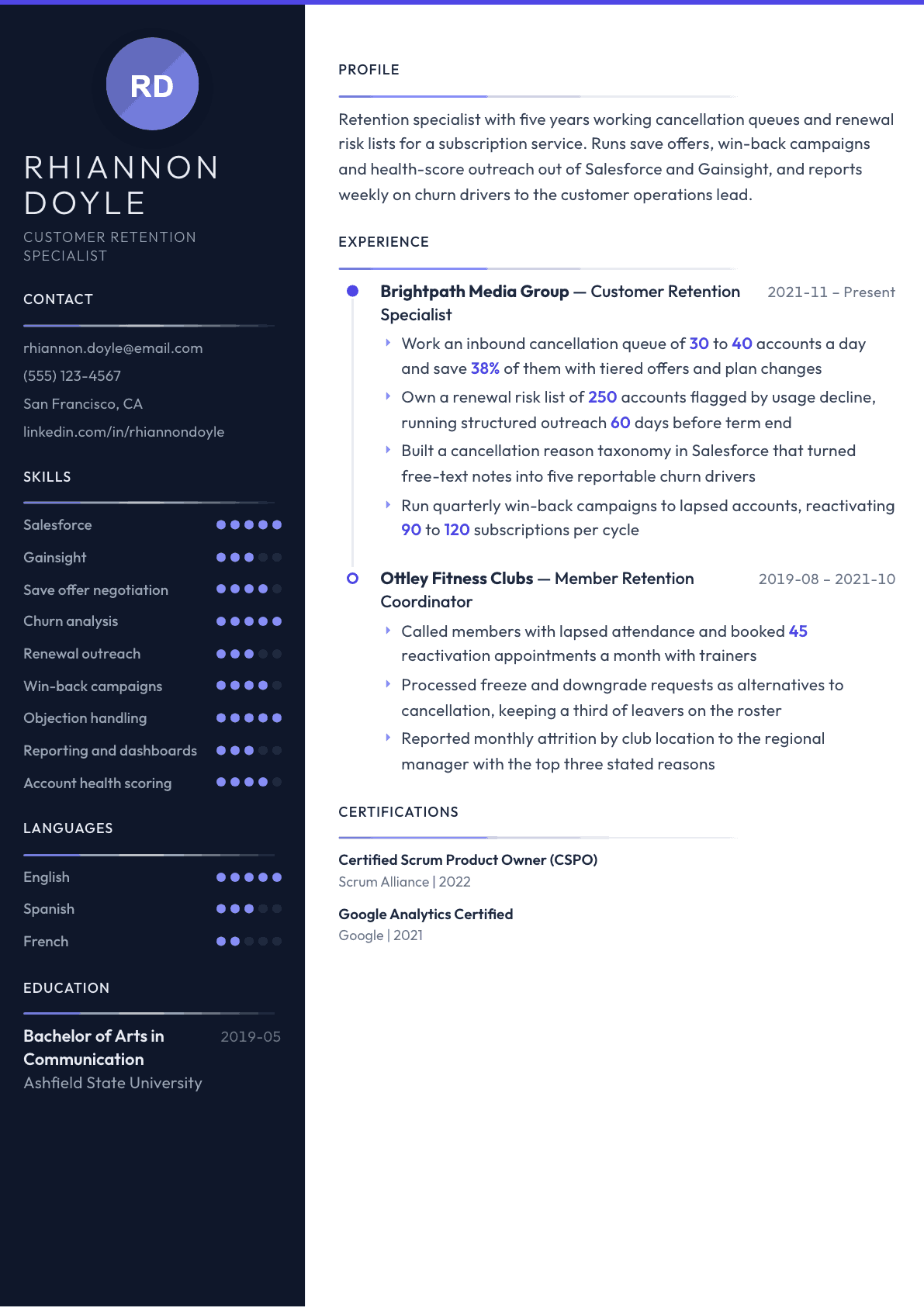
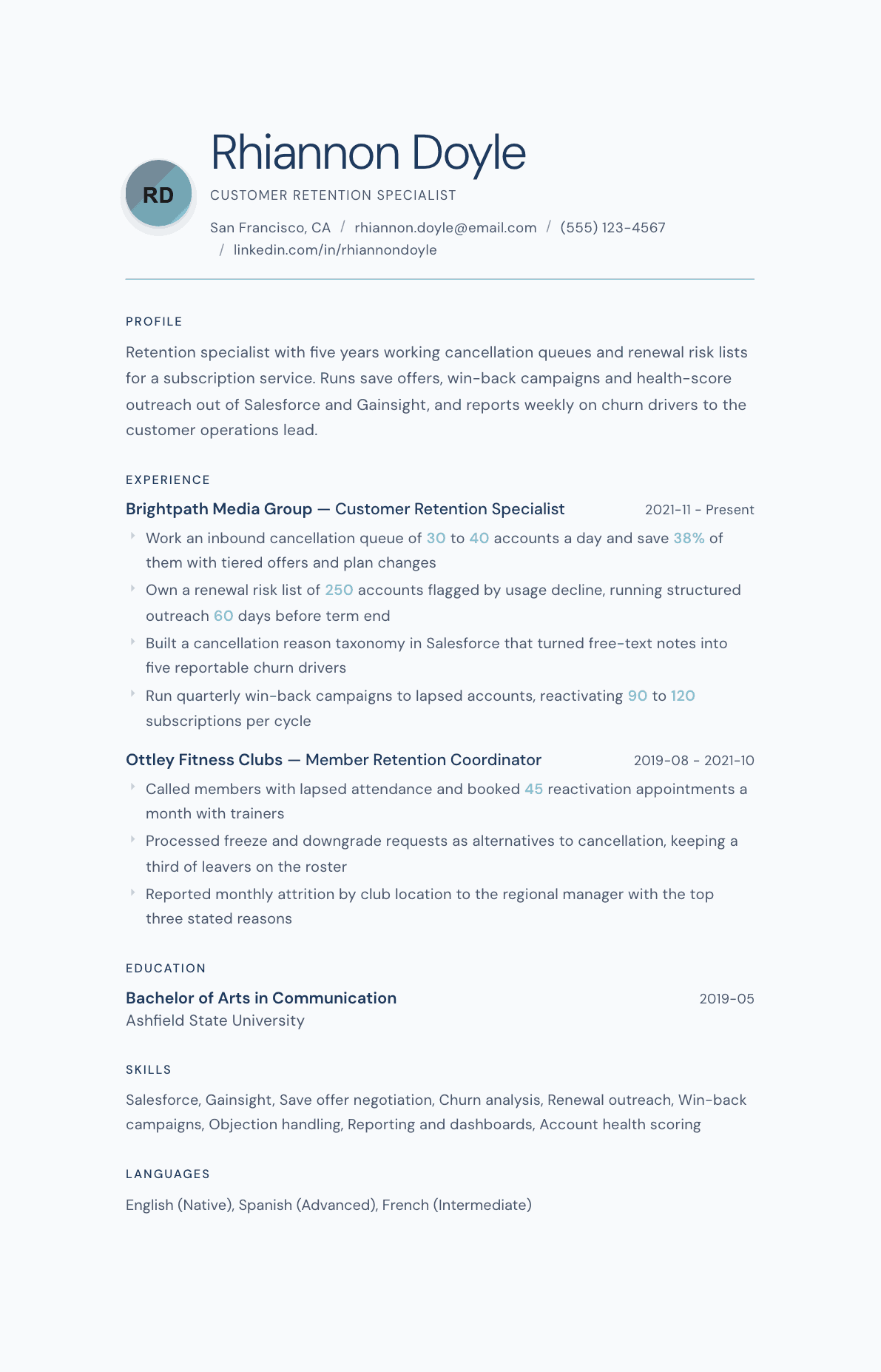
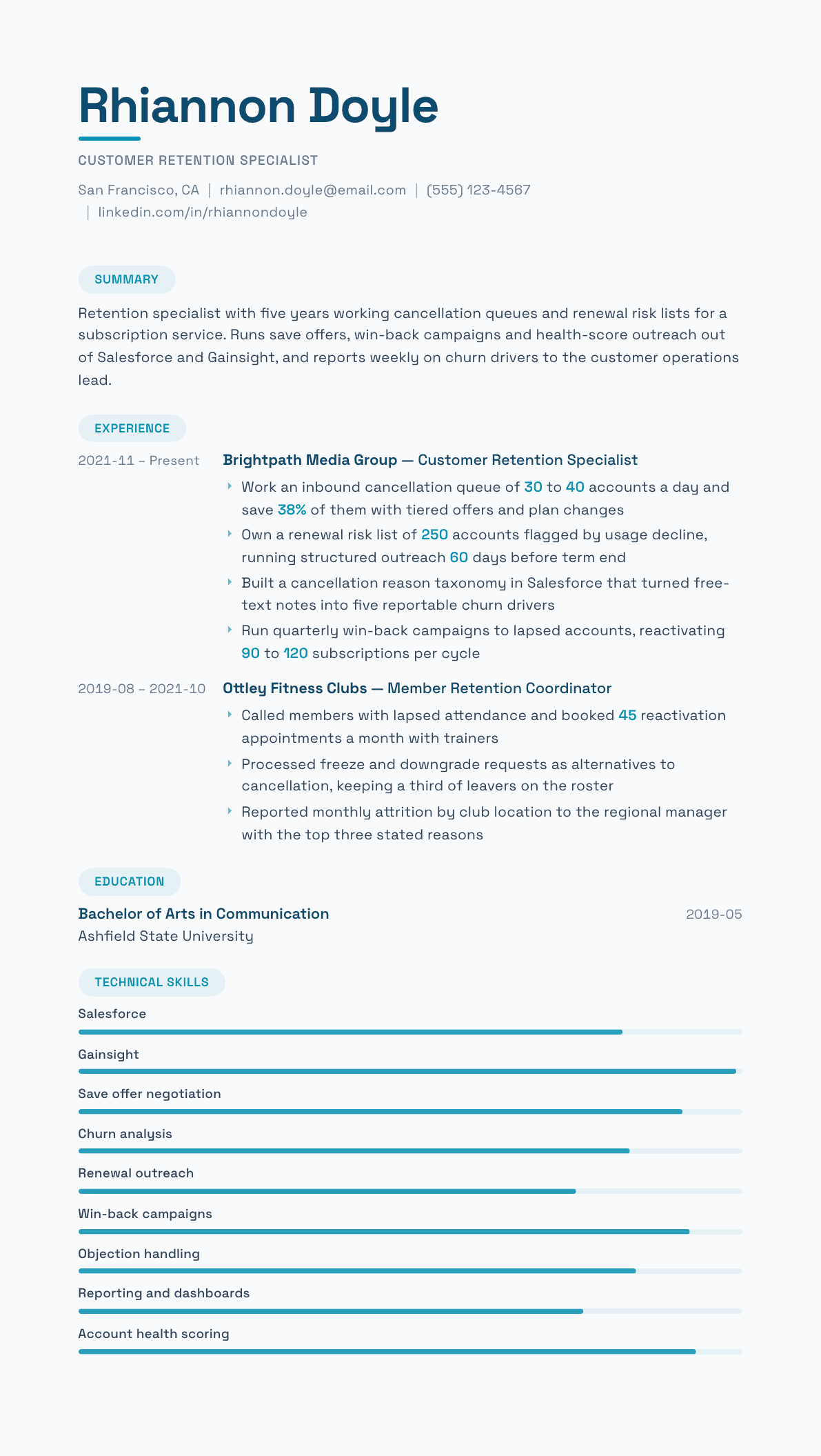
Example Customer Retention Specialist summary
Customer retention specialist with five years on cancellation queues and renewal risk lists for subscription businesses. Saves 38% of inbound cancellations with tiered offers and plan changes, owns a 250-account risk list driven by usage decline, and reactivates 90 to 120 lapsed subscriptions each win-back cycle. Built the cancellation reason taxonomy the operations team now reports churn from.
Skills to list on a Customer Retention Specialist resume
- Save offer negotiation
- Churn analysis
- Renewal management
- Win-back campaigns
- Salesforce
- HubSpot
- Gainsight
- Account health scoring
- Objection handling
- Cancellation queue management
- Voice of customer reporting
- Upgrade and downgrade offers
- Escalation handling
- Dashboard reporting
What actually gets this resume read
- Lead with a save rate on the cancellation queue, because that single number is what a retention manager benchmarks candidates against.
- Separate reactive saves from proactive renewal outreach, since the two workflows need different skills and often sit on different teams.
- Name the CRM and the customer health tool you worked in, such as Salesforce, HubSpot, Gainsight or Totango, in the skills section.
- Quantify win-back work in reactivated accounts per campaign rather than in vague statements about rebuilding lapsed relationships.
- Show that you turned cancellation reasons into reportable data, because retention teams are judged on diagnosis as much as on saves.
- Describe your offer authority, meaning the discounts, pauses and plan changes you could approve without a manager signature.
How to write a customer retention specialist resume
A customer retention specialist resume is judged on one number before anything else: the share of cancellations you saved. A retention manager reading applications already knows what their own queue converts at, and they are placing your figure next to it. If the number is missing, the reader assumes it was not good enough to print, and the file moves down the pile.
The second thing a retention lead looks for is whether you worked reactively, proactively, or both. Sitting on an inbound cancellation queue and talking a subscriber out of leaving is one skill. Owning a risk list built from declining usage and calling accounts 60 days before renewal is a different one, with different tooling and a different reporting rhythm. Many teams split the two, so a resume that blurs them makes the hiring manager guess.
This guide walks through the sections in the order a retention or customer operations manager reads them, with example summaries for a first retention role, a five-year specialist and a team lead, before-and-after bullets from save and win-back work, and the questions retention staff ask when writing.
Format: one page, the save rate above the fold
Reverse chronological, one page, single column. Put your save rate in the summary and repeat it in the first bullet of your most recent job. Retention hiring is numeric, and burying the headline figure in the third bullet of a second page is the most common self-inflicted wound on these resumes.
Add a short tools strip under the contact line naming the customer relationship system, the customer health or success platform, the billing or subscription system, and the dialer or outreach tool. Those four define the environment you can step into without a ramp.
- Header: name, city and state or "remote", phone, email.
- Sections in this order: summary, tools, experience, education, certifications.
- Career changers from sales or support lead with objection handling volume and any renewal or collections work.
Summary: business model, queue type, save rate, offer authority
Three lines. Name the business model, because saving a monthly consumer subscription is not the same job as saving an annual business contract. Then say which queues you worked, give the save rate and the volume behind it, and close with your offer authority: the discounts, pauses, downgrades and plan changes you could approve without a manager signature.
Offer authority is the detail almost every candidate omits and every retention manager cares about. It tells the reader how much judgment you were trusted with and how much margin you were allowed to spend to keep an account.
Experience: separate the reactive queue from the proactive list
Head each job with the employer, the product, the subscriber base and the queue you owned. A line such as "Inbound cancellation queue and a 250-account renewal risk list, consumer and small business subscriptions" makes the shape of the role obvious before the bullets start.
Then write the two workflows separately. For the reactive side: daily cancellation volume, save rate, the offer ladder you used, and the reasons you were saving against. For the proactive side: how the risk list was built, the outreach cadence relative to renewal date, and what happened to renewal rates on the accounts you touched. Add a win-back bullet with reactivations per campaign, and a diagnosis bullet if you turned cancellation reasons into something the business could report on.
Avoid the sentence about building strong relationships with customers. It is unmeasurable, it is on every application in the folder, and it displaces a number that would have earned you the interview.
Diagnosis: the part that separates a specialist from a save agent
Retention teams are judged on why customers leave as much as on how many stay. A specialist who converted free-text cancellation notes into a structured reason taxonomy, then reported the drivers weekly, is doing work the business cannot get from a script. That work also survives a change of employer, which is why it belongs high in the experience section.
Show the reporting rhythm and the audience. Weekly churn driver notes to a customer operations lead, a monthly attrition read by segment, or a quarterly voice of customer summary presented to product all tell the reader you were trusted outside the queue.
- Cancellation reason taxonomy: how it was built and what it replaced.
- Health scoring inputs you acted on, such as usage decline or support volume.
- Reporting cadence and who received it.
- A product or policy change that came out of your findings.
- Cohort or segment view, if you reported attrition by plan, tenure or location.
Skills and keywords: the exact stack, the exact motion
Name the platforms rather than the category. A team on a customer success platform filters for that platform by name, and a subscription business filters for its billing system. List the customer relationship system, the health or success tool, the billing or subscription platform, and the reporting surface where you built your dashboards.
Then mirror the motion language the posting uses: save offers, downgrade and pause alternatives, win-back campaigns, renewal outreach, churn drivers, escalation handling and voice of customer reporting. Use each phrase once where it is proven by a bullet rather than stacking them into a block at the foot of the page.
Customer Retention Specialist resume summary examples
First retention role
Customer support agent with two years on a subscription service line, moving into retention. Handled 40 inbound contacts a day including billing disputes and downgrade requests, kept a third of cancellation callers on a paused or reduced plan, and works daily in a customer relationship system and a billing platform.
Five years in
Customer retention specialist with five years on cancellation queues and renewal risk lists for subscription businesses. Saves 38% of inbound cancellations with tiered offers and plan changes, owns a 250-account risk list driven by usage decline, and reactivates 90 to 120 lapsed subscriptions each win-back cycle.
Retention team lead
Retention lead with eight years in subscription media and fitness, running a team of six on save queues and renewal outreach. Rebuilt the offer ladder and approval thresholds, introduced a churn driver taxonomy now used in the monthly business review, and lifted team save performance for three consecutive quarters.
Work experience bullets: before and after
Before: Handled cancellation requests from customers.
After: Worked an inbound cancellation queue of 30 to 40 accounts a day and saved 38% of them using a tiered offer ladder, plan downgrades and billing date changes.
Daily volume plus a save rate plus the tools you used gives the reader a number to benchmark against their own queue.
Before: Reached out to customers before their renewal date.
After: Owned a 250-account renewal risk list flagged by usage decline and support volume, running structured outreach starting 60 days before term end.
List size, the trigger behind it and the timing show a proactive motion rather than an occasional phone call.
Before: Ran win-back campaigns for lapsed customers.
After: Ran quarterly win-back campaigns to lapsed accounts using segmented offers by tenure and cancellation reason, reactivating 90 to 120 subscriptions per cycle.
Reactivations per cycle and the segmentation logic turn a campaign mention into a repeatable result.
Before: Tracked reasons customers were leaving.
After: Built a cancellation reason taxonomy that converted free-text agent notes into five reportable churn drivers, now used in the weekly customer operations review.
The taxonomy, the driver count and the audience show diagnosis work that outlasts any single save.
Before: Helped gym members who wanted to quit.
After: Called members with lapsed attendance, booked 45 reactivation appointments a month with trainers, and offered freeze and downgrade alternatives that kept a third of intended leavers on the roster.
An appointment count and a retained share replace a soft description with two measurable outcomes.
Hard skills
- Save offer negotiation
- Cancellation queue management
- Renewal outreach and cadence design
- Win-back campaign execution
- Churn driver analysis
- Account health scoring
- Salesforce
- HubSpot
- Gainsight
- Subscription billing systems
- Dashboard and attrition reporting
- Offer and discount authority management
- Voice of customer reporting
Soft skills
- Objection handling
- Listening for the real reason
- Composure with an angry subscriber
- Commercial judgment on what to concede
- Note discipline for reporting
- Coaching newer agents on the ladder
Certifications worth listing
- Salesforce Certified Administrator (Salesforce)
- Service Hub Software Certification (HubSpot Academy)
- Certified Customer Experience Professional (CCXP) (Customer Experience Professionals Association)
Mistakes that cost customer retention specialist candidates the interview
- Leaving the save rate off the resume, which a retention manager reads as a figure you did not want compared to theirs.
- Merging reactive save work and proactive renewal outreach into one blurred paragraph, so neither skill is provable.
- Naming no tools, which forces the reader to assume you worked from a spreadsheet and a phone.
- Reporting win-back work in campaigns run rather than in accounts reactivated per cycle.
- Omitting offer authority, so the reader cannot tell whether you exercised judgment or read from a fixed script.
- Claiming credit for a company-wide churn improvement rather than for the queue and accounts you personally owned.
Customer Retention Specialist resume questions
What is a good save rate to put on a retention resume?
Use your real one with the volume behind it, because targets vary enormously between consumer subscriptions and business contracts. A modest rate on a hard queue with the context explained beats an impressive rate that collapses when the interviewer asks how it was measured.
How is a retention specialist resume different from a customer success one?
Retention is measured on saves, renewals and reactivations against a defined queue or risk list. Customer success is measured on adoption, expansion and account outcomes over a longer arc. If you have done both, write to the posting and lead with the matching metric.
Should I include the offers I was allowed to give?
Yes. Naming your approval thresholds and the ladder you worked, such as pauses, downgrades, billing date changes and discount bands, shows how much commercial judgment you were trusted with. It is one of the strongest differentiators on a retention resume.
What if my company never tracked churn reasons?
Say what you did instead. Building a reason list yourself, tagging notes consistently, or summarizing patterns for your manager all count as diagnosis work, and describing the gap you filled reads better than inventing a reporting structure that did not exist.
Do I need a degree for a customer retention role?
Rarely. Most teams hire on queue performance, objection handling and tool fluency. A degree in communication, business or marketing helps for analyst and lead tracks, so list it, but keep your save and renewal numbers above it on the page.
Related resume examples
- Customer Success Manager Resume example
- Customer Onboarding Specialist Resume example
- Customer Service Representative Resume example
- Customer Support Specialist Resume example
- Customer Service Manager Resume example
- Complaints Resolution Officer Resume example