Construction Inspector Resume Examples: read this first
A Construction Inspector Resume That Shows What You Actually Verified
By Mustafa Tarabya, founder of CVBooster · Published · Updated
A construction inspector resume sample with daily report tips, the materials testing and code keywords agencies search for, and a section by section guide.
Sample resumes for a construction inspector
The same construction inspector content laid out in three CVBooster templates, so you can see what the finished document looks like before you write a word.
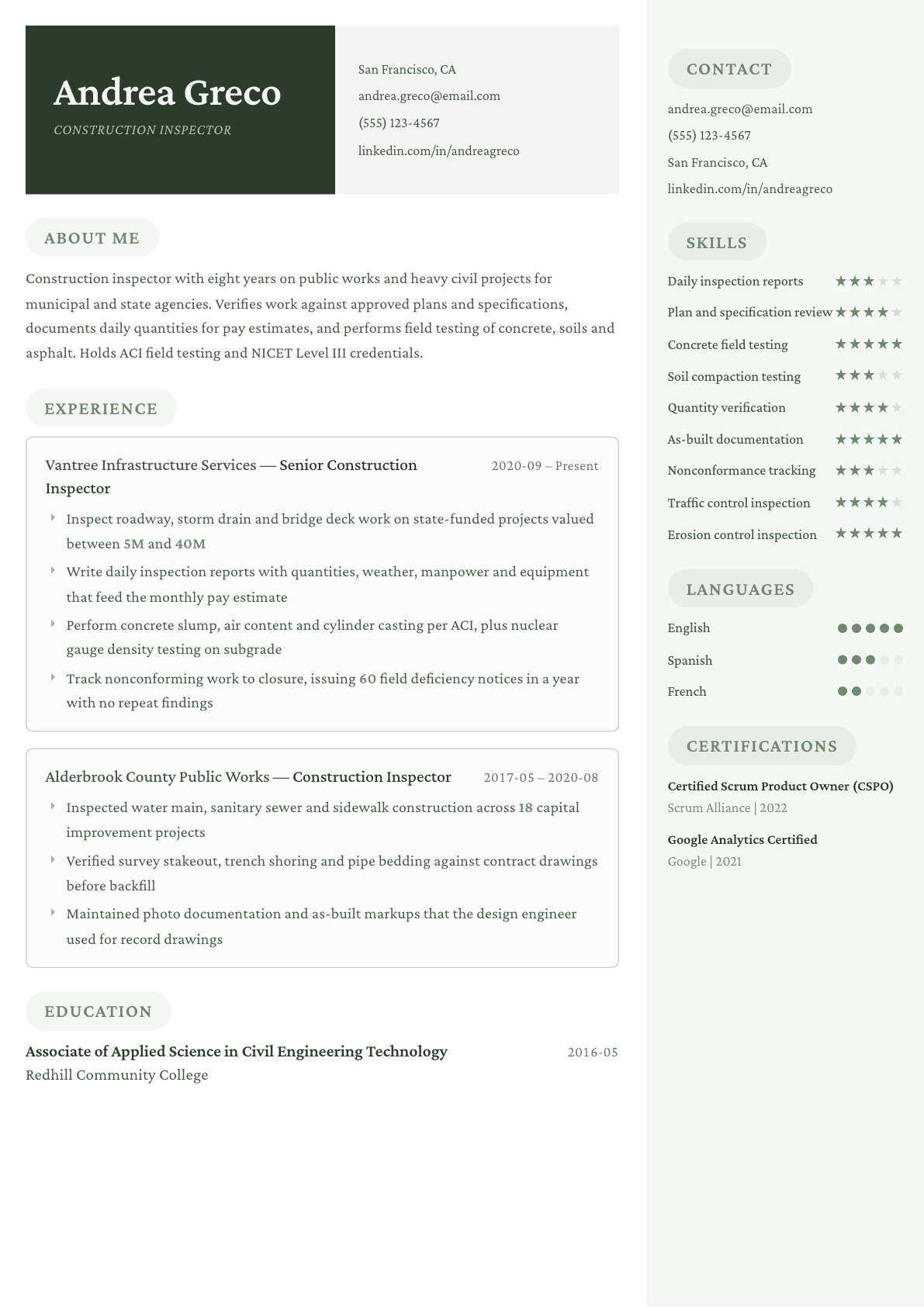
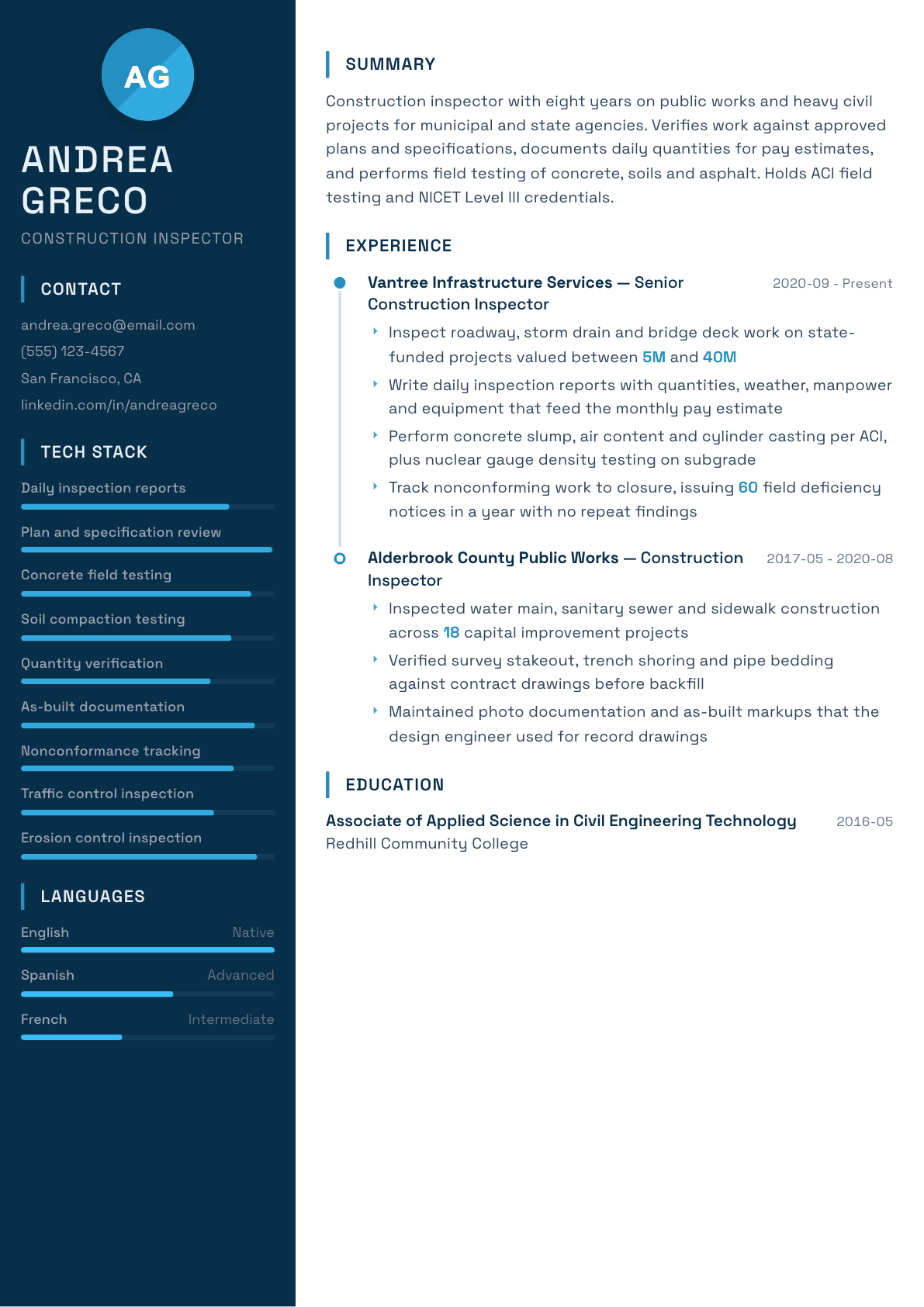
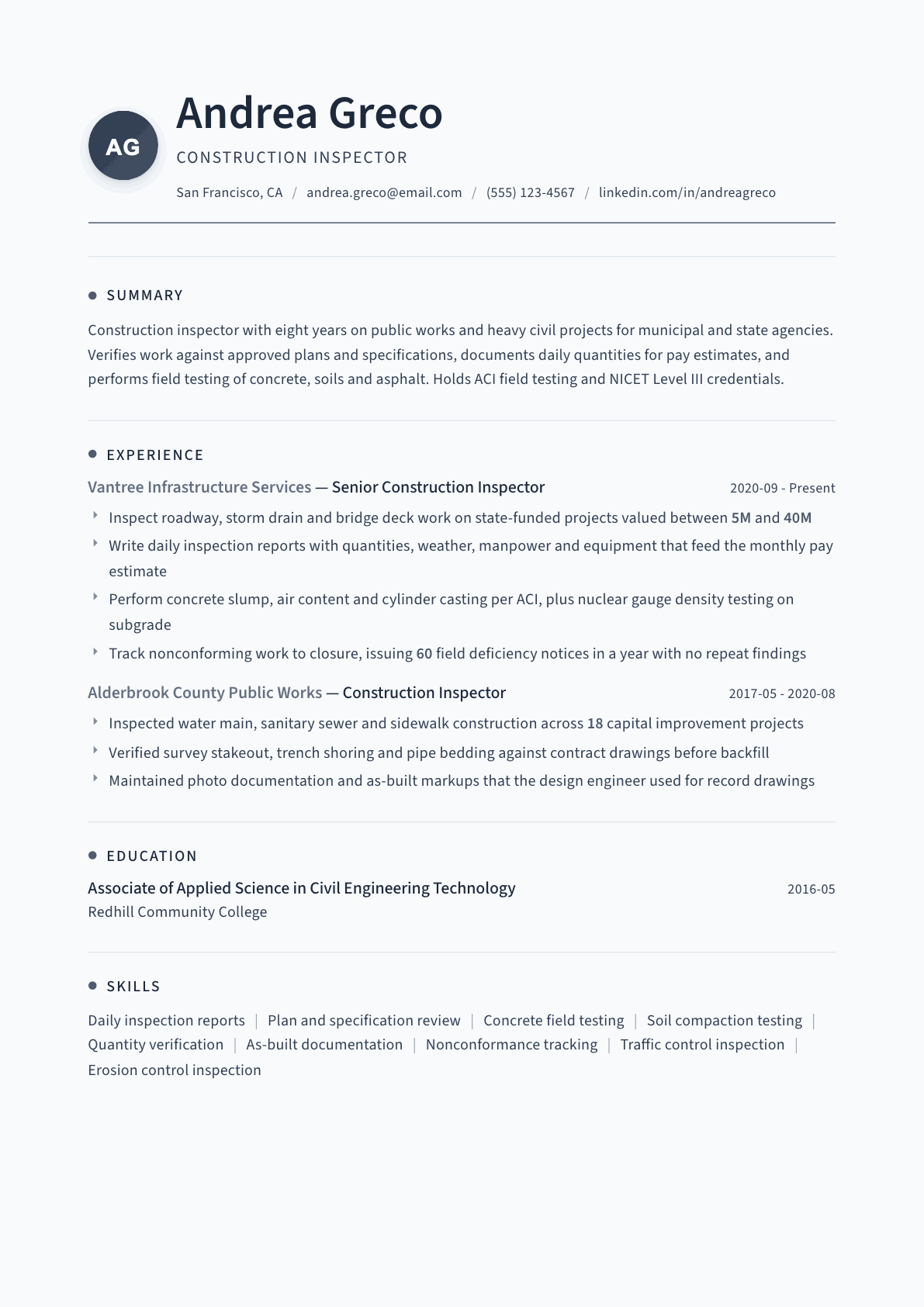
Example Construction Inspector summary
Construction inspector with eight years on municipal and state transportation projects, verifying roadway, utility and structural work against approved plans and specifications. Performs concrete, soils and asphalt field testing, casts cylinders to ACI procedure, and documents daily quantities that support the monthly pay estimate. Comfortable issuing field deficiency notices and tracking each one to a documented correction with the resident engineer.
Skills to list on a Construction Inspector resume
- Plan and specification review
- Daily inspection reports
- Quantity and pay estimate documentation
- ACI concrete field testing
- Nuclear density gauge testing
- Asphalt placement inspection
- Reinforcing steel inspection
- Trench safety and shoring review
- Erosion and sediment control
- Traffic control plan review
- As-built and record drawings
- Nonconformance reporting
- Submittal verification
- Survey stakeout checks
What actually gets this resume read
- Name the owner agency and the project type for every assignment, because public works inspection and private commercial inspection are judged differently.
- List the field tests you personally perform and the standard behind each one, ACI concrete testing or nuclear gauge density work.
- Show that your daily reports drive pay estimates, since quantity documentation is the part an agency resident engineer relies on.
- Give the dollar value and length of the projects you inspected, so a reader can size the scope you have carried alone.
- Put your ACI, NICET and ICC credentials near the top with the issuing body, because many inspection postings screen on those first.
- Describe how you handle nonconforming work, from field notice through corrective action, rather than saying you ensured quality.
How to write a construction inspector resume
A construction inspector is the owner's eyes on a job that somebody else is building. The resident engineer or agency hiring you needs to know that when you sign a daily report, the quantities are right, the work matched the approved plans, and any deviation was written down while the evidence was still visible. That trust is what the resume has to establish, and it is established with specifics, not with the word detail-oriented.
Most inspection postings are also credential gated. Agencies and their consultants filter on ACI field testing, NICET levels, welding inspection and state qualification lists before a human reads a word of prose. If those are buried on page two next to a hobby section, the resume stops there.
This guide walks through the sections in the order an inspection manager reads them: credentials, project history by owner and type, the tests you run yourself, and the documentation habits that make your reports usable months after the concrete has cured.
Format: credentials near the top, projects by owner
Put a licenses and certifications block directly under the summary, with the issuing body and the expiration for each. Then run reverse-chronological experience, and inside each employer list the projects by owner agency, type and value.
Inspection is a documentation profession, so the resume itself is read as a writing sample. Consistent dates, clean formatting and no vague ranges tell a resident engineer something about how your daily reports will look.
- Header: name, city and state, phone, email, and the certification letters you hold.
- Order: summary, certifications, experience with project detail, education, testing skills.
- Note union, agency qualification list or consultant approval status where it applies.
Summary: owner type, work type, and what you test
Say who you inspect for, a state transportation department, a city public works group, a transit authority or a private owner, and what kind of work, roadway, bridge, water and sewer, structural concrete or building envelope. Then name the field testing you personally perform.
The distinction between an inspector who observes and an inspector who tests matters, and stating it plainly avoids a wasted interview on either side.
Experience: reports, quantities and nonconforming work
The daily report is the core deliverable. Write a bullet that says what goes into yours: quantities placed, manpower and equipment on site, weather, delays, and photographs tied to station or grid location. Then connect it to money by explaining that those quantities support the monthly pay estimate, because that link is the reason an owner pays for an inspector at all.
The second cluster is verification. Say what you check before work is covered: subgrade preparation and compaction, reinforcing steel placement and cover, formwork, pipe bedding, welds, coating thickness. Include the specification or standard you check against, since that is what makes a finding defensible.
The third cluster is nonconformance. Describe how you raise a field deficiency, how corrective action is agreed, and how you verify the fix. An inspector who can describe that cycle calmly is worth more than one who describes it as catching mistakes.
- Quantities: how you measure, record and reconcile them against the contractor pay request.
- Testing: concrete slump, air and cylinders, soil density, asphalt cores, and who witnesses.
- Records: photo logs, as-built markups and the file you hand to the design team at closeout.
Testing and technical skills: cite the standard
List the field tests with the governing standard rather than as bare nouns. Concrete field testing to ACI procedure, soil density by nuclear gauge, asphalt sampling, and reinforcing steel verification against the placement drawings. If you hold a welding inspection credential, say what you inspect, structural connections or pipe, and to which welding code.
Equipment matters too. Naming the nuclear density gauge, the concrete air meter, the coating thickness gauge and the survey instrument you use tells a hiring manager which parts of the job you can cover the day you start.
Keywords in construction inspection postings
Agency and consultant postings repeat a narrow set of terms: daily inspection report, quantity verification, pay estimate, plan and specification compliance, materials testing, nonconformance report, as-built documentation, erosion and sediment control, traffic control inspection, and the owner name itself. Mirror the ones that are true of you, and use the owner language rather than a generic phrasing, because a state agency job description and a private developer job description are not written by the same people.
Construction Inspector resume summary examples
Field inspector, first role
Civil engineering technology graduate with a year of field inspection on municipal water main and sidewalk projects. Writes daily reports with quantities and photo documentation, performs concrete slump and air testing, and verifies trench bedding and compaction before backfill. ACI concrete field testing certified.
Five years in
Construction inspector with five years on state roadway and drainage projects between 5M and 40M. Documents daily quantities that support the monthly pay estimate, performs nuclear gauge density testing and concrete cylinder casting, and tracks field deficiency notices through verified correction with the resident engineer.
Lead inspector
Lead construction inspector with twelve years on bridge and transit work, supervising a team of four inspectors across three active contracts. Holds NICET Level III and welding inspection credentials, reviews quantity submittals before they reach the resident engineer, and mentors junior staff on report writing.
Work experience bullets: before and after
Before: Inspected construction work for compliance with plans.
After: Inspected roadway, storm drain and bridge deck work on state-funded contracts between 5M and 40M, verifying each phase against the approved plans and special provisions.
Naming the work types, the owner and the contract range shows what kind of inspection you have actually carried.
Before: Wrote daily reports.
After: Produced daily inspection reports covering placed quantities, manpower, equipment, weather and delays, and reconciled them monthly against the contractor pay request.
Tying the report to the pay request explains why the documentation matters to the owner.
Before: Did materials testing on site.
After: Performed concrete slump and air content testing and cast cylinders to ACI procedure, plus nuclear gauge density testing on subgrade and aggregate base.
Specific tests and a named procedure prove certification-level work rather than general observation.
Before: Reported problems to the engineer.
After: Issued 60 field deficiency notices in a year, agreed corrective action with the contractor superintendent, and verified every correction before the work was covered.
The full cycle from finding to verified fix is what an owner is buying, and the count makes it concrete.
Before: Kept project records.
After: Maintained a station-referenced photo log and as-built markup set that the design engineer used directly to produce record drawings at closeout.
Showing who consumed your records downstream proves the documentation was usable, not just filed.
Hard skills
- Plan and specification compliance review
- Daily inspection reporting
- Quantity measurement and pay estimate support
- Concrete field testing to ACI procedure
- Nuclear density gauge testing
- Asphalt placement and sampling
- Reinforcing steel and formwork verification
- Trench shoring and excavation review
- Erosion and sediment control inspection
- Traffic control plan verification
- As-built and record drawing markup
- Nonconformance reporting and closeout
Soft skills
- Impartial judgment
- Clear technical writing
- Contractor communication without escalation
- Consistency under repetition
- Standing firm on a finding
Certifications worth listing
- Concrete Field Testing Technician Grade I (American Concrete Institute)
- Construction Materials Testing certification (National Institute for Certification in Engineering Technologies)
- Certified Welding Inspector (CWI) (American Welding Society)
- OSHA 30-Hour Construction (OSHA Outreach Training Program)
- Certified Erosion, Sediment and Storm Water Inspector (CESSWI) (EnviroCert International)
Mistakes that cost construction inspector candidates the interview
- Burying ACI, NICET or welding credentials below the education section when agencies filter on them first.
- Writing that you ensured quality without naming a single test, standard or specification you checked against.
- Omitting the owner agency, which makes it impossible to tell public works experience from private developer work.
- Leaving out quantity documentation, the part of the job that feeds the pay estimate and justifies the position.
- Describing the contractor as an adversary, which reads badly to a resident engineer who needs a working jobsite.
- Forgetting expiration dates on certifications, so a recruiter has to call to find out whether yours are current.
Construction Inspector resume questions
What certifications matter most for a construction inspector?
Concrete field testing from the American Concrete Institute is close to a baseline on civil work, and NICET construction materials testing levels are widely referenced in agency job descriptions. Welding inspection credentials open structural steel and bridge assignments.
How do I show inspection experience without naming confidential projects?
Describe the project by type, scale and owner category instead of by name, such as a state-funded roadway widening or a municipal water main replacement. The scope detail is what a hiring manager needs, and the project name rarely adds anything.
Should I include photographs or sample reports with my resume?
Not attached to the resume itself. Mention that report samples are available and bring a redacted example to the interview, since an inspection manager will often ask to see how you write up quantities and deficiencies.
Is a degree required to work as a construction inspector?
Often not. Many strong inspectors come from surveying, materials testing or the trades, and agencies weigh certifications and documented project time heavily. An associate degree in civil engineering technology helps on structural and transportation assignments.
How do I move from private inspection to public agency work?
Translate your history into agency vocabulary: pay estimate quantities, special provisions, nonconformance reports and prequalification lists. Add the certifications the agency names in its posting, because public hiring tends to score credentials before it scores narrative experience.
Related resume examples
- Construction Manager Resume example
- Welder Resume example
- Building Inspector Resume example
- Site Engineer Resume example
- Construction Superintendent Resume example
- Road Construction Worker Resume example