Construction Superintendent Resume Examples: free score
Build a Construction Superintendent Resume Around Projects You Ran
By Mustafa Tarabya, founder of CVBooster · Published · Updated
Construction superintendent resume example with project values, schedule recovery, subcontractor and safety bullets, plus a writing guide.
Sample resumes for a construction superintendent
The same construction superintendent content laid out in three CVBooster templates, so you can see what the finished document looks like before you write a word.
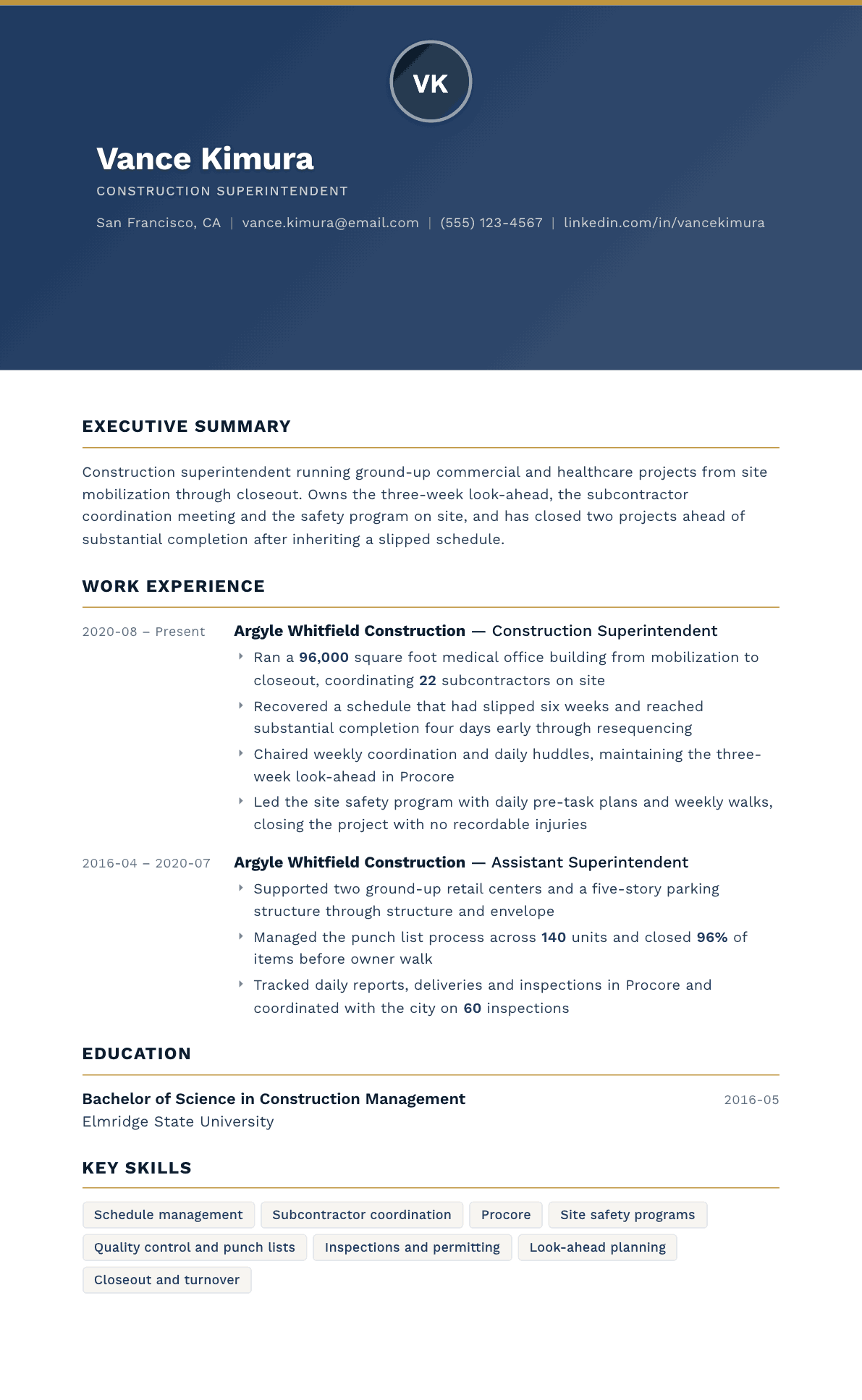
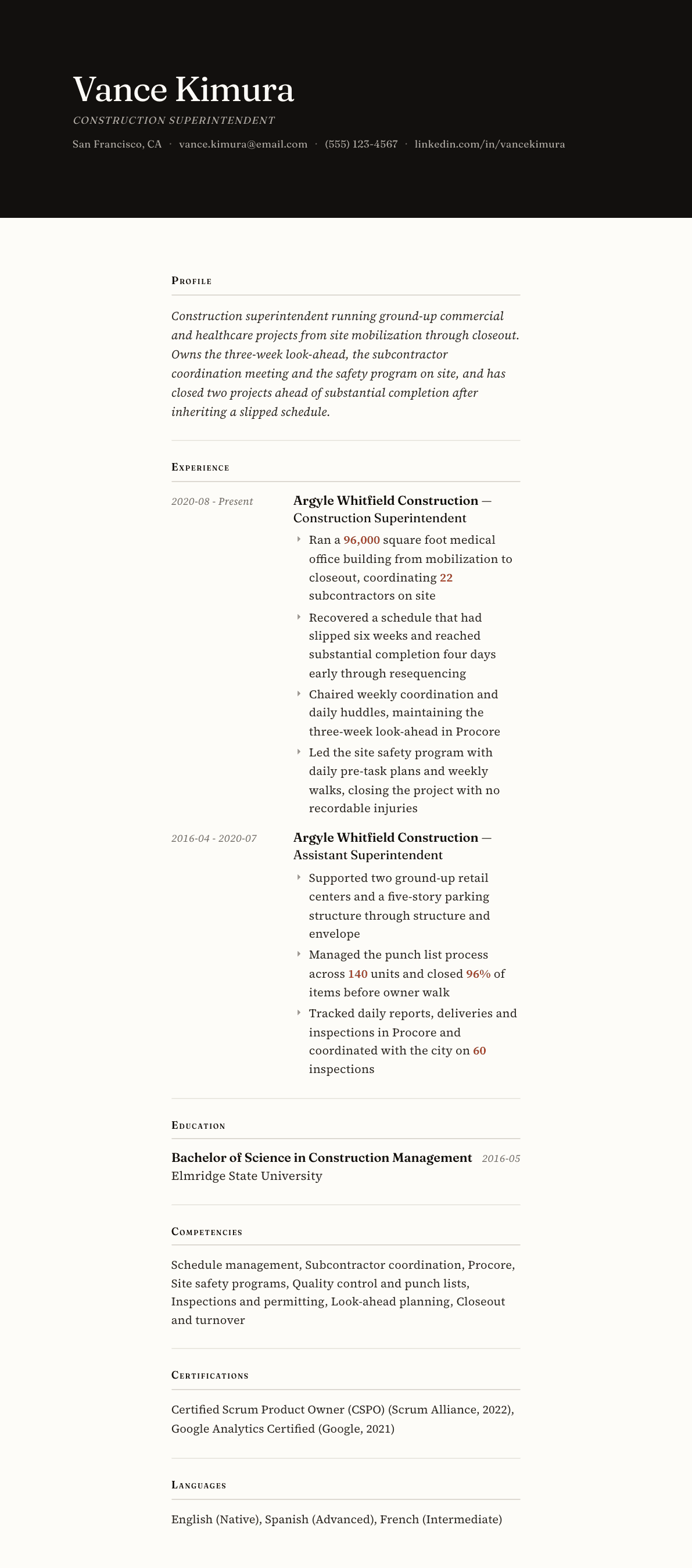
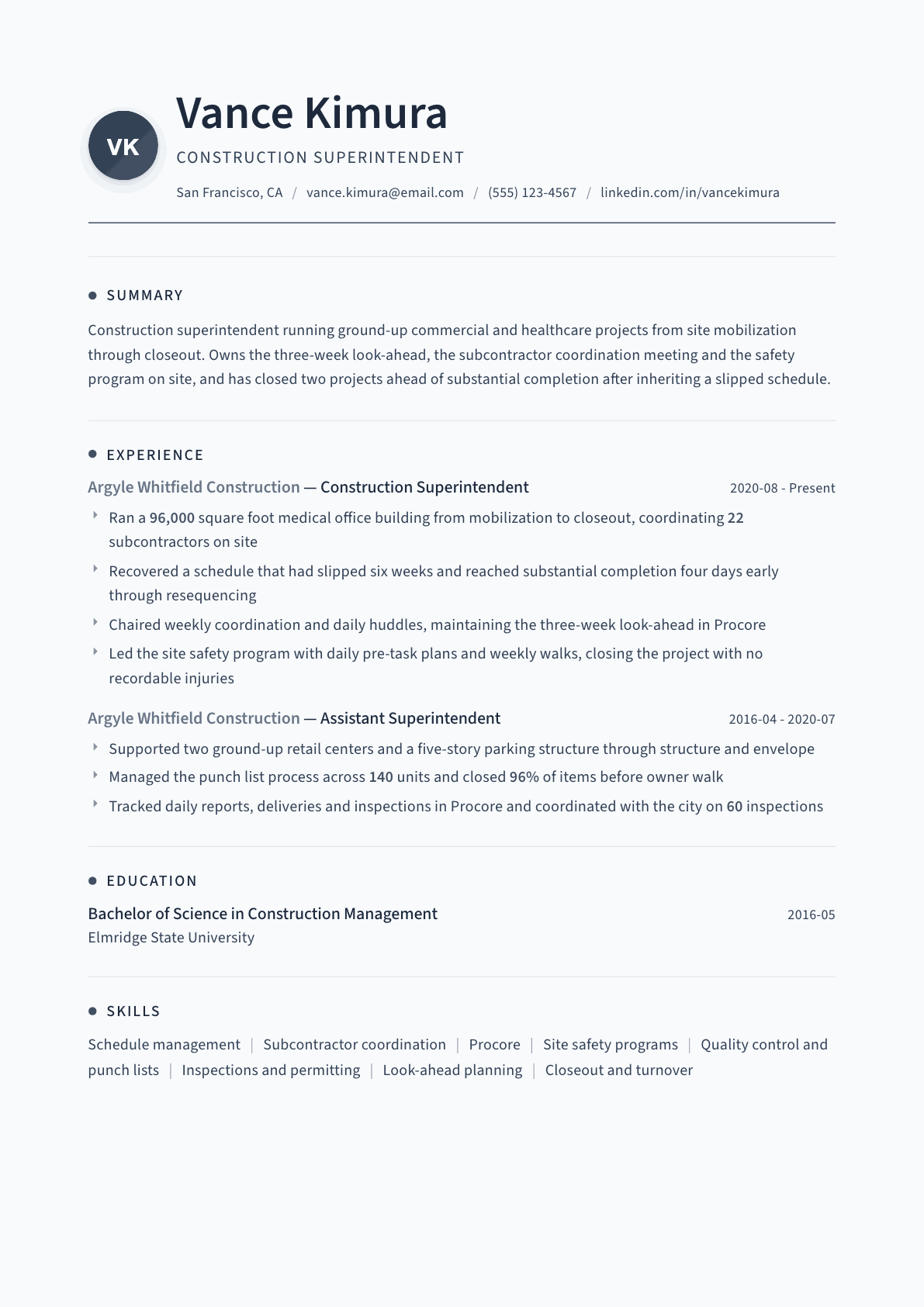
Example Construction Superintendent summary
Construction superintendent with nine years on ground-up commercial and healthcare projects, most recently a 96,000 square foot medical office building with 22 subcontractors on site. Recovered a six-week schedule slip and reached substantial completion early, ran the site safety program to a clean record, and manages look-aheads in Procore. Seeking superintendent work with a commercial general contractor.
Skills to list on a Construction Superintendent resume
- Ground-up construction
- Schedule management
- Three-week look-ahead
- Subcontractor coordination
- Site safety leadership
- Quality control
- Punch list and closeout
- Procore
- Bluebeam
- Primavera P6
- RFI and submittal process
- Inspections and permitting
- Owner and architect communication
- Daily reporting
- Logistics and site planning
What actually gets this resume read
- Build a project list with building type, square footage, contract value and your dates on each job.
- Say how many subcontractors and trades you coordinated, since that is the real measure of the seat.
- Show schedule outcomes in days or weeks against the baseline rather than saying a project went well.
- Name your project software: Procore, Autodesk Build, Bluebeam, Primavera P6 or Microsoft Project.
- Give your safety record in plain terms and describe the daily routine that produced it.
- Separate ground-up work from renovation and occupied-building work, because they are different jobs to a hiring manager.
How to write a construction superintendent resume
A superintendent is hired on the strength of a project list. Before a general contractor reads a single bullet, they scan for building types, square footage, contract values and your dates on each job, and they compare that list to the work they are trying to staff. If the list is missing, the resume is a stack of claims with nothing to anchor them.
The second thing they look for is schedule behavior. Anyone can finish a job that never got difficult. What proves a superintendent is what happened when the steel arrived late, the inspector failed a rough-in, or a subcontractor pulled crews: how you resequenced, what you gave up, and where the project landed against the baseline.
This guide covers how to build a project list a hiring contractor can read in ten seconds, how to write schedule and safety results in the terms an operations manager uses, how to describe subcontractor coordination without sounding like a project manager, and the questions superintendents ask when they change sectors or move to a larger contractor.
Format: project list first, then the narrative
Give the first page a project block: building type, square footage, contract value range, delivery method, your role and your dates. Design-bid-build, design-build and construction manager at risk all change how a superintendent works, and naming the method tells a reader whether you have run their kind of job.
Then write two or three of the most relevant projects as full entries with bullets, and leave the rest in the list. Two pages is normal for a superintendent with a decade of work, and a project list makes the second page worth turning.
- Project line: type, square footage, value range, delivery method, role, dates.
- Separate ground-up work from renovation, tenant improvement and occupied-building work.
- Note self-perform scopes you supervised directly, since that changes the job substantially.
Schedule: baseline, event, response, result
Write schedule results as a small story with four parts: what the baseline said, what went wrong, what you changed, and where the project finished. A superintendent who recovered six weeks by resequencing envelope and interior work is telling a contractor something useful. One who says the project finished on time is not.
Name the planning discipline you run. The three-week look-ahead, the pull plan with foremen, the daily huddle and the manpower call are the instruments of the job, and describing how you use them proves you run a schedule rather than react to one.
Include the constraint work that eats a superintendent's week: crane and hoist time, deliveries into a tight site, inspection sequencing, temporary power and utility tie-ins, and weather contingency on exterior scopes.
Subcontractors, quality and closeout
Give the number of subcontractors and trades you coordinated on your largest projects, and describe the meeting rhythm you own. Coordination is where a superintendent earns the seat, and a count plus a cadence beats any adjective about leadership.
Quality belongs on the page as a process, not a value. Mockups and first-work-in-place reviews, pre-installation meetings by scope, in-wall inspections before cover, and a punch list managed continuously instead of at the end are the practices contractors ask about. Give the punch numbers if you have them: items open at owner walk, or the share closed before turnover.
Closeout is where projects rot, so show it. Turnover documents, warranties, operating manuals, training sessions with the facility team and the final inspection sequence all belong in one bullet if you have owned them.
Safety, written as a program you ran
Site safety is the superintendent's responsibility on almost every project, so describe the program rather than the outcome alone. Daily pre-task plans reviewed with foremen, weekly walks with a documented punch of hazards, orientation for every new worker on site, and the specific plans for fall protection, excavation and hot work.
Then give the record: incident-free duration, or a clean inspection history. Pair it with the practices above so a reader sees the mechanism, since an unexplained clean record reads as luck to anyone who has run a job.
Software and keywords
Name the systems: Procore, Autodesk Build, Bluebeam Revu, Primavera P6, Microsoft Project, and any model coordination tool you used for clash review. Contractors standardize on one platform and a superintendent who already knows theirs is worth a month of ramp time.
Recruiters in construction search on superintendent, ground-up, look-ahead, subcontractor coordination, RFI, submittal, punch list, closeout, substantial completion, site logistics and quality control. Use the ones your projects actually earned, next to the building type they came from.
Construction Superintendent resume summary examples
Assistant superintendent
Assistant superintendent with four years supporting ground-up retail and a five-story parking structure through structure and envelope. Manages daily reports, deliveries and inspections in Procore, ran a punch process across 140 units, and coordinated 60 city inspections without a failed reinspection.
Running a project
Superintendent running ground-up commercial and healthcare work from mobilization to closeout, most recently a medical office building with 22 subcontractors on site. Recovered a six-week schedule slip through resequencing and reached substantial completion early, with no recordable injuries on the job.
General superintendent
General superintendent with eighteen years across healthcare, higher education and commercial work, currently overseeing three concurrent projects and four site superintendents. Standardized the look-ahead and pre-installation meeting process across the company and mentors assistant superintendents into their first solo jobs.
Work experience bullets: before and after
Before: Managed construction projects from start to finish.
After: Ran a 96K square foot medical office building from mobilization through closeout, coordinating 22 subcontractors on a phased site.
Building type, size and subcontractor count let a contractor match the project against the work they need staffed.
Before: Kept the project on schedule.
After: Recovered a six-week slip by resequencing envelope and interior rough-in, reaching substantial completion four days ahead of the contract date.
The event, the response and the result show schedule judgment rather than a claim of good outcomes.
Before: Held meetings with subcontractors.
After: Chaired weekly coordination and daily huddles built on a three-week look-ahead maintained in Procore with foreman input.
Naming the cadence and the planning instrument turns meetings into a management system.
Before: Focused on site safety.
After: Ran daily pre-task plans and weekly documented safety walks with every foreman, closing the project with no recordable injuries.
The routine explains the record, which is what a safety director wants to see behind a clean number.
Before: Completed the punch list before turnover.
After: Managed punch continuously by floor rather than at the end, closing 96% of items before the owner walk on a 140-unit turnover.
The method and the completion share show a superintendent who protects the closeout instead of racing it.
Hard skills
- Ground-up commercial construction
- Schedule management and look-ahead planning
- Subcontractor coordination
- Site logistics and phasing
- Quality control and mockups
- Punch list and project closeout
- RFI and submittal process
- Inspections and permitting
- Site safety program management
- Procore and Autodesk Build
- Bluebeam Revu
- Primavera P6 and Microsoft Project
- Daily reporting and documentation
Soft skills
- Holding subcontractors to commitments
- Owner and architect communication
- Decision making under schedule pressure
- Mentoring assistant superintendents
- Conflict resolution between trades
- Documentation discipline
Certifications worth listing
- OSHA 30-Hour Construction (OSHA Outreach Training Program)
- Certified Construction Manager (CCM) (Construction Management Association of America)
- Associate Constructor (AC) (American Institute of Constructors)
- Certified Professional Constructor (CPC) (American Institute of Constructors)
- LEED Green Associate (Green Business Certification Inc.)
- Adult First Aid and CPR (American Red Cross)
Mistakes that cost construction superintendent candidates the interview
- Omitting the project list, which is the first thing a construction hiring manager looks for.
- Giving schedule outcomes with no baseline, no obstacle and no recovery method behind them.
- Writing the role like a project manager resume full of budget and buyout language.
- Leaving out the delivery method, so a reader cannot tell how you worked with the owner and design team.
- Claiming a clean safety record without the daily and weekly routine that produced it.
- Naming software you have only seen, when a contractor will ask you to walk through a look-ahead build.
Construction Superintendent resume questions
How should a construction superintendent resume list projects?
Use a compact block with building type, square footage, contract value range, delivery method, your role and dates. Then expand two or three projects most like the contractor's current work into full entries with schedule, coordination and safety bullets.
What is the difference between a superintendent and a project manager resume?
A superintendent resume lives on the site: schedule, sequencing, trades, inspections, quality and safety. A project manager resume lives on the contract: buyout, budget, change orders and owner reporting. Mixing them makes a candidate look unclear about the seat they want.
How do I move from assistant superintendent to running my own job?
Show the parts you already owned alone, such as inspections, punch, a phase or a building on a multi-building site. Name the trades you coordinated directly and the durations you controlled, so a reader can see the scope of independent responsibility.
Do I need a construction management degree to be a superintendent?
No. Many superintendents came up through a trade, and contractors value that background because it makes coordination credible with foremen. If you took that route, list your trade years, journeyman status and any completed apprenticeship in place of a degree.
How do I switch from residential to commercial superintendent work?
Lead with the transferable systems: scheduling, inspection sequencing, subcontractor management and quality control. Then name any commercial-adjacent work such as large multifamily or podium projects, and add the safety training that commercial owners require before badging.
Related resume examples
- Construction Manager Resume example
- Project Manager Resume example
- Construction Foreman Resume example
- Site Supervisor Resume example
- Site Manager Resume example
- Construction Project Manager Resume example