Road Construction Worker Resume Examples: free ATS score
A Road Construction Worker Resume That Gets You Hired
By Mustafa Tarabya, founder of CVBooster · Published · Updated
Road construction worker resume examples with paving, traffic control and equipment keywords, plus certification and safety guidance.
Sample resumes for a road construction worker
The same road construction worker content laid out in three CVBooster templates, so you can see what the finished document looks like before you write a word.
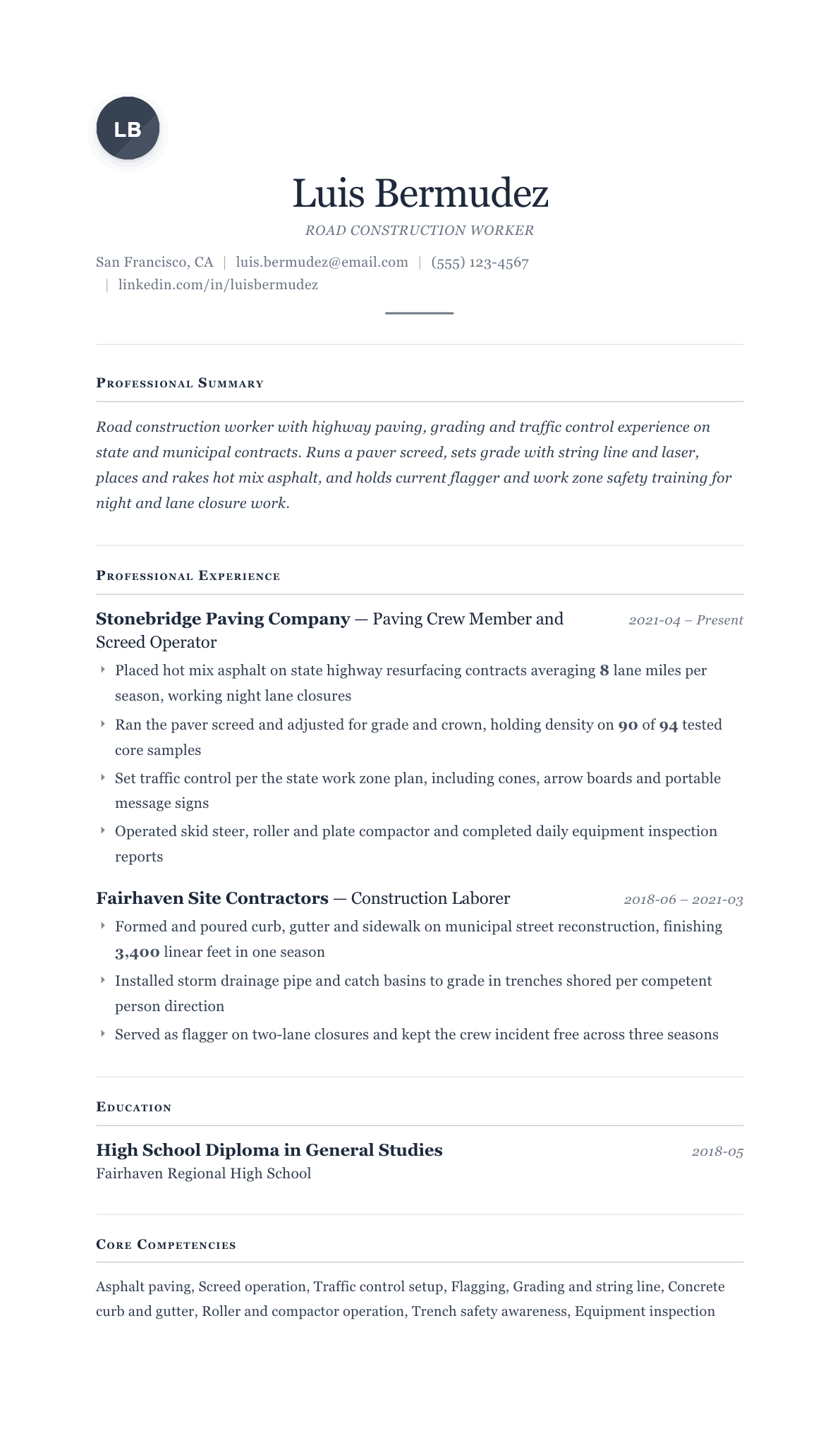
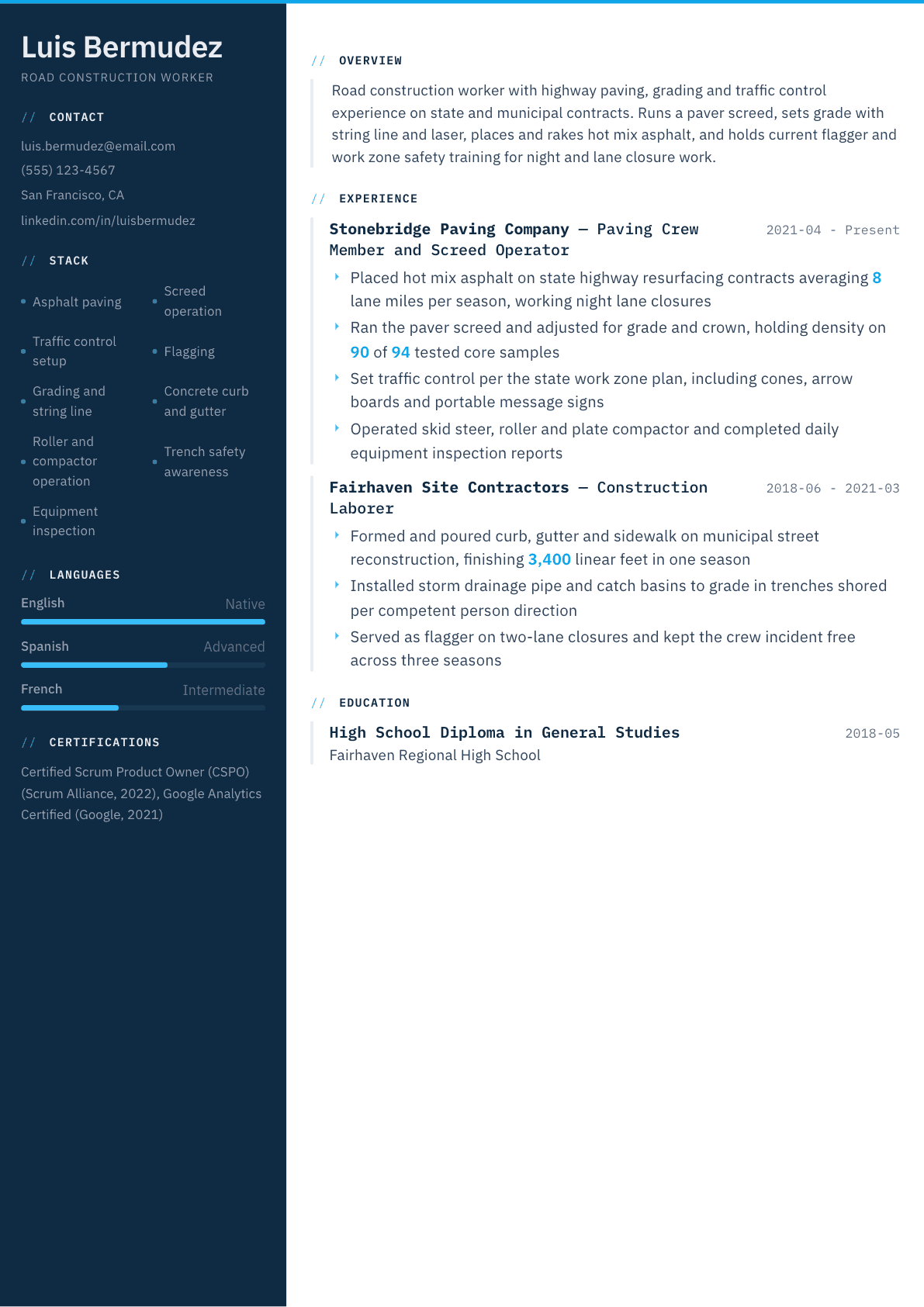

Example Road Construction Worker summary
Road construction worker with seven years on state highway and municipal street contracts. Runs the paver screed on night resurfacing work, sets grade with string line and laser, and places hot mix asphalt to density on nearly every tested core. Certified flagger with work zone safety training, experienced with roller, skid steer and plate compactor, and incident free across seven seasons.
Skills to list on a Road Construction Worker resume
- Hot mix asphalt paving
- Paver screed operation
- Roller and compaction
- Grade setting and string line
- Traffic control and flagging
- Work zone setup
- Concrete curb and gutter
- Storm drainage installation
- Skid steer operation
- Milling and pavement removal
- Trench safety awareness
- Daily equipment inspection
- Hand tools and jackhammer
- Blueprint and plan reading
What actually gets this resume read
- Put your flagger certification, work zone safety training and any commercial driver license in the header where a foreman looks.
- Name the equipment you can run by machine type, since a paving crew hires for the screed, roller or skid steer specifically.
- Say whether you have worked night shifts and lane closures, because highway contracts often run entirely after dark.
- Show your production numbers in the units the trade uses: lane miles, tons placed, linear feet of curb, or square yards.
- List the agencies you have worked under, such as a state department of transportation, so a reader knows the specification level.
- Include your safety record and the training you carry, because a clean record decides who gets called back next season.
How to write a road construction worker resume
Highway and street work hires on three things: what equipment you can run, what safety cards you carry, and whether you will still be there in August. A road construction worker resume that answers those three in the top third of the page gets a call, because a paving superintendent staffing a season does not read past the first screen full of text.
The mistake most candidates make is writing general labor bullets. Assisted the crew and performed various duties tells a superintendent nothing. He wants to know whether you can run the screed, set grade off a string line, hold density on a mat, flag a lane closure at night, and pass a drug screen for a state contract.
This guide covers the layout that works for trade resumes, how to write the summary, how to describe production in the units the road trade uses, which certifications matter and who issues them, and the questions crew members ask when they are trying to move up from laborer to operator.
Format: one page, credentials and equipment above the fold
One page. Plain type, no graphics, big clear headings. Trade resumes get read on a phone in a truck, and anything that requires scrolling past a design element loses the reader.
Directly beneath your contact details, put two short blocks: certifications and equipment operated. A superintendent filling a crew is checking whether you have a flagger card, work zone training and a driver license, and whether you can run the machine he is short on. Both answers should be visible without reading a single bullet.
- Header: name, city, phone, email, driver license class and any endorsements.
- Certifications block: flagger certification, work zone safety training, safety card, first aid and CPR.
- Equipment block: paver screed, roller, skid steer, plate compactor, milling machine, dump truck.
Summary: work type, shift availability, and machines
Three lines. Say whether your experience is highway resurfacing, municipal street reconstruction, utility trench restoration, or all three. Say which machines you run. Then say plainly that you work nights and lane closures if you do, because a large share of highway contracts run entirely after dark and crews are always short on people who will take those shifts.
Add travel willingness if it applies. Paving companies chase contracts across a region and a worker who will stay in a hotel for a two week job is worth more to the schedule than one who cannot leave the county.
Experience: production in trade units
Use the numbers the road trade uses. Lane miles resurfaced in a season, tons of hot mix placed in a shift, linear feet of curb and gutter formed and poured, square yards milled, feet of storm pipe installed to grade. Those figures immediately tell a superintendent what kind of crew you came from and what pace you are used to.
Add quality outcomes where you have them. Core samples passing density, smoothness results on a resurfacing contract, or grade checks holding within tolerance are all measurable and rarely appear on a competing resume. Density on a mat is the number the agency pays or penalizes on, so a worker who mentions it is speaking the superintendent language.
Finish with safety and reliability. Seasons worked without a recordable incident, call back rate from the same contractor, and any role you held on the crew such as lead flagger or grade checker.
Equipment: be exact about what you have actually run
List machines by type and, where it matters, by size class. Screed operation on a paver is a specific and valuable skill that many general laborers never learn, so it deserves its own line rather than being folded into a list. The same is true of milling machine and roller work, since compaction sequence is a judgment skill.
Do not inflate this section. A superintendent will put you on the machine in the first week, and a worker who claimed screed time and cannot hold grade loses the job and the reference. List what you have run supervised separately if you want credit for exposure.
- Paving: paver screed, material transfer vehicle, roller, plate compactor.
- Earth and grade: skid steer, mini excavator, grade checking with string line and laser.
- Support: dump truck, water truck, jackhammer, saw cutting, hand tools.
Certifications, agencies and the paperwork that clears you for a contract
Flagger certification and work zone traffic control training are the two that gate the most work, and requirements vary by state department of transportation. Name the certifying organization and the state. Add an OSHA construction safety card, first aid and CPR, and any confined space or trench safety training you carry.
Say which agencies you have worked under. Experience on a state department of transportation contract signals familiarity with specification, inspection and documentation levels that private site work does not require. If you have held a commercial driver license, list the class and endorsements, because it makes you useful on days the crew cannot pave.
Road Construction Worker resume summary examples
First season
Construction laborer entering a second paving season, experienced with raking mat behind the paver, setting cones and running a plate compactor. Holds a current flagger certification and a clean driver license, works night lane closures, and is training toward roller operation.
Seven seasons
Road construction worker with seven seasons on state highway and municipal street contracts. Runs the paver screed on night resurfacing work, sets grade with string line and laser, and placed hot mix that passed density on 90 of 94 tested cores last season. Certified flagger with work zone safety training.
Crew lead
Paving crew lead with sixteen seasons directing a nine person crew on highway resurfacing and reconstruction. Sets the traffic control plan each shift, runs screed and milling machine, coaches new operators on compaction sequence, and has closed six seasons with no recordable incidents.
Work experience bullets: before and after
Before: Worked on asphalt paving crews.
After: Placed hot mix asphalt on state highway resurfacing contracts averaging 8 lane miles a season, working night lane closures through the paving window.
Lane miles and night work tell a superintendent the pace and shift pattern you are used to.
Before: Operated the paver.
After: Ran the paver screed and adjusted for grade and crown continuously, holding density on 90 of 94 tested core samples.
Density results are what the agency pays on, so quoting them proves quality rather than presence.
Before: Set up traffic control.
After: Set cones, arrow boards and portable message signs to the state work zone plan and served as lead flagger on two lane closures.
Naming the devices and the plan shows you work to a specification instead of improvising.
Before: Poured concrete for sidewalks.
After: Formed and poured 3,400 linear feet of curb, gutter and sidewalk in one season on municipal street reconstruction.
Linear feet in a season is the production unit a concrete foreman compares candidates on.
Before: Installed drainage pipe.
After: Installed storm drainage pipe and catch basins to grade in shored trenches, checking invert elevations with a laser before backfill.
The grade check and the shoring reference show both accuracy and trench safety awareness.
Hard skills
- Hot mix asphalt placement
- Paver screed operation
- Roller and compaction sequence
- Milling and pavement removal
- Grade setting with string line and laser
- Traffic control device setup
- Flagging
- Curb, gutter and sidewalk forming
- Storm drainage installation
- Skid steer and mini excavator operation
- Trench safety awareness
- Daily equipment inspection
- Plan and profile reading
- Saw cutting and jackhammer work
Soft skills
- Reliability on early call times
- Working nights and weather windows
- Crew communication in noise
- Situational awareness near live traffic
- Taking direction from the foreman
- Physical stamina across a season
Certifications worth listing
- Flagger Certification (American Traffic Safety Services Association)
- Traffic Control Technician (American Traffic Safety Services Association)
- OSHA 10-Hour Construction (Occupational Safety and Health Administration)
- Commercial Driver License (State Department of Motor Vehicles)
Mistakes that cost road construction worker candidates the interview
- Writing general labor bullets that never name a machine, a production figure or a road surface.
- Burying the flagger card and work zone training at the bottom where a superintendent will never scroll.
- Claiming screed or milling time you do not have, which ends the job in the first week and costs the reference.
- Leaving out night shift and travel availability, the two answers that decide highway crew staffing.
- Ignoring density, smoothness and grade tolerance, the quality numbers the contract is actually paid on.
- Listing seasonal layoffs as employment gaps instead of labeling the work as seasonal, which every road contractor understands.
Road Construction Worker resume questions
How do I explain seasonal layoffs on a road construction resume?
Label the work seasonal and give the months rather than only years. Every paving contractor understands a winter shutdown. What looks bad is an unexplained gap, so add any winter work you did such as snow removal, shop maintenance or plowing.
What certifications should a road construction worker get first?
Flagger certification and work zone traffic control training, because they gate the most work and are quick to obtain. An OSHA construction safety card comes next, then a commercial driver license, which makes you useful on days weather stops the paving.
How do I move from laborer to equipment operator?
Ask for supervised seat time and record it on the resume as supervised hours by machine. Then add compaction sequence, grade checking and screed adjustment to your skills as you learn them. Operators are usually promoted from inside a crew rather than hired in.
Does experience on private site work count for highway jobs?
It counts, but say which is which. State highway contracts carry heavier specification, inspection and documentation requirements than private parking lot work, so a superintendent needs to know whether you have worked to agency specifications before.
Should I include physical capability on the resume?
Only in concrete terms tied to the work: hand raking behind the paver in summer heat, twelve hour night shifts, or lifting and setting devices along a closure. A general statement about being hardworking adds nothing a superintendent can use.
Related resume examples
- Construction Worker Resume example
- Construction Laborer Resume example
- Heavy Equipment Operator Resume example
- Crane Operator Resume example
- Concrete Finisher Resume example
- Excavator Operator Resume example