Site Engineer Resume Examples: free ATS score and gap list
Write a Site Engineer Resume Around Setting Out and Technical Control
By Mustafa Tarabya, founder of CVBooster · Published · Updated
A site engineer resume sample with setting out, RFI and quality tips, the technical keywords contractors screen for, and a full writing guide.
Sample resumes for a site engineer
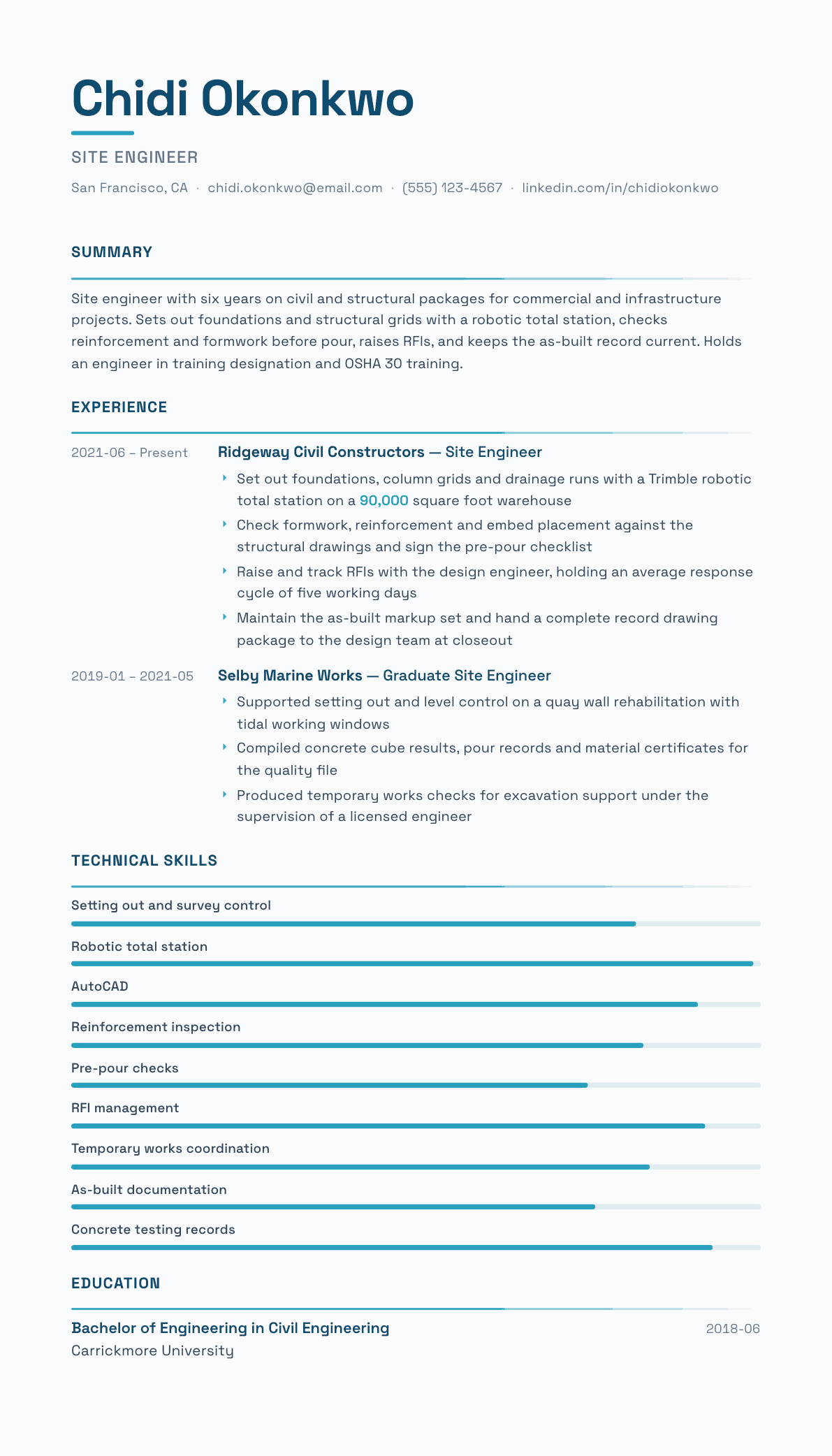
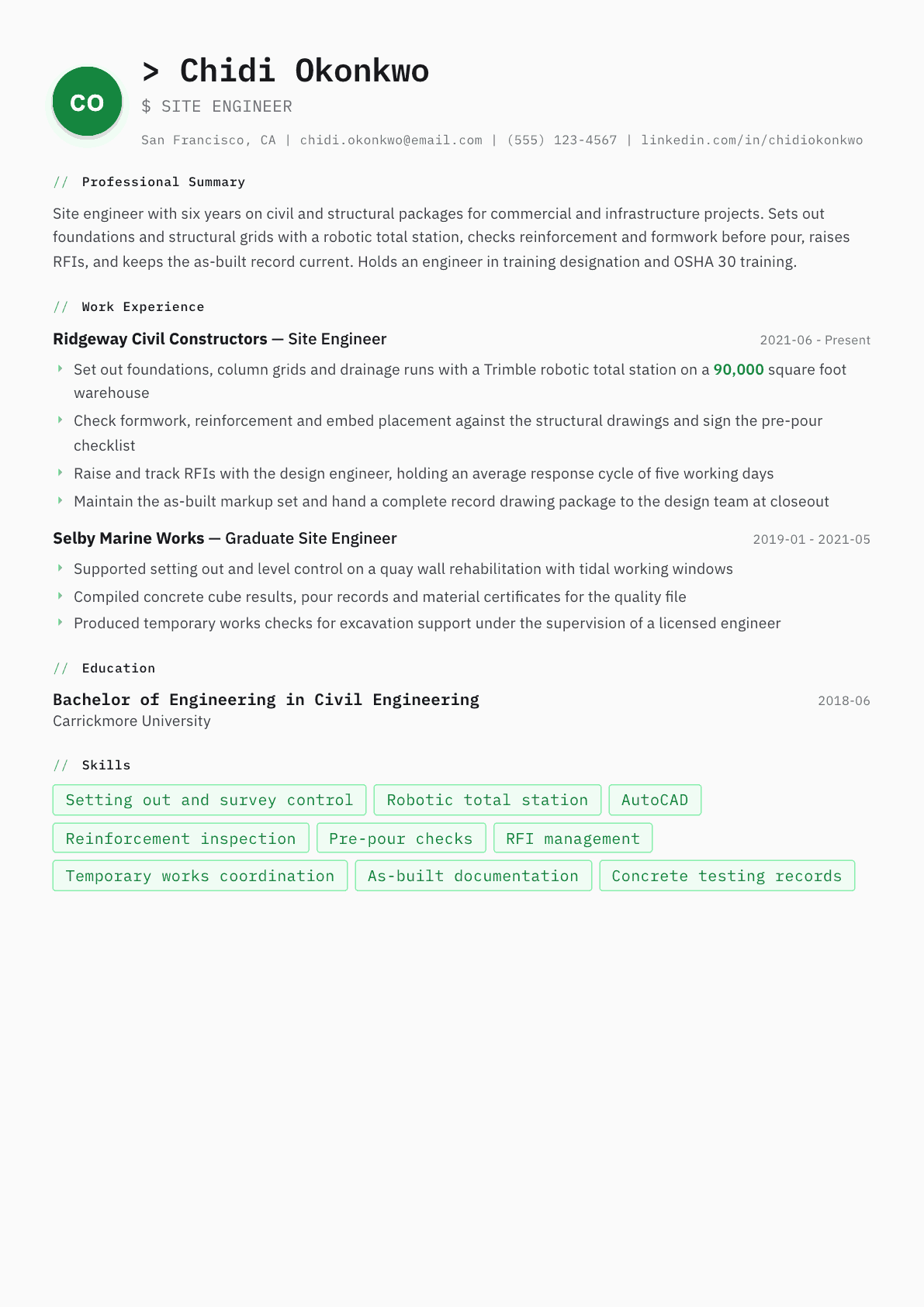
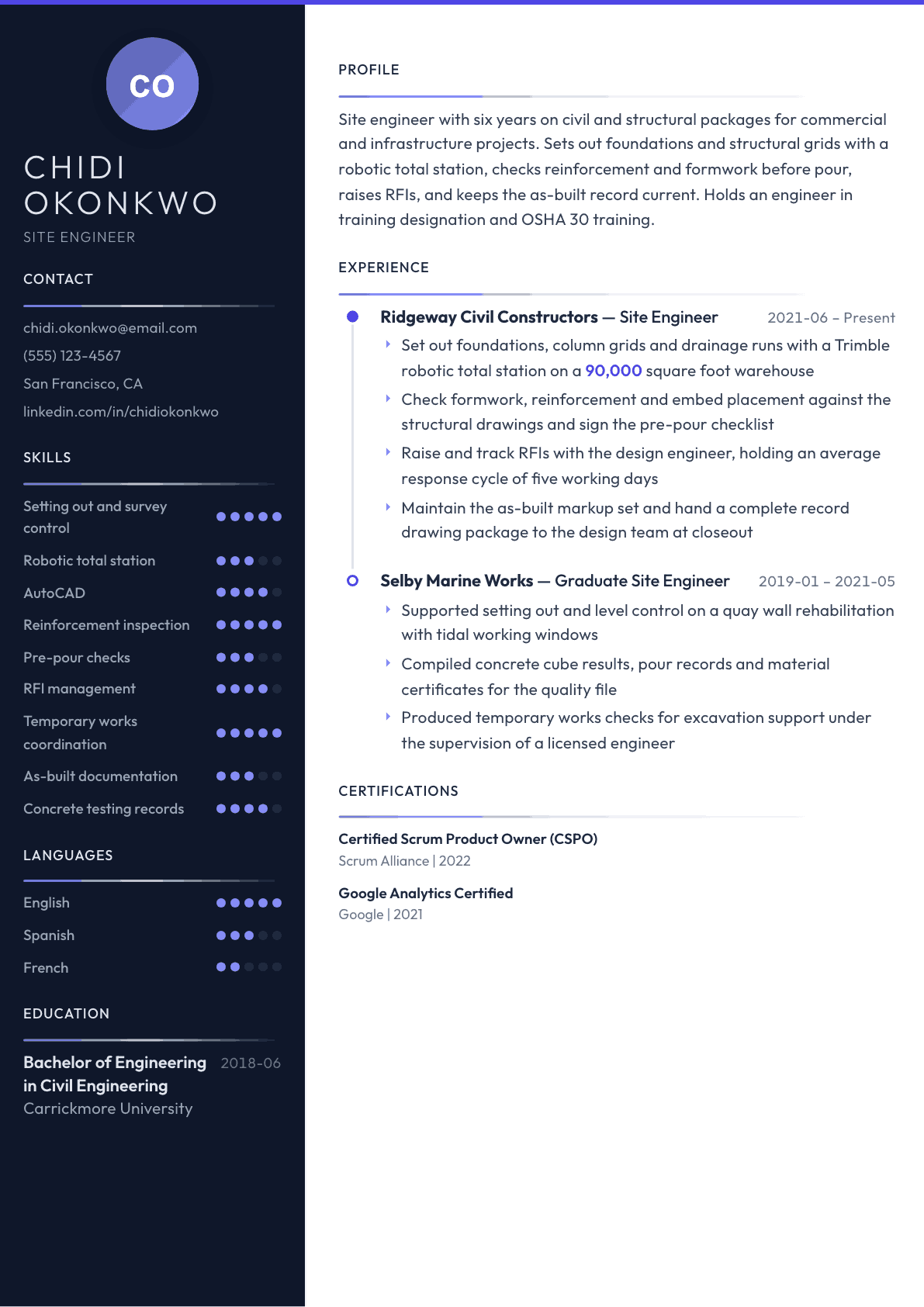
The same site engineer content laid out in three CVBooster templates, so you can see what the finished document looks like before you write a word.
Example Site Engineer summary
Site engineer with six years on civil and structural packages across commercial and infrastructure projects. Sets out foundations, column grids and drainage with a robotic total station, checks reinforcement and formwork before every pour, and raises technical queries with the design engineer. Keeps the as-built markup current from first excavation to handover, and holds an engineer in training designation with OSHA 30 construction training.
Skills to list on a Site Engineer resume
- Setting out and survey control
- Robotic total station
- GNSS survey rover
- AutoCAD
- Civil 3D
- Reinforcement and formwork inspection
- Pre-pour checklists
- RFI and technical query management
- Temporary works coordination
- Quantity measurement
- As-built and record drawings
- Concrete and materials testing records
- Method statement preparation
- Drainage and utility layout
What actually gets this resume read
- Lead with setting out and survey control, because that is the technical work only the site engineer on a jobsite is trusted to do.
- Name the instruments you operate, Trimble or Leica total station and GNSS rover, and the tolerances you work to.
- Show your quality role explicitly: pre-pour checks, reinforcement inspection, and who signs off before concrete arrives.
- Record RFI and technical query volumes with turnaround, since a site engineer is the pipe between the field and the designer.
- Say whether you are working toward professional licensure and list the engineer in training designation if you hold it.
- Include temporary works, excavation support and formwork design coordination, because those decide whether a site stays safe.
How to write a site engineer resume
The site engineer is the technical conscience of a jobsite. When the grid gets set out, when reinforcement is checked before a pour, when a dimension on the drawings does not agree with what is in the ground, that is the site engineer's work. A project manager reading your resume is looking for someone who can be trusted to say a pour is not ready, and to have the measurements to prove it.
The role is often confused with a field engineer or an office engineer, and employers use all three titles differently. Some site engineers spend the day on a total station and a pre-pour checklist. Others spend it on submittals, quantities and technical queries. Say clearly which balance you have worked, and let the bullets carry the proof rather than the title.
This guide covers setting out and survey control, quality verification before concrete, technical query management, temporary works, and the record documentation you hand to the design team when the project closes.
Format: technical evidence first
One to two pages, reverse-chronological, with a project block under each employer giving structure type, size, contract value and duration. Add a short technical skills section listing instruments and software, because a site engineer is partly hired on tool literacy.
Put your degree, any engineer in training designation and your safety training near the top. On infrastructure work these are hard requirements rather than nice extras, and the client may need to approve you by name.
- Header: name, city and state, phone, email, degree and engineering designation.
- Order: summary, projects, experience, technical skills and instruments, education, certifications.
- Note the structure types you have set out: frames, foundations, retaining walls, drainage, marine.
Summary: setting out, quality control, and the sector
Name the sector, the structures you have worked on, the survey instruments you operate, and your role in quality verification before concrete. Add whether you are on a licensure track, because employers on public infrastructure often want a path to a professional engineer credential.
Keep it to three lines and lead with the setting out, since that is the capability nobody else on the site can cover for you.
Experience: control, checks, queries and records
Start with survey and dimensional control. Which instrument you operate, whether you establish and check control points, what you set out, and the tolerances you work to. A bullet naming a robotic total station, the structures set out and the size of the footprint is worth several generic ones.
Then quality verification. Pre-pour checks on formwork, reinforcement, cover, embeds and anchor bolts, the checklist you sign, and who else witnesses. Add materials records: concrete cylinder or cube results, pour cards, delivery tickets and material certificates that go into the quality file.
Then technical query management. RFIs and design queries raised, turnaround, and the drawing revisions you push into the field so nobody builds from a superseded sheet. Close with temporary works: excavation support, formwork and falsework coordination, and craneage checks, all done under the supervision of the responsible engineer.
- Instruments: total station, GNSS rover, digital level, and the control network you maintain.
- Checks: pre-pour, pre-cover, and the document you sign before work proceeds.
- Records: as-built markups, quality file, and what the design team receives at closeout.
Software and standards: name the products
List the design and coordination software you use: AutoCAD, Civil 3D, Revit or Navisworks if you check models against the field, plus the project platform where RFIs and drawings live, usually Procore or Autodesk Build. Field data collection software for your total station belongs here too.
Reference the standards you work to by name where you can do so accurately, such as the structural specification for reinforcement placement or the concrete testing procedure your materials technician follows. Precision in this section is what separates a graduate from an engineer with site time.
Keywords in site engineer postings
The recurring vocabulary is setting out, survey control, dimensional tolerance, pre-pour inspection, reinforcement check, temporary works, method statement, technical query, quantity measurement, as-built records and snagging or punch verification. Use them where they apply to you, and name the structure types alongside, because a contractor building water treatment works and a contractor building a steel-framed warehouse read very different resumes.
Site Engineer resume summary examples
Graduate site engineer
Civil engineering graduate with eighteen months on a quay wall rehabilitation, supporting setting out and level control within tidal working windows. Compiles pour records, cube results and material certificates for the quality file, and produces temporary works checks under a licensed engineer. OSHA 30 trained.
Six years in
Site engineer with six years on civil and structural packages for commercial and infrastructure projects. Sets out foundations, column grids and drainage with a robotic total station, signs pre-pour checks on formwork and reinforcement, and manages technical queries with the design engineer through to drawing revision.
Senior site engineer
Senior site engineer with eleven years on water treatment and transport structures, leading a team of three engineers across setting out, quality verification and temporary works coordination. Licensed professional engineer who owns the as-built record set and the technical interface with the designer through handover.
Work experience bullets: before and after
Before: Set out the works on site.
After: Set out foundations, column grids and drainage runs with a Trimble robotic total station across a 90K square foot warehouse, checking control points weekly against the site network.
The instrument, the structures and the control routine prove real survey responsibility rather than assistance.
Before: Checked concrete before it was poured.
After: Signed pre-pour checks on formwork, reinforcement placement, cover and cast-in embeds against the structural drawings, rejecting two pours that were released only after correction.
Naming what is checked and admitting a rejection shows the authority the role actually carries.
Before: Raised RFIs to the designer.
After: Raised and tracked 140 technical queries with the design engineer over a 20-month build, holding an average response cycle of five working days and issuing revised sheets to the field the same day.
Volume, cycle time and the revision handoff show you close the loop instead of just sending questions.
Before: Kept as-built records.
After: Maintained the as-built markup set continuously from first excavation, handing the design team a complete record drawing package on the day of substantial completion.
Continuous updating and an on-time handover distinguish a real record process from a rushed one at the end.
Before: Helped with temporary works.
After: Coordinated temporary works for excavation support and falsework, checking loading assumptions against the design and confirming inspection sign-off before each stage of loading.
Temporary works is where site risk concentrates, so specifics here carry more weight than any general claim.
Hard skills
- Setting out and survey control
- Robotic total station operation
- GNSS rover and digital level
- AutoCAD and Civil 3D
- Reinforcement and formwork inspection
- Pre-pour checklists
- Technical query and RFI management
- Temporary works coordination
- Method statement preparation
- Quantity measurement
- As-built and record drawings
- Concrete and materials test records
Soft skills
- Precision under time pressure
- Saying no to a pour that is not ready
- Clear technical writing
- Coordination with designers and trades
- Methodical record keeping
Certifications worth listing
- Fundamentals of Engineering and Engineer in Training designation (National Council of Examiners for Engineering and Surveying)
- Professional Engineer (PE) (National Council of Examiners for Engineering and Surveying)
- OSHA 30-Hour Construction (OSHA Outreach Training Program)
- Concrete Field Testing Technician Grade I (American Concrete Institute)
Mistakes that cost site engineer candidates the interview
- Listing setting out as a skill without naming the instrument, the structures or the tolerances you worked to.
- Describing quality work in general terms instead of stating which checks you sign and at what stage.
- Leaving out technical query volume and turnaround, which is the clearest measure of the designer interface.
- Ignoring temporary works, the area where a site engineer carries the most consequential responsibility.
- Omitting the engineer in training designation or licensure progress, which many infrastructure employers screen on.
- Writing the resume as a junior project manager, which hides the technical work that makes the role hireable.
Site Engineer resume questions
What is the difference between a site engineer and a field engineer?
The titles overlap and vary by employer. A site engineer usually owns setting out and quality verification in the ground, while a field engineer at some contractors handles submittals, quantities and coordination from a trailer. Describe your actual daily work either way.
How important is survey experience for a site engineer role?
It is close to essential on structural and civil work. Name the instruments you operate, whether you establish control or work from someone else's network, and the structures you have set out, because this is the capability employers cannot easily cover with another person.
Should a graduate site engineer include university projects?
Only briefly, and only if a project involved real design or survey work. Site time counts for far more, so give your placement or internship the fuller treatment: what you set out, what you checked and what records you kept.
Do I need to be a licensed engineer to work as a site engineer?
Usually not for the role itself, since the responsible engineer of record signs the design. Passing the fundamentals exam and holding the engineer in training designation signals the right trajectory, and licensure matters if you want to sign temporary works designs later.
How do I show quality control work without sounding like an inspector?
Frame it as part of building the work, not policing it. You check reinforcement so the pour goes ahead on time, and you keep the record so the designer can close the project. That framing reads correctly to a contractor.
Related resume examples
- Construction Manager Resume example
- Welder Resume example
- Construction Inspector Resume example
- Site Manager Resume example
- BIM Modeler Resume example
- BIM Manager Resume example