Welder Resume Examples: what a hiring manager reads first
Build a Welder Resume That Gets You Hired Fast
By Mustafa Tarabya, founder of CVBooster · Published · Updated
Welder resume guide with a welding resume template filled in: certification block by code and position, experience bullets, safety and keywords.
Sample resumes for a welder
The same welder content laid out in three CVBooster templates, so you can see what the finished document looks like before you write a word.
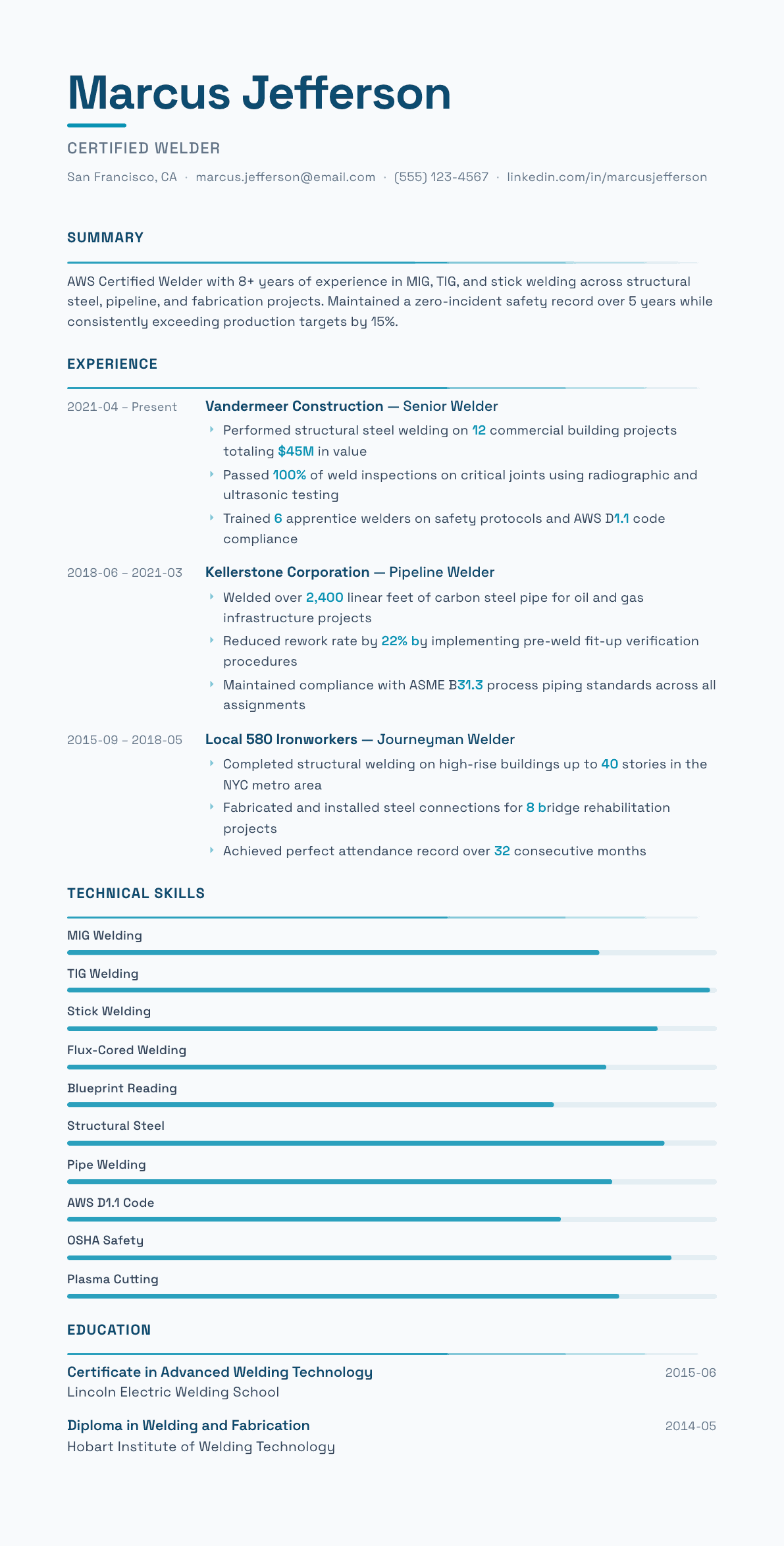
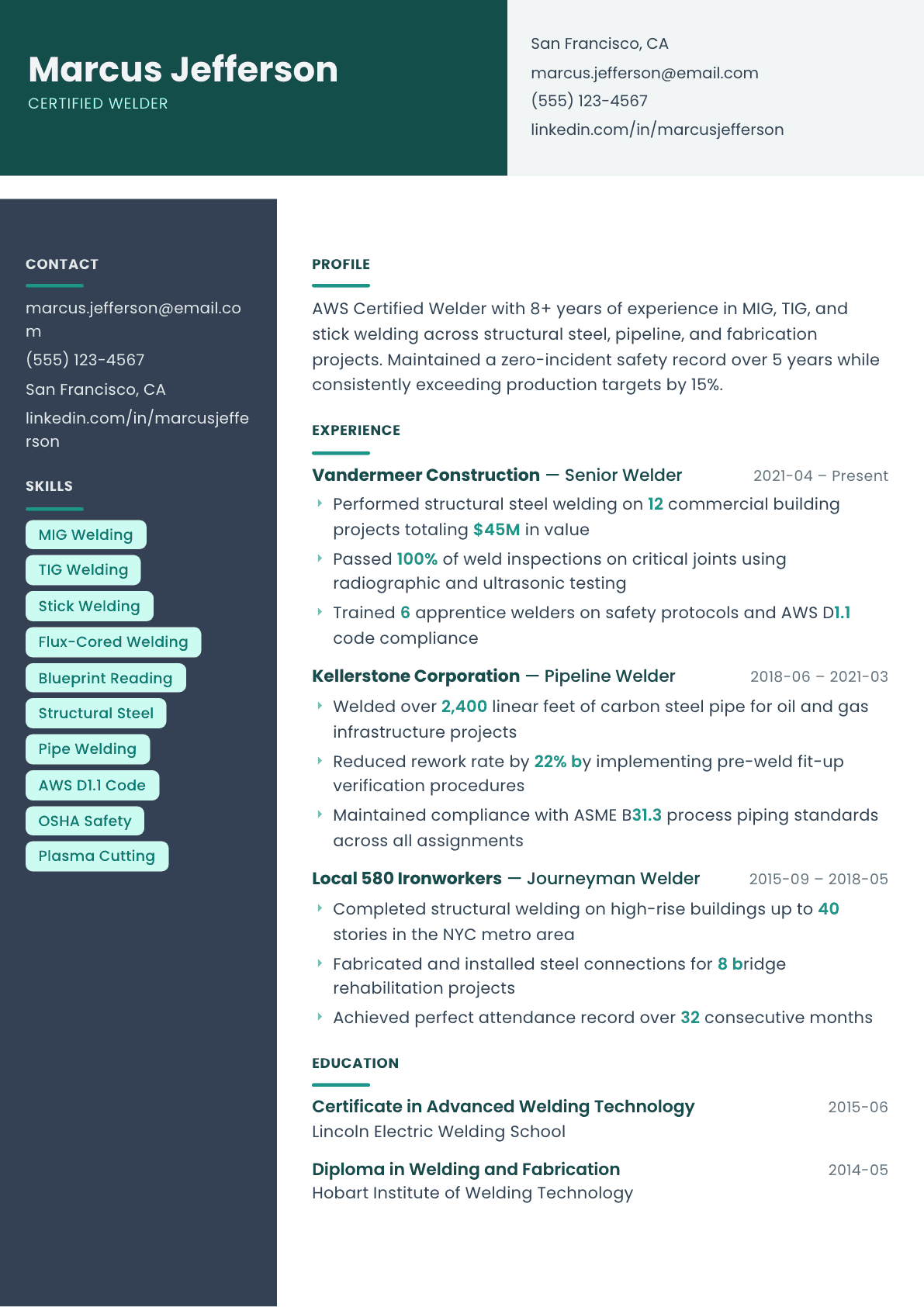
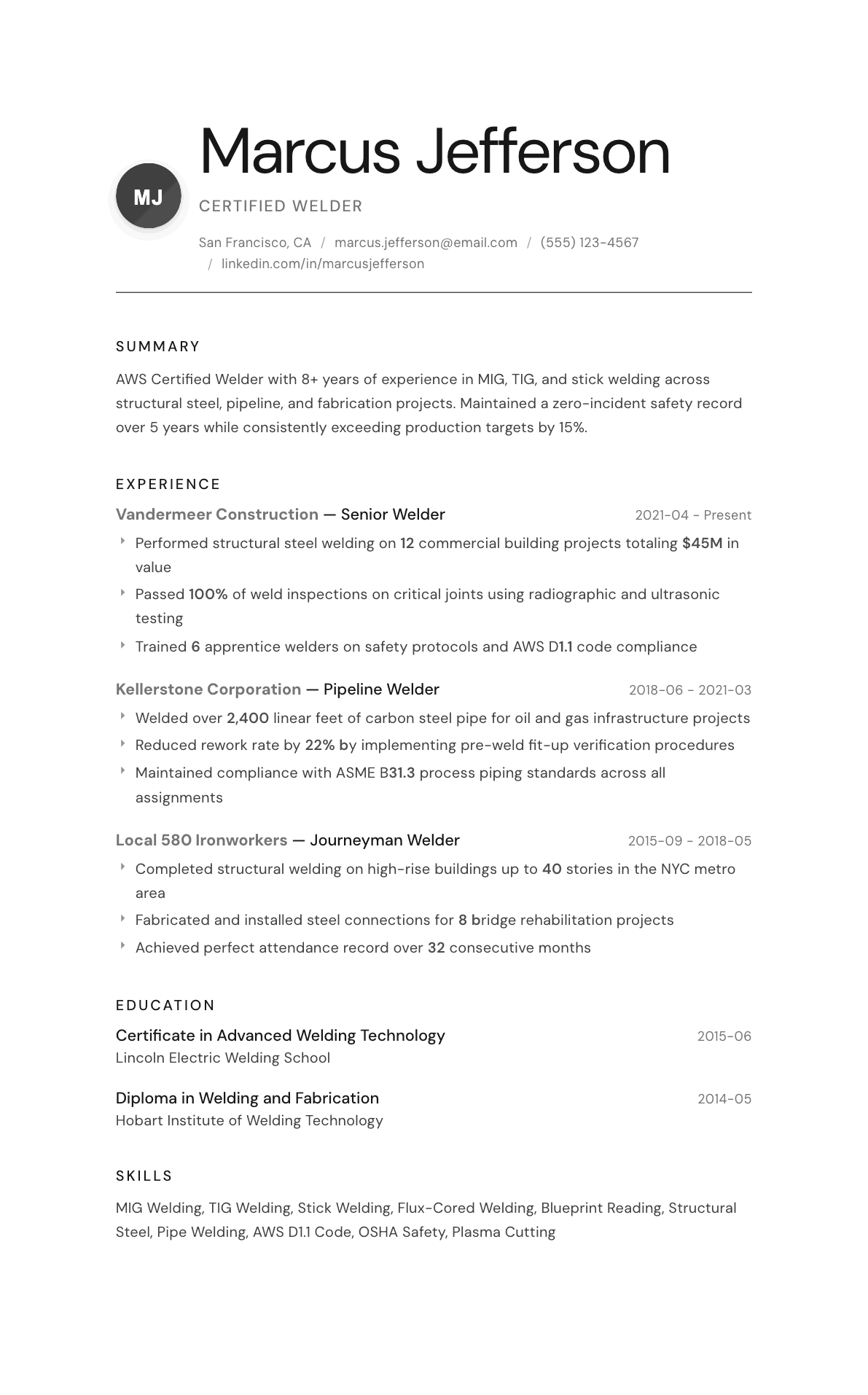
Example Welder summary
Certified Welder with 8 years of hands-on experience in structural, pipeline, and fabrication welding. Proficient in MIG, TIG, and stick processes with a 100% inspection pass rate and zero safety incidents over 5 years. Seeking a senior welding role on large-scale commercial or industrial projects.
Skills to list on a Welder resume
- MIG Welding (GMAW)
- TIG Welding (GTAW)
- Stick Welding (SMAW)
- Flux-Cored (FCAW)
- Blueprint Reading
- Welding Symbols
- Structural Steel Fabrication
- Pipe Welding
- Plasma Cutting
- Oxy-Fuel Cutting
- AWS Code Compliance
- OSHA Safety Standards
- Quality Inspection
- Metal Fabrication
- CNC Plasma Operation
What actually gets this resume read
- List all welding certifications with their codes (AWS D1.1, ASME Section IX) prominently near the top of your resume.
- Quantify your work: mention linear feet welded, number of projects completed, or pass rates on inspections.
- Highlight your safety record. Zero-incident streaks and OSHA certifications are highly valued.
- Specify the welding processes you are proficient in (MIG, TIG, Stick, Flux-Cored) and the materials you work with.
- Include any specialized training such as underwater welding, orbital welding, or robotic welding operation.
- Mention your ability to read blueprints, welding symbols, and technical drawings.
How to write a welder resume
A welder resume is a qualification document before it is a marketing document. The person screening it wants to know four things fast: which processes you run, which positions you have tested in, which codes you have worked to, and whether your paperwork is current. Everything else on the page is context around those four answers.
Shops hire against a weld procedure specification, not against adjectives. A fabricator filling a structural job needs flux-cored in the 3G and 4G positions to AWS D1.1. A pipe contractor needs 6G open root on carbon steel to ASME Section IX. If the reader cannot map your resume onto their procedure in the first ten seconds, they move to the next file, because a test booth costs money and they only test candidates who look qualified on paper.
This guide covers the layout hiring foremen expect, how to write the certification block so it survives an applicant tracking system, three summary examples for different stages of a welding career, before and after bullets, and the questions welders ask most often when they rewrite their resume.
Format: one page, certifications above the fold
Welders almost never need two pages. Use reverse chronological order, a single column, and plain text with no icons or graphics, because contractor and staffing agency parsers frequently drop content out of side columns. Put your city and state under your name along with a note on travel and per diem willingness, since a large share of structural and pipeline work is road work.
Section order that matches how a foreman reads: header, short summary, welding certifications and qualifications, processes and positions, experience, education and apprenticeship, safety credentials. Moving certifications above experience is the single change that helps most, because that block answers the only disqualifying question.
- Header: name, city and state, phone, email, and whether you hold a valid TWIC card or driver license class if the sector requires it.
- A processes and positions line: for example FCAW 3G and 4G, GTAW 6G, SMAW all positions, on carbon steel and 300 series stainless.
- A certifications block with the code, the test position, the base metal, the thickness range, and the qualifying body.
The certification block: code, position, material, thickness
This is the section a welding engineer actually reads. A line such as AWS D1.1 structural, 3G and 4G, FCAW, carbon steel, unlimited thickness tells them exactly what you can pick up on Monday. A line that says only certified welder tells them nothing and forces a phone call they will not make.
Distinguish between a portable credential and a shop qualification. An AWS Certified Welder card follows you. A qualification taken to an employer weld procedure belongs to that employer and expires when your continuity lapses, so name the code and the date range rather than implying a permanent credential. Note whether your continuity is current, because a lapsed qualification means the shop pays for a retest.
If you have passed radiographic or ultrasonic inspection on production welds, say so with the inspection method. Pass rate on a nondestructive examination is the closest thing welding has to a performance review, and hiring managers treat it that way.
Experience: the product, the code, the material, the environment
Every job needs the employer, the sector, and what you built. Structural steel on a high rise, process piping in a refinery turnaround, pressure vessels in a shop, food grade stainless for a dairy plant and aluminum on marine hulls are five different jobs that all read as welder if you do not name them.
Then bullets on the work itself: joint types and prep, fit up and tacking, open root versus backing, positions worked, plate or pipe diameter and wall thickness, preheat and interpass control, and postweld heat treatment when it applied. Add rigging, oxyfuel and plasma cutting, grinding and layout only if the job asked for them, since most shops assume them.
Skip bullets that describe welding generically. Welded metal parts together and followed safety procedures appear on every welder resume in the stack and cost you a line you could have spent on 6G open root with a hot pass on schedule 80 pipe.
Safety and inspection: the record foremen check first
Safety on a welder resume is not a personality claim, it is a record. Name your OSHA outreach card and the hours, confined space entry training, hot work permit experience, fall protection training, and any respirator fit test you carry. Add site specific safety councils where the sector uses them, because refinery and petrochemical clients will not badge anyone without one.
If you have moved toward inspection, list what you can read and sign: weld symbols, welding procedure specifications, procedure qualification records, visual inspection to AWS standards, and any inspector credential. That progression is what turns a welder resume into a foreman or quality resume.
Skills and keywords the parser is scanning
Write the process both ways, once as an abbreviation and once in words: GMAW and MIG, GTAW and TIG, SMAW and stick, FCAW and flux-cored. Staffing agencies search on whichever term the client used, so the resume that carries both surfaces in more searches. Do the same for positions, materials, codes, and equipment such as pipe beveling machines, positioners, orbital heads and robotic cells.
Do not build a keyword block that reads like a parts list. Put each term where a human would expect it: processes in the qualification block, codes beside the jobs where you welded to them, and equipment inside the bullet that describes what you made with it.
Welding resume template, filled in
A welding resume template that works for shops, contractors and staffing agencies has six blocks, with the certifications second, right under your name. Here it is filled in for an invented structural and pipe welder, Ray Dalton. Keep the order, replace every code, position and employer with your own, and leave out anything you could not repeat in a test booth.
A new welder from a training program uses the same template with the school, the booth hours and the bend tests passed in place of the experience entries.
- Header: Ray Dalton, Structural and Pipe Welder, Baton Rouge, LA, phone, email, willing to travel for turnarounds.
- Certifications: AWS D1.1 structural, 3G and 4G, FCAW, carbon steel, unlimited thickness; ASME Section IX, 6G, GTAW root and SMAW fill and cap, carbon steel pipe, continuity current; OSHA 10 hour outreach card.
- Summary: Welder with seven years in structural fabrication and refinery maintenance, running stick, TIG and flux-cored on plate and schedule 80 pipe. Production welds passed radiographic inspection, and no recordable injuries.
- Experience, pipe welder, industrial contractor, current: 6G open root and hot pass on carbon steel process piping during refinery turnarounds; preheat and interpass control to the procedure; hot work permits and confined space entry.
- Experience, structural welder, fabrication shop, previous: fit up and welding of beams, columns and connection plates to AWS D1.1 from shop drawings and weld symbols.
- Training and equipment: vocational welding certificate; pipe beveling machine, positioners, plasma and oxyfuel cutting, forklift.
Welder resume summary examples
Just out of the program
Welding program graduate with 900 shop hours across SMAW, GMAW and FCAW on carbon steel plate. Tested in 3G and 4G, comfortable reading weld symbols and cut lists, OSHA 10 card current. Seeking a structural fabrication shop position with a path to pipe.
Journeyman, five to eight years
Structural welder with 6 years on commercial steel and bridge rehabilitation, qualified to AWS D1.1 in 3G and 4G FCAW on unlimited thickness. Passed 98% of ultrasonic inspections on moment connections and trained two apprentices on fit up and preheat control.
Pipe welder or lead
Pipe welder with 12 years in refinery turnarounds and power generation, qualified 6G GTAW root with SMAW fill and cap on carbon and chrome moly to ASME Section IX. Ran a four welder crew on shutdowns and held a first pass radiographic acceptance rate above 95%.
Work experience bullets: before and after
Before: Welded steel on construction sites.
After: Welded moment connections and column splices on a 14 story steel frame using FCAW in the 3G and 4G positions to AWS D1.1, all joints accepted on ultrasonic testing.
The process, positions, code and inspection outcome let a foreman decide whether to test you, which the original bullet does not.
Before: Experienced with pipe welding.
After: Ran 6G open root GTAW with SMAW fill and cap on 6 inch schedule 80 carbon steel process piping, holding preheat and interpass temperature to the written procedure.
Diameter, wall schedule, position and pass sequence turn a claim into a qualification a welding engineer can match to a procedure.
Before: Followed all safety rules on the job.
After: Worked hot work permits in an operating refinery unit, including gas testing before each shift, fire watch coordination and confined space entry with an attendant.
A specific permit workflow proves site discipline, while following safety rules is a claim every applicant makes.
Before: Helped reduce rework in the shop.
After: Cut weld repair rework by a third over two quarters by adding a fit up and gap check before tacking and tagging out worn contact tips on the wire feeders.
Naming the two changes shows the reader how the improvement happened rather than asking them to take the number on faith.
Before: Trained new welders.
After: Coached four apprentices through their first AWS plate tests, covering electrode angle, travel speed and root gap, and all four passed on the first attempt.
The specific coaching points and the pass result show real instruction instead of informal help.
Hard skills
- SMAW stick welding
- GMAW MIG welding
- GTAW TIG welding
- FCAW flux-cored welding
- Pipe welding in 5G and 6G
- Blueprint and weld symbol reading
- Fit up and tacking
- Oxyfuel and plasma cutting
- Preheat and interpass control
- AWS D1.1 structural code
- ASME Section IX qualification
- Visual weld inspection
- Grinding and joint preparation
- Stainless and aluminum welding
Soft skills
- Reading a procedure without shortcuts
- Steady hand under time pressure
- Crew coordination on a lift
- Clear handoff between shifts
- Calling a bad joint early
Certifications worth listing
- Certified Welder (CW) (American Welding Society)
- Certified Welding Inspector (CWI) (American Welding Society)
- Certified Welding Educator (CWE) (American Welding Society)
- NCCER Welding Certification (National Center for Construction Education and Research)
- OSHA 30-Hour Construction Outreach Training (OSHA Training Institute)
Mistakes that cost welder candidates the interview
- Writing certified welder with no code, position, base metal or thickness range, which forces the reader to guess and guess low.
- Leaving out continuity, so the shop assumes your qualification lapsed and budgets for a retest before they call.
- Listing every process as expert when your card only covers two, because the test booth settles it within an hour.
- Hiding the sector: structural, pipe, pressure vessel, sheet and marine welding hire from different pools and read the same words differently.
- Using a designed template with columns and icons, which agency parsers commonly scramble so the certification block lands out of order.
- Omitting travel and per diem willingness on a resume aimed at road work, which quietly removes you from most turnaround crews.
Welder resume questions
Do I list welding certifications that have expired?
List them under a past qualifications line with the code and the position, and mark them expired. It still proves you tested and passed at that level, and many employers will retest a welder who held the qualification before rather than one who never has.
How do I write a welder resume with no shop experience?
Lead with your program hours, the processes and positions you tested in, and the projects you built in school with material and thickness. Add safety cards, forklift or rigging tickets, and any fabrication, farm or auto repair work that shows you can read a print and hold a tolerance.
Should I put a photo of my welds on the resume?
Not on the resume itself. Keep the page clean and add a short line pointing to a portfolio folder or a phone album you can open in the interview. Bring bend test coupons or macro etches to the shop visit instead, since that is what a foreman actually wants to handle.
How do I show pipe experience if most of my work is plate?
Name any pipe you have run at all, including small bore utility lines, handrail and structural round stock, and give the diameter and wall. Then state the position you tested in on pipe and say plainly that you are working toward 6G, which reads as honest rather than as padding.
What does a welder resume need for a union hall application?
Halls care about hours, apprenticeship completion, local number and past dispatch history. Put total field hours, the local you were indentured to, the journeyman certificate date, and a short list of contractors you have worked for, since dispatchers verify with those contractors directly.
Related resume examples
- Electrician Resume example
- Plumber Resume example
- Construction Manager Resume example
- Sheet Metal Worker Resume example
- Roofer Resume example
- Excavator Operator Resume example