Contract Manager Resume Examples: the lines they read
Build a Contract Manager Resume That Closes Deals
By Mustafa Tarabya, founder of CVBooster · Published · Updated
Create a contract manager resume highlighting your negotiation expertise, risk mitigation, and contract lifecycle management with professional templates.
Sample resumes for a contract manager
The same contract manager content laid out in three CVBooster templates, so you can see what the finished document looks like before you write a word.
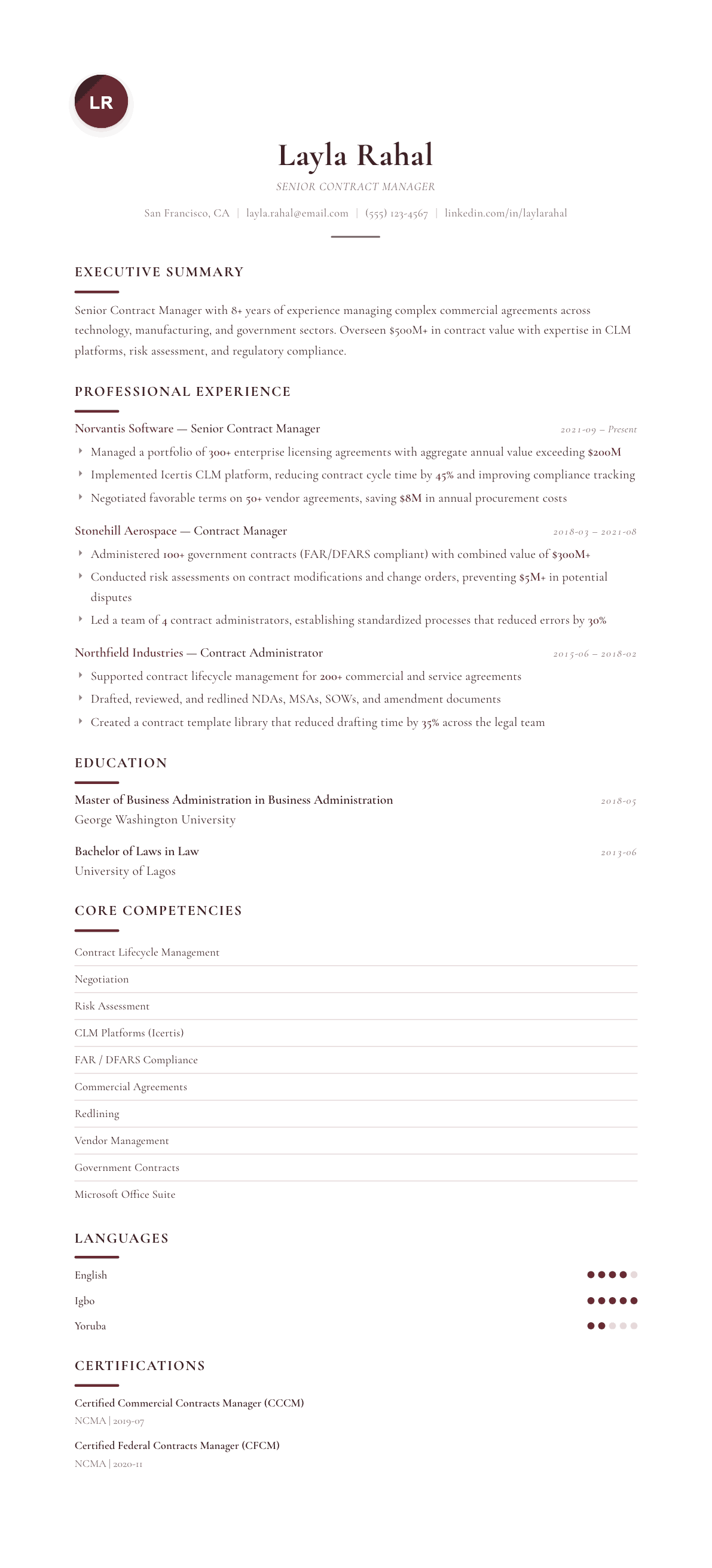
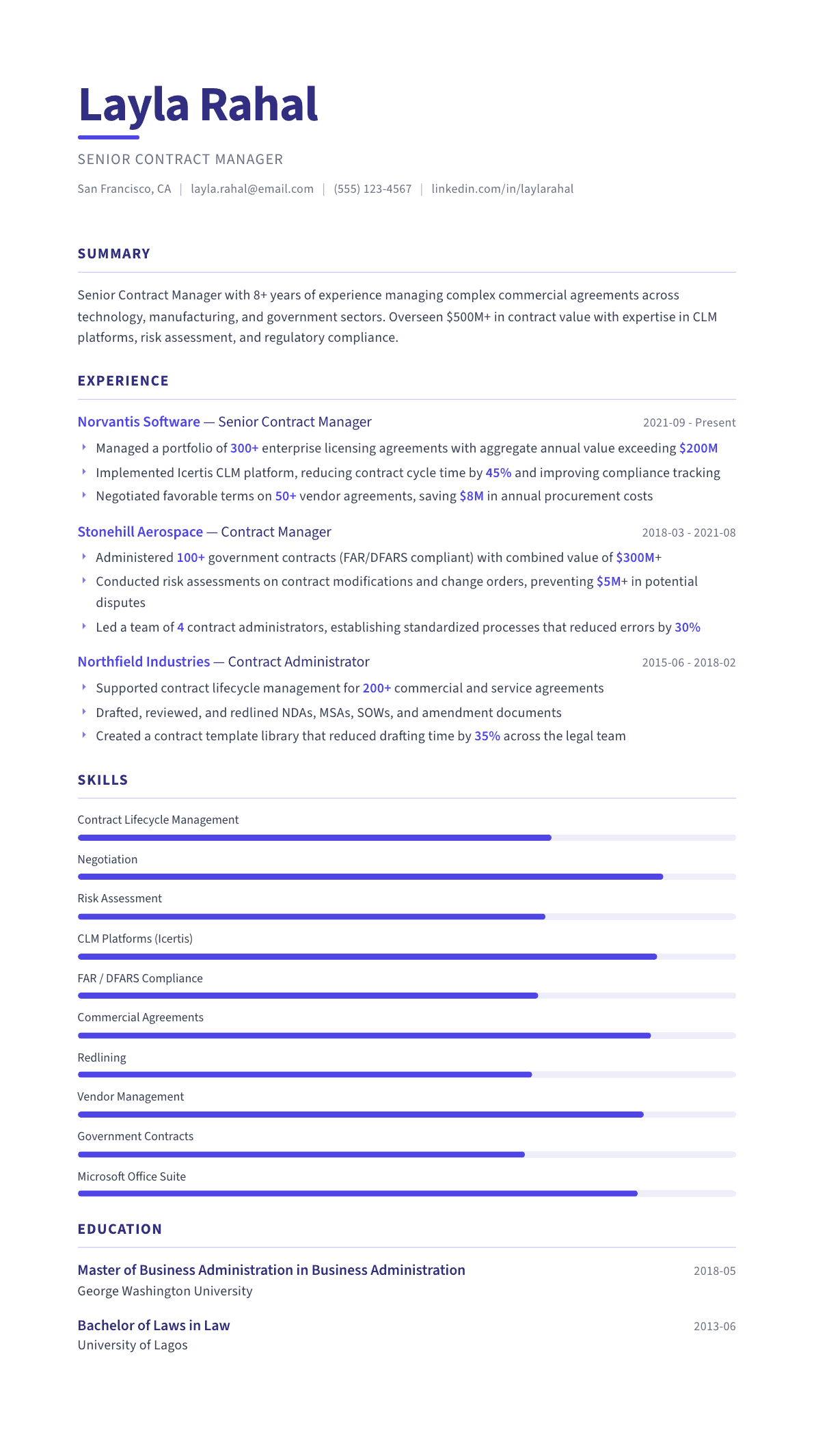
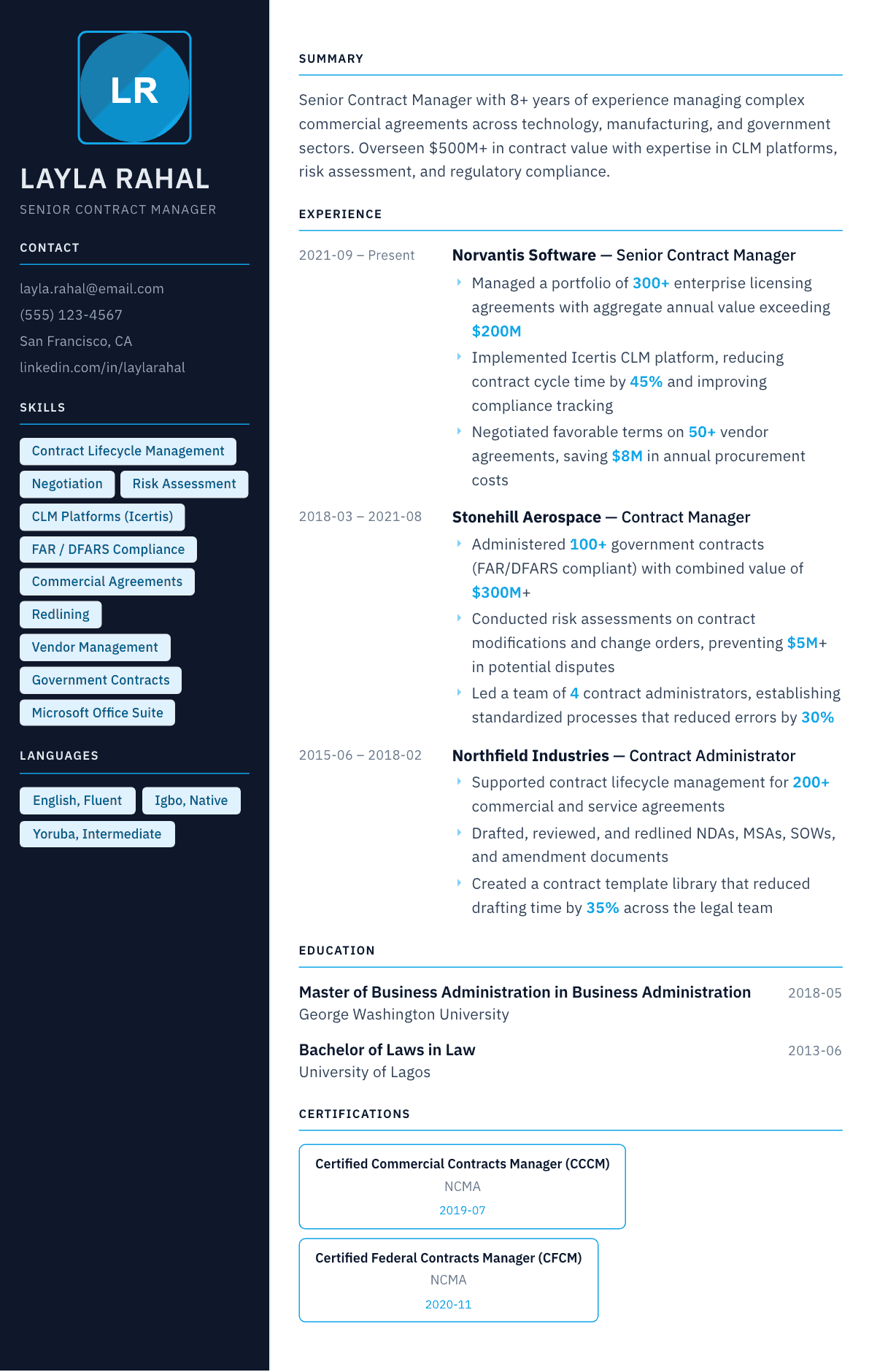
Example Contract Manager summary
Strategic Contract Manager with 8 years overseeing $500M+ in commercial and government contracts. Expert in CLM platforms, FAR/DFARS compliance, and high-stakes negotiation. CCCM and CFCM certified with a track record of reducing contract cycle times by 45% and saving $8M+ annually.
Skills to list on a Contract Manager resume
- Contract Lifecycle Management
- Negotiation
- Risk Assessment
- CLM Platforms
- FAR / DFARS Compliance
- Commercial Agreements
- Government Contracts
- Redlining
- Vendor Management
- Procurement
- Regulatory Compliance
- Microsoft Office Suite
- Template Management
- Cross-functional Collaboration
What actually gets this resume read
- Quantify your portfolio: total contract value managed, number of agreements, cost savings negotiated.
- Specify contract types: commercial, government (FAR/DFARS), SaaS licensing, construction, procurement.
- Mention CLM platforms: Icertis, Agiloft, DocuSign CLM, Ironclad, Conga.
- Highlight risk management: disputes prevented, compliance improvements, audit outcomes.
- Include NCMA certifications (CCCM, CFCM, CPCM) as they are industry-standard credentials.
- Show cross-functional collaboration with legal, procurement, finance, and business teams.
How to write a contract manager resume
Contract management sits between legal, procurement, finance and the business that wants the deal signed this week. A hiring manager reading your resume is trying to work out three things quickly: what kinds of agreements you have actually handled, how much authority you held over terms, and whether you understand the obligations that survive after signature. Most applications answer only the first.
Agreement type is the strongest filter in this field. Commercial sales agreements, procurement and vendor contracts, construction contracts, and government contracting under federal acquisition rules are four different professions that share a title. A resume that says managed contracts without naming the instruments forces the reader to assume the least demanding version.
This guide covers the structure that works for contract management applications, how to describe negotiation authority and post-award administration, three summaries across career stages, before-and-after bullets, and the questions people ask when moving between commercial, procurement and public sector contracting.
Format: agreement types and portfolio size on the first page
Reverse-chronological, one page under about six years and two after. Directly under the summary, list the agreement types you work with by name: master services agreements, statements of work, non-disclosure agreements, licensing and subscription agreements, reseller and channel agreements, supply agreements, amendments and change orders. This block does the same job a technical skills section does for an engineer.
Add the systems you have worked in, because contract lifecycle management platforms are a genuine screening criterion. Name the platform, and say whether you used it, configured it, or led an implementation, since those are three very different claims.
- Header: name, title, location, email, and any professional contract management credential.
- Order: summary, agreement types and systems, experience, education, certifications.
- Give each role a portfolio line: how many active agreements, which business units, which regions.
Experience: authority, cycle time, and the terms you actually moved
State your negotiation authority explicitly. Redlining to a playbook with escalation above a threshold is a different job from independently negotiating terms with counsel behind you, which is different again from owning the fallback positions. Hiring managers care because it tells them what they can hand you on day one.
Name the clauses you negotiate. Limitation of liability, indemnification, warranty, data protection and processing terms, service levels and credits, termination for convenience, intellectual property ownership, payment terms and audit rights are the ones that come up repeatedly. A resume that names clauses reads as a practitioner; one that says negotiated favorable terms reads as an administrator.
Cycle time is the metric this function is managed by. Average days from request to signature, backlog size, the share of agreements using approved templates, and the reduction in legal escalations are all credible and checkable. Pair a process change with the cycle time it moved rather than claiming the number alone.
Post-award administration is where the value hides
Anyone can get a contract signed. What separates a strong contract manager is what happens for the next three years: obligation tracking, milestone and deliverable management, renewal and expiry calendars, price escalation clauses applied on time, change orders processed correctly, and disputes handled before they become claims.
Renewals and auto-renewal terms deserve their own mention because missed notice periods are one of the most common and expensive failures in this discipline. If you built a renewal calendar, recovered value at renegotiation, or exited an agreement inside its notice window, that is a bullet a hiring manager will stop on.
- Show one obligation tracking mechanism you built or ran.
- Show one renewal or termination handled inside its notice period.
- Show one dispute or claim resolved without escalation to litigation.
Compliance and the sector you work in
Sector determines the compliance vocabulary and a large part of your value. Government contracting brings federal acquisition regulation clauses, flow-down requirements, cost accounting standards and audit exposure. Technology brings data protection terms, security addenda and subprocessor obligations. Healthcare brings business associate agreements. Construction brings bonding, retainage and change order discipline.
Name yours specifically and show a compliance outcome: a clean audit, an internal review passed, a flow-down matrix you maintained, a template library aligned to policy. Compliance work is hard to demonstrate abstractly, so anchor it to an event with a result.
Keywords contract management postings reuse
The recurring vocabulary includes contract lifecycle management, redlining, negotiation, risk mitigation, master services agreements, statements of work, compliance, vendor management, obligation management, renewals, and the named contract system. Mirror the posting wording once in the agreement types block and once inside a bullet.
Watch the neighboring titles. Contract administrator, contracts specialist, commercial manager and category manager overlap heavily with this role, and the posting title should appear in your summary line so both the parsing software and the recruiter see an immediate match.
Contract Manager resume summary examples
Contract administrator moving up
Contract administrator with two years supporting a commercial legal team, handling intake, template selection and redlines on non-disclosure agreements and low-value statements of work. Maintains a portfolio of 180 active agreements in a contract lifecycle system and tracks renewal notice dates. Seeking a contract manager role.
Six years in
Contract manager with six years handling technology and services agreements for a portfolio of 300 active contracts across three business units. Negotiates limitation of liability, indemnity and data protection terms to a playbook, and cut average time from request to signature from 24 days to 11.
Head of contracts
Head of contracts with twelve years across commercial and public sector agreements, leading a team of five. Owns the template library and negotiation playbook, ran a contract lifecycle platform implementation across 400 users, and reduced legal escalations by 55% while shortening cycle time.
Work experience bullets: before and after
Before: Managed a large portfolio of contracts for the company.
After: Managed 300 active commercial agreements across three business units, including master services agreements, statements of work and reseller contracts.
Naming the instrument types and the portfolio size tells a hiring manager exactly what work you can be handed.
Before: Negotiated favorable terms with vendors.
After: Negotiated limitation of liability, indemnity and service credit terms on 60 vendor agreements, holding to playbook fallbacks and escalating only 4 to outside counsel.
Named clauses and a low escalation rate demonstrate real negotiating authority rather than message passing.
Before: Helped speed up the contracting process.
After: Rebuilt the intake form and template library so 70% of requests routed to a pre-approved template, cutting average time to signature from 24 days to 11.
The mechanism explains the improvement, so the cycle time reduction reads as your work rather than a good year.
Before: Tracked contract renewals and deadlines.
After: Built a renewal calendar covering 240 agreements with notice periods flagged 90 days ahead, preventing three unwanted auto-renewals in the first year.
It shows a preventive control and a concrete loss avoided, which is what obligation management is for.
Before: Ensured compliance with government contracting rules.
After: Maintained a flow-down clause matrix for 45 federal subcontracts and passed two agency audits with no findings on contract documentation.
A named control plus an audit result makes compliance verifiable instead of asserted.
Hard skills
- Contract drafting and redlining
- Master services agreements and statements of work
- Non-disclosure and licensing agreements
- Negotiation playbooks and fallback positions
- Contract lifecycle management systems
- Obligation and milestone tracking
- Renewal and termination management
- Risk assessment and clause analysis
- Vendor and supplier management
- Change orders and amendments
- Regulatory compliance and flow-downs
- Template and clause library management
- Reporting and contract analytics
Soft skills
- Negotiation under time pressure
- Translating legal terms for business owners
- Saying no without stalling a deal
- Cross-functional coordination
- Attention to detail on long documents
- Stakeholder escalation judgment
Certifications worth listing
- Certified Professional Contract Manager (CPCM) (National Contract Management Association)
- Certified Federal Contract Manager (CFCM) (National Contract Management Association)
- Certified Commercial Contract Manager (CCCM) (National Contract Management Association)
- Certified Professional in Supply Management (CPSM) (Institute for Supply Management)
- IACCM Contract and Commercial Management Practitioner (World Commerce and Contracting)
Mistakes that cost contract manager candidates the interview
- Saying managed contracts without naming a single agreement type, which invites the least demanding assumption.
- Hiding your negotiation authority, so the reader cannot tell whether you redline or only route documents.
- Listing contract values as the headline achievement instead of the terms you moved and the risk you removed.
- Ignoring post-award work entirely, when obligation tracking and renewals are where most of the value sits.
- Naming a contract lifecycle platform without saying whether you used it, configured it or implemented it.
- Omitting the sector compliance vocabulary that the posting is screening for.
- Using vague verbs such as assisted with and supported for work you actually owned end to end.
Contract Manager resume questions
Do I need a law degree to be a contract manager?
No. Most contract managers come from business, procurement, supply chain or paralegal backgrounds. What matters is demonstrated command of clauses, risk and process. A professional contract management credential carries more weight in screening than a partial legal education.
Should I list contract values on my resume?
Portfolio scale helps a reader calibrate, but keep it proportionate and never make it the only evidence. What you negotiated, which terms you moved, and what risk you removed say more about your capability than an aggregate figure does.
How do I move from commercial contracts into government contracting?
Learn the acquisition regulation vocabulary and flow-down obligations, then reframe your existing experience around compliance discipline and documentation. A federal contract management credential signals seriousness, and subcontract administration is the usual way in.
What metrics belong on a contract manager resume?
Cycle time from request to signature, active portfolio size, share of requests using approved templates, escalation rate to legal counsel, renewals handled inside notice periods, and audit findings. Pair each number with the process change that produced it.
How do I show negotiation skill when legal holds final approval?
Describe your position in the process precisely: which clauses you own, what your fallback authority is, at what threshold you escalate, and how often escalation was needed. A low escalation rate is strong evidence of independent judgment.