Corporate Paralegal Resume Examples: what gets the call
Build a Corporate Paralegal Resume the Deal Team Trusts
By Mustafa Tarabya, founder of CVBooster · Published · Updated
Corporate paralegal resume example with entity management and closing keywords, plus a writing guide for governance and transactional support work.
Sample resumes for a corporate paralegal
The same corporate paralegal content laid out in three CVBooster templates, so you can see what the finished document looks like before you write a word.
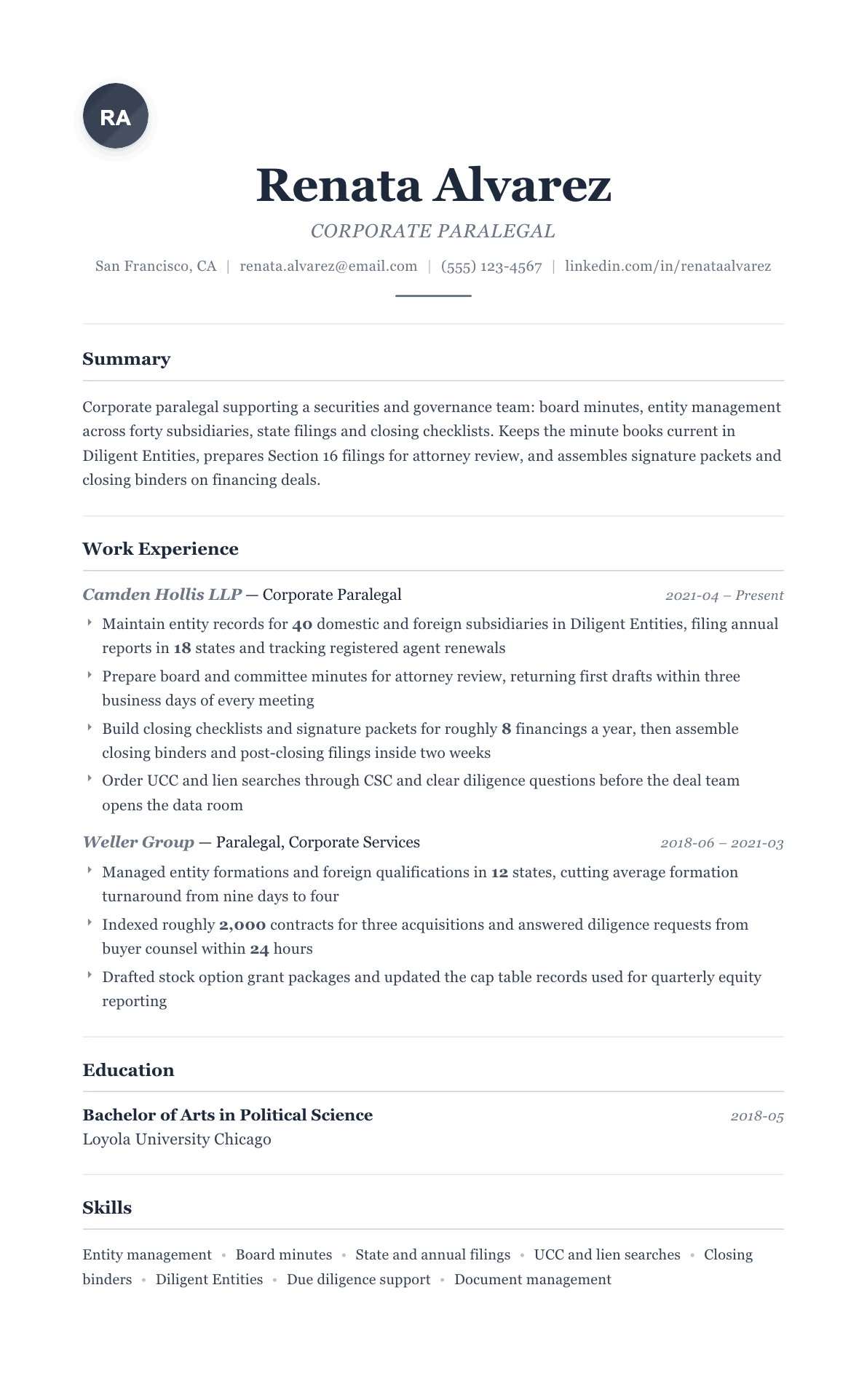
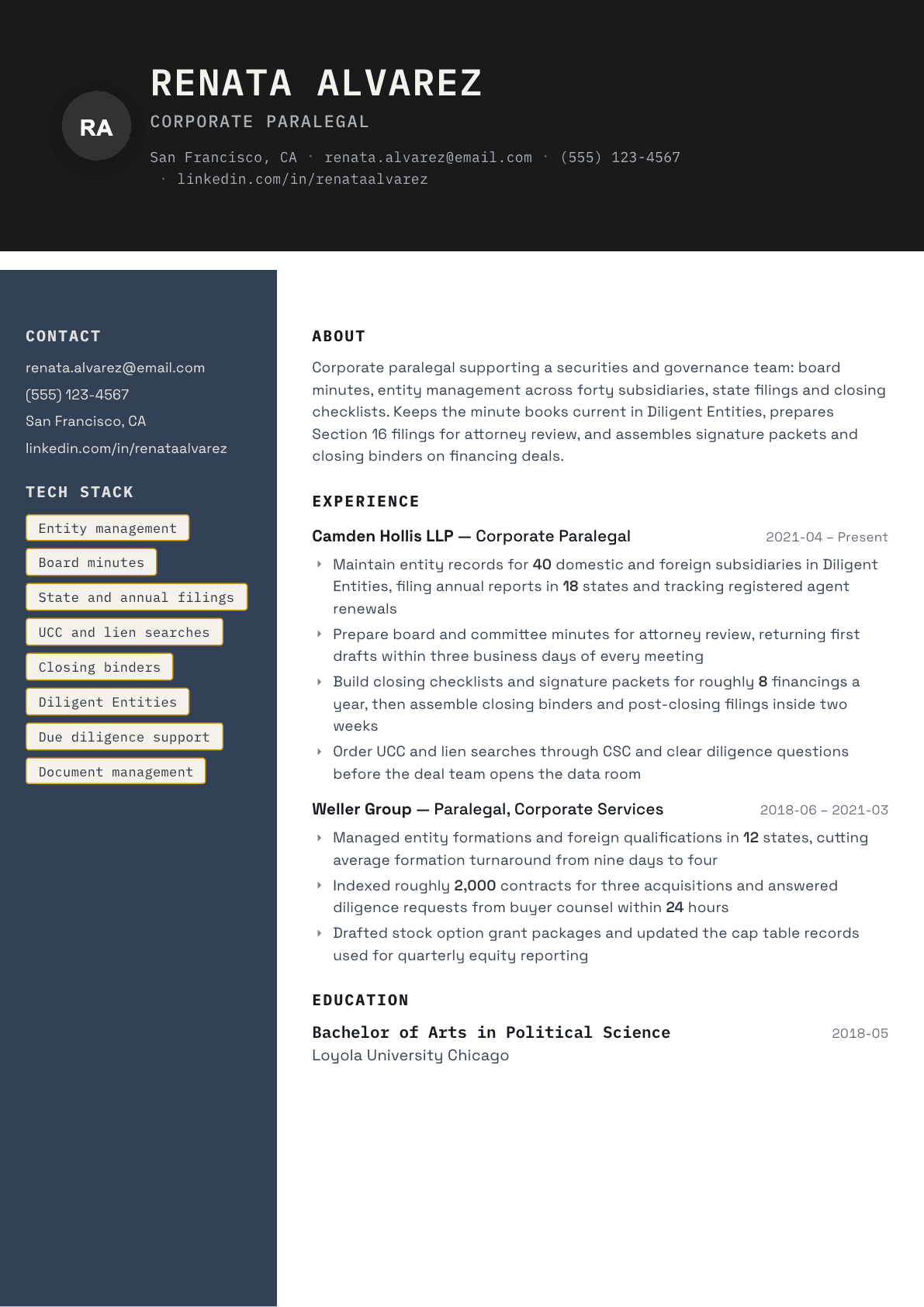
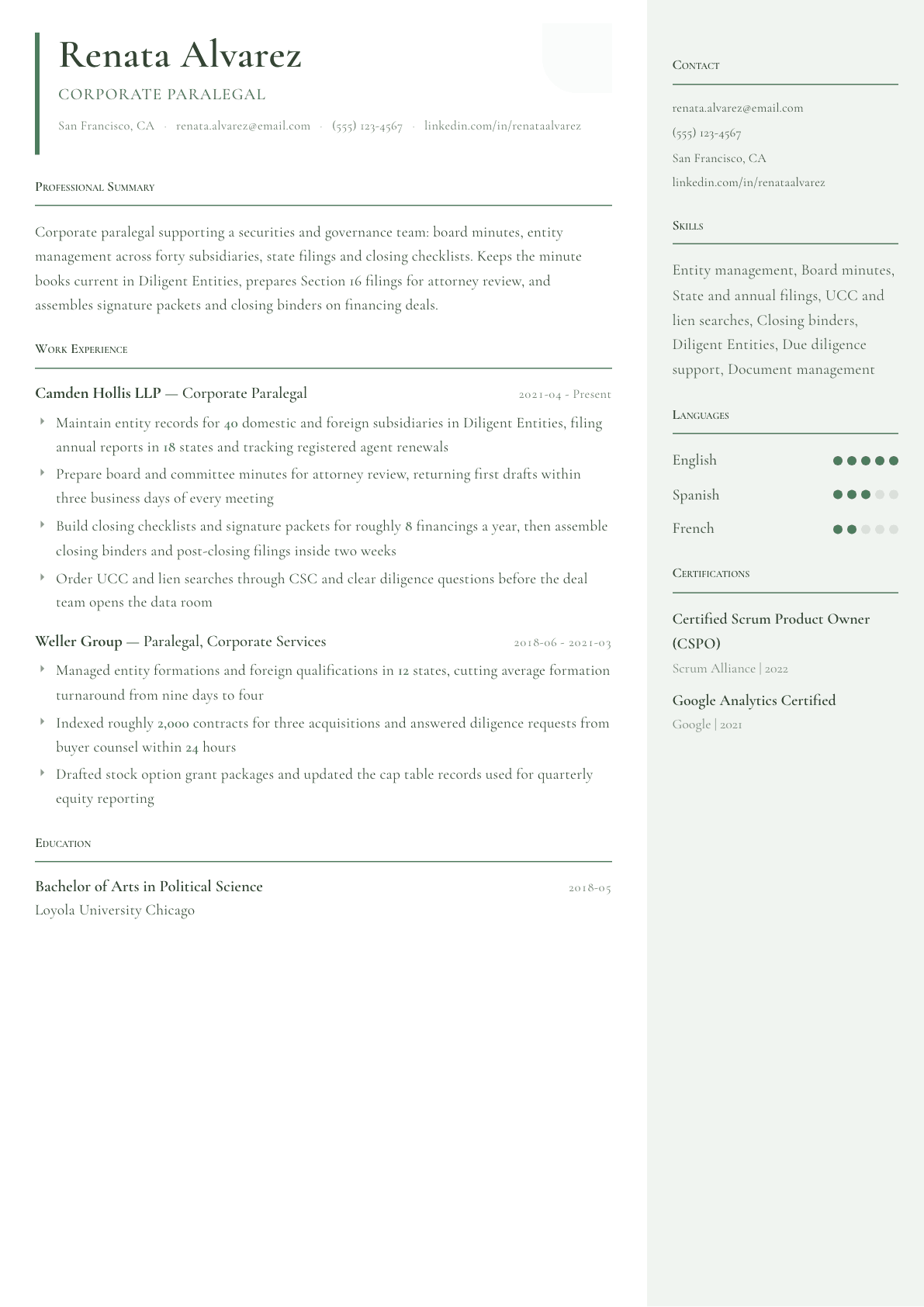
Example Corporate Paralegal summary
Corporate paralegal with six years supporting transactional and governance attorneys at a firm and a public company. Manages a portfolio of forty subsidiaries, prepares board minutes and stock records, and runs closing logistics on financings and acquisitions. Comfortable owning diligence trackers, signature packets and post-closing filings with light supervision.
Skills to list on a Corporate Paralegal resume
- Entity management
- Corporate governance support
- Board and committee minutes
- Annual report filings
- Delaware and state filings
- UCC filings and searches
- Due diligence coordination
- Closing checklists
- Signature page management
- Cap table records
- Data room administration
- Contract abstracting
- Diligent Entities
- Document retention
What actually gets this resume read
- Name the entity count and the states you file in, because that number tells a general counsel how much volume you have carried.
- Separate transactional work from governance work in each job, since firms and companies hire for one side or the other.
- List the entity, minute book and data room systems you have used by name so the screening software matches them.
- Show turnaround on minutes, filings and closing binders, as timeliness is what corporate attorneys actually complain about.
- Say whether you support a law firm or a company legal department, because the daily rhythm of the two is not the same.
- Keep a short securities line if you touch Section 16, proxy or annual report support, and drop it entirely if you do not.
How to write a corporate paralegal resume
A corporate paralegal resume is screened by someone who already knows what the job costs when it goes wrong: a missed annual report that puts an entity out of good standing on the morning of a closing, a minute book that cannot be produced during diligence, a signature page attached to the wrong version of the agreement. The reader is usually a corporate partner, a legal operations lead or a senior paralegal, and every one of them is looking for evidence that you have carried this weight without an attorney checking each step.
That evidence is specific and countable. How many entities you maintain, in how many states, on which system. How fast minutes come back after a board meeting. How many closings you have staffed and what you owned in each. Resumes that describe the role in the abstract, assisting attorneys with corporate matters, get filtered out because they say nothing a hiring manager can act on.
This guide covers the sections in the order a corporate legal team reads them, gives example summaries for someone breaking in, someone with a few years and someone running the entity portfolio, and shows how to rewrite the bullets most corporate paralegals write on the first draft.
Format: reverse chronological, one page until you have real closing volume
Corporate legal readers want dates, employers and continuity, so reverse chronological order is the only safe structure. Keep to a single column: firm document management systems and applicant tracking software both mangle side-by-side layouts, and a resume that arrives with the dates stripped out invites the exact question you do not want asked.
Put a credentials line under your name if you hold a paralegal certificate or certification, then the city and state. If you support entities in a specific jurisdiction of formation, mention it once here rather than repeating it in every job.
- Header: name, paralegal certification if held, city and state, phone, email.
- Order: summary, corporate experience, systems and skills, education, certifications.
- Two pages become normal once you have both firm and company-side experience to show.
Summary: entity count, deal type, and who you support
Three lines. Name the setting first, a law firm corporate group or a company legal department, because the daily work diverges sharply between them. Then the portfolio: how many entities, formed where, and whether they are domestic only or include foreign subsidiaries. Then the transactional side: financings, acquisitions, reorganizations, or nothing at all if your work is purely governance.
Avoid the word detail-oriented. Every corporate paralegal claims it, and the entity count already proves it far better than the adjective does.
Experience: separate the governance work from the deal work
Inside each job, group your bullets into two clusters even if you do not label them. Governance covers entity maintenance, annual reports and franchise tax filings, registered agent management, minute books, board and committee minutes, written consents, officer and director changes, and stock records. Deal work covers diligence trackers, data room administration, closing checklists, signature packets, funds flow support, and post-closing filings.
Each cluster wants a number attached. Forty entities across eighteen states is a portfolio. Eight financings a year with the closing binder delivered inside two weeks is a rhythm. Without those, the reader cannot tell whether you supported one deal in three years or one a month.
Name the systems in the bullets, not only in a skills list: entity management platforms, the data room you have administered, the document management system, the search vendor you use for lien and litigation searches. A corporate group on the same stack will read that as a shorter ramp-up.
Securities and public company work: include it only if you have it
If you have supported a public company, say so plainly and name the work: Section 16 filing preparation, proxy statement logistics, annual meeting support, stock plan administration, insider trading pre-clearance logs. This is a genuine differentiator, because far fewer paralegals have touched it than claim familiarity with it.
If your experience is private company only, do not blur the line with phrases like exposure to securities matters. A corporate partner will ask about it in the first ten minutes and a vague claim turns into an awkward answer.
Skills and keywords the screening software is matching
Corporate postings repeat a short vocabulary: entity management, good standing, foreign qualification, registered agent, minute book, written consent, capitalization table, due diligence, closing checklist, UCC filings, and the platforms. Mirror the exact phrase the posting uses once in the skills block and once inside a bullet where you actually did it. Keyword blocks with no matching bullet are transparent to a human reader.
Keep the skills section factual: systems, filing types and jurisdictions. Attributes like organized and dependable belong in the experience section, demonstrated by turnaround times rather than asserted.
Corporate Paralegal resume summary examples
Moving in from another paralegal area
Paralegal with two years of litigation support and a corporate certificate, now focused on transactional work. Maintains entity records for 15 subsidiaries, prepares annual report filings in 6 states, and assembles diligence indexes and closing checklists under attorney supervision. Trained on Diligent Entities and a firm document management system.
Five years, firm side
Corporate paralegal supporting a 9-attorney corporate group: entity formations, qualifications and annual filings across 20 states, board minutes and written consents, and closing logistics on venture financings. Runs the diligence tracker and closing binder on roughly 10 deals a year and manages the registered agent relationship for the whole client base.
Senior, company side
Senior corporate paralegal owning a portfolio of 60 domestic and foreign entities for a public company: good standing, franchise tax, officer changes and minute books. Prepares Section 16 filings and annual meeting materials for review, supports the equity plan administration, and trains two junior paralegals on the entity platform.
Work experience bullets: before and after
Before: Assisted attorneys with corporate matters and filings.
After: Maintained 42 domestic and foreign entities in Diligent Entities, filing annual reports in 18 states and clearing three lapsed registrations back into good standing.
The portfolio size, the platform and a recovered problem replace a sentence that could describe any legal support role.
Before: Prepared board meeting materials.
After: Drafted board and compensation committee minutes for attorney review within three business days of each meeting, and kept written consents and signature tracking current in the minute book.
Turnaround and the specific governance documents show a manager exactly what lands on her desk and when.
Before: Helped with due diligence on acquisitions.
After: Built and ran the diligence tracker on three acquisitions, indexing roughly 2,000 contracts in the data room and answering buyer counsel requests within 24 hours.
Ownership of the tracker plus volume and response time turns generic help into a described workstream.
Before: Worked on closings.
After: Staffed 8 financings a year end to end: closing checklist, signature packets, funds flow distribution list, then the closing binder and post-closing filings delivered inside two weeks.
Listing the closing artifacts proves you know the sequence rather than that you were present for it.
Before: Ordered searches and filed UCC documents.
After: Ordered UCC, judgment and tax lien searches through CSC across 12 jurisdictions and prepared UCC-1 and termination filings, resolving discrepancies before the deal team reviewed the summary.
Naming the search types, the vendor and the jurisdiction count shows independent handling of a task attorneys hate revisiting.
Hard skills
- Entity management and good standing
- Foreign qualifications and withdrawals
- Annual report and franchise tax filings
- Board and committee minutes
- Written consents and resolutions
- Minute book maintenance
- Stock records and capitalization tables
- Due diligence trackers
- Data room administration
- Closing checklists and signature packets
- UCC filings and lien searches
- Post-closing filings
- Contract abstracting
- Document management systems
Soft skills
- Deadline ownership
- Attorney communication
- Discretion with confidential deal information
- Coordination across time zones
- Calm handling of closing pressure
- Training junior staff
Certifications worth listing
- Certified Paralegal (CP) (National Association of Legal Assistants)
- Registered Paralegal (RP) (National Federation of Paralegal Associations)
- Professional Paralegal (PP) (NALS, the association for legal professionals)
Mistakes that cost corporate paralegal candidates the interview
- Writing assisted attorneys with corporate transactions and leaving the reader with no idea what you actually held.
- Omitting the entity count and the states, which is the single number a corporate hiring manager wants first.
- Blending governance and deal work into one undifferentiated list so neither strength is visible.
- Claiming public company experience through vague words when you have only supported private entities.
- Leaving out the entity management and document systems, then losing to a candidate who named the platform the team already runs.
- Using a two-column template with graphics, which firm systems often parse out of order and strip of dates.
- Listing every deal you were near, rather than the ones where you owned the checklist or the binder.
Corporate Paralegal resume questions
Do I need a paralegal certificate to work as a corporate paralegal?
Not always. Many corporate teams hire on transactional experience alone, especially company side. A certificate helps when you are moving in from another practice area or another industry, because it signals you understand the vocabulary before your first closing.
How do I move from litigation to corporate work on paper?
Lead the summary with the corporate work you have done, however small, then translate litigation strengths that carry over: document indexing, deadline calendars, exhibit control and vendor management. Put a corporate certificate or coursework near the top so the reader sees deliberate direction.
Should I list every deal I supported?
No. List the deal types and annual volume, then describe two or three matters where you owned a workstream such as the diligence tracker, the signature process or the closing binder. A long list of transactions reads as attendance rather than responsibility.
How do I describe entity management without sounding repetitive?
Give the portfolio once with a number and a jurisdiction range, then spend the remaining bullets on the harder parts: restoring lapsed entities, dissolving dormant ones, restructuring a group after an acquisition, or migrating records onto a new platform.
Is firm experience or company experience better for a corporate paralegal?
Neither ranks above the other, but they read differently. Firm experience signals deal volume across many clients, and company experience signals ownership of one entity structure over time. Say which you have and match your bullets to the setting the posting describes.