Dispatch Coordinator Resume Examples: what gets the call
Keep Things Moving with a Dispatch Coordinator Resume
By Mustafa Tarabya, founder of CVBooster · Published · Updated
Create a dispatch coordinator resume showcasing your scheduling, routing, and real-time coordination skills for transportation and logistics roles.
Sample resumes for a dispatch coordinator
The same dispatch coordinator content laid out in three CVBooster templates, so you can see what the finished document looks like before you write a word.
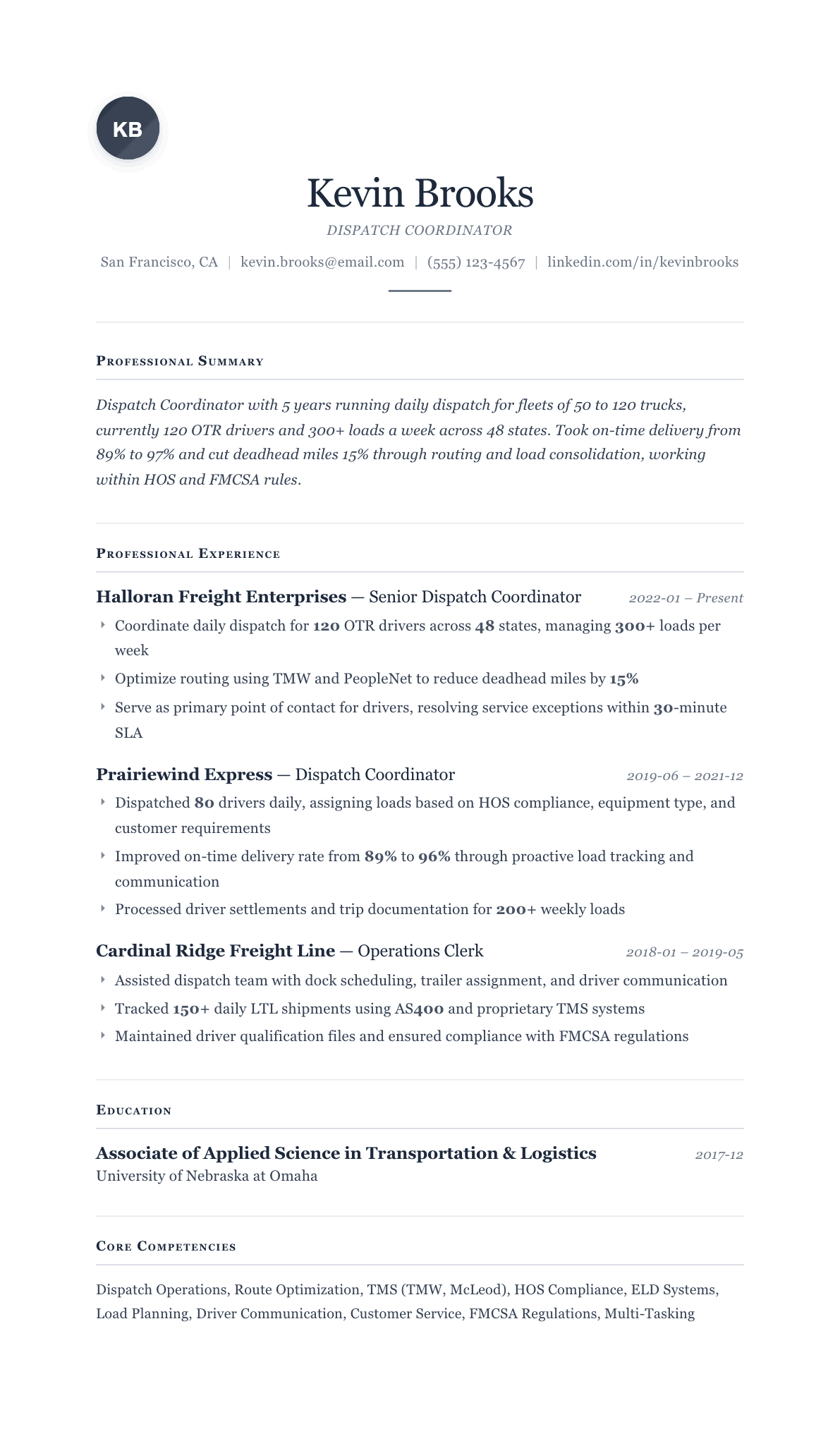
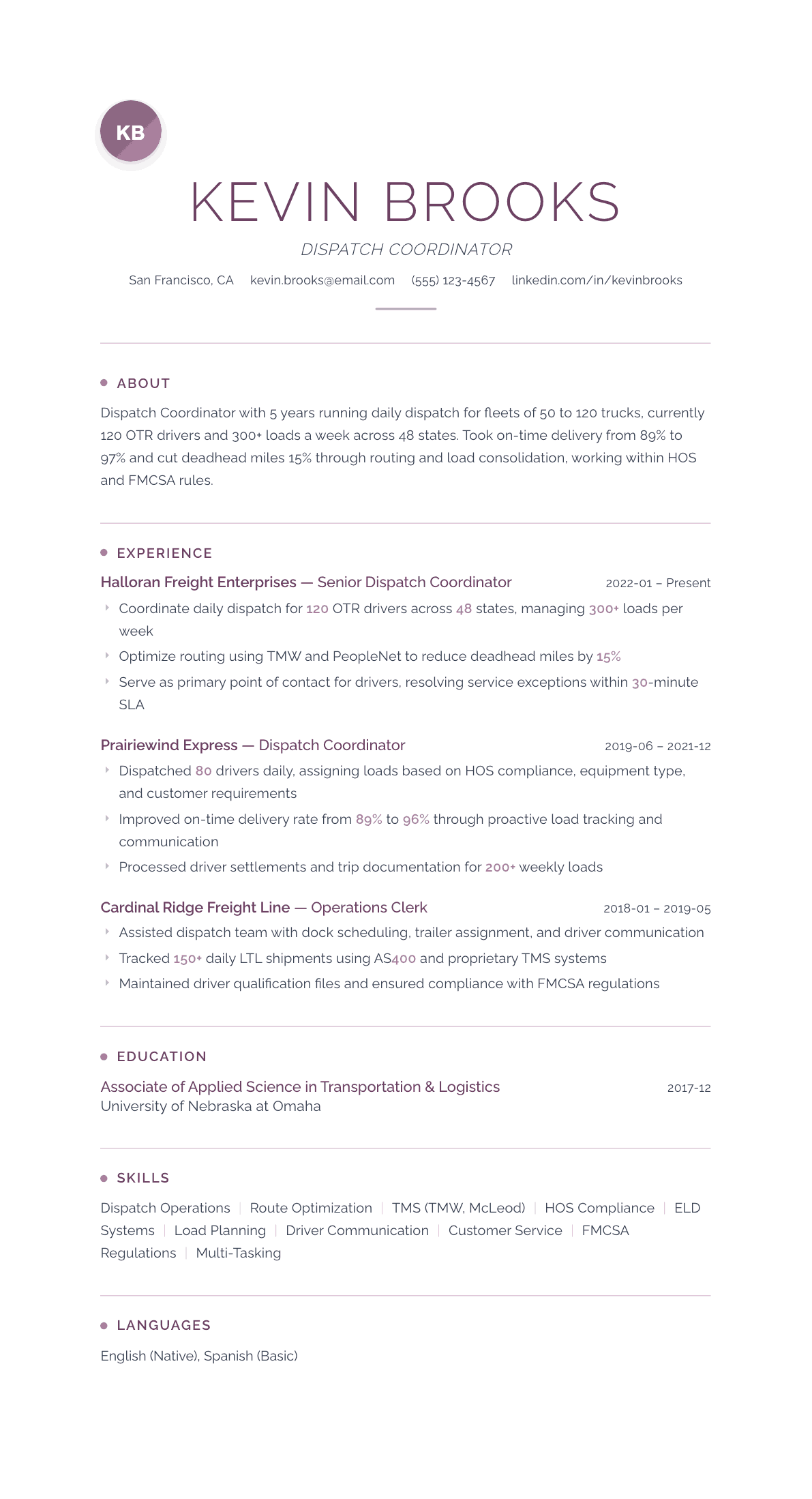
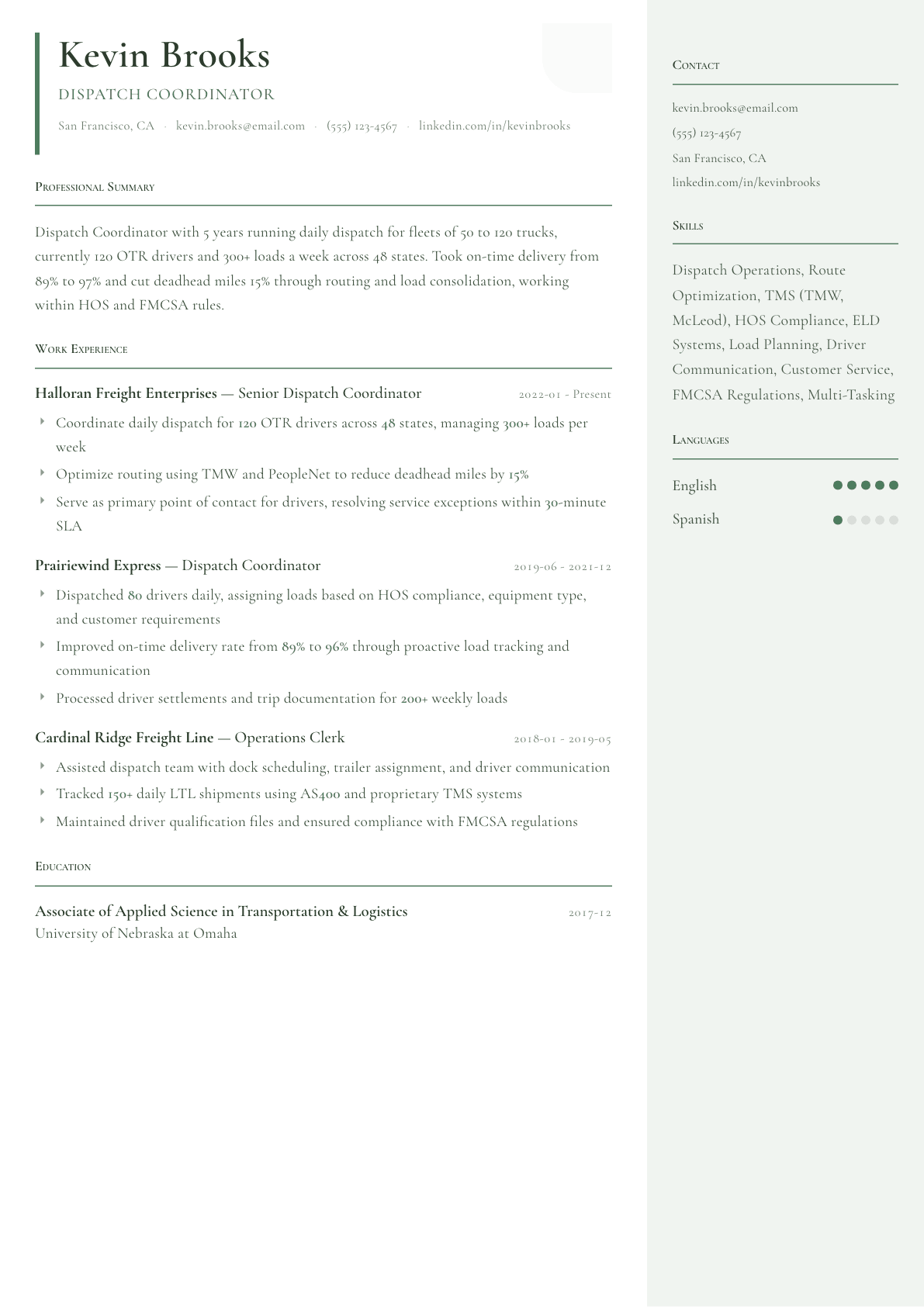
Example Dispatch Coordinator summary
Experienced Dispatch Coordinator managing daily operations for 120+ vehicle fleets across 48 states. Improved on-time delivery from 89% to 97% and reduced deadhead miles by 15% through optimized routing. Seeking a dispatch manager role with a top carrier.
Skills to list on a Dispatch Coordinator resume
- Dispatch Operations
- Route Optimization
- TMS Systems
- ELD / Telematics
- HOS Compliance
- Load Planning
- Driver Management
- Customer Communication
- FMCSA Regulations
- Problem Solving
- Multi-Tasking
- Documentation
- DOT Compliance
- Scheduling
What actually gets this resume read
- Quantify your dispatch volume: number of drivers, loads per week, and geographic coverage area.
- Highlight on-time delivery improvements and deadhead mile reductions with specific percentages.
- List TMS and ELD platforms: TMW, McLeod, PeopleNet, Omnitracs, Samsara, KeepTruckin.
- Emphasize your knowledge of HOS regulations and FMCSA compliance requirements.
- Show your ability to handle high-pressure situations and make quick decisions.
How to write a dispatch coordinator resume
Dispatch is a job of constraints, and the people hiring for it read a resume to find out which constraints you have worked inside. Hours of service limits, appointment windows, equipment availability, driver home time, customer service agreements and weather all collide on the same board, and a dispatch coordinator is judged on how well the day survives that collision. A resume built from duties tells the reader nothing about that. A resume built from fleet size, load counts and service numbers tells them everything.
The second question is what kind of dispatch you have run, because the title covers several different jobs. Over-the-road truckload dispatch is about hours of service planning and driver relationships across days. Local and less-than-truckload dispatch is about a fixed door schedule and tight stop counts. Field service dispatch is about technician skills, parts and appointment promises. Each has its own systems and its own failure modes, so the resume has to say which one.
This guide covers the layout, how to write driver and load volume, how to present service recovery and compliance work, three summaries from a dispatch clerk to a dispatch supervisor, before-and-after bullets, and the questions coordinators ask when they move between carriers, brokers and private fleets.
Format: one page early, two once you have supervised a board
Keep it to a page for the first few years, then move to two once you have run a board of your own or supervised other coordinators. Single column, reverse-chronological, plain headings. Under each title, open with a scope line: fleet size, geography, equipment types, loads per week and the shift you covered.
Shift matters more here than in most operations roles. Night dispatch, weekend coverage and holiday rotation are hard to staff, and a coordinator who has held those slots reliably should say so, because it removes a scheduling worry for the hiring manager.
- Header: name, city and state, phone, email, and shift availability if you are open to nights or weekends.
- Sections in this order: summary, dispatch experience with a scope line each, systems, compliance and safety, education.
- Name the equipment: dry van, reefer, flatbed, tanker, intermodal, straight truck, cargo van or service vehicles.
- Say whether the fleet was company drivers, owner operators, or a mix, since that changes how loads are offered.
Summary: fleet size, load volume, lanes and the service number you own
Name the years, the number of drivers you dispatched, weekly load count, the geography and the one service metric you improved. On-time pickup and delivery, empty mile percentage, loads covered without a broker, detention hours reduced and driver turnover are the numbers dispatch is graded on.
If you are moving from brokerage to an asset carrier or the other way, say so and name what transfers. Covering loads on a load board and dispatching a fleet you own use overlapping skills but different constraints, and a manager will assume you do not know the difference unless you show that you do.
Experience: the board, the drivers, the exceptions
Write bullets across three areas. The board is planning: load assignment against available hours, appointment scheduling, pre-planning the next load before the current one delivers, trailer pool and drop and hook management, and empty mile reduction through backhaul matching. Numbers here are loads per week, drivers covered and empty miles as a share of total.
The drivers are the second area, and the one most dispatch resumes underplay. Driver retention is heavily influenced by dispatch, because home time promises, load fairness and how a coordinator handles a bad day decide whether a driver stays. Say how many drivers you carried, how you handled home time requests, and whether retention on your board differed from the fleet.
The third area is exceptions, which is where the job actually happens. Breakdowns and roadside repair coordination, weather reroutes, missed appointments, detention at the dock, refused loads, service failures reported to the customer and recovery plans. One clear bullet about a recovery under pressure carries more weight than three about routine assignment.
- Board: loads per week, drivers dispatched, lanes and regions, equipment mix, pre-plan rate.
- Compliance: hours of service planning, electronic logging device exceptions reviewed, driver qualification file support, hazardous materials paperwork.
- Service: on-time pickup and delivery rate, check call cadence, customer status updates, detention tracking and billing support.
- Recovery: breakdowns coordinated, loads recovered after a service failure, weather reroutes, relay and team assignments.
Systems: name every platform you have worked in
This is the section a dispatch manager reads twice, because training on a new transportation management system takes weeks. Name the system you dispatched in, the electronic logging and telematics platform, the load boards you sourced from, the customer portals you posted status into, and any electronic data interchange status messaging you handled.
Add the adjacent tools honestly: mapping and mileage software, fuel routing, appointment scheduling portals used by large receivers, and the spreadsheet or reporting layer you built your daily board from. Coordinators who built their own pre-plan sheet in a spreadsheet should say so, because it shows initiative in a role where most people work only inside the software given to them.
Compliance, safety and the vocabulary to mirror
Dispatch sits close to compliance, and a coordinator who understands the rules is worth substantially more than one who dispatches into a violation and lets safety clean it up. Show that you planned loads against available driving and duty hours, reviewed logging exceptions, held loads rather than pushing a driver past a limit, and supported driver qualification and inspection paperwork.
Mirror the posting language. Truckload postings use pre-plan, deadhead, relay, detention, appointment and reefer settings. Less-than-truckload postings use pickup and delivery routes, door assignments, linehaul and dock schedule. Field service postings use technician skills matrix, first-time fix rate, parts availability and appointment windows. Use the vocabulary of the job you want rather than the one you left.
Dispatch Coordinator resume summary examples
Dispatch clerk
Dispatch clerk with two years supporting a board of 40 drivers, entering loads, tracking 150 shipments a day and maintaining check calls and status updates into two customer portals. Familiar with electronic logging exceptions and driver qualification paperwork. Seeking a full dispatch coordinator seat on a regional fleet.
Five years in
Dispatch coordinator with five years running boards of 50 to 120 drivers across 48 states, covering roughly 300 loads a week on dry van and reefer. Lifted on-time delivery from 89% to 97% and cut empty miles by 15% through backhaul matching and earlier pre-planning.
Dispatch supervisor
Dispatch supervisor with eleven years and four years leading a team of six coordinators over a 220-truck fleet. Owns board assignments, escalation on service failures, driver home time policy and the weekly service review with three national accounts, holding driver turnover below the fleet average.
Work experience bullets: before and after
Before: Dispatched drivers and assigned loads daily.
After: Dispatched a board of 120 over-the-road drivers across 48 states, covering roughly 300 loads a week and pre-planning the next load before delivery on more than eight in ten trips.
Fleet size, geography, load volume and a pre-plan rate describe a board rather than a job description.
Before: Improved on-time delivery for customers.
After: Raised on-time delivery from 89% to 97% over three quarters by moving appointment booking one day earlier and adding a mid-transit check call on every load over 500 miles.
Two values and the mechanism behind them show a change you designed rather than a trend you rode.
Before: Reduced empty miles for the fleet.
After: Cut empty miles by 15% by building a backhaul matrix for the six busiest outbound lanes and holding trucks for a matching return load rather than dispatching them home unloaded.
The lever is named, so the saving reads as a planning decision instead of a lucky freight mix.
Before: Communicated with drivers throughout the day.
After: Handled 80 driver calls a shift on load changes, breakdowns and home time, resolving service exceptions inside a 30-minute response standard and escalating repairs to the maintenance desk with the unit number and location.
Call volume, a response standard and a named escalation path turn communication into a measurable practice.
Before: Made sure drivers followed hours of service rules.
After: Planned every assignment against remaining driving and duty hours, refused three loads a week that could not be run legally, and worked with the safety desk to review logging exceptions before they aged.
Refusing loads is the concrete proof of compliance judgment that a general statement about rules never provides.
Hard skills
- Load planning and assignment
- Hours of service planning
- Transportation management systems
- Electronic logging device platforms
- Load board sourcing
- Appointment and dock scheduling
- Empty mile and backhaul optimization
- Trailer pool and drop and hook management
- Check calls and status reporting
- Detention tracking and documentation
- Rate confirmations and load paperwork
- Driver settlement support
Soft skills
- Composure with frustrated drivers
- Rapid prioritization
- Clear phone communication
- Negotiating appointment changes
- Handling overlapping interruptions
- Fairness in load assignment
Certifications worth listing
- Certified in Logistics, Transportation and Distribution (CLTD) (Association for Supply Chain Management)
- Certified Transportation Broker (CTB) (Transportation Intermediaries Association)
- Hazardous Materials Employee Training (Pipeline and Hazardous Materials Safety Administration)
- ICS-100 Introduction to the Incident Command System (Federal Emergency Management Agency)
- Transportation Worker Identification Credential (Transportation Security Administration)
Mistakes that cost dispatch coordinator candidates the interview
- Listing duties like assigning loads and answering calls without the fleet size or weekly load volume that makes them mean something.
- Leaving out the transportation management system you dispatched in, which is the biggest factor in your training time.
- Ignoring driver retention, even though dispatch decisions are one of the main reasons drivers leave a carrier.
- Saying you ensured compliance without showing a single case where you held a load rather than run it illegally.
- Failing to name the equipment types, so a reefer carrier cannot tell whether you have handled temperature settings.
- Describing brokerage coverage and asset fleet dispatch as if they were the same work.
- Hiding night and weekend shift experience, which is the coverage most dispatch managers struggle to fill.
Dispatch Coordinator resume questions
What numbers should a dispatch coordinator put on a resume?
Drivers dispatched, loads per week, geography and equipment mix, on-time pickup and delivery rates, empty mile share, detention hours and driver retention on your board. Pair anything you improved with the starting value and the change you made.
How do I write a dispatch resume with no trucking experience?
Lead with any scheduling, routing or customer coordination work you have done, then add the industry vocabulary you have learned and any hours of service or hazardous materials training. Field service, taxi, ambulance and delivery scheduling all transfer better than applicants assume.
Should I list every transportation management system I have used?
Yes, and name the version or module if you know it, along with the electronic logging platform, load boards and customer portals. System fluency shortens onboarding by weeks, and hiring managers frequently choose between two candidates on this section alone.
How do I show that I handled pressure well?
Show it through an incident rather than a claim. Describe a breakdown, weather closure or missed appointment, what you did, who you told and what the customer received in the end. Interviewers ask for exactly this story, so put your best one on the page.
Is dispatch experience from a different industry transferable?
Often yes, because the core skill is allocating limited resources against time windows while people call you with problems. Translate your vocabulary to the target industry, name the systems, and add whatever regulatory knowledge the new field expects.
Related resume examples
- Fleet Manager Resume example
- Logistics Coordinator Resume example
- Truck Driver Resume example
- Dispatcher Resume example
- Delivery Operations Manager Resume example
- 911 Dispatcher Resume example