Tow Truck Driver Resume Examples: the lines they read
Build a Tow Truck Driver Resume Dispatchers Call First
By Mustafa Tarabya, founder of CVBooster · Published · Updated
A tow truck driver resume guide with equipment keywords, recovery examples, endorsement placement, and a sample that shows real road experience.
Sample resumes for a tow truck driver
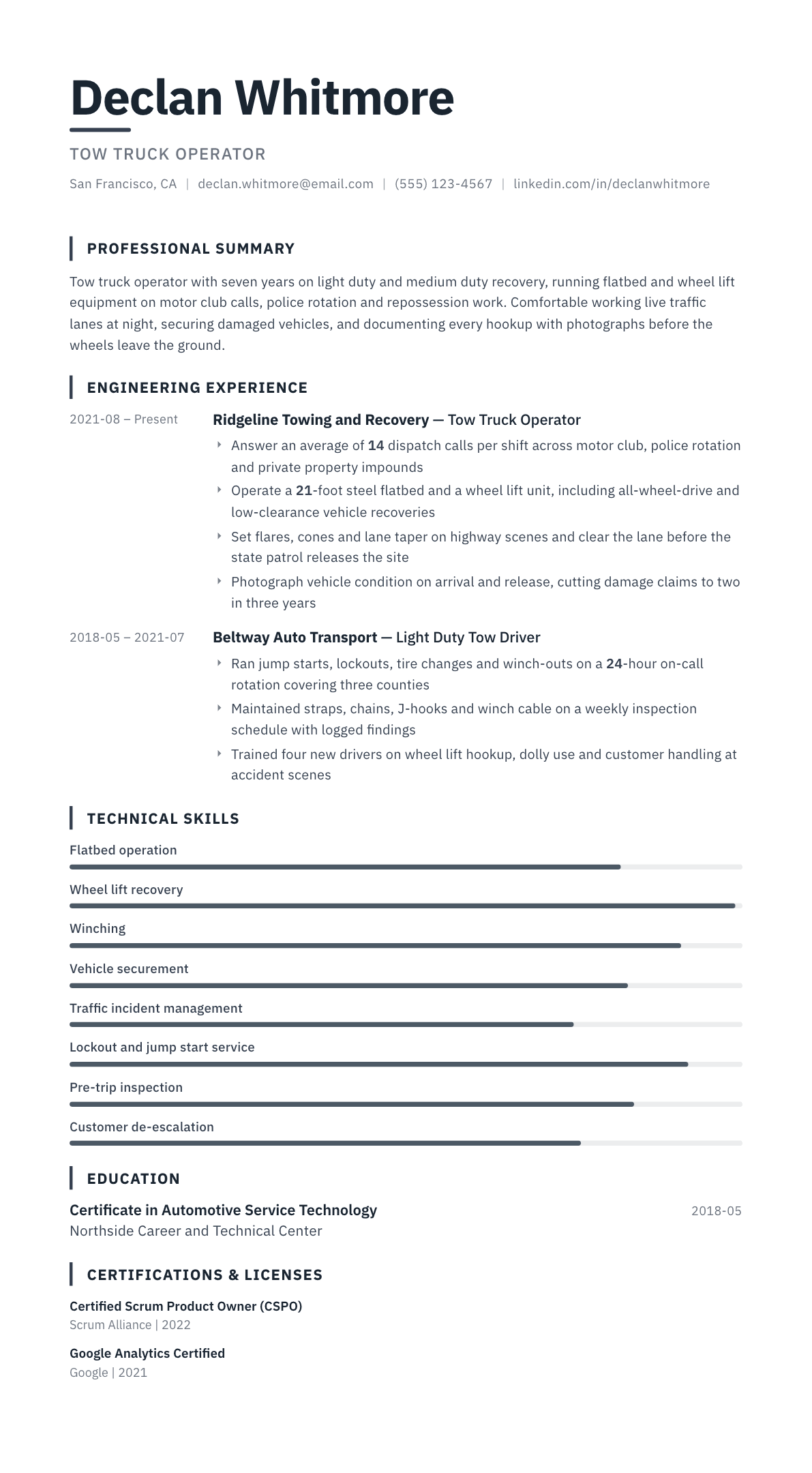
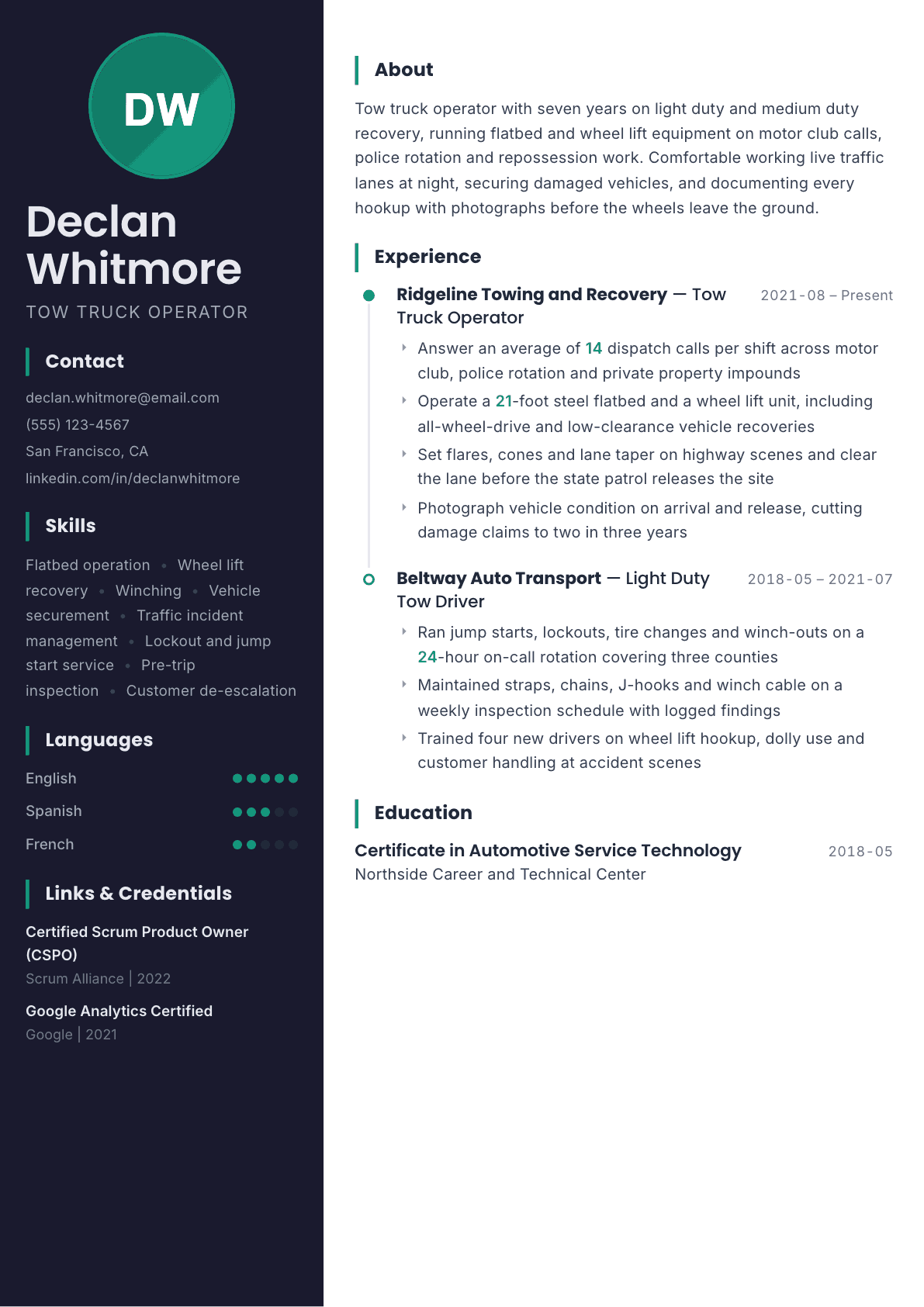
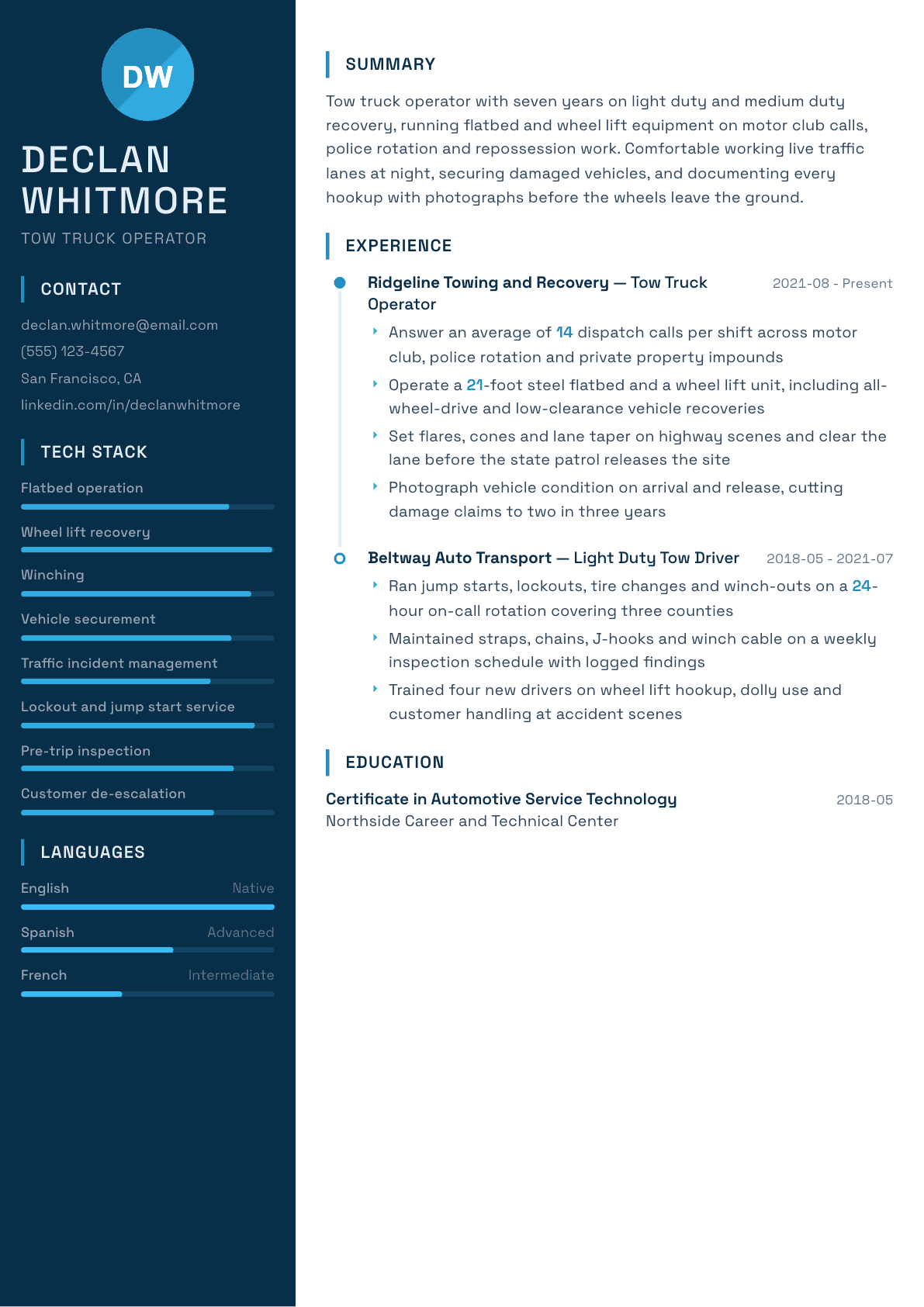
The same tow truck driver content laid out in three CVBooster templates, so you can see what the finished document looks like before you write a word.
Example Tow Truck Driver summary
Tow truck operator with seven years running flatbed and wheel lift equipment on motor club, police rotation and impound calls. Experienced with winch recoveries, all-wheel-drive hookups and night work in live traffic lanes, with a documented photo inspection habit that keeps damage claims near zero. Looking for a rotation position with a company that runs medium duty and heavy recovery.
Skills to list on a Tow Truck Driver resume
- Flatbed towing
- Wheel lift towing
- Winch recovery
- Vehicle securement and strapping
- Traffic incident management
- Roadside assistance
- Lockout service
- Jump starts and tire changes
- Impound and repossession procedures
- Dispatch software
- Pre-trip and post-trip inspection
- Accident scene documentation
- Customer de-escalation
- Air brakes
What actually gets this resume read
- Name every truck type you have run: flatbed, wheel lift, integrated, hook and chain, or heavy wrecker.
- Put your license class, endorsements and driving record status in the header where dispatch checks first.
- Describe the call mix you handled: motor club, police rotation, repossession, private property or accident recovery.
- Show safety on the page with scene setup, lane closure practice, and a low damage claim record.
- Include winch-out, off-road recovery and low-clearance work, because those calls need experienced operators.
- List any towing certification and its issuing body rather than writing that you are certified.
How to write a tow truck driver resume
Tow companies hire on two things they cannot train quickly: judgment on a scene and a driving record the insurance carrier will accept. Everything on a tow truck driver resume should feed one of those two answers. An owner reading your file wants to know which trucks you have run, what kinds of calls you have taken, whether you have damaged customer vehicles, and whether you can work a highway shoulder at two in the morning without becoming the second accident.
The usual mistake is writing the resume as a generic driving history. Towing is a skilled trade with its own equipment vocabulary, and an operator who never names a wheel lift, a dolly, a J-hook or a snatch block reads like someone who has only ridden along. The specifics are the qualification.
What follows is the section order tow operators should use, how to describe call volume and equipment, which credentials are real and worth listing, three summaries for different points in a towing career, and rewritten bullets that show the difference between listing duties and proving competence.
Format: one page, equipment and record visible immediately
Use one page and reverse-chronological order. Under your name, put license class, state, endorsements and driving record status, then a one-line equipment summary such as flatbed, wheel lift and medium duty wrecker. An owner reading on a tablet in the yard should have the answer in four seconds.
Keep the layout plain. Many towing operators post through job boards that strip formatting, and a resume built in two columns with icons can arrive with the equipment line detached from the job it belongs to.
- Header: name, city and state, phone, license class and endorsements, driving record status, medical card status if you hold one.
- Order: summary, equipment operated, towing experience, certifications and training, other driving history, education.
- State availability plainly. Night, weekend and on-call rotation coverage is often the deciding factor.
Summary: trucks run, call types taken, record held
Three lines that answer the phone screen in advance. Years operating, the truck classes you are checked out on, the mix of work you have handled, and one hard fact about your record. An operator who has run flatbed and wheel lift on motor club, police rotation and private property impounds for seven years with no at-fault accidents has said more than a page of adjectives.
If you are moving up from light duty to medium or heavy recovery, say that plainly and name the recovery work you have already assisted with. Owners promote from inside when they can, and they hire from outside when the resume shows the next step is a short one.
Experience: equipment, call mix, and what went right
Open each job with the fleet you operated and the call mix, then write bullets underneath. Steel or aluminum flatbed and its length, wheel lift unit, integrated truck, hook and chain, or a heavy wrecker with its boom rating. Then the mix: motor club dispatch, police rotation, accident recovery, private property impound, repossession, dealer transport or roadside assistance.
Bullets should carry the parts of the job an inexperienced driver gets wrong. All-wheel-drive hookups that require dollies, low-clearance vehicles that need ramps or skates, electric vehicles that cannot be towed on two wheels, winching a vehicle out of a ditch with proper anchor points, and securing a damaged car with straps rather than chains over painted surfaces.
Give call volume per shift and the geography you covered. Fourteen calls across three counties on a night shift describes a workload; saying you responded to service calls describes nothing.
- Name the trucks and their configuration, not just the word truck.
- Give the call mix in the proportions you actually ran it.
- Include scene safety practice: cone taper, flares, high visibility gear, lane closure coordination with police.
- Show a damage record, because customer vehicle claims are the cost that owners feel most.
Safety and documentation: the part that keeps the company insured
Write a bullet or two about how you set up a scene and how you document a vehicle. Photographing the vehicle on arrival and again at release, noting existing damage on the tow ticket, and getting a signature before the wheels leave the ground are practices that protect the company from claims. An operator who does this without being told is worth training around.
Equipment inspection belongs here too: checking winch cable for broken strands, straps for fraying, chains and J-hooks for wear, and the daily pre-trip on brakes, lights and hydraulics. Say what you inspected and what you found, because a driver who reports a fault before a failure is the one owners keep.
Keywords that hiring owners and job boards look for
The vocabulary is narrow and consistent: flatbed, wheel lift, winch out, recovery, rollover, secondary containment of fluids, motor club, rotation, impound, repossession, roadside assistance, lockout, jump start, tire change, vehicle securement and traffic incident management. Put these in the skills block and repeat the ones you are strongest at inside a bullet.
Add the dispatch platform you worked in if you used one, and name the motor clubs you took calls from by category rather than by brand if you are unsure of contract terms.
Tow Truck Driver resume summary examples
New operator
Driver with two years of local delivery and a clean record, recently trained on wheel lift and dolly hookup and now running light duty roadside calls. Handles lockouts, jump starts and tire changes independently and assists on flatbed loads. Looking for a full-time roadside position with a company that trains toward recovery work.
Six years on the truck
Tow operator with six years on flatbed and wheel lift equipment across motor club, police rotation and impound calls. Comfortable with all-wheel-drive hookups, low-clearance loads and winch-outs, and averages 14 calls per shift across three counties. No at-fault accidents and two damage claims in six years.
Lead operator
Lead tow operator with twelve years across light and medium duty recovery, currently running rotation calls and training four newer drivers on hookup, rigging and scene setup. Experienced with rollovers, load shifts and off-road winching using snatch blocks and proper anchor points. Seeking a shift lead or recovery supervisor role.
Work experience bullets: before and after
Before: Towed vehicles for customers as assigned by dispatch.
After: Answered an average of 14 dispatch calls per shift across motor club, police rotation and private property impounds, covering three counties on a night rotation.
The call count, the mix and the coverage area show the workload an owner is hiring you to absorb.
Before: Operated a tow truck safely.
After: Operated a 21-foot steel flatbed and a wheel lift unit, including all-wheel-drive recoveries on dollies and low-clearance loads using ramps and skates.
Naming the equipment and the two hookups that inexperienced drivers get wrong proves the skill instead of asserting safety.
Before: Worked accident scenes with police.
After: Set flares, cones and a proper lane taper on highway accident scenes, contained spilled fluids with absorbent, and cleared the travel lane before the state patrol released the site.
The sequence describes real scene procedure, which is what a rotation contract holds a company to.
Before: Careful with customer vehicles.
After: Photographed vehicle condition on arrival and at release and noted existing damage on every tow ticket, holding damage claims to two across three years.
A documented practice plus a claims record makes carefulness verifiable rather than a personality claim.
Before: Checked equipment regularly.
After: Inspected winch cable, straps, chains and J-hooks weekly with logged findings and completed daily pre-trips on brakes, lights and hydraulics, taking the truck out of service twice before a failure.
Listing the rigging by name and the two catches shows an operator who prevents downtime rather than reporting it.
Hard skills
- Flatbed operation
- Wheel lift operation
- Winch and recovery rigging
- Dolly and skate use
- Vehicle securement with straps and chains
- Traffic incident management
- Accident scene documentation
- Lockout and jump start service
- Tire change and fuel delivery
- Impound and repossession procedure
- Pre-trip and post-trip inspection
- Dispatch software and electronic tow tickets
- Fluid spill containment
- Air brake systems
Soft skills
- Composure at accident scenes
- Customer de-escalation
- Independent judgment on hookup method
- Night and on-call reliability
- Clear radio communication with dispatch
- Training newer operators
Certifications worth listing
- National Driver Certification Program (Towing and Recovery Association of America)
- WreckMaster Operator Certification (WreckMaster)
- SHRP2 Traffic Incident Management Responder Training (Federal Highway Administration)
- Commercial Driver Medical Examiner Certificate (Federal Motor Carrier Safety Administration)
Mistakes that cost tow truck driver candidates the interview
- Writing a driving history with no equipment vocabulary, so the reader cannot tell a flatbed operator from a ride-along.
- Omitting the driving record and endorsement status, which is the first thing the insurance carrier will ask about.
- Skipping the call mix, leaving an owner unable to tell whether you have worked a rotation or only private property tows.
- Treating scene safety as understood rather than describing how you actually set up a lane closure.
- Leaving out damage claims or accident history entirely, when a clean record is one of the strongest things you can prove.
- Listing a towing certification without the issuing body, which reads as filler to anyone who knows the real programs.
Tow Truck Driver resume questions
Do tow truck drivers need a commercial driver license?
It depends on the truck weight rating and the state. Light duty units are often driven on a standard license, while medium and heavy duty wreckers typically require a commercial class with air brakes. Put your actual class and endorsements on the resume rather than guessing at the requirement.
How should I list towing equipment on my resume?
Give it its own short line under the summary and repeat the details inside each job. Name the truck type, the bed length or boom rating, and the accessories you are checked out on such as dollies, skates, snatch blocks and go-jaks. Owners scan for those words.
What if I have an imperfect driving record?
Do not draw attention to it on the page, but do not hide the record status either. State the class and endorsements, keep the dates honest, and be ready to explain any incident directly in the interview with what you changed afterward. Background screening will surface it anyway.
How do I move from roadside assistance into recovery work?
Lead with the recovery-adjacent work you already do: winch-outs, off-road hookups, load shifts and any assists on rollovers. Then list the training you have completed toward heavier work. A resume that shows the next step is short gets the interview from an owner who is short on recovery operators.
Should I mention repossession experience?
Yes if you have it, because it demands different skills: quiet hookups, conflict avoidance, accurate documentation and compliance with state notice rules. Some companies run heavy repossession volume and screen specifically for operators who have handled it without incident reports.
Related resume examples
- Truck Driver Resume example
- Fleet Manager Resume example
- Local Truck Driver Resume example
- Dispatcher Resume example
- Bus Driver Resume example
- School Bus Driver Resume example