Van Driver Resume Examples: free ATS score and gap list
Build a Van Driver Resume Hiring Managers Trust
By Mustafa Tarabya, founder of CVBooster · Published · Updated
A van driver resume example with multi-drop route numbers, DVIR and load securement detail, ATS keywords and a full section-by-section writing guide.
Sample resumes for a van driver
The same van driver content laid out in three CVBooster templates, so you can see what the finished document looks like before you write a word.
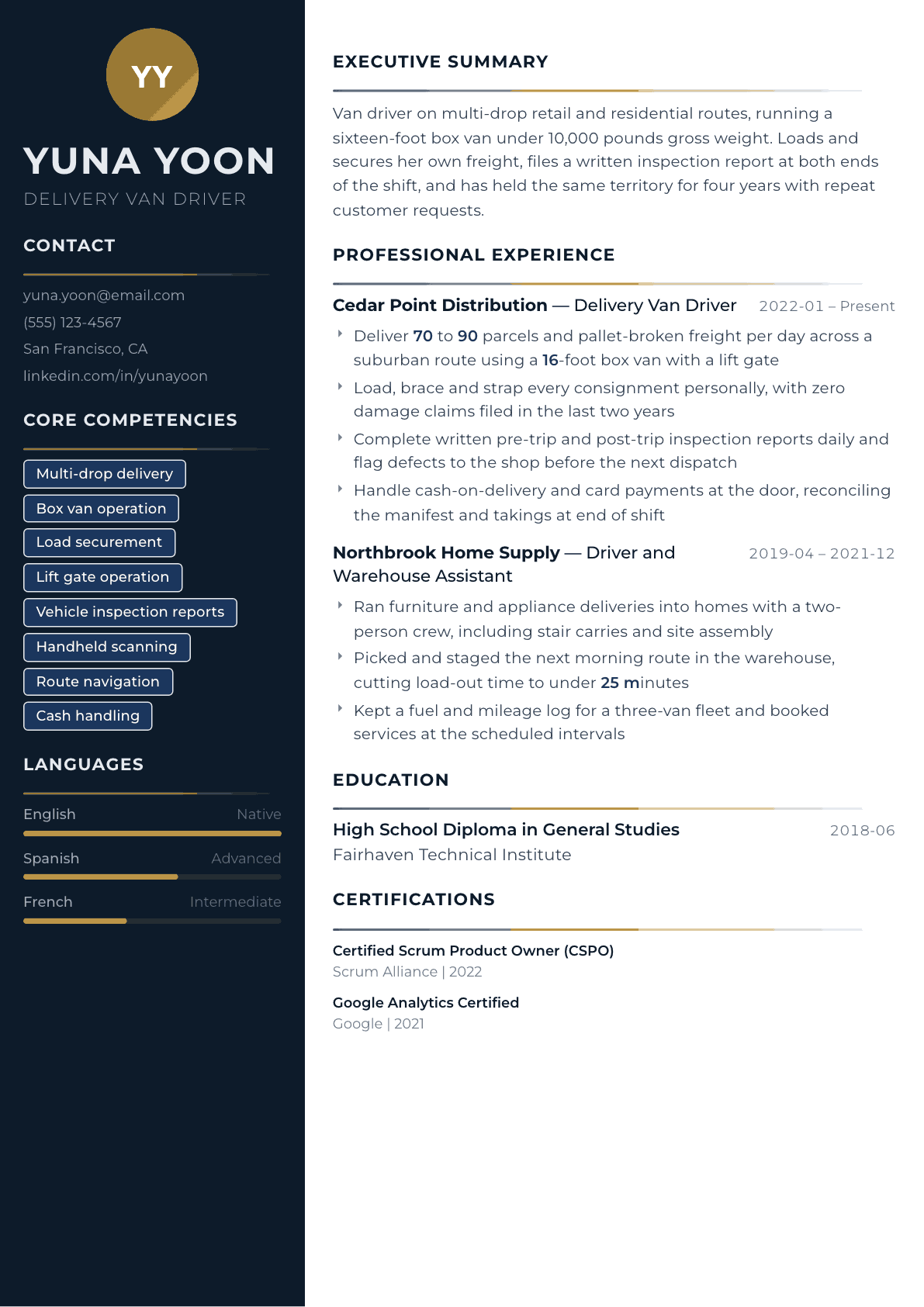
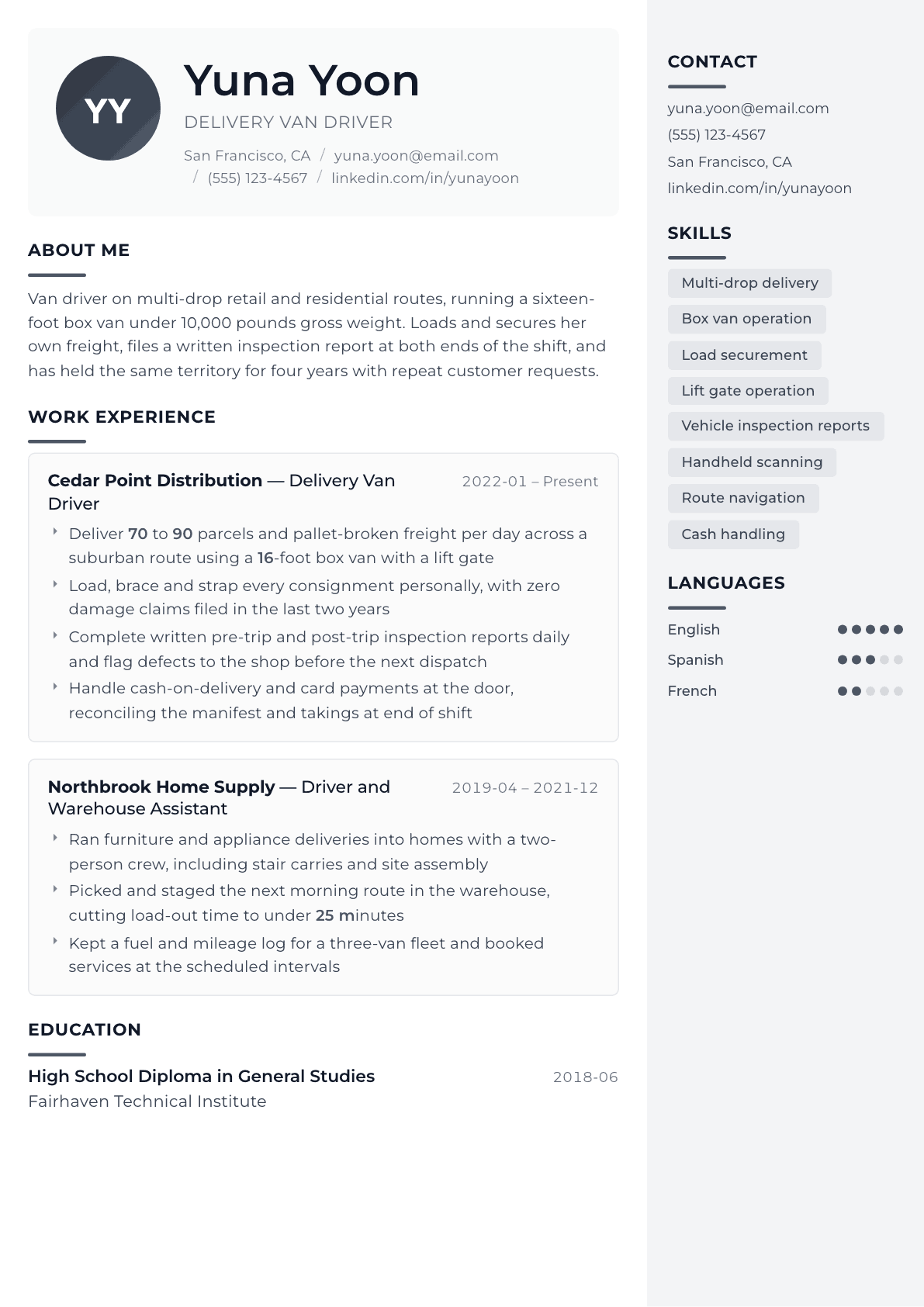
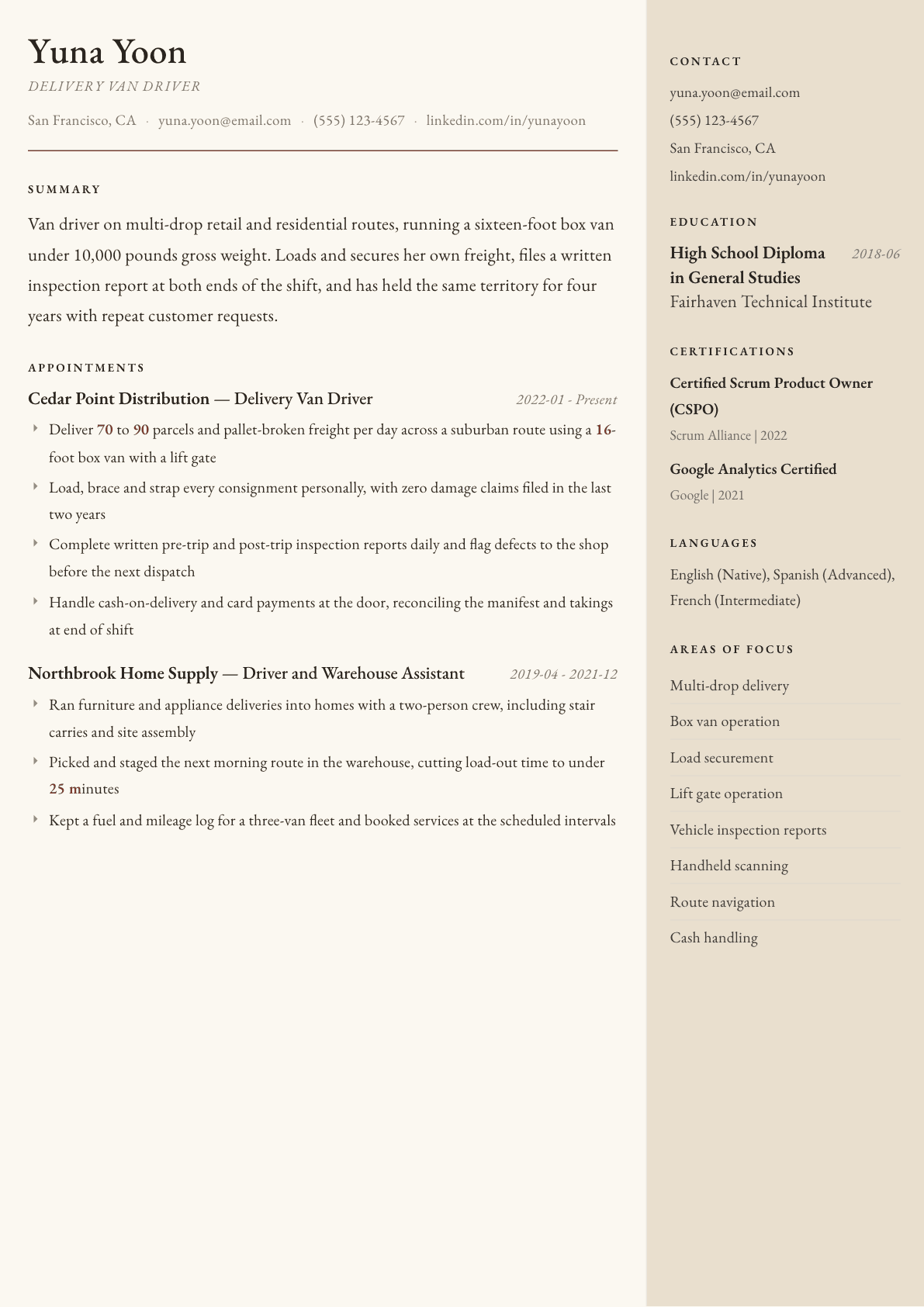
Example Van Driver summary
Van driver with five years on multi-drop retail and residential routes in a sixteen-foot box van with a lift gate, averaging eighty stops a day. Loads and straps her own freight, files written pre-trip and post-trip inspection reports, and has gone two years without a damage claim. Seeking a fixed-route driving position with a company that runs a maintained fleet.
Skills to list on a Van Driver resume
- Multi-drop routes
- Box van operation
- Load securement
- Lift gate operation
- Pallet jack
- Pre-trip inspection
- Post-trip inspection
- Route navigation
- Handheld scanner
- Customer delivery
- Cash handling
- Manifest reconciliation
- Defensive driving
- Fuel and mileage logs
What actually gets this resume read
- Say what size van you drove and its gross weight class, because that decides whether a license endorsement is needed.
- Give drops per day and the type of stop: residential doors, retail back doors, building sites or medical offices.
- Show that you inspect the vehicle: name the pre-trip and post-trip report and how you escalate defects.
- Mention lift gate, pallet jack and hand truck experience, since a lot of van work is really loading work.
- Include damage and claim history if it is clean, because freight damage is the cost a manager fears most.
- List the delivery app or scanner you used and whether you closed out your own manifest at end of shift.
How to write a van driver resume
Van driving is a loading job with a steering wheel attached. The person hiring you knows that, which is why a van driver resume that only talks about driving misses half of what the role is. Between the first stop and the last, you are strapping freight, working a lift gate, wheeling a hand truck up a ramp, and deciding whether a pallet is stable enough to move. The page has to show both halves.
The second thing a transport supervisor looks for is care of the vehicle. Vans get abused, and the driver who files an honest defect report on a soft brake pedal saves the company a breakdown mid-route. Inspection discipline, damage history and fuel and mileage logging are worth as much space on the resume as the delivery count.
What follows is the structure a fleet supervisor expects, how to fill the summary and experience sections with numbers rather than adjectives, three summaries for different stages of a driving career, before and after bullets, and answers to the questions van drivers ask most.
Format: one page, license and vehicle class first
Reverse-chronological, one page, plain single column. Transport offices print resumes and mark them up by hand, so avoid narrow columns and light gray text that vanishes on a laser printer.
Under your contact line, add a short driving block. It should answer the three screening questions before the reader reaches your first job: what you are licensed to drive, what you have actually driven, and whether your record puts you on the insurance without a surcharge.
- Driving block: license class and state, years held, vehicle sizes driven, insurance-relevant record, and availability.
- Body order: summary, driving experience, warehouse or loading experience, skills, training, education.
- Add a line for forklift or pallet jack certification if you hold one, since many van roles include yard work.
Summary: van size, route type, and drops per day
Name the vehicle in feet or by class, the route type, and the daily drop count in the first sentence. A sixteen-foot box van with a lift gate on multi-drop retail work is a completely different day from a small panel van running parts between branches, and the supervisor is staffing one of them, not both.
Then add the differentiator. Something like loads and secures his own freight, or four years on the same territory with repeat customer requests, tells the reader what kind of driver arrives on Monday. Keep it to three lines so the summary does not crowd the experience section.
Experience: the route, the freight, and the handling
Give each job a header line with the employer, the van and any equipment on it, and the route shape: multi-drop residential, retail back door, business to business, or site delivery. Then write bullets that a dispatcher could use to build a route.
Cover four areas across your bullets: volume, handling, customer contact and vehicle care. Volume is drops and parcels. Handling is what you moved by hand, what you strapped, and how heavy it was. Customer contact is signatures, payments, refusals and returns. Vehicle care is the daily inspection report and how you escalate a defect.
Damage and claim history deserves its own bullet when it is clean. Freight damage is a direct cost the depot manager carries on a monthly report, so a driver who can say two years with no damage claims is arguing with the same number the manager is measured on.
Loading skills belong on the page
Write out the equipment by name: lift gate, pallet jack, hand truck, e-track and load bars, ratchet straps, moving blankets, roll cages. If you have loaded your own van from a pick face in the morning, say so, because that means the depot can start you earlier and use you in the warehouse when routes are light.
Weight matters too. Describe typical consignment weights or how you handle two-person items, and note any manual handling training you have completed. Back injuries end driving careers, and a supervisor reads handling technique as a sign you will still be there next year.
Keywords that van postings repeat
Job boards fill van driver listings from a small set of phrases. Use them once in your skills list and once inside a bullet where the claim is proven: multi-drop, box van, lift gate, load securement, pre-trip inspection, defect reporting, proof of delivery, handheld scanner, manifest, clean driving record and customer service.
Also mirror the phrasing for the type of goods when the posting names it. Chilled goods, fragile items, furniture and appliances, building materials and pharmacy stock each imply handling rules the reader is checking for.
Van Driver resume summary examples
New to van work
Licensed driver with three years of warehouse picking and loading, moving into multi-drop van work. Confident with pallet jacks, hand trucks and load securement, familiar with handheld scanners from goods-in work, and available for early starts. Clean record with no points on the license.
Four years on a route
Van driver on multi-drop retail and residential routes in a 16-foot box van with a lift gate, averaging 80 drops a day. Loads and straps his own freight, files written inspection reports at both ends of the shift, and has completed two years with no damage claims and no missed service windows.
Lead driver
Lead van driver with ten years across parcel, furniture and pharmacy delivery, now running route planning and driver induction for a nine-van depot. Still drives the hardest territory four days a week, holds manual handling and forklift certification, and has kept the depot damage rate the lowest in the region.
Work experience bullets: before and after
Before: Delivered items to customers in a company van.
After: Delivered 70 to 90 parcels and broken-pallet freight per day on a suburban multi-drop route in a 16-foot box van with a lift gate.
The volume, freight type, vehicle size and lift gate let a supervisor picture the exact route you can be dropped onto.
Before: Made sure the load was secure.
After: Loaded, braced and strapped every consignment personally using load bars and ratchet straps, with no damage claims filed in two years.
It names the equipment and pairs the method with the result the depot manager reports on each month.
Before: Checked the van before driving.
After: Completed written pre-trip and post-trip inspection reports every shift and escalated defects to the workshop before the next dispatch, keeping the van off the road only once in three years.
A written report and an escalation path are evidence of a habit, while checking the van is a claim anyone can make.
Before: Took payments from customers.
After: Handled cash-on-delivery and card payments at the door and reconciled the manifest and takings at end of shift, with no cash variances recorded.
Payment handling is a trust question, and the reconciliation detail answers it before the reader has to ask.
Before: Loaded the van in the morning.
After: Picked and staged the next morning route from the pick face the night before, cutting load-out time to under 25 minutes and freeing the depot to dispatch earlier.
It shows warehouse capability and connects the driver's own habit to a depot-wide gain in dispatch time.
Hard skills
- Multi-drop route delivery
- Box van and panel van operation
- Lift gate operation
- Pallet jack and hand truck use
- Load securement with straps and load bars
- Written vehicle inspection reports
- Handheld scanner and proof of delivery
- Manifest and paperwork reconciliation
- Cash and card payment handling
- Route navigation and resequencing
- Fuel and mileage logging
- Manual handling technique
Soft skills
- Punctuality across long shifts
- Polite doorstep manner
- Honest defect reporting
- Physical stamina
- Working alone without supervision
Certifications worth listing
- Powered Industrial Truck Operator Training (Employer certification under OSHA standards)
- First Aid and CPR (American Heart Association)
- Defensive Driving Course (National Safety Council)
Mistakes that cost van driver candidates the interview
- Not saying what size van you drove. Weight class decides whether a license endorsement, inspection regime and logbook apply, so the reader has to know.
- Treating the loading work as beneath mention. Handling equipment and securement method are half the job and half the reason a driver gets hurt or damages freight.
- Writing excellent customer service with nothing behind it. Signatures collected, refusals handled and payments reconciled are the proof that phrase needs.
- Omitting the daily inspection. Fleet supervisors hire for the driver who reports a fault early, because that driver prevents a route failure.
- Listing every short driving job with no dates. Employment gaps and month-long stints look worse unexplained than they do described in a single honest line.
- Claiming knowledge of a route app you used twice. Naming a system invites a question about it in the interview, so only list what you can talk through.
Van Driver resume questions
What weight of van can I drive on a standard license?
In the United States a normal license covers vehicles below the commercial weight threshold, which takes in most sprinters and box vans without heavy payloads. Above that line a commercial license applies. State your license class and the largest van you have driven, and let the employer match it to the fleet.
How many drops per day should I put on a van driver resume?
Give a realistic range rather than a peak figure, such as 70 to 90 parcels across a suburban route. Dispatchers know what their own routes carry, and an inflated number will be tested with a follow-up question about the territory and the shift length.
Does warehouse experience help a van driver application?
It helps a great deal. Depots want a driver who can pick and stage a route, use a pallet jack safely and cover the yard when routes are light. Put warehouse work in its own short section rather than folding it silently into your driving jobs.
Should I mention penalty points or an old accident?
Do not list the details on the resume, but never claim a spotless record you do not have, because the insurer checks. Write the record accurately, and if you have a single old incident, be ready to explain what changed in your driving since then.
How do I show reliability when my last two jobs were short?
State the reason briefly in the job line, such as a fixed-term contract or a depot that closed. Then let your longest role carry the reliability argument with attendance, route ownership and years on the same territory, which reads stronger than any adjective.
Related resume examples
- Delivery Driver Resume example
- Courier Resume example
- Truck Driver Resume example
- Warehouse Associate Resume example
- Mover Resume example
- Food Delivery Driver Resume example