Underwriter Resume Examples: free ATS score and gap list
Create an Underwriter Resume That Assesses Every Risk
By Mustafa Tarabya, founder of CVBooster · Published · Updated
Build an underwriter resume demonstrating risk evaluation, portfolio profitability, and underwriting discipline with loss ratio and premium volume metrics.
Sample resumes for a underwriter
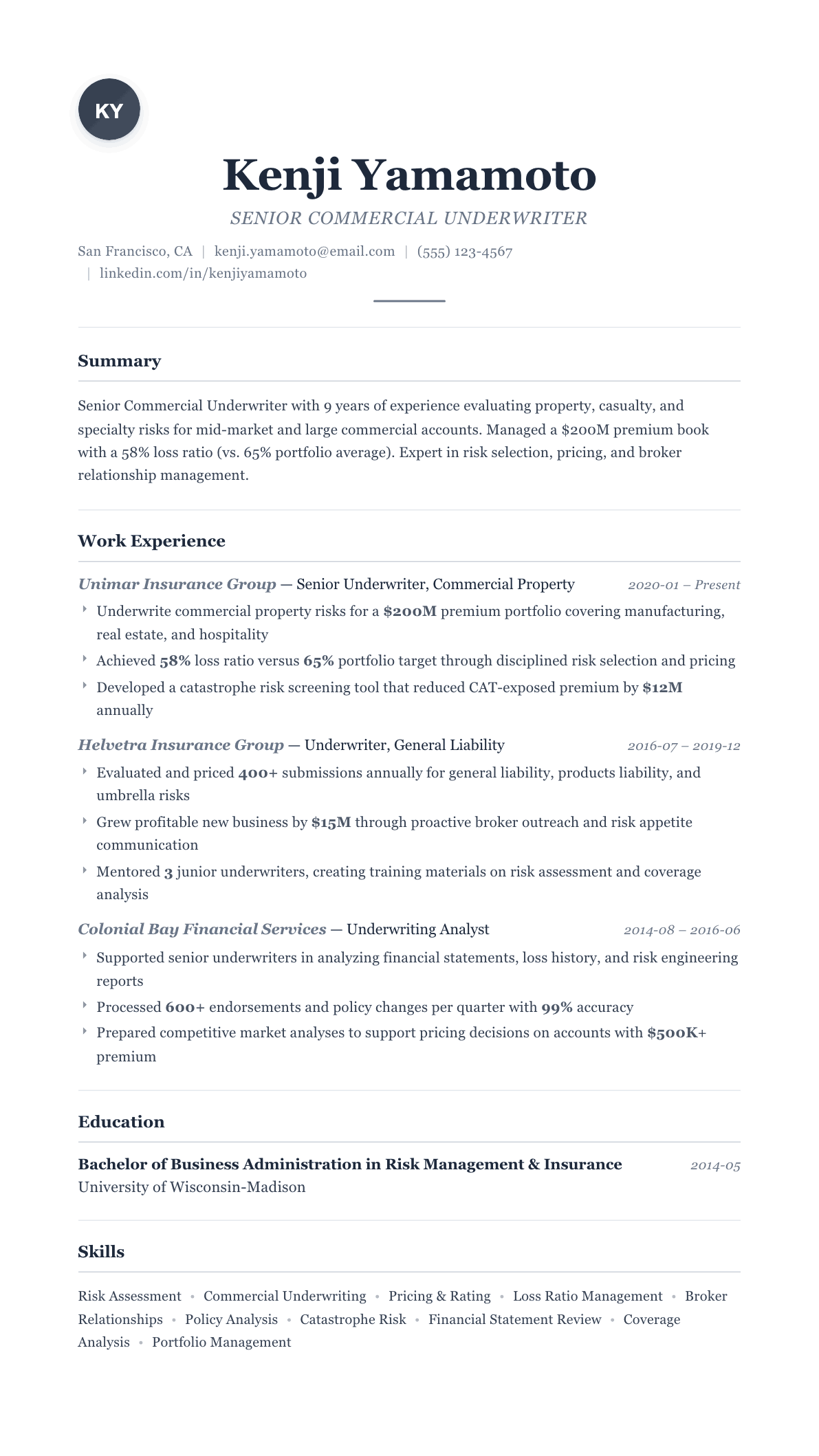
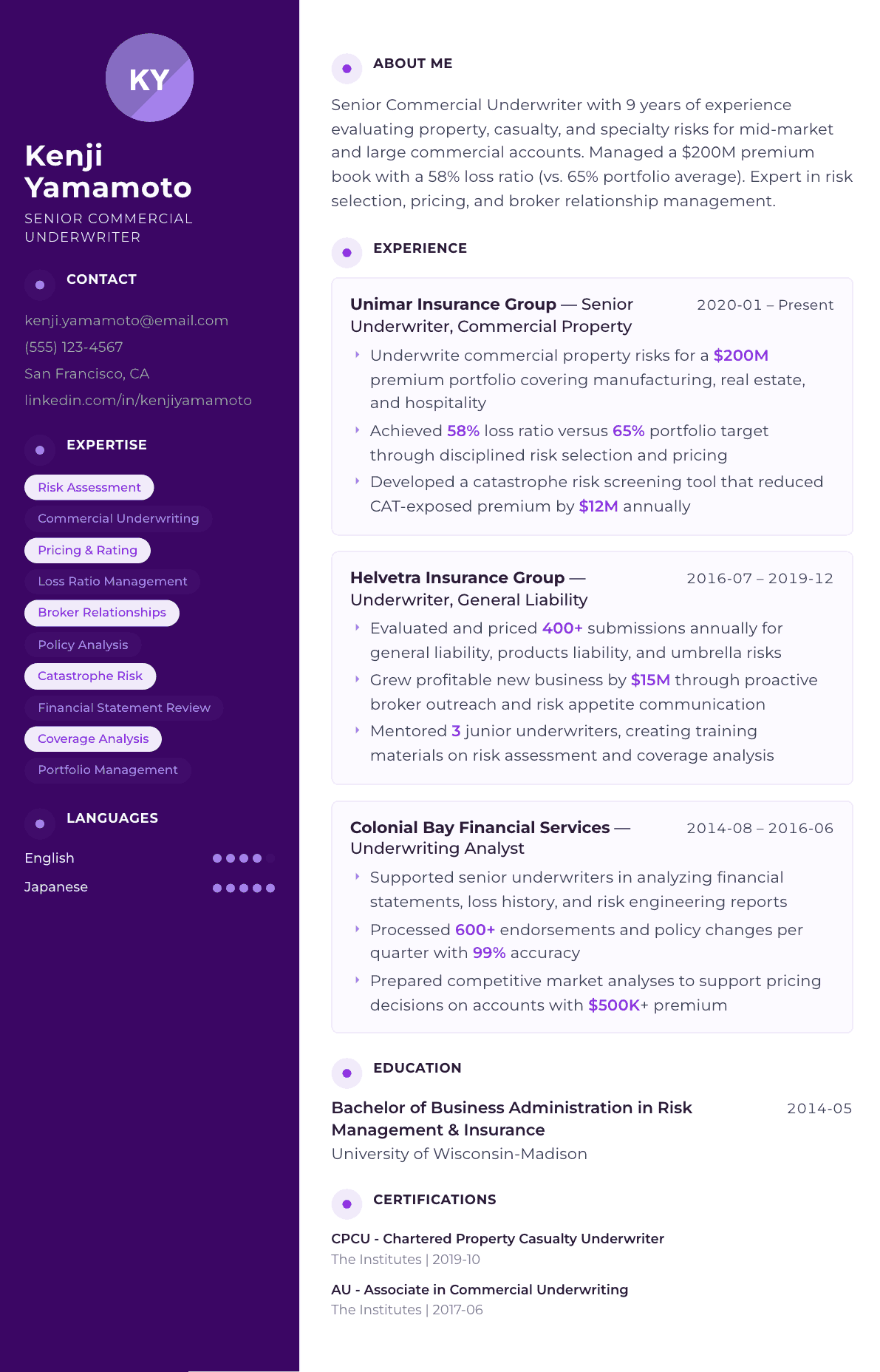
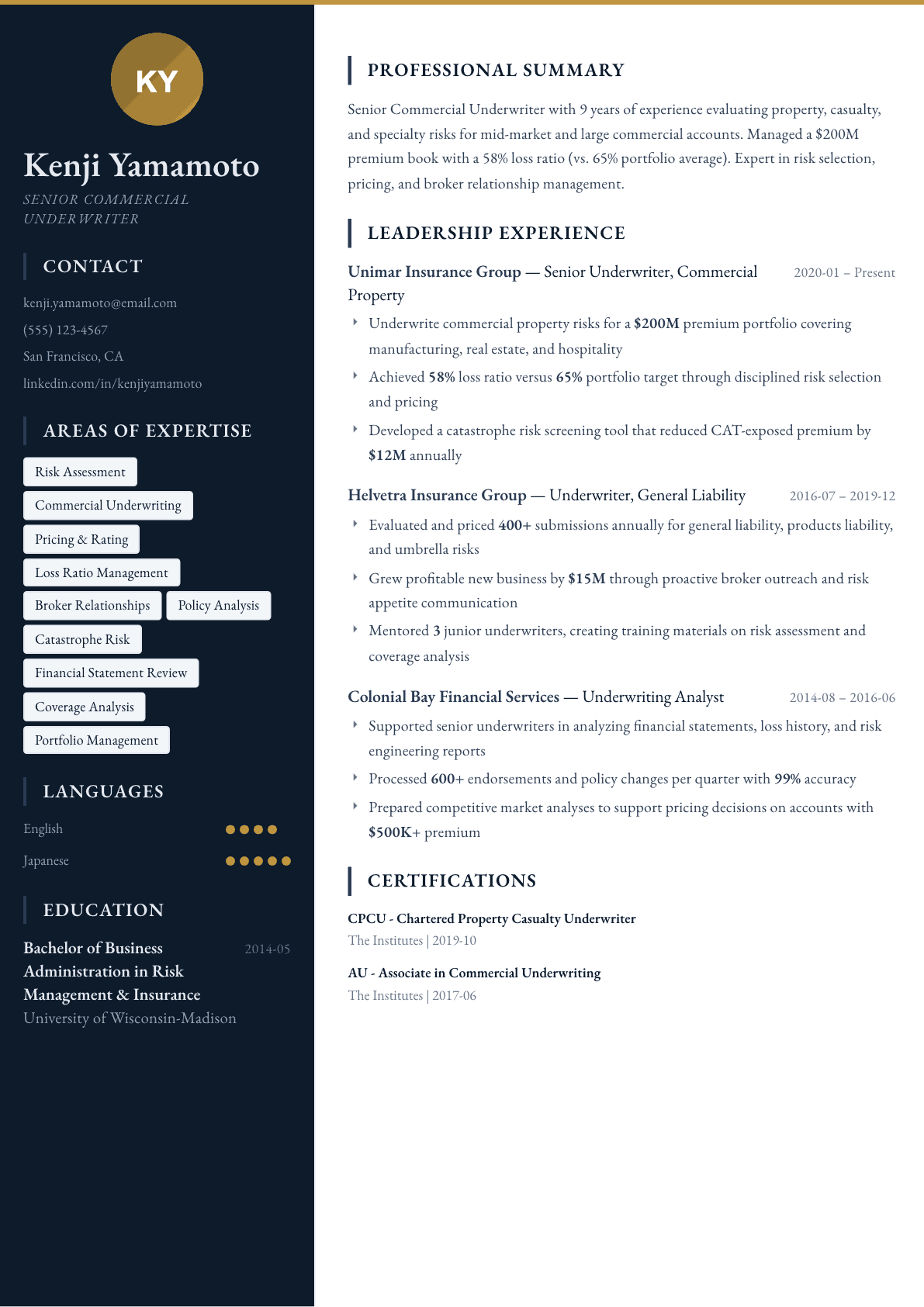
The same underwriter content laid out in three CVBooster templates, so you can see what the finished document looks like before you write a word.
Example Underwriter summary
CPCU and Senior Commercial Underwriter with 9 years of experience managing a $200M premium book across property and casualty lines. Achieved a 58% loss ratio through disciplined risk selection and innovative screening tools. Expert in broker relationship management and new business development. Seeking an Underwriting Manager role to lead a team and drive profitable growth.
Skills to list on a Underwriter resume
- Commercial Underwriting
- Risk Assessment
- Pricing & Rating
- Loss Ratio Management
- Broker Relationships
- Policy Analysis
- Catastrophe Risk
- Financial Analysis
- Coverage Analysis
- Portfolio Management
- Reinsurance
- Regulatory Compliance
What actually gets this resume read
- Lead with premium volume managed, loss ratio performance, and growth metrics.
- Highlight specific lines of business: property, casualty, specialty, professional liability.
- Show risk selection discipline through loss ratio versus portfolio or industry benchmarks.
- Include broker and agent relationship management as a key competency.
- CPCU designation is highly respected; display it prominently.
- Demonstrate both technical underwriting skills and business development capabilities.
How to write a underwriter resume
An underwriter is paid to say no often enough to keep the book profitable and yes often enough to keep the brokers calling. That tension is what an underwriting manager is reading for. She wants to see the portfolio you were responsible for, the authority you held, the results the book produced, and evidence that you priced risk rather than followed a rating manual.
Because the title spans several industries, the resume has to declare the line of business immediately. Property and casualty commercial underwriting, personal lines, professional and management liability, workers compensation, surety, life and health, or mortgage and credit underwriting are related trades with different vocabularies. A reader who cannot place you in the first two lines moves on.
This guide covers the structure that suits an underwriting resume, three summaries from trainee to senior, before and after bullets, and the portfolio and authority detail that separates a technical underwriter from a file processor.
Format: book facts first, then authority, then results
One page for the first several years, two once you carry a book and broker relationships. Directly under the header, give the book snapshot: line of business, premium volume, policy or account count, average account size, territory, and the distribution channel you underwrite through. Everything else in the resume is interpreted against those numbers.
Then state your authority explicitly, because it is the cleanest measure of trust in this profession: the limits you can bind without referral, the classes inside your appetite, and what has to go to a referral underwriter or the reinsurer. An underwriter who does not state authority is assumed to have very little.
- Header: name, designation such as CPCU, city and state, phone, email.
- Order: book snapshot, summary, experience, technical skills and systems, licenses and designations, education.
- Trainees replace the book snapshot with the training program, classes handled and referral supervision level.
Summary: line of business, appetite, and results
Name the line and the segment in the first clause: middle market property and casualty, small commercial package, excess and surplus lines property, healthcare professional liability, contractor workers compensation. Then the appetite you know well, since class expertise is what a manager is buying when she hires a lateral. An underwriter who genuinely understands habitational property or heavy contracting exposures is not interchangeable with a generalist.
Follow with the results in the language of the trade: loss ratio over a stated period, retention on renewals, new business hit ratio, rate change achieved, and premium growth. Give them together, because any one alone can be gamed. A book can hit a beautiful loss ratio by writing nothing, and a manager knows it.
Experience: risk selection, pricing and the broker relationship
Show how you actually underwrite a submission. What you look at in the loss runs and how far back, the exposure data you verify rather than accept, the financial analysis on the insured, the site or loss control reports you order and act on, the coverage terms and endorsements you use to shape a risk, and the deductible and limit structures you build. This is the part most underwriting resumes skip entirely and it is the part that proves you are technical.
Show the pricing side next: the rating platform, where you apply judgment through schedule credits and debits, how you justify them, and how you handle a large loss free account against a competitor undercutting you. Add reinsurance interaction if you have it, such as facultative placements or treaty referrals, because it signals work on larger or less standard risks.
Then the distribution side. Number of agencies or brokers in your territory, submission volume received, quote turnaround time, and how you manage the relationship when you decline. Declining well is a professional skill: brokers keep sending submissions to underwriters who answer quickly and explain the decision.
Systems, data and the analytical layer
Name the policy administration and underwriting platforms you have worked in, such as Guidewire PolicyCenter, Duck Creek, Majesco or a carrier proprietary system, plus the rating engine, the submission clearance tool, and the document platform. Carriers hire around platform migrations and familiar hands are valuable during one.
Then the data tools that increasingly define the job: predictive models and underwriting scores you work alongside, catastrophe modeling output for wind, quake and flood exposures, third party data such as motor vehicle records, property characteristics and financial or credit information, and any reporting you build yourself in Excel or a business intelligence tool to watch your own book. An underwriter who monitors mix, rate adequacy and loss emergence without waiting for the actuarial pack is unusual and should say so.
Designations, licensing and the words the posting uses
The CPCU is the recognized designation across property and casualty, and the Associate in Underwriting is the more focused technical mark. Line specific designations such as the Chartered Life Underwriter for life and the Associate in Risk Management for broader risk work are worth listing when relevant. State any resident and nonresident licenses if you hold them, along with continuing education status.
Job postings repeat a stable vocabulary: risk selection, appetite, submission, quote, bind, endorsement, loss ratio, rate adequacy, retention, hit ratio, referral authority, loss control, reinsurance, catastrophe exposure, and the line of business names. Mirror the ones that fit your experience and place them next to real examples rather than in a list at the bottom.
Underwriter resume summary examples
Underwriting trainee
Underwriting trainee at a regional carrier handling small commercial package submissions up to modest limits, working under referral supervision on risk selection and pricing in Guidewire. Completed the carrier technical training program and two Associate in Underwriting examinations. Seeking an associate underwriter role in commercial lines.
Five years in
Commercial underwriter managing a 28 million property and casualty book across roughly 190 middle market accounts in a three state territory, with binding authority to defined limits. Held a 54% loss ratio over three years with 88% renewal retention across 22 appointed agencies.
Senior underwriter
Senior commercial underwriter and CPCU with eleven years in property and casualty, running a 95 million book in habitational and contracting classes with authority to bind large limits. Mentors three underwriters, sits on the appetite review committee, and handles facultative placements on the largest accounts.
Work experience bullets: before and after
Before: Underwrote commercial insurance accounts.
After: Underwrote a 28 million property and casualty book of roughly 190 middle market accounts across three states, binding to defined authority limits and referring larger schedules to the home office.
Premium, account count, territory and authority are the four facts that let a manager size the job you held.
Before: Achieved a good loss ratio on my book.
After: Held a 54% loss ratio over three years while growing premium 12%, by tightening the appetite on two poorly performing contractor classes and repricing the wind exposed schedules.
Pairing the loss ratio with growth and the specific actions rules out the suspicion that you simply wrote less business.
Before: Reviewed submissions and provided quotes.
After: Reviewed roughly 60 submissions a month, quoted inside a 48 hour service standard, and analyzed five years of loss runs and current exposure data before pricing any account above the small commercial threshold.
Volume, turnaround and the actual review depth show a working underwriter rather than a description of the role.
Before: Maintained relationships with agents and brokers.
After: Managed 22 appointed agencies, visited the top eight quarterly to walk through appetite and declination reasons, and lifted submission flow from the territory across two years.
Naming the cadence and the declination conversation shows the professional skill that keeps brokers submitting.
Before: Worked with loss control and claims teams.
After: Ordered loss control surveys on every new habitational risk, tracked recommendation completion as a condition of renewal, and reviewed large loss files with claims to feed findings back into the class appetite.
Closing the loop from claims experience into appetite is portfolio thinking, which is what promotes an underwriter.
Hard skills
- Risk selection and appetite management
- Pricing and schedule rating judgment
- Loss run and exposure analysis
- Coverage forms and endorsement structuring
- Deductible and limit structuring
- Loss ratio and rate adequacy monitoring
- Catastrophe exposure evaluation
- Reinsurance referral and facultative placement
- Guidewire PolicyCenter or Duck Creek
- Predictive model and underwriting score interpretation
- Financial analysis of insureds
- Loss control coordination
Soft skills
- Declining a risk without losing the broker
- Explaining a price increase
- Judgment inside authority limits
- Negotiating terms under deadline
- Consistency across similar accounts
- Mentoring junior underwriters
Certifications worth listing
- Chartered Property Casualty Underwriter (CPCU) (The Institutes)
- Associate in Underwriting (AU) (The Institutes)
- Associate in Commercial Underwriting (ACU) (The Institutes)
- Associate in Risk Management (ARM) (The Institutes)
- Chartered Life Underwriter (CLU) (The American College of Financial Services)
- Registered Professional Liability Underwriter (RPLU) (Professional Liability Underwriting Society)
Mistakes that cost underwriter candidates the interview
- Not naming the line of business, which leaves a professional liability manager and a property manager equally unsure whether to read on.
- Omitting binding authority, so the reader assumes you referred everything and were trusted with little.
- Quoting a loss ratio with no period, premium base or growth alongside it, which any underwriting manager will discount immediately.
- Describing the process of quoting instead of the judgment in it. Say what you looked at in the loss runs and what you did with it.
- Ignoring the broker side, when submission flow and retention are half of what an underwriting seat is measured on.
- Leaving out the policy administration platform, since carriers hire specifically for familiar hands during a system migration.
Underwriter resume questions
What numbers should an underwriter resume include?
Premium volume, account or policy count, average account size, loss ratio with the period stated, renewal retention, new business hit ratio, rate change achieved, and submission volume. Give several together, since a single figure is easy to misread.
How do I show underwriting authority on a resume?
State the limits you could bind without referral, the classes inside your appetite, and what had to be referred and to whom. Authority is the profession shorthand for how much a carrier trusted your judgment, so it belongs near the top.
Is the CPCU necessary to advance in underwriting?
Not required, but it is the most recognized designation in property and casualty and it appears on senior postings regularly. The Associate in Underwriting is a faster and more technical option if you want the knowledge without the full program.
How do I move from claims or brokerage into underwriting?
From claims, lead with the loss analysis, coverage interpretation and reserve judgment you already exercise. From brokerage, lead with submission quality, market knowledge and account structuring. Both translate well, but say what you have not yet done rather than implying authority you never held.
Should I explain a poor loss ratio year on my resume?
Only briefly, and only where the cause was clearly external, such as a catastrophe event or an inherited book. One short clause naming the driver is better than an unexplained number, since underwriting managers assume the worst about a gap they cannot account for.
Related resume examples
- Actuary Resume example
- Claims Adjuster Resume example
- Credit Analyst Resume example
- Credit Manager Resume example
- Trader Resume example
- Insurance Broker Resume example