Prosecutor Resume Examples: free ATS score and gap list
Write a Prosecutor Resume That Proves Courtroom Judgment
By Mustafa Tarabya, founder of CVBooster · Published · Updated
Prosecutor resume example with trial, charging and victim advocacy keywords, plus a guide to writing for a district attorney hiring panel.
Sample resumes for a prosecutor
The same prosecutor content laid out in three CVBooster templates, so you can see what the finished document looks like before you write a word.
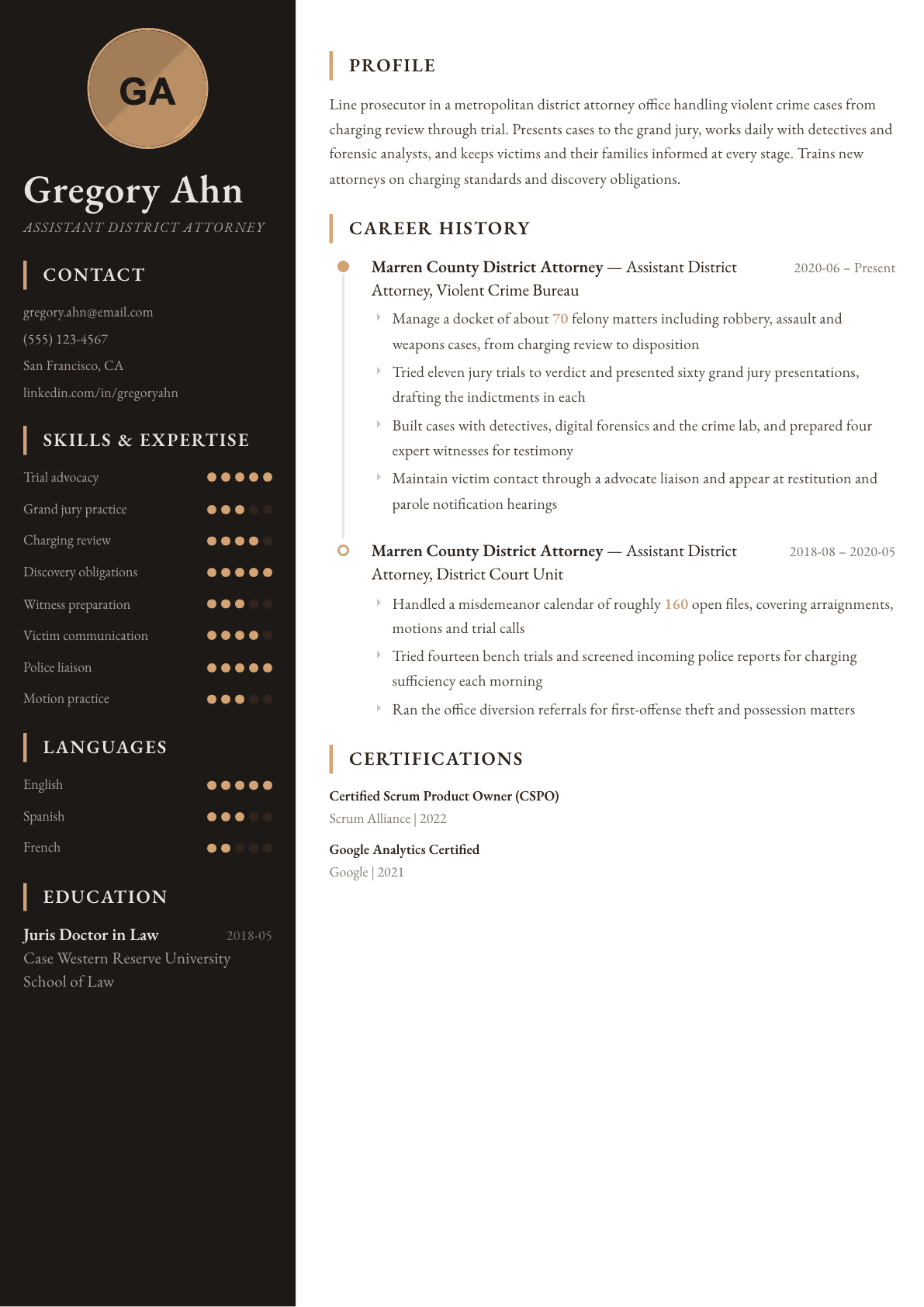
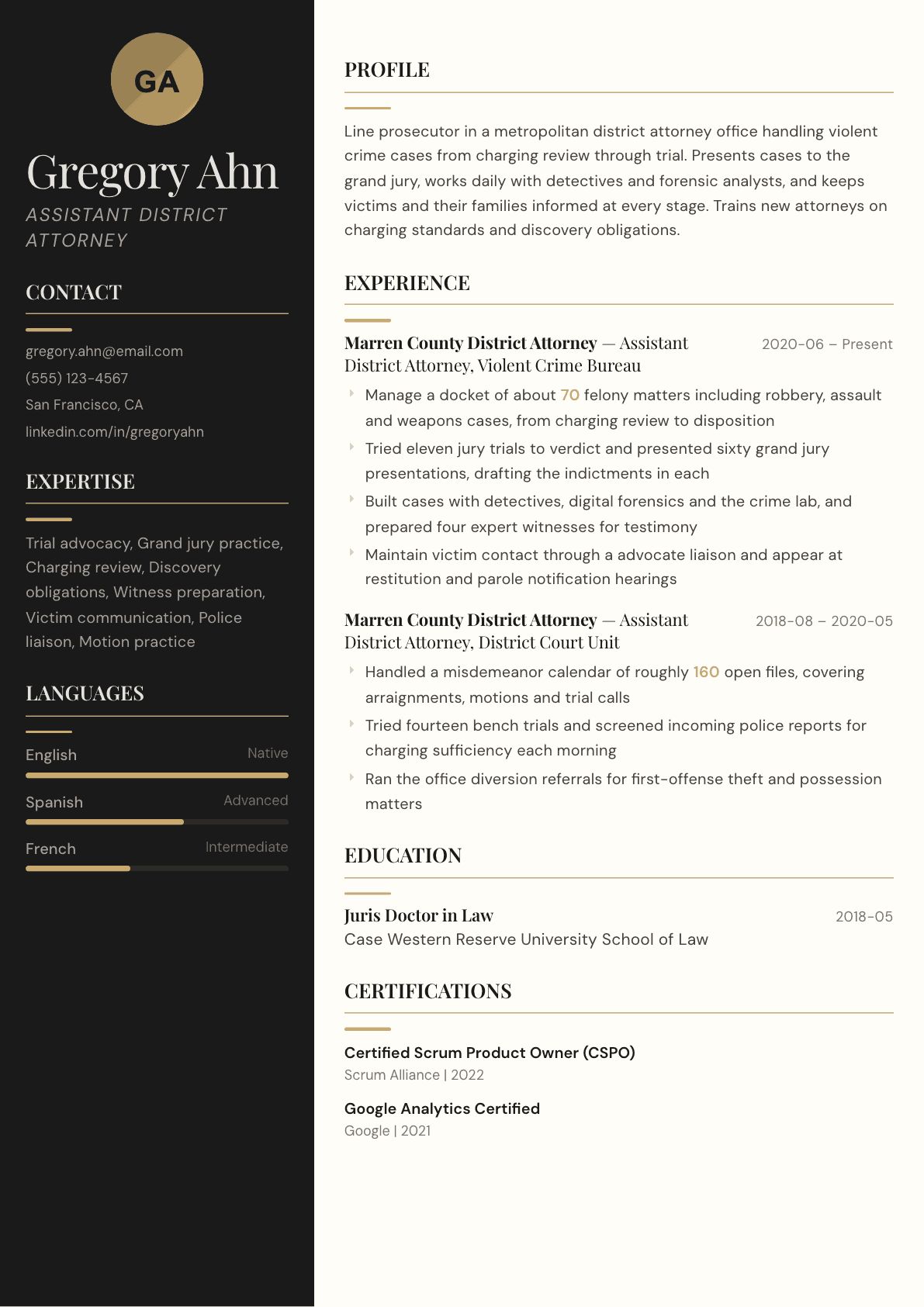
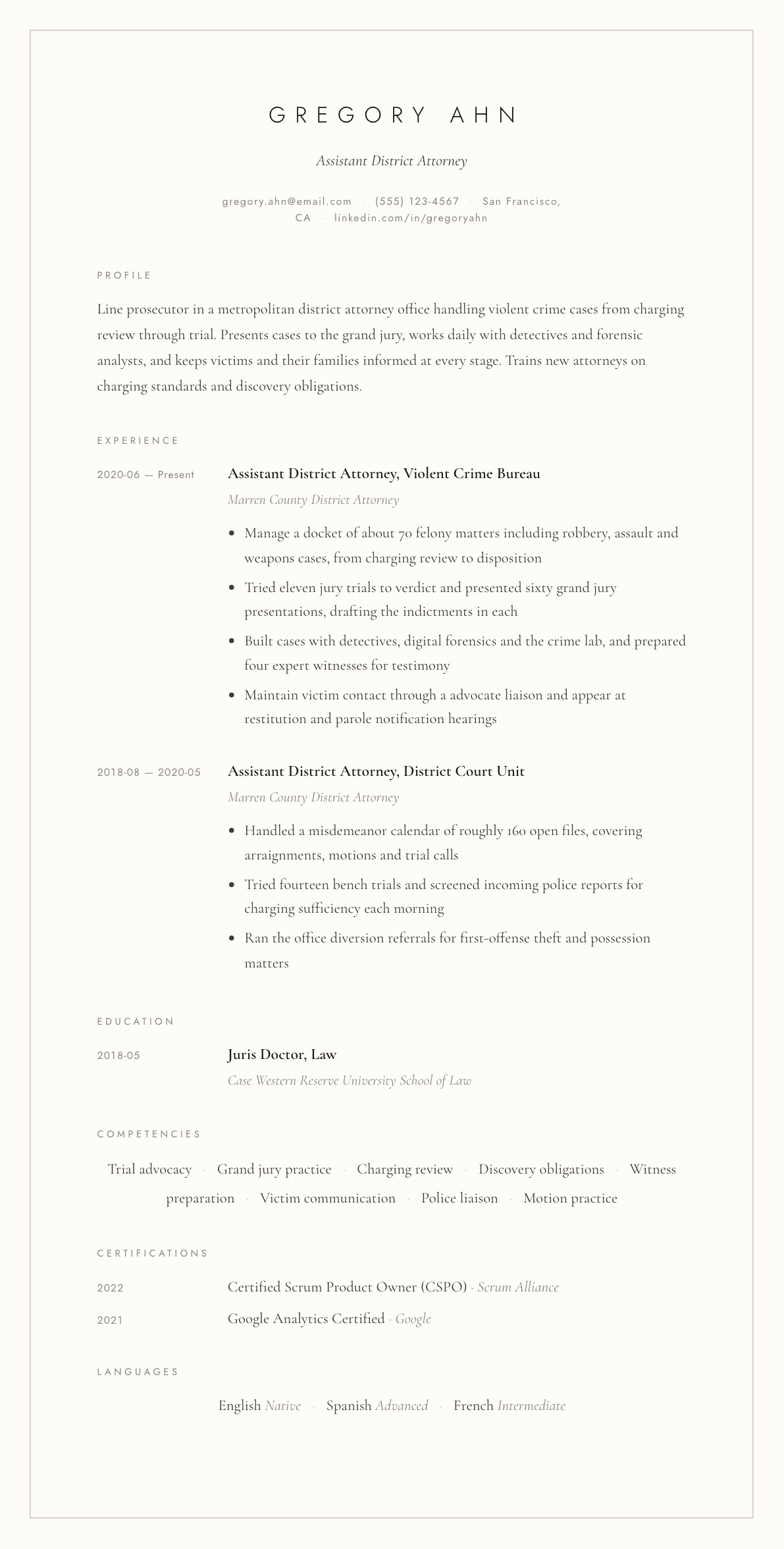
Example Prosecutor summary
Assistant district attorney with six years in a metropolitan office, currently in the violent crime bureau with a docket of roughly seventy felony matters. Eleven jury trials to verdict, sixty grand jury presentations, and case building with detectives, the crime lab and digital forensics. Trains new attorneys on charging standards and discovery duties. Seeking a supervising trial attorney role.
Skills to list on a Prosecutor resume
- Criminal trial advocacy
- Grand jury presentation
- Charging and case screening
- Indictment drafting
- Pretrial motion practice
- Cross-examination
- Expert and forensic witness preparation
- Discovery and disclosure compliance
- Plea negotiation
- Sentencing advocacy
- Victim and witness communication
- Law enforcement liaison
- Search warrant review
- Appellate record preservation
What actually gets this resume read
- Put the bureau or unit next to every title, because a violent crime docket and a district court calendar test different skills.
- Report trials by count and type, then name the charge categories, since a hiring panel reads that line before anything else.
- Show charging judgment: screening volume, declination decisions and how you built a case with detectives before filing.
- Name your grand jury experience if the office uses one, including how many presentations you handled and who drafted the indictment.
- Include victim and witness work, because prosecutors are evaluated on communication with families as much as on verdicts.
- Keep discovery compliance visible, since offices care that you understand disclosure duties and track them on a large docket.
How to write a prosecutor resume
A prosecutor resume is screened by a bureau chief or a hiring committee inside a district attorney or state attorney office, and the reading is fast because these offices hire in cycles and receive stacks of applications from clerks, defenders and firm associates at once. What survives the first pass is a page that shows courtroom volume and sound charging judgment, in that order.
The role is unusual because the employer expects you to make decisions against your own side. Screening a weak case out, disclosing material that hurts the file, declining a charge a detective wants: those calls define a prosecutor, and a resume that lists only convictions misses what the interviewer is testing.
This guide covers the section order an office expects, three summaries for a new attorney, a felony trial prosecutor and a supervisor, before-and-after bullets from charging, grand jury and trial work, and the questions candidates ask when applying from a clerkship, private practice or a defender office.
Format: one clean page early, two pages after several trials
Keep the layout simple and single column. Put bar admission with the state in the header, because most offices cannot interview a candidate who is not admitted or awaiting results, and that check happens before anyone reads a bullet.
Order the experience by unit rather than by employer alone. Prosecutors move between district court, general felonies, special victims, narcotics, appeals and economic crime inside the same office, and each move is a promotion or a specialization the reader needs to see.
- Header: name, city and state, contact details, bar admission with the state and admission date status.
- Sections: summary, experience by unit, trial record, education, honors, service and languages.
- Give internal transfers their own dated entry rather than folding them into one long office block.
Charging and case screening: the judgment half of the job
Describe the intake work you did: reviewing police reports, deciding what could be proved, sending cases back for further investigation, and declining matters that should not be filed. Screening volume is a real measure of experience, and declination decisions show a reader that you understand the standard is provable guilt rather than plausible suspicion.
Where you have worked cases up before filing, say so. Meeting with detectives, requesting phone records, waiting on the crime lab or reinterviewing a reluctant witness are the difference between a case that survives a suppression hearing and one that collapses at the calendar call.
Trials, grand jury and motions
Count your trials, separate jury from bench, and list the charge categories. Then give grand jury experience if your jurisdiction uses one: presentations handled, indictments drafted and whether you presented alone. Offices treat grand jury work as proof you can carry a case narrative unassisted.
Motion practice belongs on the page from the defense angle too. Responding to suppression motions, litigating admissibility of forensic evidence, arguing witness competency and handling severance requests all show that you have defended a file under attack rather than only presented one.
Trial preparation deserves at least one bullet. Witness preparation, exhibit management, expert coordination with a crime lab or medical examiner, and jury instruction drafting are the mechanics of a verdict, and they are what a supervisor will hand you first.
Discovery obligations and ethics
Disclosure duties are the fastest way an office loses a case and a reputation, so demonstrating that you take them seriously is worth real space. Describe how you tracked disclosure across a large docket, worked with law enforcement to collect material, and handled impeachment information about witnesses.
If you have participated in a conviction integrity review, a post-conviction disclosure or an office policy update on discovery, include it. Those items signal judgment and they read as maturity rather than as a weakness.
Victims, witnesses and the community side
Prosecutors are evaluated on how families experience the process. Describe your contact with victims and witnesses, your work with advocates, the notification obligations you met, and any restitution or protective order work you handled.
Community involvement, school outreach, diversion program participation and specialty court work such as drug or veterans court all belong here. They tell an office you can carry a public-facing role, which line prosecutors do every day whether they intend to or not.
Prosecutor resume summary examples
New attorney
Recently admitted attorney with a summer in a district attorney office screening misdemeanor filings and drafting responses to suppression motions, plus a prosecution clinic where two bench trials were tried under supervision. Judicial internship in a criminal calendar. Applying for a line prosecutor position in district court.
Felony trial prosecutor
Assistant district attorney in the violent crime bureau carrying about 70 felony matters from charging review to disposition. Eleven jury trials to verdict, sixty grand jury presentations with self-drafted indictments, and case building alongside detectives, digital forensics and the crime lab. Trains new attorneys on charging standards and disclosure duties.
Bureau supervisor
Supervising attorney over a homicide bureau of six prosecutors, reviewing charging decisions, second-chairing complex trials and running the office relationship with the medical examiner and forensic laboratory. Thirty-one jury trials personally tried, and author of the office protocol on disclosure of impeachment material.
Work experience bullets: before and after
Before: Prosecuted a variety of criminal cases.
After: Managed a docket of about 70 felony matters in the violent crime bureau, including robbery, aggravated assault and weapons cases, from charging review through disposition.
The bureau, the docket size and the charge mix give a supervisor a precise picture of the caseload you can absorb.
Before: Presented cases to the grand jury.
After: Handled sixty grand jury presentations without a supervising attorney in the room, drafting each indictment and returning three matters for further investigation before presentation.
Working alone and sending cases back are the details that separate real charging responsibility from observing the process.
Before: Reviewed police reports for charging.
After: Screened incoming police reports each morning for charging sufficiency, filing on provable cases, requesting supplemental investigation on 40 files and declining eleven matters that lacked corroboration.
Declination and follow-up numbers show the judgment side of charging, which a conviction-only bullet hides entirely.
Before: Worked with victims and their families.
After: Kept victims informed at each stage with the office advocate, prepared families for testimony, and appeared at restitution and parole notification hearings on eighteen closed matters.
Naming the stages and the collaborator turns a caring statement into an account of obligations you actually met.
Before: Prepared witnesses and exhibits for trial.
After: Prepared four expert witnesses from the crime lab and medical examiner office for testimony, built the exhibit and stipulation packets, and drafted the jury instruction proposals in each felony trial.
Trial mechanics become credible when the reader sees which experts, which documents and which drafting you owned.
Hard skills
- Criminal trial advocacy
- Grand jury presentation and indictment drafting
- Case screening and charging decisions
- Response to suppression motions
- Cross-examination and direct examination
- Forensic and expert witness preparation
- Discovery and impeachment disclosure
- Plea negotiation and diversion referral
- Sentencing advocacy and restitution
- Search warrant review
- Victim and witness communication
- Law enforcement liaison
- Appellate record preservation
Soft skills
- Ethical judgment
- Public speaking to a jury
- Working with detectives
- Calm under calendar volume
- Clear written narrative
- Handling emotional testimony
Certifications worth listing
- Board Certification in Criminal Trial Law (National Board of Trial Advocacy)
Mistakes that cost prosecutor candidates the interview
- Presenting only wins, which reads as a candidate who does not understand the duty to decline and disclose.
- Leaving the unit off each entry, so a reader cannot tell a district court calendar from a homicide bureau assignment.
- Skipping grand jury detail in a jurisdiction that uses one, which is a direct measure of independent charging work.
- Describing disclosure obligations nowhere on the page, when that is the risk area an office worries about most.
- Using vague quantity words for trials instead of counting verdicts and splitting jury from bench.
- Ignoring victim and witness work, which is a daily obligation and a standing interview question.
Prosecutor resume questions
How do I get a prosecutor job with no criminal law experience?
Lead with courtroom exposure of any kind: a prosecution or defense clinic, a judicial internship on a criminal calendar, moot court or trial advocacy competition results. Then show writing under deadline and comfort with police reports and forensic material, because that is the daily reading in the job.
Should I list conviction rates on a prosecutor resume?
No. A conviction rate invites the wrong reading of the role and can suggest you screen cases to protect a statistic. Give trial counts, charge categories and outcomes without framing them as a success percentage, and let charging and disclosure work show your judgment.
How much does grand jury experience matter?
A great deal in jurisdictions that indict by grand jury, because presenting alone means you have carried the case theory, the witness order and the legal instructions unsupervised. Give the number of presentations, who drafted the indictments and whether a supervisor was present.
Can a defense attorney move into a prosecutor role?
Yes, and the trial and motion experience transfers directly. Emphasize verdicts, cross-examination and comfort with forensic evidence, and prepare a straightforward interview answer about why you want the charging responsibility rather than a criticism of defense work.
What belongs in the education section for a prosecutor application?
Law school, graduation date, any trial advocacy honors, journal work and relevant clinics. Offices with structured hiring also look for a criminal procedure and evidence background, so listing an advanced evidence course or a trial team placement is worth the line.