Public Defender Resume Examples: the lines they read
Write a Public Defender Resume That Shows Trial Readiness
By Mustafa Tarabya, founder of CVBooster · Published · Updated
Public defender resume example with caseload, trial and client advocacy keywords, plus a guide to writing for a defender office hiring committee.
Sample resumes for a public defender
The same public defender content laid out in three CVBooster templates, so you can see what the finished document looks like before you write a word.
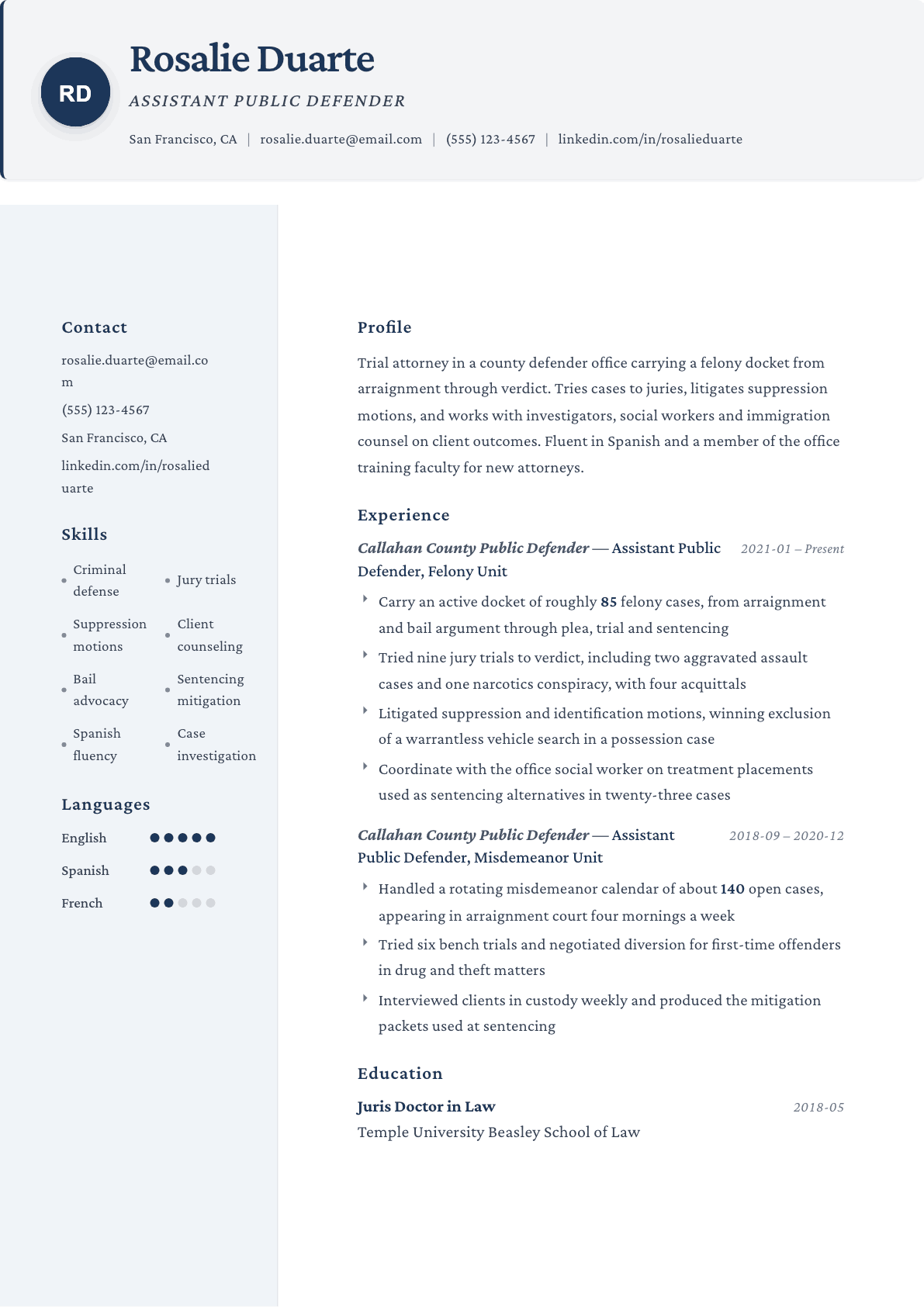
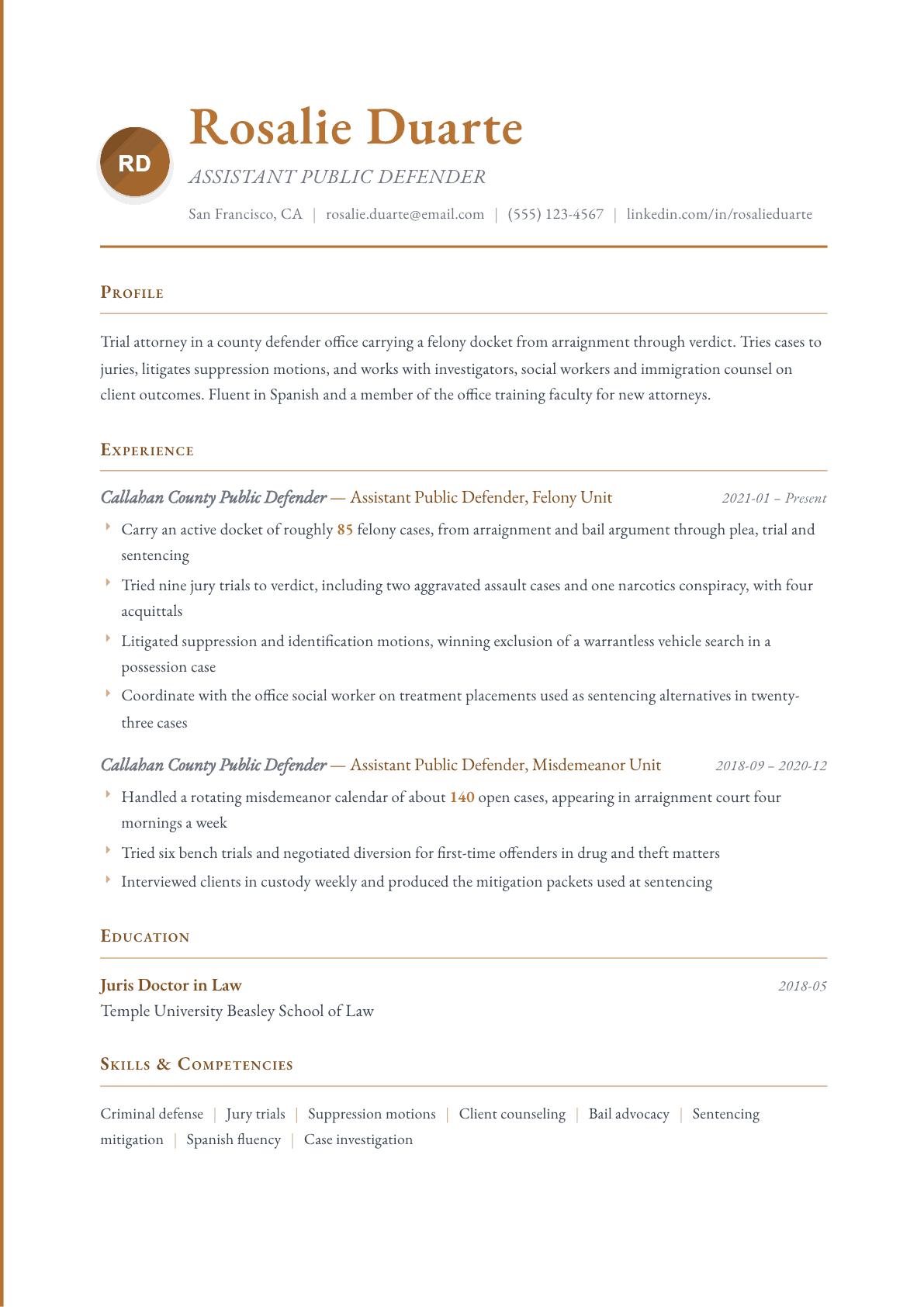
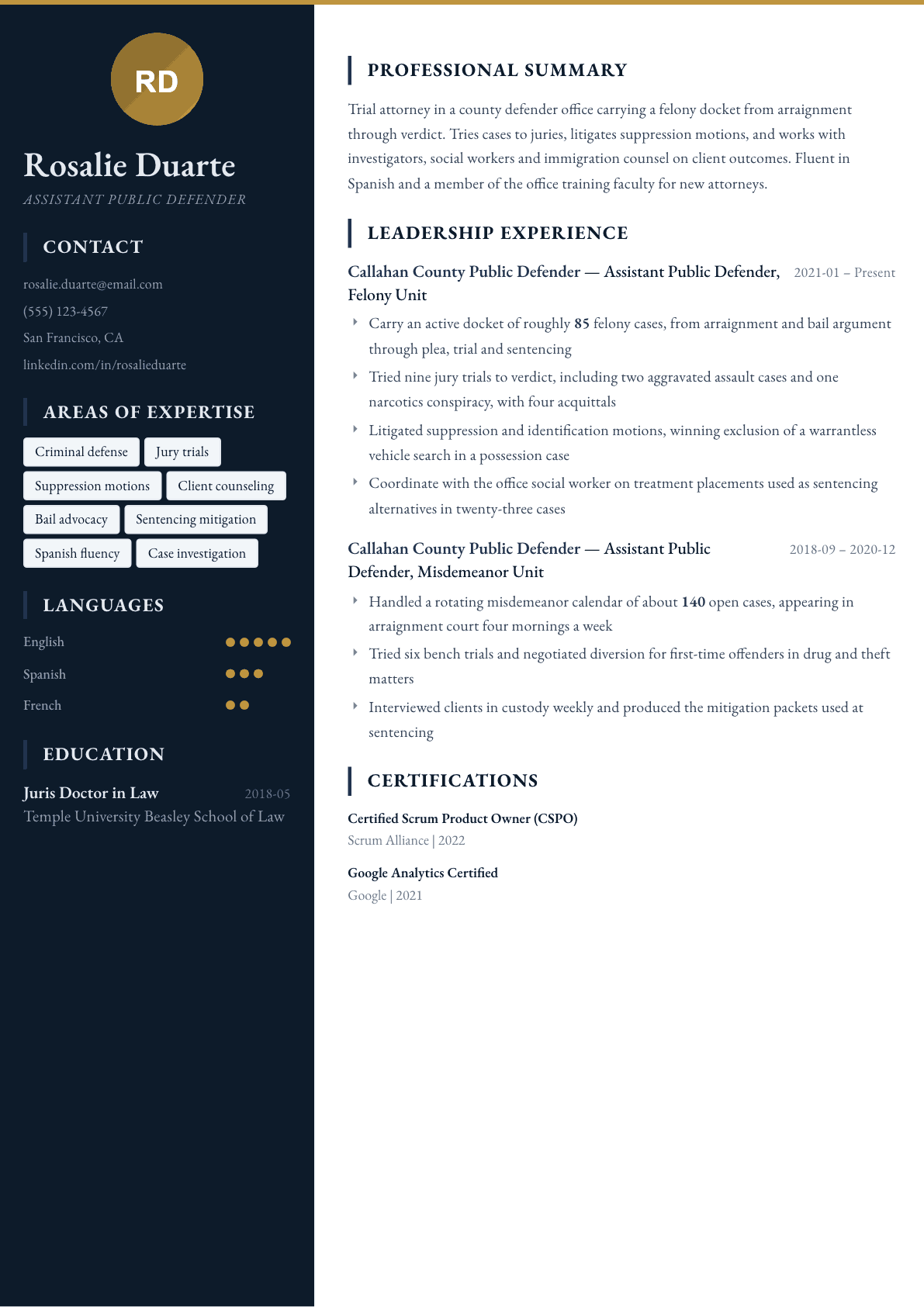
Example Public Defender summary
Assistant public defender with five years in a county office, now carrying a felony docket from arraignment through verdict. Nine jury trials to verdict, four acquittals, and a suppression win on a warrantless vehicle search. Works with the office social worker on treatment-based sentencing alternatives and trains incoming attorneys on bail advocacy. Spanish speaking and seeking a senior trial position.
Skills to list on a Public Defender resume
- Criminal defense litigation
- Jury trial advocacy
- Bench trials
- Suppression and pretrial motions
- Bail and detention hearings
- Plea negotiation
- Sentencing mitigation
- Client counseling in custody
- Cross-examination
- Discovery review
- Expert witness preparation
- Case investigation coordination
- Appellate issue preservation
- Juvenile delinquency practice
What actually gets this resume read
- State the docket type and the caseload, because a defender office hiring committee reads volume as proof you can carry the work.
- Count your trials and say which were jury and which were bench, then name the charge categories you tried.
- Show motion practice by naming the motions you argued and what the court did, not only that you filed them.
- Include client-centered work such as mitigation, treatment placement and family contact, since offices hire for that as much as trial skill.
- Note any second language and how you use it with clients, because interpreter-free client contact is a real staffing advantage.
- Keep clinic, internship and externship work if you are early, and name the supervising office and the courtroom you appeared in.
How to write a public defender resume
A public defender resume is read by a supervising attorney or a hiring committee inside a defender office, and they are answering one practical question: can this person carry a real docket and stand up in court next month. The office is short-staffed, the calendar does not pause, and a resume that reads as an academic profile with a criminal law seminar on it will not answer that question.
What answers it is docket detail. The unit, the case types, how many open files you carried, how many trials you have taken to verdict, which motions you have argued, and what you did for clients beyond the courtroom. Defender offices also hire for values and for stamina, and both come across through specifics rather than through a paragraph about a commitment to justice.
This guide walks through the sections in the order a defender office reads them, gives summaries for a new attorney, a felony-level defender and a supervisor, shows how to rewrite the bullets most applicants send, and answers the questions that come up when you apply from a clinic, a firm or a prosecutor office.
Format: one page early, two once you have trials
Reverse chronological, plain formatting, and bar admission with the state at the top. Many offices hire on a rolling basis with a small administrative team, so a clean single-column page that lists admission, languages and courtroom experience in the first third saves the reader work.
A new attorney puts education first with clinic and internship experience directly under it. Once you have carried your own docket, experience moves above education and the clinic becomes a two-line entry near the bottom.
- Header: name, city and state, phone, email, bar admission with state and any pending admission.
- Order once practicing: summary, experience by unit, trials and motions, education, languages, service.
- A separate trial list is useful once you pass roughly five verdicts, with charge type and outcome.
Experience: unit, docket size, case types
Every position needs the office, the unit and the docket. "Felony unit, active docket of approximately 85 cases, arraignment through verdict" tells a supervisor what you can absorb. Without a number the reader assumes the docket was small, because applicants who carried heavy caseloads almost always say so.
Name the case types you have handled rather than the statutes: robbery, assault, weapons, narcotics, burglary, domestic violence, homicide-adjacent matters if you have them. Add the stages you own, since the difference between covering arraignments and running a case from bail argument through sentencing is the whole job.
Write bullets about decisions. Advising a client on a plea against a mandatory minimum, filing a motion nobody else in the unit filed, tracking down a witness the investigator could not reach: those are the moments that show a supervisor how you think when the file gets hard.
Trials and motions: count them and name them
Give trials as a number split between jury and bench, then name the charge categories and outcomes. Offices count verdicts because verdicts are the scarcest experience in indigent defense hiring, and a candidate who has taken four cases to a jury is treated differently from one who has watched forty.
Motion practice deserves its own line or two. Suppression, identification, severance, discovery sanctions, speedy trial, competency and bail review are all worth naming, along with what the court did. A granted suppression motion is a story a supervising attorney will ask about in the interview, so make sure it is on the page to be asked about.
Client work beyond the courtroom
Defender offices hire people who can sit in a jail visiting room and be understood. Describe client contact volume, custody visits, family communication and the mitigation work you assembled, along with how you used social workers, investigators, immigration counsel and treatment providers.
Collateral consequences are a real part of the practice. Immigration exposure, housing, licensing, family court and school discipline all sit behind a criminal case, and an applicant who names them shows the office they understand what a client actually stands to lose.
Language, service and the values section
A second language used directly with clients is one of the most useful things on a defender resume, because it removes an interpreter from the most sensitive conversations. State the language and your working level honestly, since it will be tested in practice within a week.
Keep community, volunteer and advocacy work if it is real and current. It supports the commitment question without a paragraph of declaration, and it gives the interview somewhere to go beyond the docket.
Public Defender resume summary examples
New attorney
Newly admitted attorney with two semesters in a criminal defense clinic, appearing as a certified student attorney at arraignments, bail hearings and two bench trials. Summer with a defender office covering the misdemeanor calendar and drafting suppression motions. Spanish speaking and seeking a line defender position.
Felony defender
Assistant public defender carrying an active felony docket of about 85 cases from arraignment through verdict. Nine jury trials tried to verdict with four acquittals, including two aggravated assault matters, plus a suppression win excluding a warrantless vehicle search. Works with the office social worker on treatment-based sentencing alternatives.
Supervising attorney
Supervising attorney in a county defender office, overseeing eight attorneys in the felony unit while carrying a reduced docket of serious cases. Twenty-six jury trials to verdict, office training lead on cross-examination and forensic evidence, and the point of contact for the appellate unit on preserved issues.
Work experience bullets: before and after
Before: Represented indigent clients in criminal cases.
After: Carried an active felony docket of roughly 85 cases in the violent crime unit, handling every stage from bail argument and preliminary hearing through plea, trial and sentencing.
The docket size, the unit and the stages tell a supervisor precisely how much of the job you already do alone.
Before: Tried several cases in court.
After: Tried nine cases to a jury verdict, including two aggravated assault matters and a narcotics conspiracy, with four acquittals and one hung jury on the top count.
Verdict counts, charge types and outcomes are the scarcest information in defender hiring, so they should never be summarized as several.
Before: Filed pretrial motions in various matters.
After: Litigated suppression and identification motions in fourteen felony cases, winning exclusion of a warrantless vehicle search and limiting an in-court identification after a suggestive show-up.
Naming the motion types and what the court did turns filing activity into demonstrated courtroom results.
Before: Worked with clients to understand their situations.
After: Visited clients in custody weekly, prepared mitigation packets with the office social worker, and secured residential treatment placement as a sentencing alternative in twenty-three cases.
Client-centered work becomes evidence once the reader sees the frequency, the collaborator and the concrete outcome.
Before: Assisted with training for new attorneys.
After: Built and taught the office session on bail advocacy for incoming attorneys, running mock arguments and giving written feedback to eleven new hires across two intake classes.
A training claim needs the material you made, the format you ran and the number of people you actually taught.
Hard skills
- Felony and misdemeanor trial practice
- Jury selection and trial advocacy
- Suppression and identification motions
- Bail and pretrial detention argument
- Cross-examination
- Plea negotiation
- Sentencing mitigation
- Discovery review and forensic evidence
- Expert witness preparation
- Juvenile delinquency practice
- Appellate issue preservation
- Client counseling in custody
- Collateral consequences analysis
Soft skills
- Composure under docket pressure
- Client trust building
- Difficult conversations
- Working with investigators and social workers
- Time triage across a full calendar
- Persuasive speaking
Certifications worth listing
- Board Certification in Criminal Trial Law (National Board of Trial Advocacy)
Mistakes that cost public defender candidates the interview
- Describing representation in general terms without ever naming a docket size, a unit or a case type.
- Rounding trial experience into a vague word instead of counting verdicts and separating jury from bench.
- Omitting motion outcomes, which leaves the reader unable to tell filed paper from argued and won.
- Leading with a paragraph about a passion for justice while the courtroom detail sits on the second page.
- Forgetting to state bar admission status and any pending application, which is the first thing an office checks.
- Cutting language ability, custody visits and mitigation work, which are core to the role rather than extras.
Public Defender resume questions
How do I apply to a defender office straight out of law school?
Lead with clinic and internship work described as practice: the court you appeared in, the certification you held, the hearings you argued and the motions you drafted. Then name the office training and mentoring you are looking for, because entry hiring assumes supervision and looks for judgment and stamina.
Should I include a trial list on my resume?
Once you have several verdicts, yes. A short block giving the charge type, whether it was jury or bench, and the outcome lets a supervisor size you up quickly. Keep client names off it entirely and describe cases at a level that respects confidentiality.
Can I move from a prosecutor office to a public defender role?
It happens regularly, and the trial experience transfers. Emphasize courtroom volume, motion practice and cross-examination, and be ready in the interview to explain the switch in terms of the work you want to do rather than criticism of your former office.
How do I show caseload without breaching client confidentiality?
Use aggregate numbers and case categories rather than facts that identify anyone. Docket size, trial counts, motion types, charge categories and outcomes are all safe. Never include client names, docket numbers or distinctive facts, even from matters that are closed or public.
Does a private criminal defense background help when applying?
Yes, if you frame it around volume and courtroom time rather than fee-paying clients. Offices care that you can run a calendar, handle a jail visit and pick a jury. Add any court appointment work, because appointed representation is the closest private analogue to the caseload you will inherit.