Loss Prevention Manager Resume Examples: free ATS score
Create a Loss Prevention Manager Resume That Delivers Results
By Mustafa Tarabya, founder of CVBooster · Published · Updated
Build a professional loss prevention manager resume showcasing your shrinkage reduction results, investigation skills, and team leadership.
Sample resumes for a loss prevention manager
The same loss prevention manager content laid out in three CVBooster templates, so you can see what the finished document looks like before you write a word.
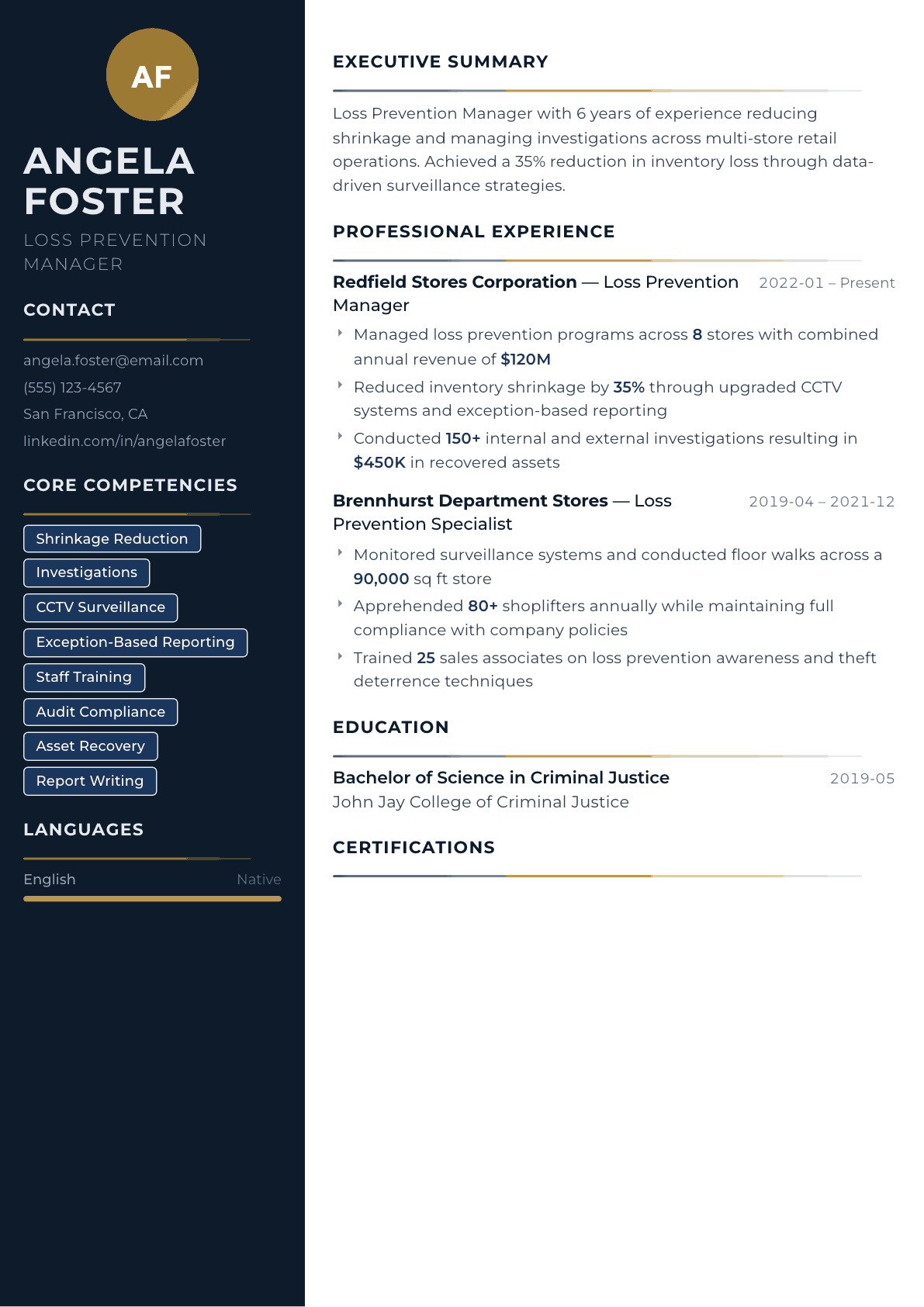
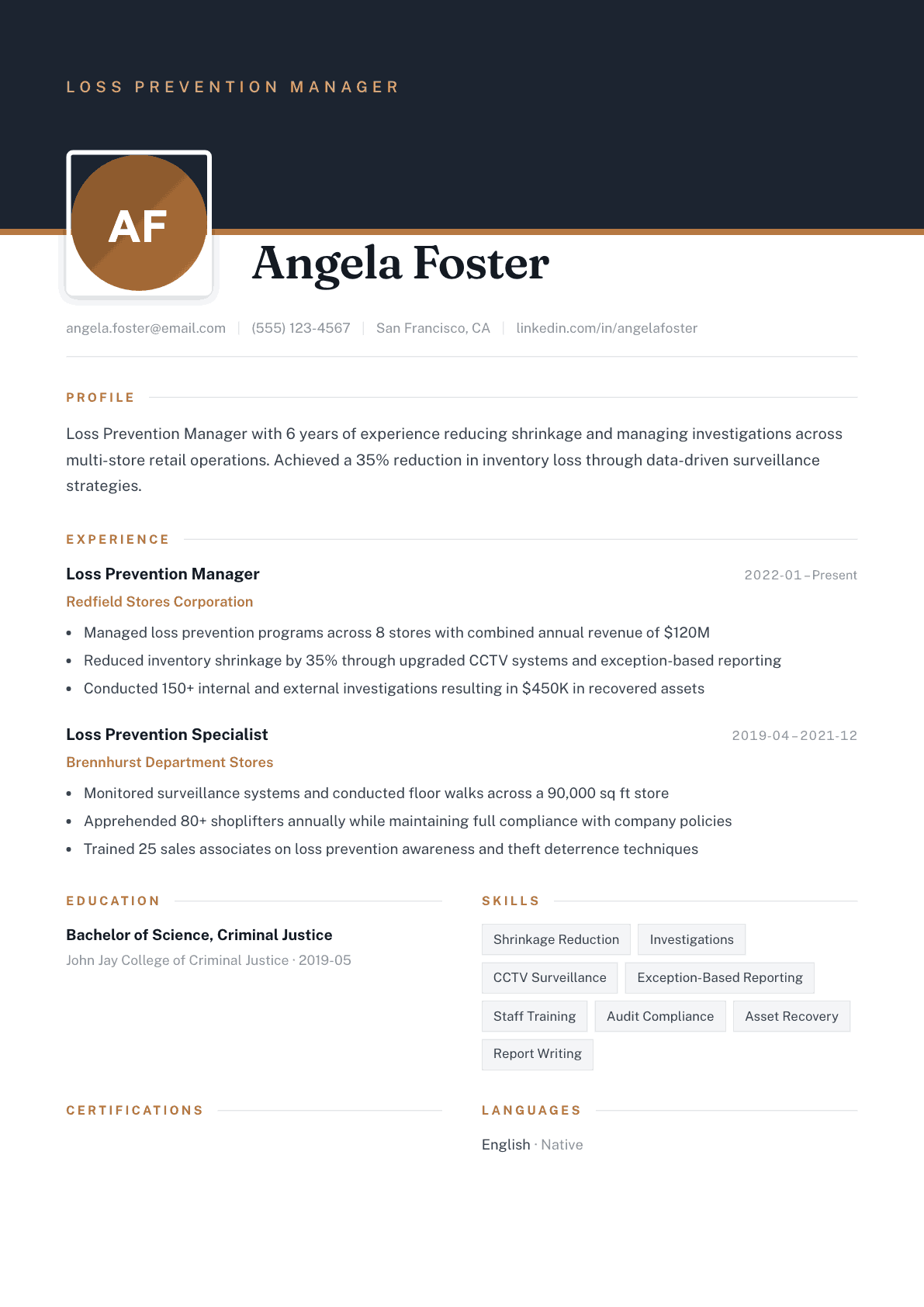
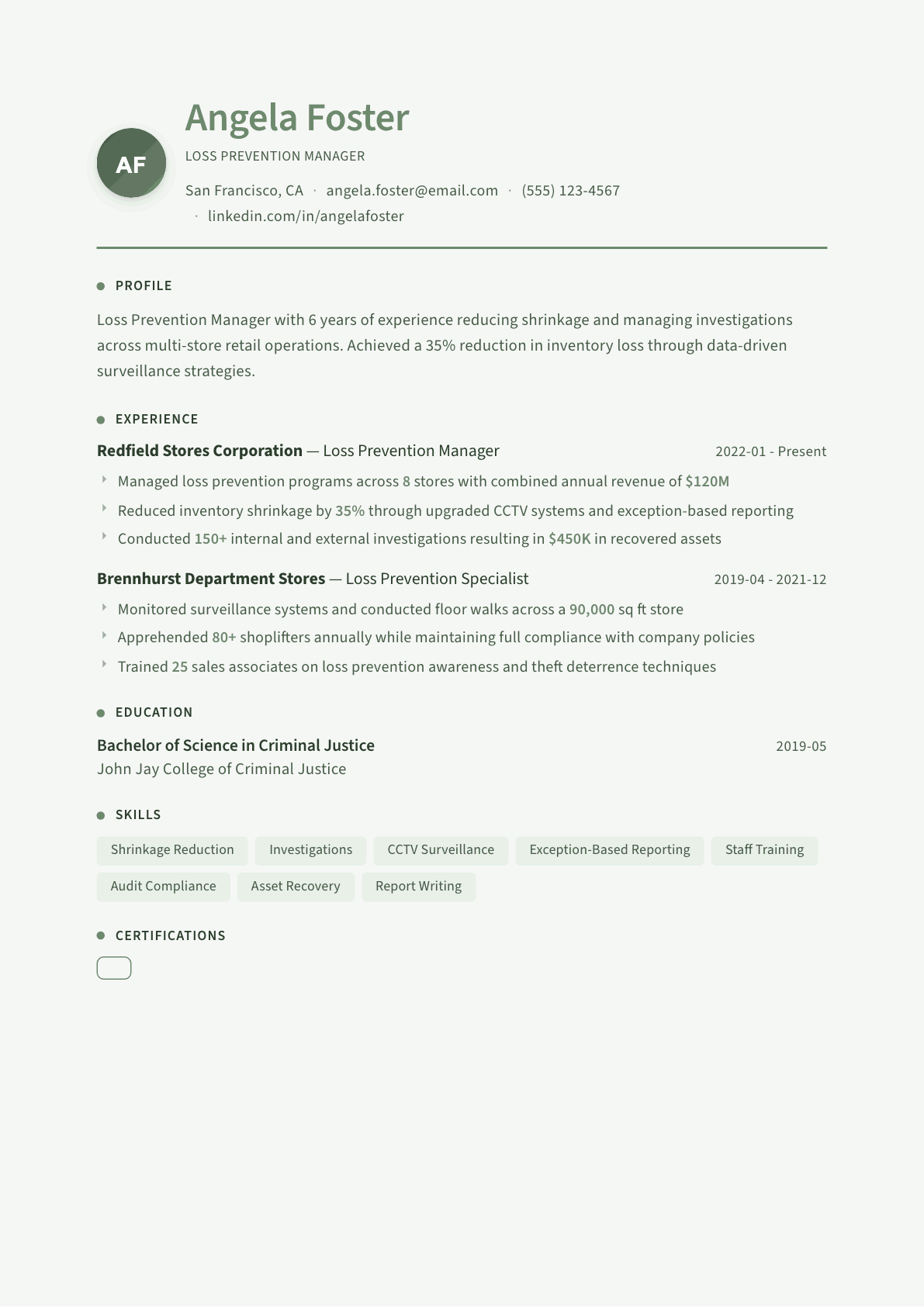
Example Loss Prevention Manager summary
Loss prevention manager across eight stores and $120M in revenue, 6 years in the field, with shrink down 35% after upgrading camera coverage and moving to exception-based reporting. Has closed 150 internal and external cases worth $450K in recovered assets and trains store teams on deterrence and safe apprehension policy.
Skills to list on a Loss Prevention Manager resume
- Loss Prevention Strategy
- Internal Investigations
- Surveillance Systems
- Exception-Based Reporting
- Asset Protection
- Audit Management
- Staff Training
- Incident Documentation
- Organized Retail Crime
- Risk Mitigation
What actually gets this resume read
- Lead with shrinkage reduction percentages and dollar amounts of recovered assets.
- Highlight investigation experience including the number and outcomes of cases handled.
- Include technology proficiency with CCTV, EAS, and exception-based reporting systems.
- Mention training programs you developed or delivered to show leadership beyond security.
How to write a loss prevention manager resume
Loss prevention is a profit-protection job that happens to involve security, and the resume has to be written that way. The regional asset protection director reading it wants two numbers first: what shrink was when you took the stores, and what it was when you left. Everything else on the page exists to explain how you moved that gap without turning the sales floor into a hostile place for customers or associates.
The second thing that reader checks is whether you understand where the loss actually comes from. External theft and organized retail crime are visible and get the attention, but internal dishonesty, process failure at receiving, markdown and refund abuse, and inventory accuracy issues usually account for more. A resume that talks only about apprehensions reads as a floor officer, not a manager.
This guide covers the section order retail asset protection leaders expect, three summaries from a store officer to a multi-store manager, before-and-after bullets, and the questions that come up when investigative work has to be described without naming cases.
Format: scope of stores, then shrink results
One page for a single-store manager, two once you carry a district. Reverse chronological, plain layout, and clean dates, since retail asset protection roles run background checks that dislike unexplained gaps.
Under each job title, write a scope line: number of stores, format and square footage, sales volume of the group, and how many officers or agents reported to you. That line lets a director place you instantly between a single big-box location and a multi-store district.
- Header: name, city and state, phone, email, and whether you are open to district travel.
- Order: summary, scope and results, experience, systems and certifications, education.
- Note interview certification and any Wicklander-Zulawski training, which many postings ask for by name.
Summary: stores, shrink, investigations, team
Three or four lines. Say how many stores you covered, the shrink result you delivered against the company target, the volume of investigations you closed, and how many people you led. Shrink expressed as a change in basis points or as a percentage of sales is the language a retail finance partner uses, and using it marks you as somebody who sits in the profit conversation.
If you are moving up from a store detective or officer seat, lead with the case volume and the recovery you produced, then with the training you delivered to associates. Districts promote from that pattern regularly.
Experience: the four sources of loss, not just apprehensions
Cover external theft with case volume, organized retail crime work, civil recovery, and the partnerships you built with local law enforcement and other retailers. Then cover internal cases separately, since interviewing an associate is the higher-skill work and the area where policy exposure is greatest.
Give real space to operational shrink. Receiving and vendor audits, cycle counts and inventory accuracy, damage and salvage process, refund and markdown exception review, key and alarm control, and store audit scores. A manager who moved shrink by fixing the back door and the return desk is more valuable than one who caught more shoplifters.
Show the technology work: exception-based reporting queries you built, camera coverage you redesigned, electronic article surveillance placement and tag compliance, point of sale analytics, and any case management system you administered. Naming the exception report that surfaced a pattern is far stronger than saying you monitored surveillance.
Finish with the awareness half of the job. Associate training programs, shrink meetings with store leadership, incentive or awareness campaigns, and how you kept apprehension policy compliance clean. Directors screen hard on safety and policy discipline because the legal exposure sits with them.
Systems, policy and safety
Name the systems by category: the exception-based reporting platform, the video management system, the case management tool, the electronic article surveillance hardware, and the inventory or point of sale system you pulled data from. Also state your familiarity with the company approach to apprehension, since every retailer has its own rules on approach, pursuit and detention.
Safety belongs on this resume. Many asset protection managers also own store safety programs: accident investigation, hazard walks, workers compensation claim reporting and emergency procedures. If you carried that, say so, because a large share of postings combine the two functions.
Keywords a retail asset protection screen looks for
The recurring terms are asset protection, shrink reduction, inventory shrinkage, internal and external investigations, organized retail crime, exception-based reporting, civil recovery, audit compliance, safety program, interview and interrogation, case management and associate awareness training. Mirror the posting phrasing once high on the page and once in a bullet with a result attached, and keep the number of apprehensions in proportion to the operational work around it.
Loss Prevention Manager resume summary examples
Store loss prevention officer
Loss prevention officer in a large-format store of roughly ninety thousand square feet: surveillance monitoring, floor coverage and receiving audits. Handled 80 apprehensions a year with full policy compliance, and trained 25 sales associates on theft deterrence and awareness. Ready for a store manager role.
Six years in asset protection
Loss Prevention Manager covering eight stores with combined annual sales of 120M. Cut inventory shrink by 35% over three years through upgraded camera coverage, exception-based reporting and receiving audits, and closed more than 150 internal and external investigations.
District asset protection manager
District asset protection manager for 22 stores, leading six store-level managers and owning shrink, safety and audit compliance for the district. Moved district shrink below company target for two consecutive inventory cycles and built the organized retail crime case partnership with regional law enforcement.
Work experience bullets: before and after
Before: Reduced shrinkage across my stores.
After: Cut inventory shrink from 1.8% to 1.1% of sales across eight stores over three inventory cycles, moving the group below company target for the first time.
A starting figure, an ending figure and the target make the result auditable rather than a general claim of improvement.
Before: Conducted investigations into theft.
After: Closed 150 internal and external cases, including nine internal investigations developed from exception-based refund and void reporting and resolved through non-confrontational interviews.
Separating internal from external work and naming the data source shows investigative method, not just case count.
Before: Monitored CCTV cameras and watched for shoplifters.
After: Redesigned camera coverage around high-theft categories and the receiving dock, closing three blind spots that had accounted for repeat unexplained inventory variances.
A camera decision tied to a known loss pattern reads as analysis, where monitoring cameras reads as a shift task.
Before: Trained store employees on loss prevention.
After: Ran quarterly awareness training for 300 associates on refund policy, tag compliance and reporting concerns, and added a shrink segment to every store leadership meeting.
Audience size and the specific content show a program rather than an occasional briefing.
Before: Worked with police on retail crime cases.
After: Built case files with video, transaction data and vehicle information for an organized retail crime group, working with the regional task force through to prosecution across multiple store locations.
Describing what went into the case file proves you can produce evidence a prosecutor will actually use.
Hard skills
- Shrink reduction strategy
- Internal and external investigations
- Interview and interrogation technique
- Exception-based reporting analysis
- Video management and camera design
- Electronic article surveillance
- Organized retail crime case building
- Civil recovery process
- Store operational audits
- Inventory accuracy and cycle counts
- Receiving and vendor fraud controls
- Safety program and accident investigation
- Case management documentation
Soft skills
- Working with store leadership without policing them
- Neutral questioning in a sensitive interview
- Judgment on when not to approach
- Clear written reporting for legal review
- Coaching officers on policy discipline
Certifications worth listing
- LP Qualified (LPQ) (Loss Prevention Foundation)
- LP Certified (LPC) (Loss Prevention Foundation)
- Certified Forensic Interviewer (CFI) (International Association of Interviewers)
- Wicklander-Zulawski Interview and Interrogation Certification (Wicklander-Zulawski and Associates)
- Certified Protection Professional (CPP) (ASIS International)
- Certified Fraud Examiner (CFE) (Association of Certified Fraud Examiners)
Mistakes that cost loss prevention manager candidates the interview
- Building the entire resume on apprehension counts, which reads as a floor officer rather than a manager of loss.
- Reporting shrink improvement with no starting point and no company target, so the reader cannot judge the size of the win.
- Ignoring operational shrink from receiving, damages, refunds and inventory accuracy, where much of the loss actually sits.
- Leaving out store count, format and sales volume, which are the numbers that place your experience level.
- Skipping interview certification when postings name it as a requirement, and it is a cheap screening question to clear.
- Describing specific cases in identifiable detail rather than the method, the data source and the outcome.
Loss Prevention Manager resume questions
How should I present shrink numbers on a loss prevention resume?
Give the starting figure, the ending figure and the company target, expressed as a percentage of sales or in basis points. Add the number of inventory cycles the change took, because a single good count can happen for reasons that have nothing to do with your work.
Do apprehension numbers still matter to hiring managers?
They matter as evidence of floor capability and policy discipline, especially early in a career. At manager level they should sit alongside internal case work, audit results and operational fixes, since a district director is hiring somebody to reduce loss rather than to increase stops.
Should I list Wicklander-Zulawski or CFI training?
Yes if you hold it. Interview training is named directly in many asset protection postings, and it signals that you can conduct an internal interview inside policy. Put it in the credentials block with the issuing body rather than mentioning it inside a bullet.
How do I write about internal investigations without exposing anyone?
Describe the source of the lead, the method you used, and the resolution type. Say that a refund exception report surfaced a pattern and the case closed through a non-confrontational interview and restitution. Never include names, store identifiers or details that could identify a former associate.
What if my role covered both loss prevention and store safety?
Give safety its own bullets. Accident investigation, hazard walks, claim reporting and emergency response are a real part of many asset protection jobs, and a candidate who has run both saves a retailer from hiring two people.
Related resume examples
- Cybersecurity Manager Resume example
- Private Investigator Resume example
- Bodyguard Resume example
- Loss Prevention Detective Resume example
- Security Manager Resume example
- Security Guard Resume example