Production Manager Resume Examples: the lines they read
Build a Production Manager Resume That Drives Results
By Mustafa Tarabya, founder of CVBooster · Published · Updated
Create a results-oriented production manager resume that showcases your manufacturing efficiency, team management, and quality control expertise.
Sample resumes for a production manager
The same production manager content laid out in three CVBooster templates, so you can see what the finished document looks like before you write a word.
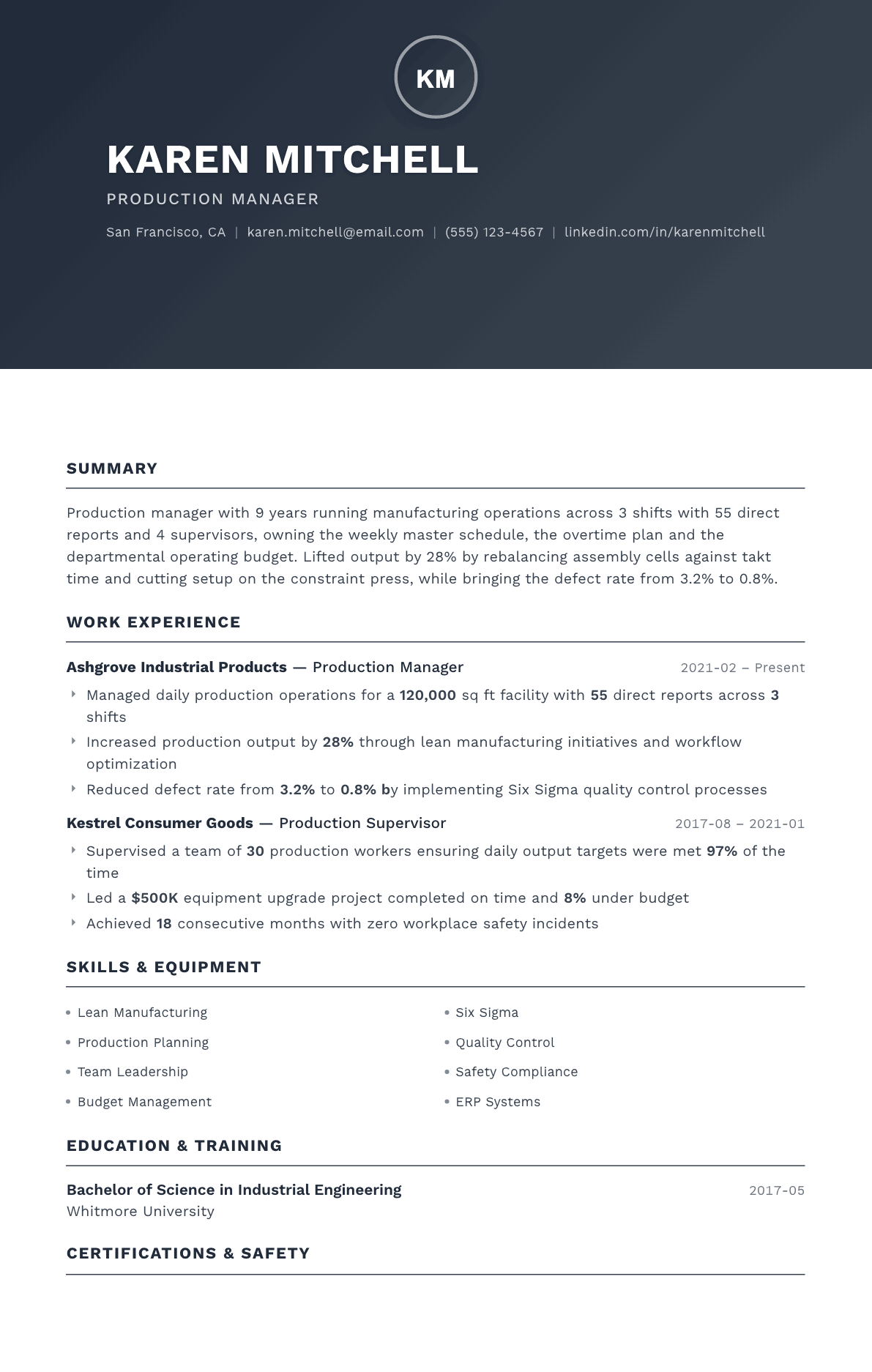
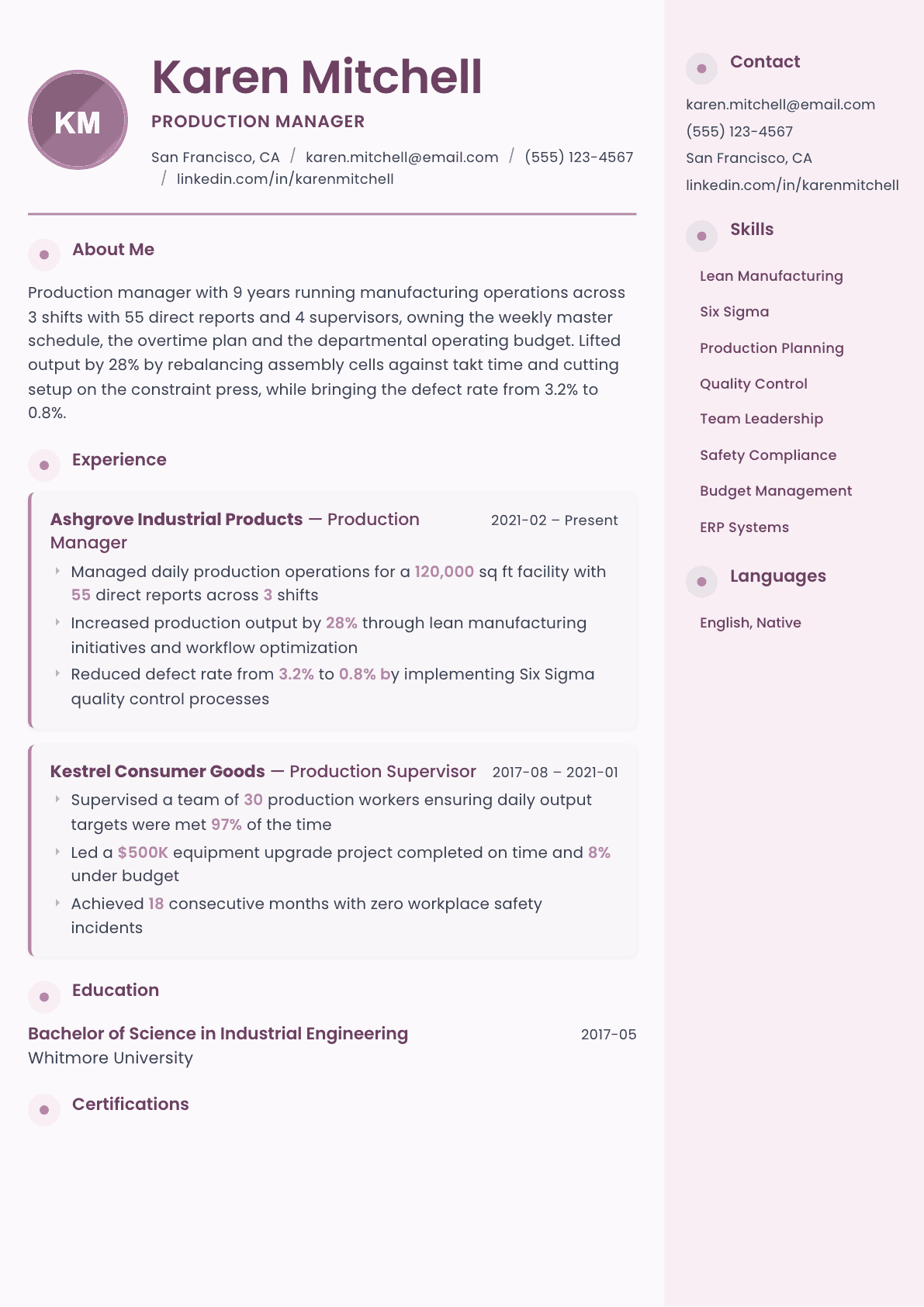
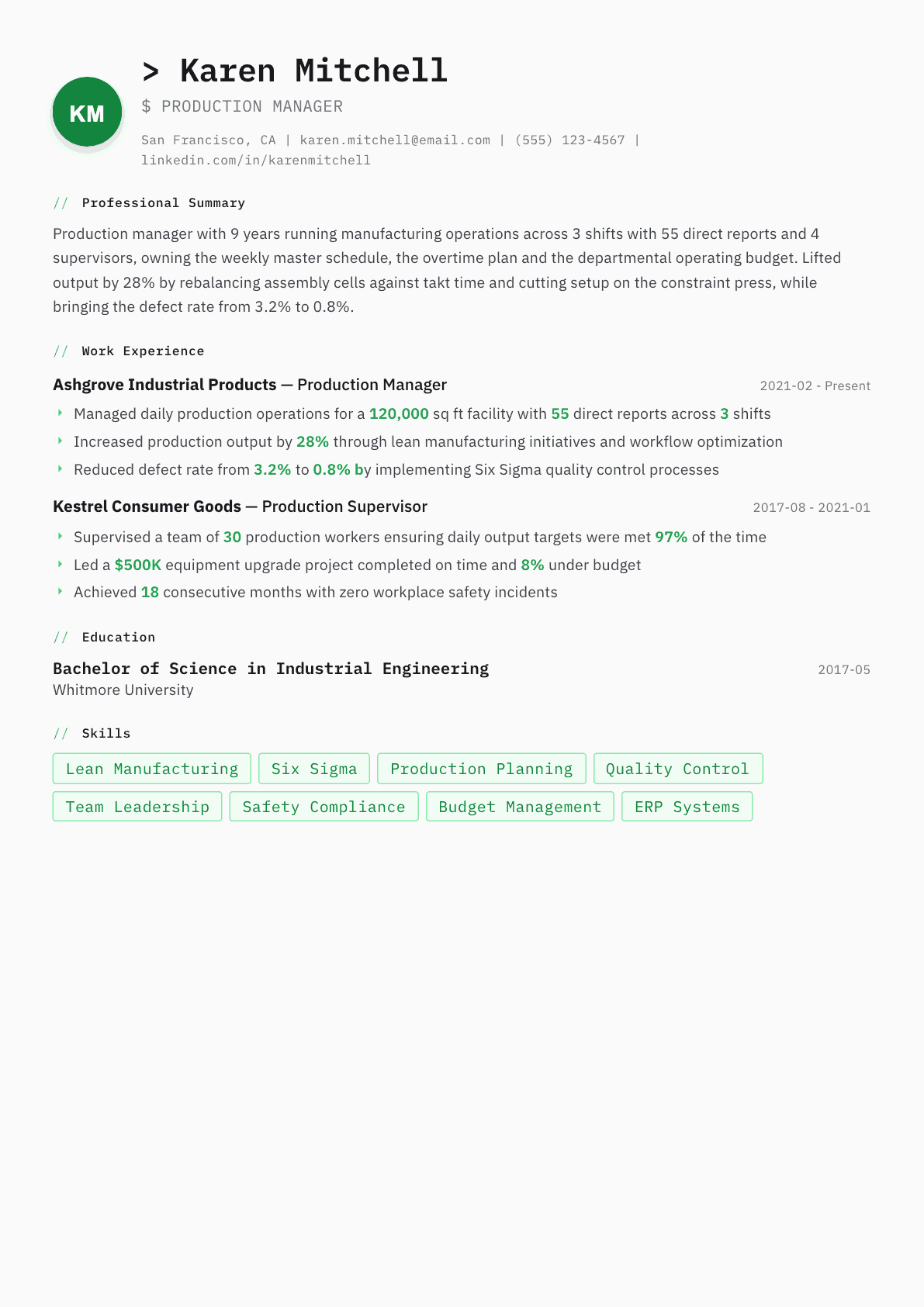
Example Production Manager summary
Production manager with 9 years leading manufacturing operations across 3 shifts with 55 direct reports and 4 supervisors, owning the master schedule, capacity planning and the departmental operating budget. Raised output 28% through line balancing and setup reduction while cutting the defect rate from 3.2% to 0.8%, and closed the year inside budget.
Skills to list on a Production Manager resume
- Production Planning
- Lean Manufacturing
- Six Sigma
- Quality Assurance
- Team Management
- Safety Compliance
- Budget Oversight
- ERP Systems (SAP)
- Continuous Improvement
- Supply Chain Coordination
What actually gets this resume read
- Give a scope line under every title: plant type and product, volume, direct and indirect headcount, supervisors reporting to you, lines and shift pattern.
- Name the constraint in every improvement bullet, because a reader cannot tell a diagnosed bottleneck from simply pushing the line harder.
- Pair any output gain with a second measure such as overtime, inventory or defect rate, since a gain bought with overtime is not an improvement.
- Show ownership of the plan and the money: master schedule, capacity against demand, inventory position and variance against the operating budget.
- Describe a capital project end to end, from equipment justification and vendor selection through installation, qualification and the ramp to full rate.
- Name the planning modules you used inside the enterprise resource planning package rather than listing the package on its own.
How to write a production manager resume
A production manager resume is judged on span of control and on ownership of a plan. Supervisors run shifts. The production manager owns the schedule against the sales forecast, the departmental budget, the capacity of the equipment, the inventory position, and the supervisors themselves. An operations director reading the page is looking for evidence that you have carried all four at once and can answer for a missed customer date.
What separates a strong file from an average one is the connective tissue. Plenty of candidates can say they increased output. Very few explain what the constraint was, how the schedule was rebuilt around it, what it cost, and what happened to on time delivery and inventory at the same time. Output that arrives at the expense of finished goods stock or overtime is not an improvement, and an experienced reader knows it.
This guide covers the structure operations directors expect, three summaries at increasing scope, before-and-after bullets built around planning and budget decisions, and the questions production managers ask when moving between plants or industries.
Format: scope first, results second, tools last
Reverse chronological, two pages once you have managed more than one department. Under every title give the scope line the reader needs: plant type and product, annual or monthly volume, direct and indirect headcount, number of supervisors reporting to you, number of lines or cells, shift pattern, and the size of the operating budget you controlled described in a way you are comfortable disclosing.
Then results, then the systems. Putting the enterprise resource planning package at the top and the headcount at the bottom inverts the order the reader cares about.
- Header: name, city and state, phone, email, and belt or planning certifications if held.
- Order: summary, scope and results snapshot, experience with a scope line per role, certifications, education.
- Candidates stepping up from supervisor should show the planning and budget pieces they already own.
Summary: what you ran, at what volume, against what plan
Say the product and the process, the headcount and supervisor count, and one outcome that pairs throughput with a second measure. Increased output while holding defect rate under one in a hundred, or raised on time delivery while cutting finished goods inventory, are the sentences that read as management rather than as effort.
If you have moved a plant through a launch, a line transfer, a capacity expansion or a facility move, put it in the summary. Those events are rare, hard, and exactly what a director hiring a production manager wants to know you have survived.
The plan: scheduling, capacity and inventory
This is the part supervisors do not own and it should dominate your experience section. Master production schedule ownership, capacity planning against demand, the sales and operations planning cycle, make to order versus make to stock decisions, lot sizing and run strategy, raw material and work in process levels, finished goods coverage, and how you handled the weeks when the forecast was wrong.
Write the constraint into the bullet. A production manager who says the press was the bottleneck, that changeover time was the recoverable minutes, and that the schedule was resequenced by tooling family, is describing real work. A production manager who says workflow was optimized is describing nothing.
The money: budget, labor and capital
Operating budget ownership is a dividing line between supervisor and manager, so make it explicit. Labor cost per unit, overtime as a share of hours, indirect spend, tooling and consumables, and variance against the plan month over month. If you closed a year inside budget while volume rose, say both halves.
Capital projects belong here too. Equipment justification and approval, vendor selection, installation and qualification, operator training and the ramp to full rate. Naming a project you scoped, defended and brought to rate tells a director you can be trusted with the next one.
People, quality and the systems the plant runs on
Say how many supervisors reported to you and what you did with them: performance reviews, succession, cross shift standardization, and the discipline process under any collective bargaining agreement. Then the quality interface: defect and yield ownership, containment and corrective action when a customer complaint lands, and audit readiness against the plant quality standard.
Close with the systems. The enterprise resource planning package and the specific modules you have used for production planning, the manufacturing execution system, the maintenance management system, and the reporting you built to run a daily management meeting.
Production Manager resume summary examples
Supervisor stepping up
Production supervisor with 5 years running a 30-person assembly department and now owning the weekly build schedule and overtime plan. Rebuilt the sequence around the paint line constraint, lifted on time delivery to 97%, and completed a green belt project on a repeat defect.
Production manager, single plant
Production manager with 9 years leading manufacturing operations across 3 shifts with 55 direct reports and 4 supervisors. Raised output by 28% through line balancing and setup reduction while cutting the defect rate from 3.2% to 0.8%, and closed the year inside the departmental budget.
Multi-line operations leader
Senior production manager with 16 years across metal fabrication and consumer assembly, running 6 lines, 180 employees and 7 supervisors. Led a line transfer between plants with no missed customer shipments, and owns the sales and operations planning cycle with the commercial team.
Work experience bullets: before and after
Before: Managed daily production operations at the facility.
After: Ran manufacturing operations across 3 shifts with 55 direct reports and 4 supervisors, owning the weekly master schedule, the overtime plan and the departmental operating budget.
Span of control plus schedule and budget ownership is what separates a manager from a shift supervisor on paper.
Before: Improved production output through better processes.
After: Lifted output by 28% by rebalancing 3 assembly cells against takt time and cutting setup on the constraint press, without adding headcount or a fourth shift.
Naming the constraint and stating what was not spent shows the gain was real rather than bought with overtime.
Before: Worked to reduce defects.
After: Brought the defect rate from 3.2% to 0.8% over 3 quarters by adding in-process checks at 2 stations, tightening incoming material inspection and closing 14 corrective actions.
A timeline and the specific controls make the reduction traceable instead of aspirational.
Before: Led an equipment upgrade project.
After: Scoped and justified a press replacement, selected the vendor, managed installation and qualification during a planned shutdown, and returned the line to full rate a week ahead of the plan.
The full capital cycle from justification to ramp is the evidence a director needs before funding your next request.
Before: Kept inventory at reasonable levels.
After: Cut finished goods coverage from 6 weeks to 4 while holding on time delivery above 97%, by moving 3 high-runner items to a fixed replenishment cycle.
Pairing an inventory reduction with a service level proves the stock came out without the customer feeling it.
Hard skills
- Master production scheduling
- Capacity planning
- Sales and operations planning
- Operating budget management
- Inventory and replenishment strategy
- Line balancing and takt time
- Setup and changeover reduction
- Capital project justification
- Corrective and preventive action
- ERP production planning modules
- Daily management and shift reporting
- Supplier and material coordination
Soft skills
- Developing supervisors
- Negotiating with commercial teams
- Decision making with an incomplete forecast
- Cross functional problem solving
- Communicating a missed date to a customer team
- Change management during a launch
Certifications worth listing
- Certified in Planning and Inventory Management (CPIM) (Association for Supply Chain Management)
- Certified Supply Chain Professional (CSCP) (Association for Supply Chain Management)
- Certified Six Sigma Black Belt (CSSBB) (American Society for Quality)
- Certified Manager of Quality/Organizational Excellence (CMQ/OE) (American Society for Quality)
- Project Management Professional (PMP) (Project Management Institute)
Mistakes that cost production manager candidates the interview
- Writing a supervisor resume for a manager posting, with shift duties and no schedule, budget or capacity ownership anywhere on the page.
- Quoting an output gain without saying what it cost in overtime, inventory or quality, which any operations director will assume was the trade.
- Never naming the constraint, so the reader cannot tell whether you diagnosed a bottleneck or simply pushed harder.
- Omitting the number of supervisors reporting to you, which is the cleanest measure of managerial scope in a plant.
- Listing an enterprise resource planning package without the modules or the planning work you actually did in it.
- Leaving capital projects out entirely, when equipment justification and ramp are a core part of the role.
Production Manager resume questions
What is the difference between a production manager and a supervisor resume?
The manager version has to show ownership of the plan and the money: master schedule, capacity, inventory, operating budget and the supervisors reporting in. A supervisor resume covers a crew and a shift, which reads as under-scoped for a manager posting.
How do I show planning experience if the schedule came from corporate?
Describe what you controlled inside the plan: sequencing by tooling family, lot sizing, overtime decisions, changeover placement, and the escalations you raised when the plan exceeded capacity. Constraint management is planning work even when the volumes arrive from elsewhere.
Should I put the operating budget size on the resume?
Give a scale you are comfortable disclosing, because budget ownership is one of the clearest signals of managerial scope. If the exact number is sensitive, describe it as a departmental operating budget and focus on your variance record against it.
Do I need Six Sigma to be a production manager?
It is not required, but a belt from a recognized body with a real project behind it helps when the plant runs a formal improvement program. What matters more is evidence that you diagnosed a constraint, changed something specific and measured what happened.
How do I present a plant launch or a line transfer?
Give it its own block with the scope, the timeline, the equipment moved, the qualification steps and the customer impact. Completing a transfer without missing shipments is one of the strongest credentials a production manager can put on a page.
Related resume examples
- Production Supervisor Resume example
- Operations Manager Resume example
- Plant Manager Resume example
- Manufacturing Supervisor Resume example
- Quality Assurance Resume example
- Manufacturing Manager Resume example