Data Analytics Consultant Resume Examples: free score
Create a Data Analytics Consultant Resume That Proves Data-Driven Impact
By Mustafa Tarabya, founder of CVBooster · Published · Updated
Build a powerful data analytics consultant resume showcasing analytical expertise, business intelligence delivery, and measurable insights that drive strategic decisions.
Sample resumes for a data analytics consultant
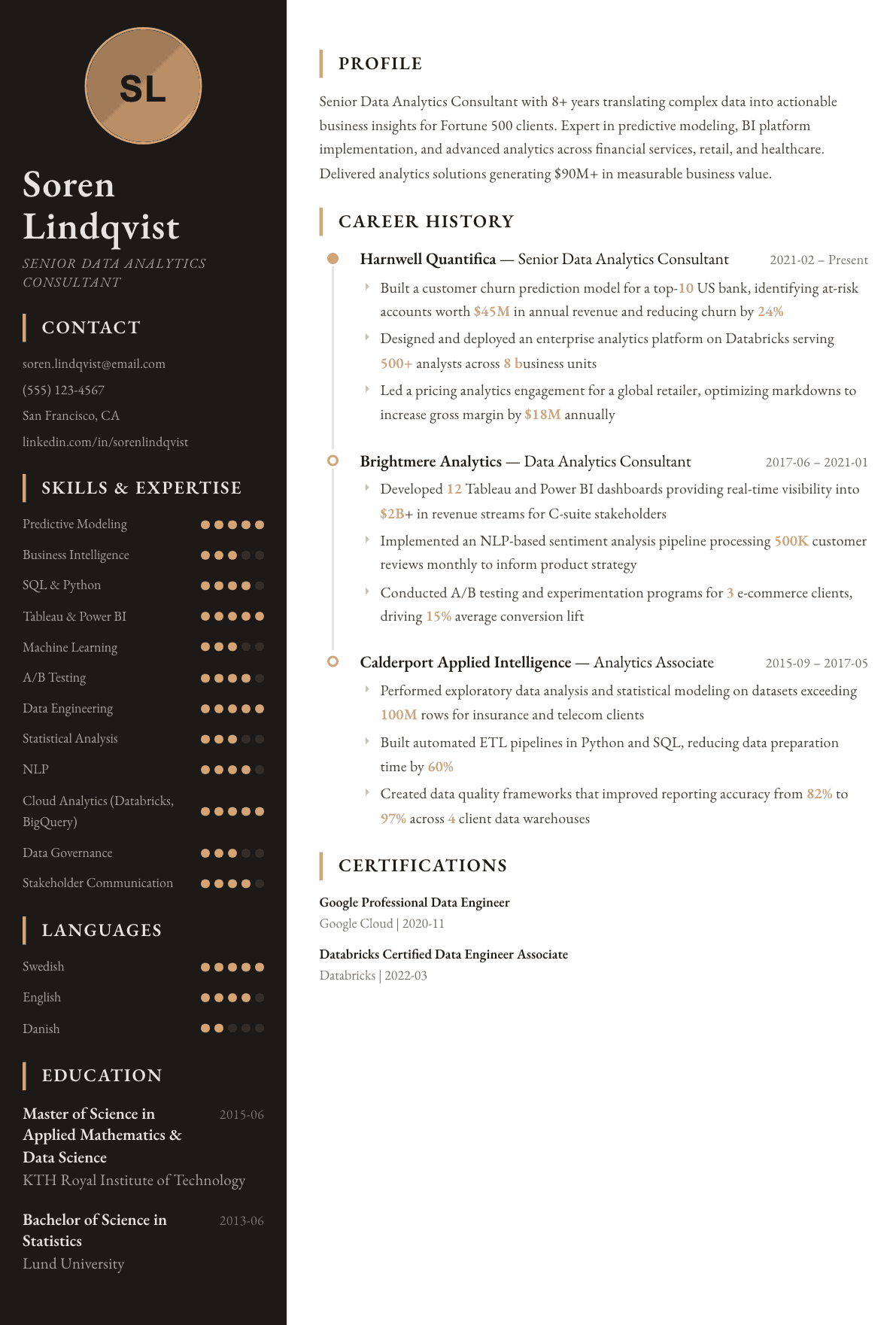
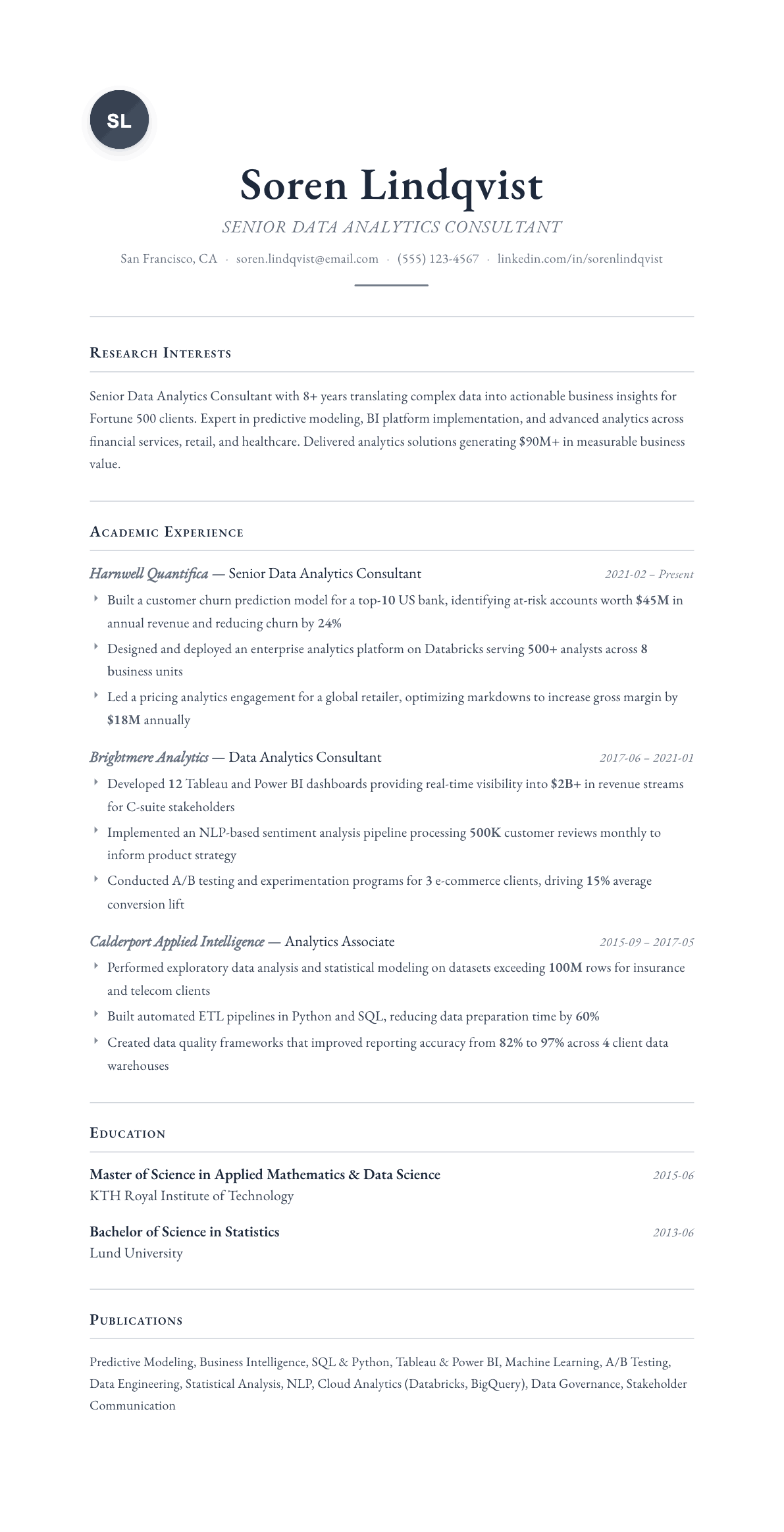
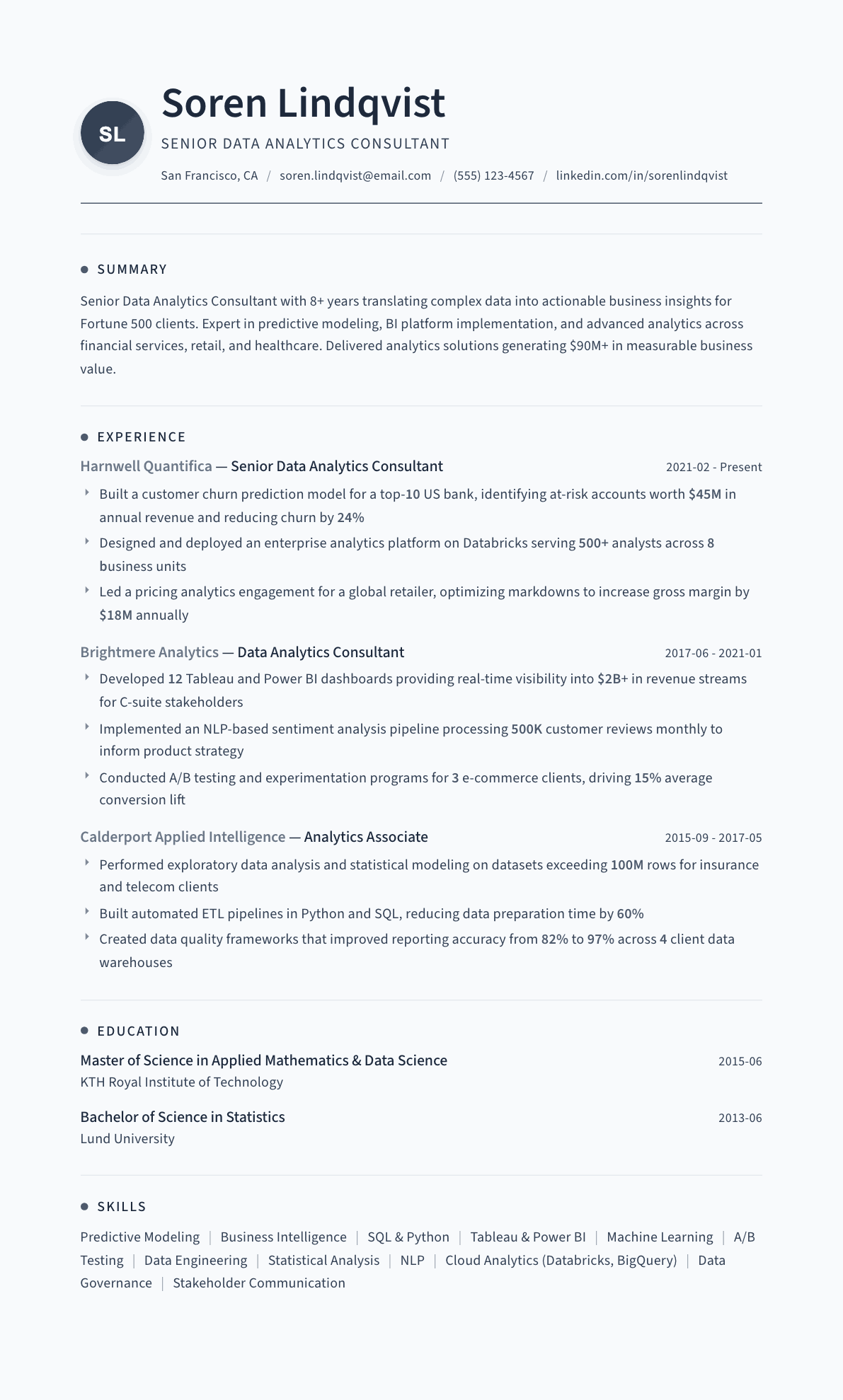
The same data analytics consultant content laid out in three CVBooster templates, so you can see what the finished document looks like before you write a word.
Example Data Analytics Consultant summary
Analytics consultant, 8 years, taking engagements from data pipeline to the decision the client makes. Built a churn model that flagged $45M of at-risk revenue and cut churn 24%, stood up a Databricks platform for 500 analysts, and runs the pricing and experimentation work behind an $18M annual margin gain.
Skills to list on a Data Analytics Consultant resume
- Predictive Analytics
- Business Intelligence
- SQL
- Python
- Tableau
- Power BI
- Machine Learning
- A/B Testing
- Data Engineering
- Statistical Modeling
- NLP
- Cloud Analytics
What actually gets this resume read
- Quantify business impact of your analytics work: revenue influenced, costs saved, accuracy improved, and decisions enabled.
- List specific tools and platforms prominently. Name Tableau, Power BI, Python, SQL, Databricks, and cloud services.
- Showcase both technical depth and business communication skills. Consultants must translate insights for non-technical stakeholders.
- Highlight end-to-end analytics delivery: from data engineering and modeling to visualization and decision support.
- Include cloud and data engineering certifications to demonstrate modern platform proficiency.
How to write a data analytics consultant resume
A data analytics consultant resume has to survive two very different readers. Staffing partners at a consulting firm screen for billable skills against a client pipeline: can this person land on a retail pricing engagement on Monday and open a Snowflake instance without hand holding. The engagement manager or client side director then reads for the part most analysts leave out, which is whether the work you built actually changed a decision.
That second test is where most of these resumes fail. Consultants describe dashboards delivered and models trained, and never say who used the output, what they did differently, or what it was worth. A model with an impressive area under the curve that nobody put into production is a training exercise, and an experienced reviewer can tell the difference in a single bullet.
This guide covers how to structure the file so tools are found fast, how to write engagement entries when you have worked across ten clients in three years, three summary examples from analyst to principal, before and after bullets, and the questions consultants ask when they rewrite this resume between projects.
Format: one page early, two once you have a client list
Reverse chronological by employer, with engagements nested underneath. Do not list each client as a separate job, because it makes a stable three year tenure look like six months of job hopping. Under one employer heading, run short engagement blocks that give the client sector, the duration, your role on the team, and the outcome.
Put a technical skills block near the top, grouped rather than dumped: languages, data platforms, visualization, cloud, and modeling techniques. Recruiters at consultancies search on exact tool names, so write SQL, Python, dbt, Airflow, Snowflake, Databricks, Tableau and Power BI as they appear in postings rather than as categories like data visualization tools.
- Header: name, city, phone, email, and a link line for a portfolio or public repository if the work there is genuinely yours.
- Order: summary, technical skills, consulting experience with nested engagements, selected projects if early career, education, certifications.
- Give every engagement a sector tag: grocery retail, commercial insurance, upstream energy, hospital network.
- Name team size and your position on it, because a lead analyst on a three person team is a different hire from one of forty offshore developers.
Summary: domain, stack, and the decisions you supported
Three lines. State the years, the industries you have real depth in, the core stack, and the type of analytics problem you keep being staffed on: customer segmentation and retention value, demand forecasting, pricing and elasticity, churn, marketing mix, supply chain optimization, or building the reporting layer a finance team runs on.
Domain depth is the differentiator at the consulting end of this profession, more than the algorithm list. Two candidates both know gradient boosting. The one who has already modeled claims severity for a commercial insurer wins the insurance engagement, so say the industry out loud rather than hiding it inside a client name the reader may not recognize.
Experience: the question, the method, the decision it changed
Write each achievement bullet as a compressed case. Start with the business question the client had, name the data and the method you used, then close with what changed. A merchandising director reallocating shelf space, a finance team retiring a manual month end close, a marketing lead cutting spend on a channel that was not converting. Method without a decision is a hobby, and a decision without a method is a claim.
Include the unglamorous engineering, because clients pay for it and reviewers know that most of the work is there. Pipelines built in dbt or Airflow, a semantic layer defined so three departments finally agreed on one revenue definition, data quality tests that caught source breakage, a migration from spreadsheets to a governed warehouse model.
Say what happened after handover. Whether the dashboard is still in weekly use, whether the model was deployed into a scoring job, whether you trained the client team to maintain it. Consultancies sell adoption, and a bullet that ends at delivery quietly signals that the work did not stick.
Skills and evidence: prove the depth, do not rate yourself
Avoid self assessed proficiency bars. A reviewer reads a four out of five in Python as a claim with no evidence behind it. Instead attach each significant tool to a bullet where it did work: wrote the transformation layer in dbt across 90 models, tuned Snowflake warehouse sizing to cut query cost, built row level security in Power BI for a client with 14 regional teams.
Statistical honesty helps you here. Naming a technique correctly, and naming its limits, reads as senior. Say time series forecasting with a seasonal model and holiday regressors rather than artificial intelligence, and say uplift modeling on a randomized holdout rather than a vague reference to machine learning.
Keywords the screener searches on
The recurring terms across postings for this role are SQL, Python, dbt, Snowflake, Databricks, Tableau, Power BI, Looker, data modeling, ETL, experimentation, A/B testing, forecasting, segmentation, stakeholder management and data governance. Mirror the exact spellings the posting uses, and place each one somewhere it is backed by a sentence.
One caution on certification stuffing. A long list of cloud badges with no engagement behind them reads as study rather than practice, especially at a firm that bills your time. Keep the certifications that match the platforms you actually work on and let the engagements carry the rest.
Data Analytics Consultant resume summary examples
First consulting role
Analytics consultant with 2 years supporting retail and consumer goods clients in SQL, Python and Power BI. Built a store level demand forecast that cut stockouts by 12% for a regional grocery chain. Economics degree with coursework in econometrics and experimental design.
Five years in
Data analytics consultant with 5 years across insurance and banking, leading three to five person teams. Delivered a claims triage model now scoring every new claim at intake, and rebuilt a client reporting layer in dbt and Snowflake that replaced 60 spreadsheets with one governed source.
Principal consultant
Principal analytics consultant with 11 years in energy and utilities, owning scoping, pricing and delivery for engagements worth several million in fees. Built the analytics practice from 4 to 22 consultants, and sits with client executives to define the questions before any modeling starts.
Work experience bullets: before and after
Before: Built dashboards in Tableau for the client team.
After: Built a Tableau margin dashboard for 38 category managers at a grocery client, replacing a weekly manual workbook and moving assortment reviews from monthly to weekly.
Naming the audience, the process it replaced and the new cadence proves the dashboard was adopted rather than merely delivered.
Before: Used machine learning to predict customer churn.
After: Built a gradient boosted churn model on 3 years of billing and usage data, validated on a holdout, and handed the top decile to retention agents, lifting saved accounts by 22%.
The data, the validation and the operational handoff turn a generic model claim into work a client can trace.
Before: Responsible for data cleaning and preparation.
After: Rebuilt an ingestion pipeline in Airflow and dbt across 14 source systems, added 200 data quality tests, and cut the client finance close from 9 days to 4.
The tools, the scale and the cycle time show engineering competence that vague preparation language hides.
Before: Worked with stakeholders to gather requirements.
After: Ran a two week discovery with supply chain, finance and merchandising, narrowed 30 requested metrics to 9 decision drivers, and got sign off on one shared revenue definition.
Cutting a requirement list down is the actual consulting skill, and the numbers make the judgment visible.
Before: Presented findings to senior management.
After: Presented a pricing elasticity analysis to the client executive committee and defended the recommendation to hold price on 4 categories, which the committee adopted the same quarter.
A decision made in the room is stronger evidence than the fact that a presentation happened.
Hard skills
- SQL
- Python (pandas, scikit-learn)
- dbt
- Snowflake
- Databricks
- Tableau
- Power BI
- Airflow
- Dimensional data modeling
- A/B testing and experiment design
- Time series forecasting
- Customer segmentation and retention value
- Data governance and lineage
- Cloud data platforms (AWS, Azure, GCP)
Soft skills
- Scoping an ambiguous client question
- Explaining a model to a non-technical executive
- Managing a client sponsor
- Handover and enablement
- Working across client politics
- Estimating effort under a fixed fee
Certifications worth listing
- Certified Analytics Professional (CAP) (INFORMS)
- Microsoft Certified: Power BI Data Analyst Associate (Microsoft)
- Tableau Certified Data Analyst (Tableau)
- SnowPro Core Certification (Snowflake)
- Databricks Certified Data Analyst Associate (Databricks)
- Google Cloud Professional Data Engineer (Google Cloud)
- AWS Certified Data Engineer, Associate (Amazon Web Services)
Mistakes that cost data analytics consultant candidates the interview
- Listing each client as its own employer, which turns steady tenure into apparent job hopping.
- Stopping the bullet at delivery, so nobody learns whether the dashboard or model is still in use.
- Rating your own tool proficiency with bars or scores instead of evidencing it inside a project bullet.
- Calling everything artificial intelligence when the work was a regression, a rules engine, or a well built report.
- Hiding the industry behind a client name a reader outside that market will not recognize.
- Omitting the data engineering work, which is often the majority of the engagement and a differentiator against pure analysts.
Data Analytics Consultant resume questions
How do I show client work when the client is confidential?
Replace the name with a descriptor that carries the same weight: a top five North American grocery retailer, a mid market commercial insurer, a listed utility with 3 million customers. The sector and the scale are what the reader needs, not the brand.
Should I include a portfolio or public repository?
Only if it holds work you would defend in an interview. A tidy repository with two well documented analyses beats twenty forked tutorials. Never publish client data or derivatives of it, and say clearly when a project used a public dataset.
Do I need a graduate degree to be a data analytics consultant?
No. A quantitative bachelor degree plus demonstrable delivery gets people hired at most firms. A master degree helps at research heavy practices and in some markets where clients expect it, but engagement outcomes on the resume outrank the credential once you have a few years of work.
How technical should the summary be?
Technical enough to pass a keyword screen, plain enough for a partner to read. Name the core stack in one clause and spend the rest of the space on the industries and the decision problems you own, because that is what determines which engagement you get staffed on.
How do I move from an in-house analyst role into consulting?
Reframe your internal projects as engagements. Give each one a sponsor, a scope, a duration and a decision it drove, and add anything that shows you can work across departments rather than inside one. Firms screen for client readiness more than for tooling.
Related resume examples
- Data Scientist Resume example
- Business Intelligence Analyst Resume example
- Data Engineer Resume example
- Digital Transformation Consultant Resume example
- Operations Analyst Resume example
- Business Consultant Resume example